AI Champions Network: The Operating-Model Component That Makes AI Adoption Stick
You bought the tools. The team is using Copilot. There is an AI lead, a working group, maybe an AI center of excellence deck on a shared drive. Delivery metrics are flat. An AI champions program built as evangelism produces a Slack channel.
You bought the tools. The team is using Copilot. There is an AI lead, a working group, maybe an AI center of excellence deck on a shared drive. Your AI strategy, if you read your own slides honestly, is a list of pilots. Delivery metrics are flat. The board is asking why the investment is not showing up in the numbers, and you can feel that one or two department heads are politely letting the initiative starve while everyone else nods in the room.
The thing nobody told you when you funded the program is that a champions network, the line item you signed off on for "internal AI advocates" or "AI evangelists", is not the morale layer of your transformation. It is the operating-model component that converts isolated team-level wins into organization-wide standards. Without it, your investment in tools and training does not compound. With it, but built wrong, you get a Slack channel.
This article is what good actually looks like.
Quick answer. An ai champions network is a cross-functional group of practitioners with a written charter, an explicit selection rubric, protected time, and a cadence designed to surface blockers and convert proven workflows into organizational standards, measured against adoption and outcome targets, not enthusiasm. An AI Center of Excellence sets governance and standards; champions embed those standards into day-to-day work and signal back what is breaking. The two are complements, not substitutes.
Champions Are Not Your Enthusiasm Layer
Most public writing about an ai champions program frames champions as evangelists. They spread excitement, they run lunch-and-learns, they post Copilot tips in Slack, they make AI feel approachable. That is a real function, but it is the trailing function, and it is what makes the program look like a culture initiative rather than an operating-model decision.
Running this kind of program in delivery orgs reveals the opposite. The most valuable thing a champion does is not evangelism. It is blocker surfacing and standard conversion. The champion sits close enough to the actual work, close enough to see the eval the team quietly gave up on, the prompt nobody bothered to write down, the workflow that broke the first time it touched production load, to know what is genuinely wrong. And, structurally arranged, that same champion converts one team's isolated AI win into a written standard the next three teams inherit before the win decays.
Decay is the part most programs underweight. An internal ai champions program without a conversion mechanism produces what I think of as a quarterly half-life: a team figures out how to use AI in spec drafting, the workflow works for that team, six weeks pass, the person who built it changes priorities, the workflow stops being maintained, and within a quarter the team is back to where it started. The next team, three floors away, has no idea any of this happened. Repeat across functions and you have a transformation budget producing pockets of capability that never become organizational capability.
The mechanism that prevents this is structural, not cultural. A charter. A cadence. A selection rubric. A blocker-surfacing protocol that escalates to the executive layer, not the manager layer. A standards conversion path with versioning. Measurement that distinguishes adoption from outcomes. Sunset criteria. None of these are about enthusiasm. All of them are about whether your operating model has a layer that converts pockets into standards.
AI Center of Excellence vs Champions: The Division of Labor
Before going further into the network itself, I want to deal with the framing question every transformation lead at this maturity asks: ai center of excellence vs champions, do I need both, and how do they relate?
The short answer is they are not alternatives. They sit at different layers of the operating model, and they fail without each other.
What the CoE owns
The Center of Excellence owns policy, governance, model and vendor risk review, security and legal exposure, approved tooling, standard templates and patterns, and the decision rights around what gets formally adopted at the organization level. It is the central body that says "this prompt pattern, this eval framework, this integration shape, this redaction rule is now a standard." It is sponsored by the C-suite and accountable to the board.
The risk pattern of a CoE without champions is well documented: a small central team writes excellent policies that nobody operationalizes, produces standard templates that do not survive contact with delivery, and slowly becomes a Confluence space everyone forgets. The CoE has authority but no contact surface with the work.
What internal AI champions own
Champions own local workflow fit, peer onboarding, demonstration of approved patterns in real team contexts, friction signals from the actual work, and the proposal of new patterns when the standard does not cover a real case. They do not own governance. They do not approve standards. They run the conversion path that brings a working local pattern to the CoE for review and standardization, and they run the embedding path that takes a CoE-approved standard back into team practice.
The risk pattern of champions without a CoE is also well documented, and it is the one I see most often in companies that skipped the governance layer: every team has a champion, every team has its own "approved" pattern, none of those patterns survived a real security or evaluation review, and after six months the architecture is a museum of inconsistent integrations with overlapping data exposure.
The handshake
The actual operating model is the handshake between the two. Concretely:
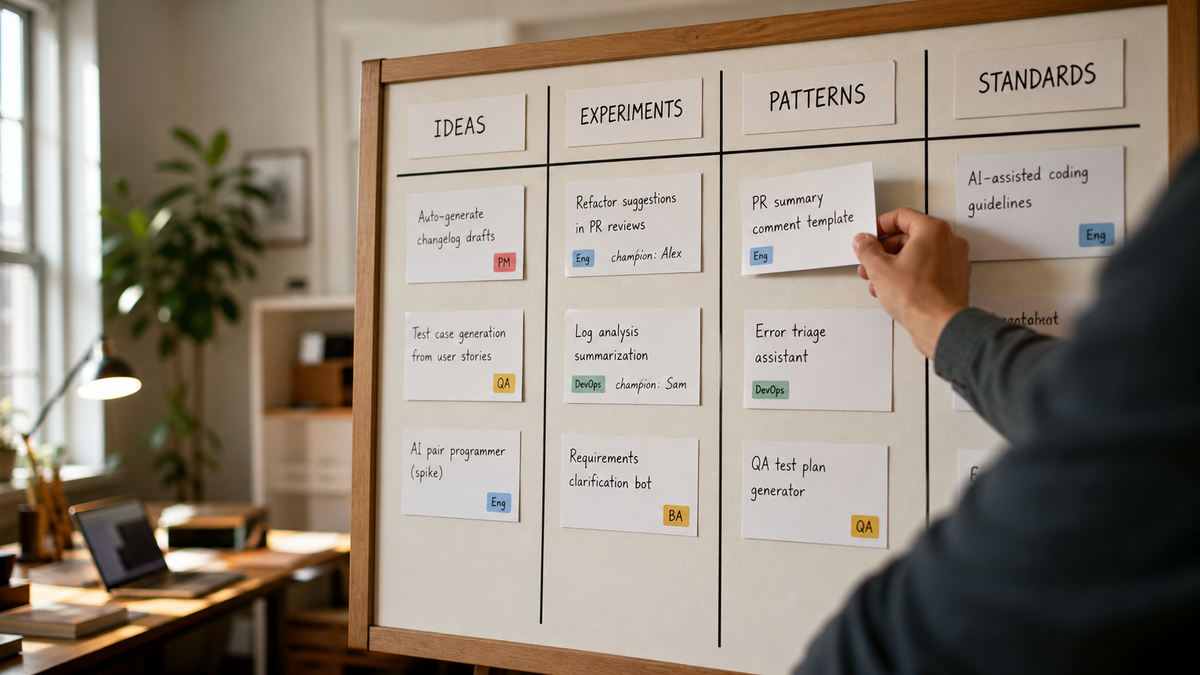
- A champion observes a working local pattern. They write it up as a candidate using the CoE's pattern template.
- The CoE reviews against governance, security, evaluation, and cost criteria within a published time window.
- On approval, the pattern becomes a versioned standard (Standard v1.0). The champion embeds it locally and signals to peer champions.
- When the pattern breaks under new conditions or a champion sees a friction the standard does not handle, the friction is logged in the Blocker Register. The CoE schedules a review and either updates the standard (v1.1) or escalates to security, legal, or architecture as needed.
The handshake is the thing. Without it, the CoE writes into a void and the champions improvise into entropy. With it, you have a system where local discovery becomes organizational standard on a predictable cadence.
The Operating-Model Framework
This is the 8-stage framework I would stand up if I were being asked to install an ai champions network today from scratch in a 200–2000-person tech-enabled company. Read it as the minimum viable structure, not the ceiling, and as one component of the AI operating model rather than a standalone program.
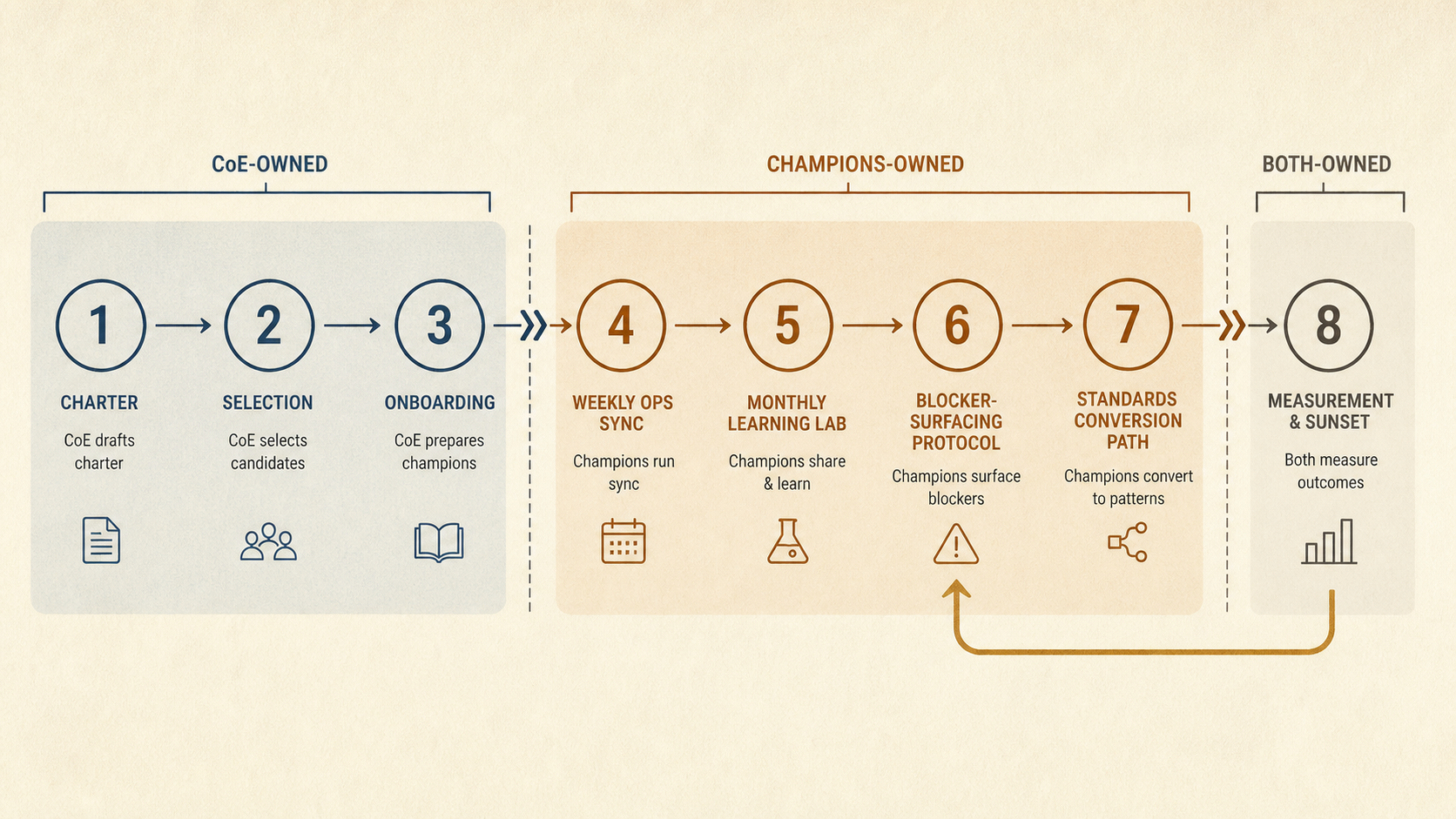
| # | Stage | What it produces | Decision rights |
|---|---|---|---|
| 1 | Charter | A one- to two-page written document naming the network's scope, outcomes, escalation path, sponsor, and decision rights. Signed by the C-level sponsor. | Sponsor signs; CoE reviews. |
| 2 | Selection rubric | Explicit criteria for who qualifies as a champion (peer credibility, function coverage, safety awareness, willingness to write things down), plus a manager agreement specifying protected time and outcome goals. | Sponsor + manager co-sign. |
| 3 | Onboarding kit | A small artifact set: approved-tool list with guardrails, the demo template, the pattern-proposal template, the Blocker Register access, and the standards inventory. | CoE owns the kit; champions ratify. |
| 4 | Weekly ops sync | A 45–60 minute meeting where champions surface blockers, share in-flight experiments, and make small decisions. Produces a Blocker Register entry, a use-case pipeline update, and an action list. | Champions chair; CoE attends. |
| 5 | Monthly learning lab | A 90-minute peer demo session. Each demo follows a fixed format: problem, before-state, AI-assisted workflow, observed outcome, what would block scaling it. Produces candidate patterns for standardization. | Champions own format; CoE selects standardization candidates. |
| 6 | Blocker-surfacing protocol | A structured path that takes a friction (security, legal, model, cost, workflow) from observation to resolution. Each blocker has an owner and a recommended SLA window (a working week for routine, a month for material). | Champion files; CoE routes; sponsor unblocks at the executive layer when needed. |
| 7 | Standards conversion path | The pipeline that takes a candidate pattern from monthly lab → CoE review → versioned standard. Standards are versioned (v1.0, v1.1) and dated, with a named owner. | CoE approves; champions ratify and embed. |
| 8 | Measurement and sunset | A small dashboard of leading and lagging indicators per function. A sunset rule: champions who cannot meet the manager agreement rotate out without prejudice; standards that have not been used in a quarter go to review. | Sponsor reviews quarterly. |
What good looks like is not a tighter table. What good looks like is that every one of those eight stages has a named artifact a successor could pick up. If the charter exists only in the sponsor's head, the network has not been installed; it has been described.
Best for, not for
This framework is best for organizations whose sponsor has the authority to set cadence, write a charter, and route escalations to the executive layer. It is not for organizations seeking a grassroots Slack channel without operating-model commitments. That is a community-of-practice, and it is a perfectly fine thing, but it is a different decision. Calling a community-of-practice an ai champions program is the most common mislabeling I see, and it produces six months of optimistic reporting followed by a quiet wind-down.
Selecting Internal AI Champions: Role-Level Redesign in Practice
The selection question is where most networks accidentally optimize for the wrong person. The default instinct is to pick the most enthusiastic builder: the engineer who already runs Cursor and Claude Code on personal projects, the PM who has tried six AI assistants. Build a network out of enthusiastic builders and you discover, four months in, that they have built impressive things nobody else can use because the patterns assume the builder's level of skill and care.
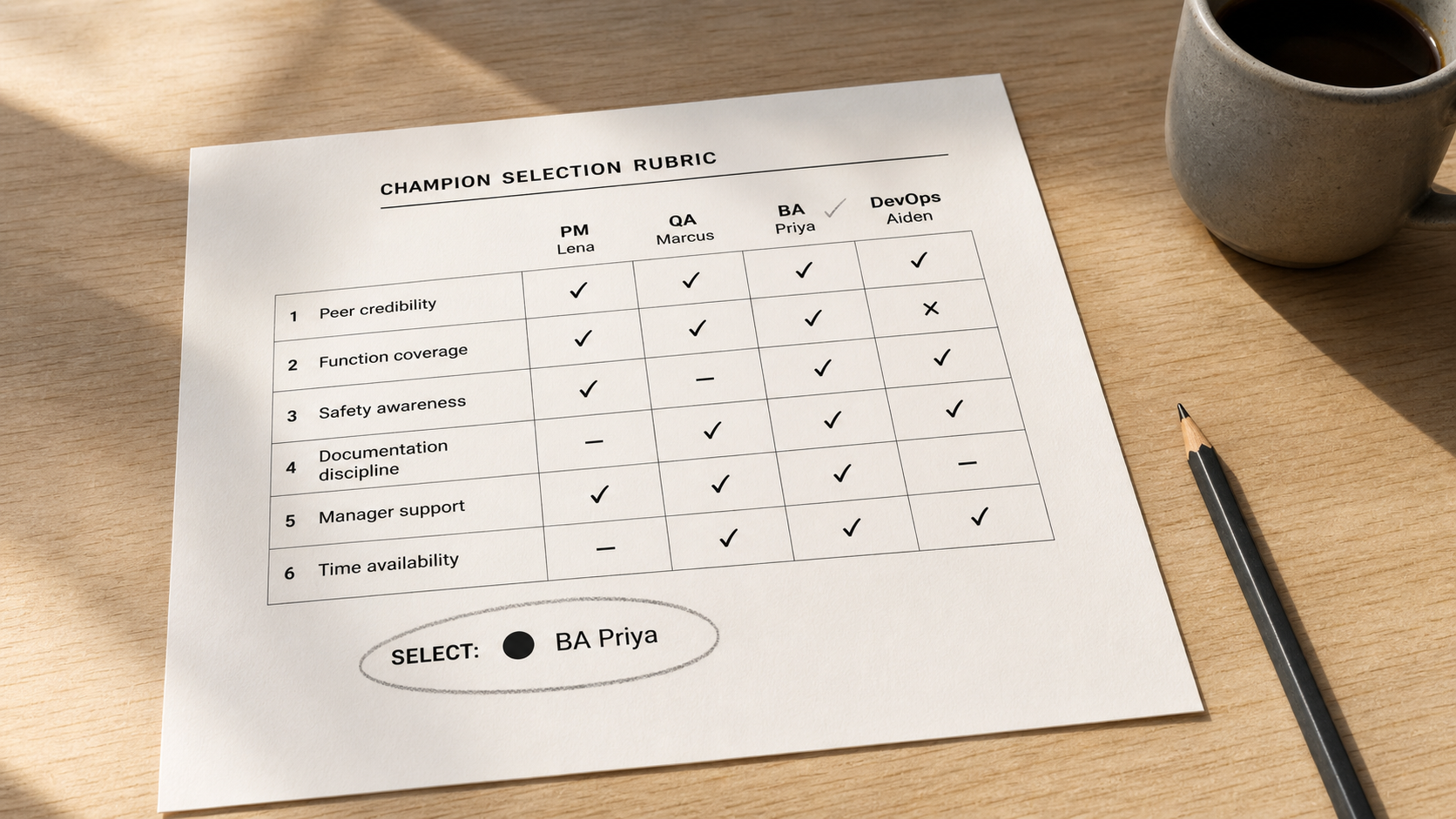
The selection rubric
A working rubric balances six criteria, not one.
- Peer credibility. When this person says "we are going to use the pattern this way," does the rest of the function listen? A champion who is technically excellent but socially unrooted produces standards that get ignored.
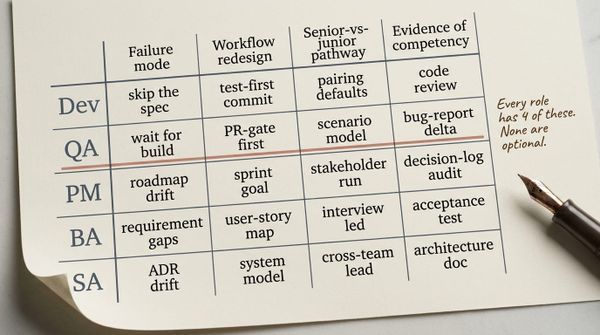
- Function coverage. A champion represents a function (QA, BA, PM, Dev, SA, DevOps, FP&A, Customer Support). The network should not have three champions from the same function and zero from the next.
- Safety and governance awareness. A champion needs to recognize when a workflow has crossed into data handling, model risk, or regulatory territory that requires CoE escalation. Builders who optimize for speed without this instinct become liabilities.
- Documentation discipline. This is the underweighted one. A champion's primary deliverable is a written pattern that the next three teams can read and apply. Builders who cannot or will not write things down do not produce repeatable capability; they produce dependencies on themselves.
- Manager support. The champion's manager must sign the agreement and protect the time. A champion whose manager is quietly resentful produces participation theater.
- Time availability. Recommended range: 10–20% of the champion's working time for the first 90 days, decaying to 5–10% steady-state once the function's standards inventory matures. Adjust by company size and the function's AI exposure.
The rubric is not arithmetic. You will not find one person who scores high on all six. You will find that the strongest champions tend to score high on three of the first four and have a manager agreement that compensates for the rest.
The manager agreement
The manager agreement is the artifact most programs skip and then quietly regret. It names the protected time as a percentage of the champion's role, lists two or three outcome goals tied to the function's standards inventory (not posts hosted or sessions attended), and sets an exit ramp: what happens if the protected time is consistently not honored or the outcomes are consistently not met.
The agreement is signed by the manager, the champion, and the sponsor. It lives next to the charter. Without it, six weeks into the program, the manager's quarterly delivery pressure quietly wins and the champion's network time disappears. The exact mechanism plays out predictably: enthusiasm at month one, a missed weekly sync at month two, a quiet attrition by month three. The agreement is the structural fix.
Incentives that match the work
The incentive structure should pay off documented contributions to the standards inventory and to blocker resolution, not attendance or post counts. Counting Slack posts produces Slack posts. Counting standards proposed, blockers closed, and adoption of a champion's pattern by other functions produces standards, closed blockers, and adoption. The metric drives the behavior. This is uncontroversial but routinely violated.
Cadences That Produce Standards
A cadence is not a meeting schedule. It is the rhythm at which the network converts friction into structure. The two non-negotiable beats are a weekly operations sync and a monthly learning lab. The third, a 30–60 day standardization cycle, is the cycle within which a pattern moves from observed to standardized.
The weekly operations sync
Forty-five to sixty minutes. Same time every week. Attended by every champion plus a CoE delegate plus the sponsor on the third week of every month. The agenda is fixed:
- New entries in the Blocker Register. Each blocker has an owner, a recommended SLA window, and a status.
- In-flight experiments. Each champion gives a two-minute update: what is being tried, what is being seen, what would make this a candidate for the monthly lab.
- Decisions. Small, reversible, in-meeting. Anything larger goes to the lab or to the CoE.
- Action list. Written, owned, deadlined.
What this sync produces is two artifacts: a running Blocker Register and a use-case pipeline. Both live where every champion can read them. Both are the basis for the monthly lab's selection of standardization candidates.
The mistake I see most often is using the weekly sync as a status meeting. It is not a status meeting. It is a decision and surfacing meeting. If a champion leaves without either filing a blocker, moving an experiment forward, or signing off on an action, the sync has failed for them that week.
The monthly learning lab
Ninety minutes. Two to four peer demos. Each demo follows the format:
- Problem. What was the friction in the function's actual work?
- Before-state. How was the work being done without AI assistance, and where was the cost: time, error rate, throughput, or quality?
- AI-assisted workflow. What is the working pattern? Tools, prompts, integration points, guardrails.
- Observed outcome. What changed, expressed as a range. (Specific numbers belong in the CoE pattern review.)
- What would block scaling. What would have to be true (security review, integration, training, data access) for the next three teams to inherit this?
The output of every demo is a one-page candidate pattern. The CoE selects which candidates move into the standardization cycle. The rest live in the candidate library for re-review.
What separates a strong learning lab from a vendor demo day is the What would block scaling section. Vendors do not run that section because they do not have to. Champions must. It is where the standards conversion path begins.
The 30–60 day standardization cycle
The standardization cycle is the path a candidate pattern walks from the monthly lab to a versioned standard.
Within 30 days of a lab demo, the CoE delegates one of three verdicts: standardize, request modifications, or shelve. Standardize means a named owner, a versioned artifact, and a documented adoption target. Request modifications means a defined gap (usually security, evaluation, or cost) and a re-review date. Shelve means the pattern is filed but does not become an active standard.
Within 60 days of a standardize verdict, the pattern should be embedded in at least one adjacent function. Adoption past the originating team is what makes a pattern a standard rather than a local artifact. If 60 days pass without cross-functional adoption, the cycle returns the pattern to review with a question: was this genuinely a candidate standard, or was it a local optimization that should not have left its function?
These are recommended SLA ranges. Adjust by company size and regulatory exposure. The point is that the cycle has a clock. Without a clock, candidate patterns accumulate and the standards inventory does not grow.
The escalation ladder
When a blocker cannot be resolved at the weekly sync or the monthly lab, it follows a published escalation ladder. CoE owns governance, security, and model-risk escalations. The sponsor owns cross-functional blockers: the case where two department heads disagree on whether a pattern applies to their function. Architecture and legal sit one step beyond.
A working escalation ladder publishes who unblocks what, and within what window. Unpublished escalation ladders default to "ask the sponsor," which means the sponsor becomes the bottleneck and the network slows to the sponsor's calendar.
Measurement: From Adoption to Outcomes
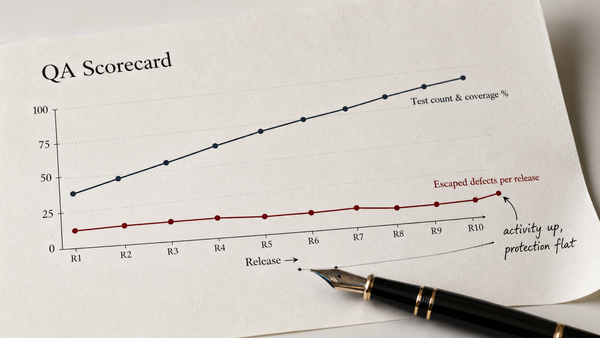
The measurement problem in an ai champions network is the same as in every other transformation initiative: leading indicators are easy to count and tempting to report; lagging indicators are what the board actually wants and harder to attribute. The job is to distinguish the two, report both, and avoid the failure mode where leading indicators become the measure of success.
Leading indicators
These tell you whether the mechanism is operating. They do not tell you whether the mechanism is working.
- Active champions per function. (Active means met the manager agreement this month.)
- Blocker Register entries opened, closed, and aging. Aging entries past the recommended SLA are the early warning that the network's escalation path is breaking.
- Candidate patterns proposed in the monthly lab.
- Standards proposed, standards approved, and standards aging without adoption.
- Peer demos hosted across functions.
Lagging indicators
These tell you whether the mechanism is producing the outcome the program was funded to produce. Report as ranges. If you do not yet have an internal baseline, label as observed range rather than precise figure.
- Time-to-resolution changes on relevant workflows (customer support handle time, FP&A scenario reconciliation cycle time, engineering spec drafting time).
- Error rate changes on AI-assisted workflows compared to baseline.
- Cycle-time improvements on the function's primary delivery loop.
- Adoption depth: how many functions have embedded each standard, and at what fraction of the eligible workflow.
- Revenue or customer-experience impact where attribution is honestly possible.
The metrics theater trap
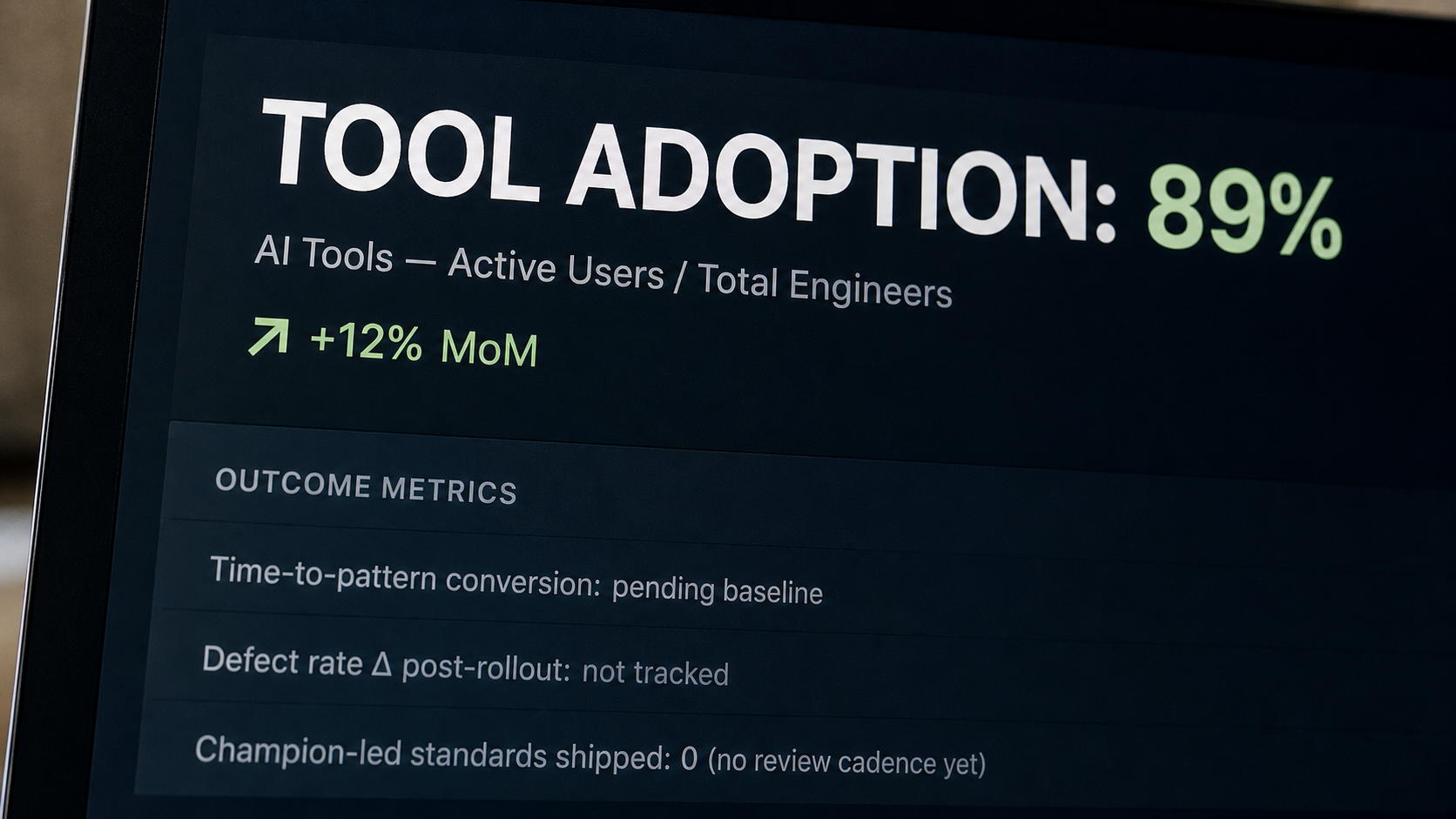
Counting peer sessions hosted, badges issued, and Slack posts produces peer sessions hosted, badges issued, and Slack posts. None of these are outcomes. They are activity. They make the program look healthy to a casual reader and tell you nothing about whether delivery has moved.
The board update I would write at month six of this program leads with the lagging indicators (even when they are still developing) and uses leading indicators to explain the mechanism. The board update I would not write leads with badges and lab attendance. The difference is whether you are reporting organizational capability or whether you are reporting program activity.
Examples: What Good Looks Like
Three sketches across functions. None of these are real-customer accounts. Treat them as composites, what a working local pattern looks like in three different functional contexts, drawn from patterns seen across AI-enabled delivery orgs.
Example 1: Customer Support
Imagine a customer support function where champions noticed that two senior agents had quietly developed a prompt pack that condensed the handle-time on a category of tickets by a meaningful range (call it 10–20%) while improving accuracy on a class of policy-edge cases.
The pattern went through the monthly lab. The blocker surfaced was personal-data redaction: the prompt pack assumed the agent had stripped PII before pasting context. The CoE took the redaction step into governance review and produced a pre-prompt that handled redaction inline. The combined pattern became Standard v1.1 of the support assistance pattern. Within 60 days, an adjacent regional support team had embedded the pattern with a small dialect adjustment. The original two agents were credited in the standards inventory and rotated into the rubric of next-cohort champion selection.
What was load-bearing here was not the prompt pack. It was the redaction step the CoE caught and the cross-team embedding the cadence forced.
Example 2: FP&A
Imagine an FP&A function where a champion piloted a scenario-planning agent against a quarterly reconciliation workload. The observed improvement was a reduction in reconciliation errors and a faster turnaround on the iteration cycle when the underlying forecast changed.
The lab demo identified the blocker as model behavior on edge cases: the agent produced confident outputs on cases it had not seen in training data shape. The CoE added an explicit eval suite to the pattern, requiring a human review gate on a defined set of edge conditions before the agent's output entered the reconciliation pipeline. The standard was versioned and adopted by the regional FP&A teams within the cycle.
What was load-bearing here was the eval suite the CoE added, not the agent itself. The champion's contribution was the friction observation: the model was confident where it should have been uncertain. The lab's contribution was forcing the conversation about what review gate the pattern needed.
Example 3: Product / Engineering
Imagine a product engineering team where the champion operationalized AI-assisted spec drafting with explicit guardrails around hallucinated requirements. The workflow worked locally. The blocker surfaced in the weekly sync was that the spec drafts were occasionally producing confidently-wrong references to internal APIs that did not exist.
The CoE response was a retrieval-augmented context layer that constrained the spec draft to a verified internal API inventory. The pattern was standardized. The hallucination-on-internal-API failure mode became one of the named risks in the CoE's broader pattern library: the kind of insight that does not surface until a champion sits close enough to the work to see the failure mode at the rate it actually happens.
What was load-bearing here was the constrained-context layer the CoE added. The champion's contribution was, again, the friction observation: the model was confident on the parts of the codebase it had not been grounded in.
The pattern across all three examples is the same. The champion sees the friction. The lab makes it legible. The CoE adds the missing structural piece (redaction, eval gate, retrieval grounding). The standard converts. The next team inherits. The capability compounds.
Pitfalls That Stall AI Champions Programs
These are the failure modes I see most often, in roughly the order they appear in programs that are about to quietly wind down.
1. Evangelism without a charter. The network has energy and no decision rights. Champions spread enthusiasm, run demos, post in Slack, and discover at month three that nothing they have produced is binding on anyone. The fix is a written charter signed by a C-level sponsor that names what the network decides, what it proposes, and what it escalates.
2. No manager time protection. The champion's manager agreed in principle and then quietly clawed the time back when quarterly delivery pressure built. The fix is the manager agreement as a separate artifact, with named outcomes tied to the function's standards inventory rather than to attendance, and with an exit ramp when the time is not honored.
3. Slack-only "community." The network exists primarily as a channel. There is no Blocker Register, no candidate pattern pipeline, no standards conversion path. Useful tips accumulate; standards do not. The fix is to add the operating-model components (the weekly sync's agenda artifacts, the monthly lab's candidate output, the CoE's review pipeline) and accept that the Slack channel is the chat layer, not the work layer.
4. Metrics theater. The program reports badges, posts, attendance. Leading indicators look strong. Lagging indicators are not reported, because nobody has agreed on what they would be. The fix is to publish the measurement model upfront: leading indicators visible monthly, lagging indicators reported quarterly with honest attribution caveats. Let the sponsor defend the model when the board asks for a single ROI number.
5. Builder bias in selection. The network is built from the most enthusiastic individual contributors and produces patterns that assume the builder's level of skill. Adoption past the originating team is rare. The fix is the six-criterion rubric and an explicit selection check: would the second-quartile practitioner in this function be able to inherit this pattern?
6. No sunset criteria. Champions who can no longer meet the manager agreement stay in the network out of inertia. Standards that nobody has used in a quarter sit in the inventory. The network slowly becomes a relic. The fix is published sunset criteria: champions rotate out without prejudice at defined intervals or when the agreement is unmet for two cycles; standards return to review when they have not been used or updated within a quarter.
7. Over-indexing on tooling. The network's monthly lab becomes a tools demo day. Vendors are invited. The champion role drifts from operator to evaluator. The fix is to keep tools in the onboarding kit and pattern-proposal context, never as the headline of a lab. The headline of the lab is the function's workflow change, not the tool category.
8. Escalation through the manager layer. Blockers route up through line management because the escalation ladder was not published. The sponsor sees blockers late, the executive layer never sees them, and the cross-functional friction the network was supposed to surface stays buried. The fix is to publish the escalation ladder explicitly and to honor the bypass: champions file blockers to the CoE directly, with manager visibility, not through the manager.
Key Takeaways
- An ai champions network is an operating-model component, not a morale program. The load-bearing artifacts are the charter, the selection rubric, the cadences, the Blocker Register, the standards conversion path, and the measurement model.
- The CoE and champions are complements, not substitutes. The CoE owns governance and standards; champions own local fit and friction surfacing. The handshake between them is the operating-model layer that converts local discovery into organizational standard.
- Champions are most valuable for blocker surfacing and standard conversion, not evangelism. Select for peer credibility, function coverage, safety awareness, and documentation discipline, not for enthusiasm.
- Cadence is the rhythm at which friction becomes structure. A weekly ops sync, a monthly learning lab, and a 30–60 day standardization cycle are the minimum viable beat. Without a clock, the program drifts.
- Measure leading and lagging indicators separately. Lead with lagging indicators when reporting to the sponsor and board. Counting badges produces badges.
What This Means for Your Operating Model
If you have funded an AI transformation and the delivery numbers have not moved, the gap is almost never at the tool layer. The tools work. The training works. What is missing is the structural mechanism that converts pockets of capability into repeatable capability at the organization level.
An ai champions network built as an operating-model component (charter, selection, cadence, blocker surfacing, standards conversion, measurement, sunset) is that mechanism. Without it, the next quarter looks like the last: isolated wins, no compounding, a flatter board update than the program deserves.
The work this requires from you is not bigger. It is more structural. Write the charter. Sign the manager agreements. Publish the escalation ladder. Run the cadence. Report the lagging indicators. Let the network do what it can only do when it is treated as a load-bearing part of how the company operates: convert what one team has learned into what the next three teams inherit.
That is what makes AI adoption stick.
AI Transparency Notice: This article and its accompanying images were created with the assistance of generative AI. The author directed the content, contributed the underlying ideas and analysis, and reviewed the final publication.