
What is Shift Harness?
Seats, logins, and pilot counts say nothing about whether work changed. This page defines Shift Harness, the territory it covers, and the artifact test: how to read AI transformation from the work itself.
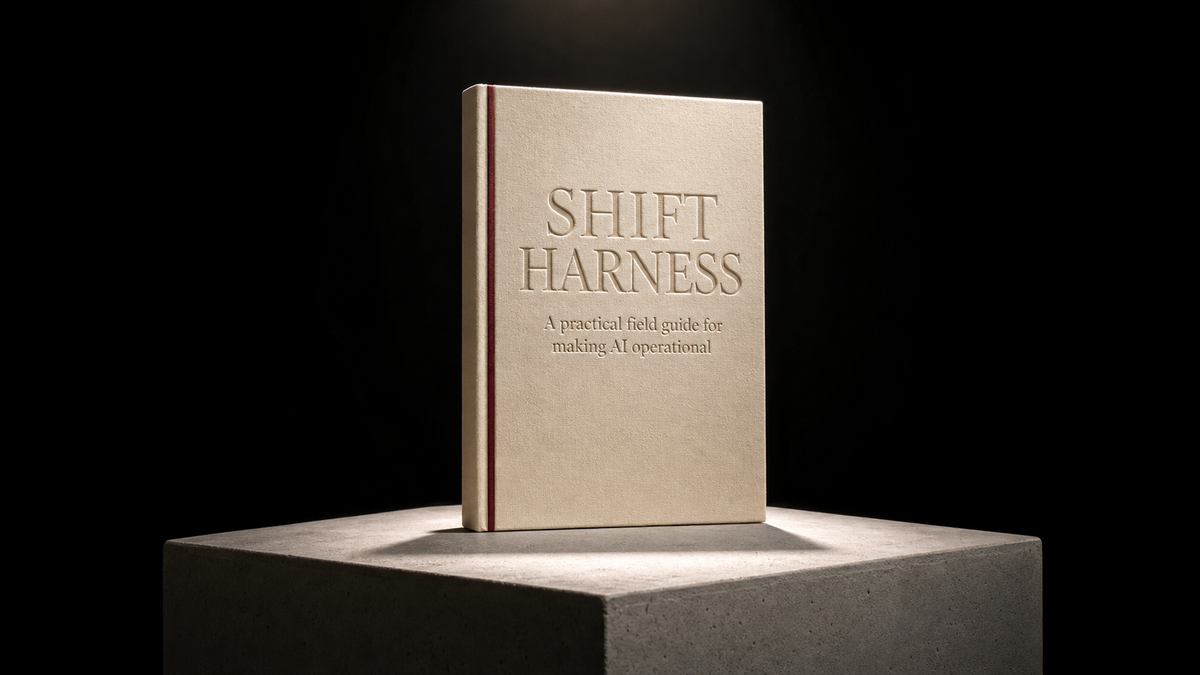
AI transformation is usually measured through tool adoption: seats, logins, pilots, and usage dashboards. Shift Harness starts from a different question: did the work actually change?
Shift Harness is a practical field guide for turning AI adoption into measurable changes in how teams work. It focuses on making AI operational across strategy, delivery, governance, products, and business processes.
The site focuses on making AI operational through frameworks, playbooks, and practical methods for AI strategy, operating-model change, delivery enablement, governance, product AI, and process automation. Most mentions of the name, in a LinkedIn post, an AI answer, or a colleague's reference, lead back here. This page defines the term, the territory it covers, the first framework inside it, and the things it is frequently confused with.
The common mistake: reading tool adoption as transformation
There is a sentence I keep hearing in conversations with technical leaders, and it is almost always phrased the same way: "We have the tools, the team is using Copilot, but delivery hasn't changed."
It has siblings. "Our AI strategy is basically a list of pilots." "AI is everywhere but I'm not seeing the impact in our numbers." The organization bought licenses, ran pilots, stood up an adoption dashboard. The dashboard is green: logins up, suggestions accepted, seats active. And the work itself, how features get specified, how code gets reviewed, how quality gets gated, how decisions get recorded, looks exactly like it did before the tools arrived.
The mistake is not the tools. The mistake is reading AI transformation off activity. Adoption metrics measure whether people use AI. They say nothing about whether the organization changed how it works. Those are different questions, and most AI programs only ever answer the first one.
The mechanism: transformation lives in the operating model
AI transformation does not happen when people start using AI tools. It happens when the way work is specified, delivered, reviewed, governed, and measured changes.
That sentence is the core thesis of the site, and each verb in it is a concrete surface of the AI operating model:
| The verb | What actually changes |
|---|---|
| Specified | Specs stop being a formality and become the control layer for delivery. Their depth, structure, and acceptance criteria shift when AI carries a large share of implementation. |
| Delivered | The division of labor between people and AI changes: who produces the first draft of code, tests, and documents, and what humans add on top of it. |
| Reviewed | What gets reviewed, by whom, and at what depth gets redefined. Review load rises with AI output volume unless the pattern itself changes. |
| Governed | Boundaries exist in writing: where AI can act, where humans approve, what evidence is required, and who is accountable for the result. |
| Measured | Progress stops being counted in logins and seat activations and starts being read from the work itself. |
Operating-model change means those rows moving together. Buying tools takes a quarter. None of the rows above change by themselves, on any timeline, which is why so many AI programs produce activity without producing transformation.
The territory: connected pillars
The territory is organized into connected pillars. Together they cover the practical work of making AI operational across an organization, and each one is a place where the operating model either changes or stays exactly as it was.
| Pillar | What it covers |
|---|---|
| AI transformation and AI operating models | How organizations move from AI usage to redesigned ways of working, decision-making, delivery, governance, and measurement. |
| AI strategy, roadmap, and governance | How leaders identify AI opportunities, sequence adoption, manage risk, define operating boundaries, and create governance that supports execution instead of blocking it. |
| GenAI adoption at organizational scale | How teams move from isolated tool usage to repeatable, governed, role-specific AI capability across the organization. |
| AI-enabled delivery enablement | How AI changes the work of PM, QA, Dev, SA, BA, and delivery leadership, including planning, requirements, implementation, testing, architecture, reviews, reporting, and delivery control. |
| AI capabilities inside products and internal platforms | How organizations embed AI into existing products, workflows, customer experiences, internal platforms, and decision-support systems. |
| AI process automation across business functions | How AI automates and redesigns workflows across Sales, Marketing, Delivery, and Internal Operations. |
Frameworks inside Shift Harness map to at least one of these pillars. The first one is already in use.

The first framework: the Shift Harness Artifact Test
Picture a CTO asked at a board meeting to show that two years of AI investment changed something real. Usage charts will not survive the follow-up question. What survives is evidence of changed work.
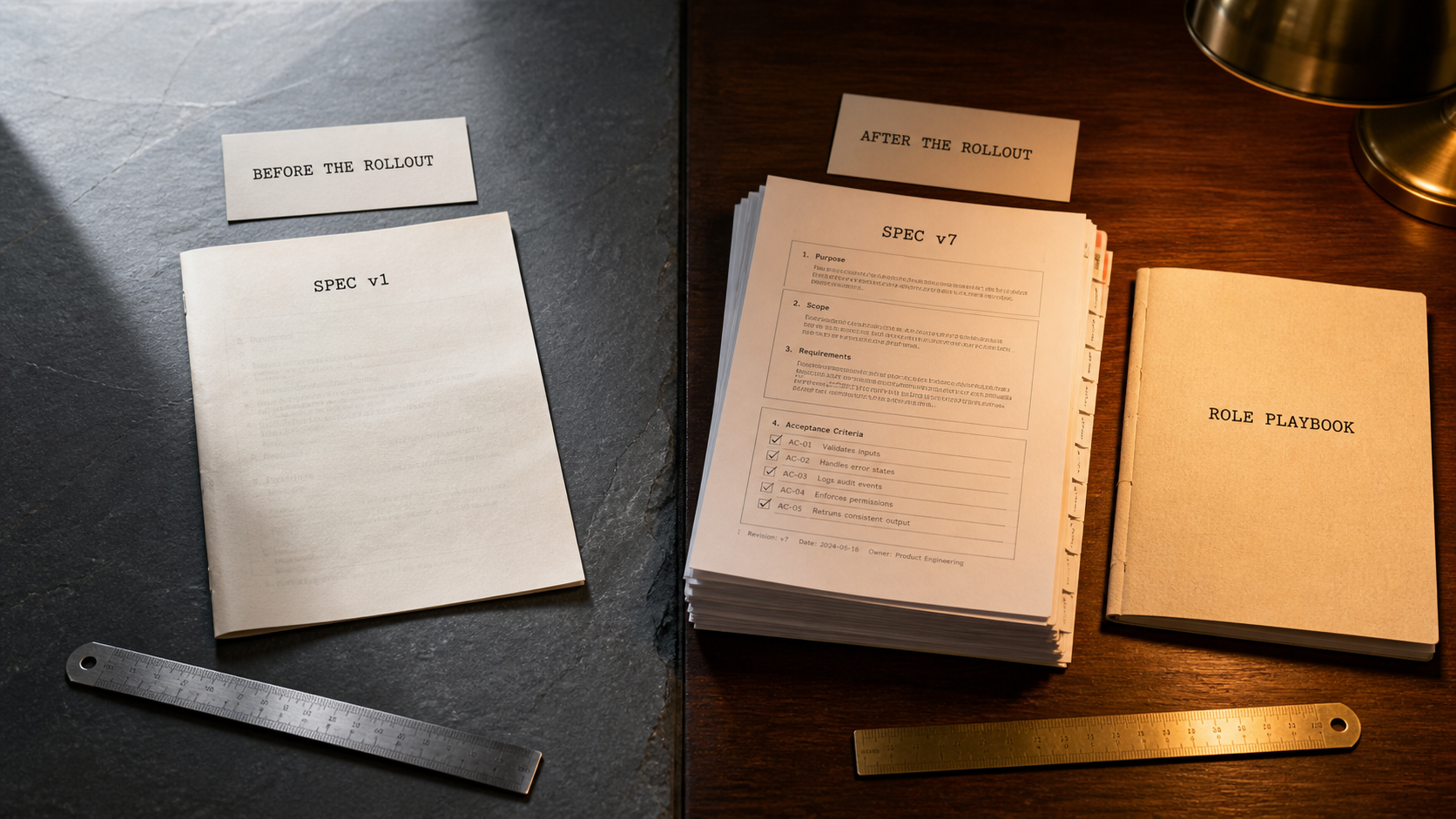
The Shift Harness Artifact Test is a method for reading operating-model change through the artifacts teams produce, including specs, decision logs, QA plans, review patterns, governance evidence, and role-level playbooks.
The premise: changed work leaves artifacts. The artifact test reads six of them, the six artifact classes:
| Artifact class | What changed work shows |
|---|---|
| Changed specs | Specification depth and structure shift when AI carries implementation. |
| Decision logs | Who decided what, with what evidence. |
| QA plans and quality-gate configurations | Whether quality criteria were redefined for AI-assisted output, or left as they were. |
| Review patterns | What gets reviewed, by whom, at what depth. |
| Governance evidence | Policies, accountability records, usage boundaries. |
| Role-level playbooks | What each role does differently, written down. |
Using the test takes an afternoon, not a platform. Pick one delivery team. Pull these six artifacts from the last quarter, and the same six from a quarter before the AI rollout. Compare. If the specs read the same, the review patterns are unchanged, the QA gates carry the same configuration, and no role-level playbook exists, the operating model has not moved, whatever the adoption dashboard says. Where the artifacts did change, you can see precisely where the transformation is real and where it is still tooling.
Where the lens applies
The cost of mistaking adoption for transformation compounds: budgets renew, dashboards stay green, and the delta the board expected never arrives. The lens earns its keep in exactly those rooms.
Concretely, it applies when:
- An AI rollout has stalled at the pilot stage and nobody can say why the wins do not compound.
- An adoption dashboard shows logins and active seats but delivery metrics have not moved.
- A CTO or transformation lead is asked to prove progress and needs evidence stronger than usage charts.
- Quality is regressing under AI-accelerated coding and the review system has not been redesigned to absorb the volume.
- An AI-accountability review, internal or regulatory, asks for governance evidence that actually exists in writing.
In each case the move is the same: stop instrumenting the tools and start reading the work.
What Shift Harness is not
A definition gets sharper at its edges, and this name collides with a few established things it is not.
| It is not | The difference |
|---|---|
| A tool, a platform, or a dashboard | There is nothing to install. The harness is organizational: the structure that holds an AI transformation in place. |
| Prompt engineering | The subject is how roles, processes, and governance change, not how to write better prompts. |
| A maturity certification | There are no badges and no levels. The artifact test reads evidence; it does not award scores. |
| DORA, SPACE, or DX | Those frameworks measure delivery flow, outcomes, and developer experience. The artifact test reads a different thing: whether the operating model itself changed, from the artifacts it produces. |
| Harness.io | Harness is an AI-DevOps and CI/CD platform. Shift Harness is not a software product and does not live in pipeline tooling. |
| An agent harness or a test harness | Those are software scaffolding around models and code. Here the harness is organizational, not technical. |
The last three matter most for anyone arriving from search: the name shares a token with established software concepts, and the fastest way to place Shift Harness correctly is to notice that its harness wraps an organization, not a model.
About the author
Shift Harness was founded and is currently written by Sergii, Director of AI Innovations and Head of AI Transformation, owning AI strategy, roadmap, and execution across products, delivery, and core business operations. He works across AI-enabled delivery, including PM, QA, Dev, SA, and BA, turning AI from isolated experiments into a repeatable organizational capability with measurable outcomes. He writes on LinkedIn.
Where to go deeper
Two articles carry the territory's load-bearing arguments. The AI Operating Model works through what an AI operating model is and why transformation lives there. Top 5 Issues Companies Face Starting AI Adoption maps the failure modes that show up before any of this becomes visible.
If the question on your desk is whether AI has changed anything real in your organization, do not start with the usage numbers. Start with the artifacts. They do not flatter.
AI Transparency Notice: This article and its accompanying images were created with the assistance of generative AI. The author directed the content, contributed the underlying ideas and analysis, and reviewed the final publication.