The DevOps AI Playbook: Building the Infrastructure AI Agents Operate In
A background agent opened a PR at 2 a.m. and the gate let it through, because the gate was built for a worker who could be reasoned with. The DevOps job is no longer writing infrastructure. It is owning the bounded environment agents act inside.
A background agent opened a pull request at 2 a.m. It touched the Terraform that defines your staging network, passed the build, and waited for a human to merge it. Nobody specified what it was allowed to touch. Nobody decided whether it could reach production. It just ran, because the pipeline let it run, and the pipeline was designed for a world where the thing producing code was a person who could be reasoned with, slowed down, and held to a review queue. That world is gone. The worker in the pipeline now generates code faster than any human can read it, and the gate model most teams still operate was never built for that worker.
AI DevOps is the redesign of the DevOps role around AI agents as a new kind of actor inside the delivery pipeline. It is not using AI to write infrastructure faster. It is building the guardrailed pipelines and execution environments those agents are permitted to run inside at all, which shifts the role from writing infrastructure to owning the infrastructure of control.
The articles ranking for ai devops almost all tell the same story. AI augments automation. AI accelerates the pipeline. AI forces DevOps to move faster. The framing treats the agent as a faster hand on the same keyboard, and the implied job is to keep up. That framing is not wrong so much as it answers a question that stopped being the interesting one. The interesting question is no longer "how does AI help DevOps go faster." It is "who builds the bounded environment the agent is allowed to act inside." Those are different jobs. The first one is assistance. The second one is governance. This playbook is about the second one, because that is the one that is actually changing what a DevOps lead does on Monday.
DevOps' AI job is not faster scripting
Here is the reframe that the productivity framing skips. For most of a DevOps career, the job has been to author infrastructure: write the Terraform, define the pipelines, configure the runners, wire the secrets. AI in DevOps, in the assisted reading, just means writing that infrastructure faster. Copilot suggests the resource block. An agent scaffolds the CI config. The role stays the same; the keystrokes get cheaper.
That is the version of AI adoption that produces activity without transformation. The tool arrived, the role did not change, and six months later the lead is still defending the same end-of-line review gate against a workload that now moves at machine speed. Tool adoption without role redesign creates motion, not capability. DevOps got an agent for Terraform, and the function it sits inside stayed exactly where it was.
The redesign is the inversion. DevOps' AI job is not writing infrastructure faster, it is building the infrastructure of control that AI agents execute inside. When an agent can open a PR, modify a network rule, and request a deploy, the agent is no longer a faster hand. It is a new actor in the system, one that does not get tired, does not respect a review queue out of social pressure, and does not know what it is not allowed to touch unless something in the pipeline tells it. The job of telling it, the job of bounding it, is the job. The role moves from infrastructure author to infrastructure-of-control owner.
This is the L3 pivot in the DevOps AI maturity progression, and it is the center of gravity for the rest of this piece. At lower maturity, AI assists the writing of IaC and the automation of operational flows. At L3, the engineer stops being assisted and starts being the architect of agent execution: the CI/AI pipeline, the security-scanning infrastructure, the agent runtime, the secrets boundary. Everything below is the mechanism of that one role change.
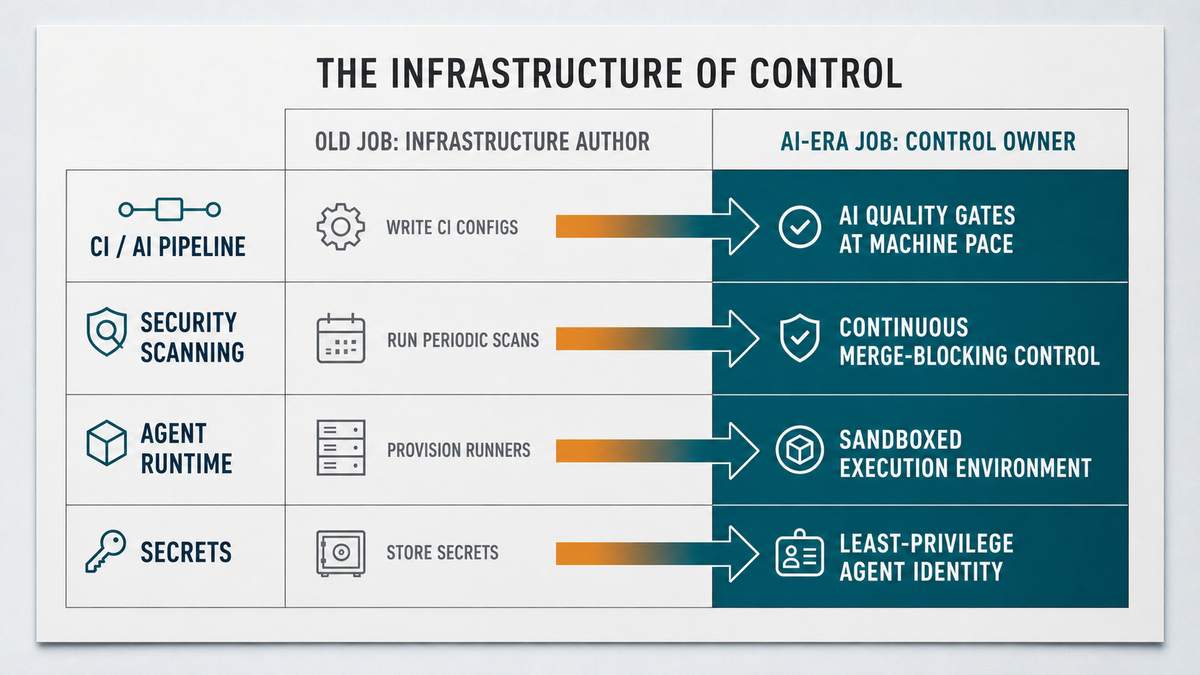
| DevOps surface | Old job (infrastructure author) | AI-era job (infrastructure-of-control owner) |
|---|---|---|
| CI/AI pipeline | Write CI configs, keep builds green | Operate AI quality gates that review agent output at machine pace |
| Security scanning | Run a periodic scan, file findings | Make scanning a continuous, merge-blocking control in every PR |
| Agent runtime | Provision build runners | Build the sandboxed execution environment agents are bounded inside |
| Secrets | Store secrets, rotate them | Define least-privilege identity for agents: what can the agent reach |
This table is the whole article in four rows. The sections that follow are each one row, worked out in mechanism. If you want the general version of how AI redesigns a delivery role rather than this DevOps-specific one, that argument lives in the role-based AI playbooks; this piece is the DevOps deep dive and does not re-derive it.
The quality gate becomes machine-paced
The classical code-review gate has a hidden assumption baked into it: that code arrives at human pace. A developer writes a feature over a day, opens a PR, and a reviewer reads it within their working hours. The review is sparse because the production is sparse. One human paces another human, and the gate holds because both sides move at roughly the same speed.
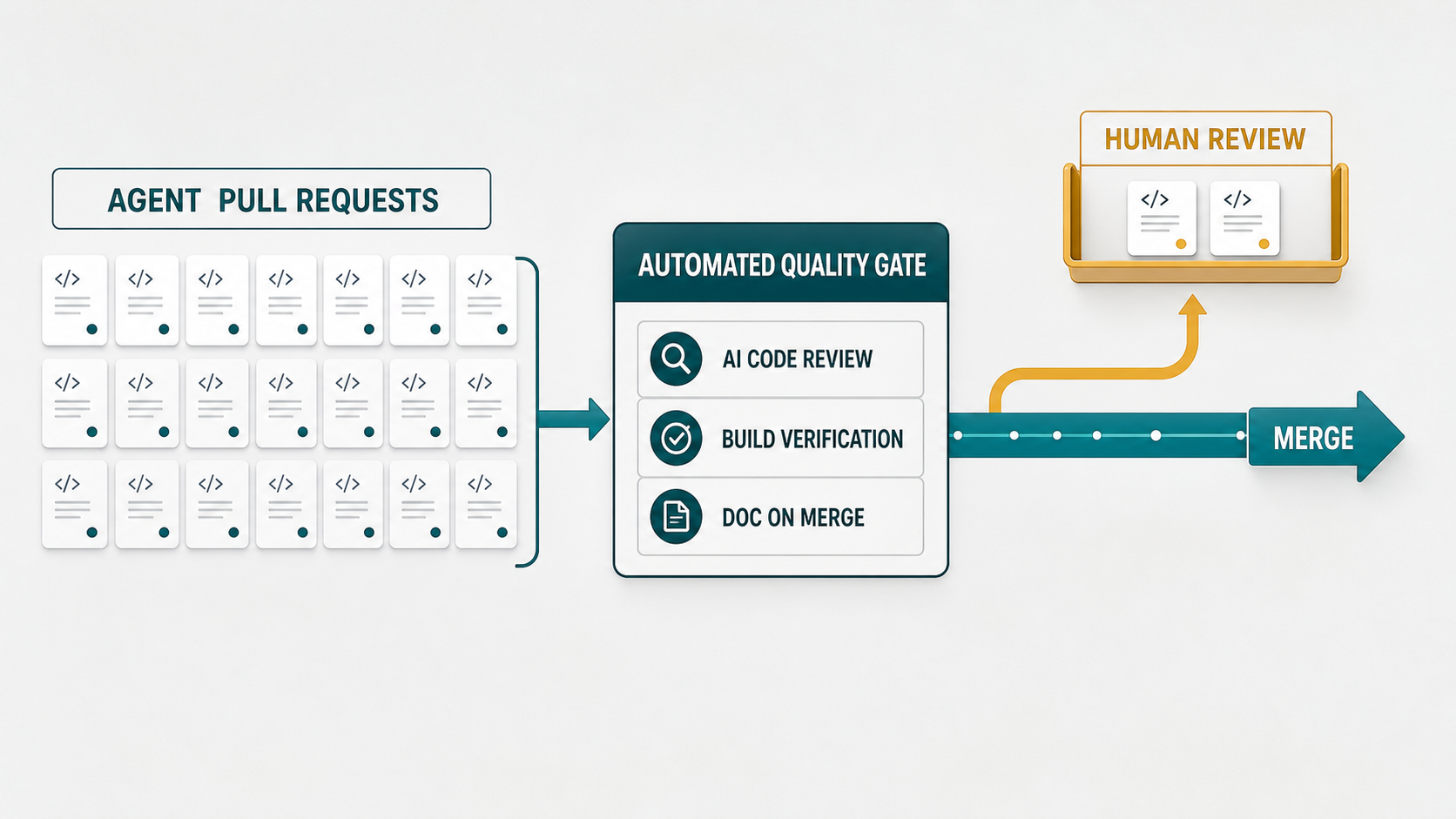
Agent throughput breaks that assumption. When an agent can produce a dozen PRs in an hour, the human reviewer becomes the bottleneck, and a bottleneck under pressure does one of two things. It either slows the whole system to its own speed, which destroys the productivity the agent was supposed to deliver, or it waves things through, which destroys the review. Neither is a gate. Both are the gate failing quietly.
The redesign is to make the first-pass review itself machine-paced. A CI/AI pipeline runs AI-powered quality gates on every pull request before a human ever looks at it. AI code review on the PR flags the obvious defects, the missing tests, the security smells, the drift from the codebase's own conventions. Build verification confirms the change compiles and the test suite stays green. Documentation generation on merge keeps the written record current without a human writing it. The point is not that AI replaces the human reviewer. The point is that AI quality gates absorb the volume the human cannot, so the human reviews the small set of changes that genuinely need judgment instead of drowning in the set that does not.
There is a handoff here that is easy to blur, and blurring it is how this work goes wrong. The architecture of the quality gate, which checks run, in what order, what blocks a merge versus what only warns, is a design decision. That design is led by the Solutions Architect, co-owned in practice with AppSec, platform engineering, and the service owners, and the Solutions Architect AI playbook covers it as a design problem. DevOps usually does not own the gate's policy. DevOps implements and operates it: wires it into the CI runner, tunes the thresholds against real false-positive rates, keeps it fast enough that it does not become its own bottleneck, and owns the on-call when it breaks. The architecture decides what good looks like. DevOps makes good happen on every commit, continuously, without anyone having to remember to do it. The QA function's half of the same gate stack is worked through in the QA AI playbook.
That word, continuously, is the operating-cadence shift hiding inside this section. The old review was an event: it happened once, at the end, when a human got to it. The new review is a property of the pipeline: it happens every time, at the start, because the pipeline is built to make it happen. Governance stopped being a thing you do and became a thing the system is.
Security scanning is merge-blocking infrastructure, not a one-time gate
Most security review in delivery is still shaped like an approval. Someone, at some point, looks at the change and signs off. The shape carries an assumption that the productivity framing never questions: that there is a someone, that they have time, and that the volume of change is low enough for a human pass to be meaningful. Agent-assisted delivery violates all three, and a one-time human security gate against machine-pace output is theater.
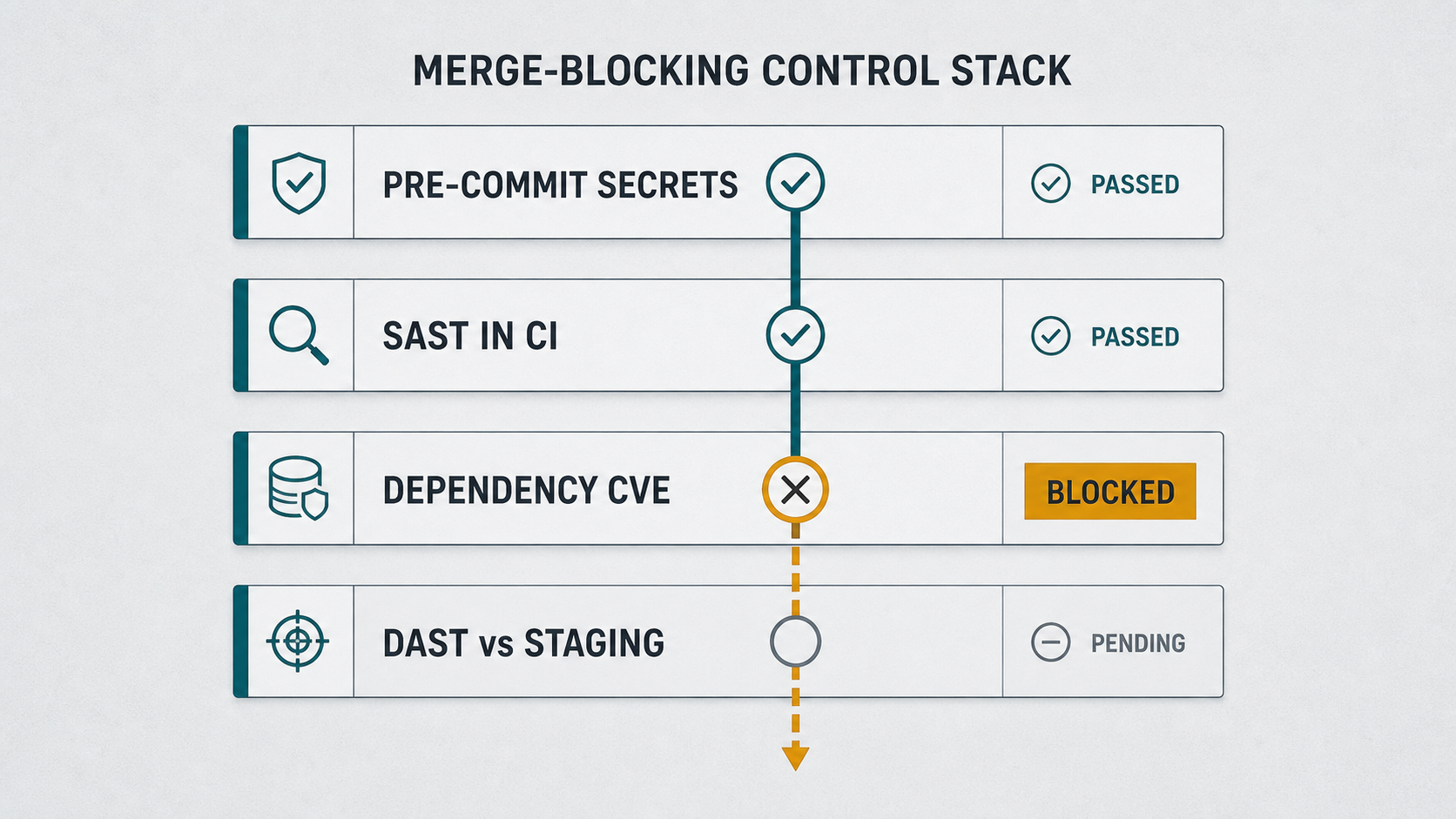
The redesign turns security scanning into infrastructure that blocks merges automatically. The mechanism is a stack of checks, each one a control rather than an opinion:
- Pre-commit secrets detection. Tools like gitleaks and truffleHog scan the diff before it ever reaches the remote, catching an API key or a hardcoded credential at the moment it is written rather than after it has been pushed to a place where it must be considered leaked. An agent that confidently inlines a secret it found in context gets stopped at the commit, not discovered in an incident.
- SAST in CI. Static analysis with Snyk, Semgrep, or SonarQube runs on every pull request and flags injectable patterns, unsafe deserialization, and the security anti-patterns that agent-generated code reproduces from its training distribution. Findings above a severity threshold block the merge. The control is the block, not the report.
- Dependency CVE scanning. Dependabot and equivalents watch the dependency graph for known vulnerabilities and open the remediation PR automatically. Agents pull in dependencies fluently and without a sense of supply-chain risk; the scan is what makes that fluency safe.
- DAST against staging. Dynamic testing exercises the running application in a staging environment, catching the runtime vulnerabilities that static analysis cannot see. It is the last check before the change is allowed to graduate toward production.
The unifying property is that every one of these is a continuous, in-pipeline control that blocks bad changes, not a one-time approval that a human grants. That distinction is the governance reframe at the heart of the redesign: governance is a governed path the change has to pass through, not a block someone imposes from outside. The lead who installs this stops being the person who says no and becomes the person who built the road that only safe changes can travel.
There is a reason the runtime, and not only the code, has to be bounded, and it comes from a specific and well-named threat. OWASP lists prompt injection as LLM01 in its 2025 Top 10 for LLM applications, the first-listed risk class. The reason it ranks where it does is structural: any input surface that becomes part of an agent's context window is an attack surface. A support transcript, a retrieved document, a comment in a pull request, an error message the agent reads while debugging: each of these is text the agent will treat as instruction if an attacker has shaped it to be read that way. You cannot scan that risk out of the code, because the code is fine. The danger is in what the agent reads at runtime and what it is then able to do about it. That is why scanning the code is necessary but not sufficient, and why the next section is about the room the agent runs in.
The agent execution environment is the room agents run inside
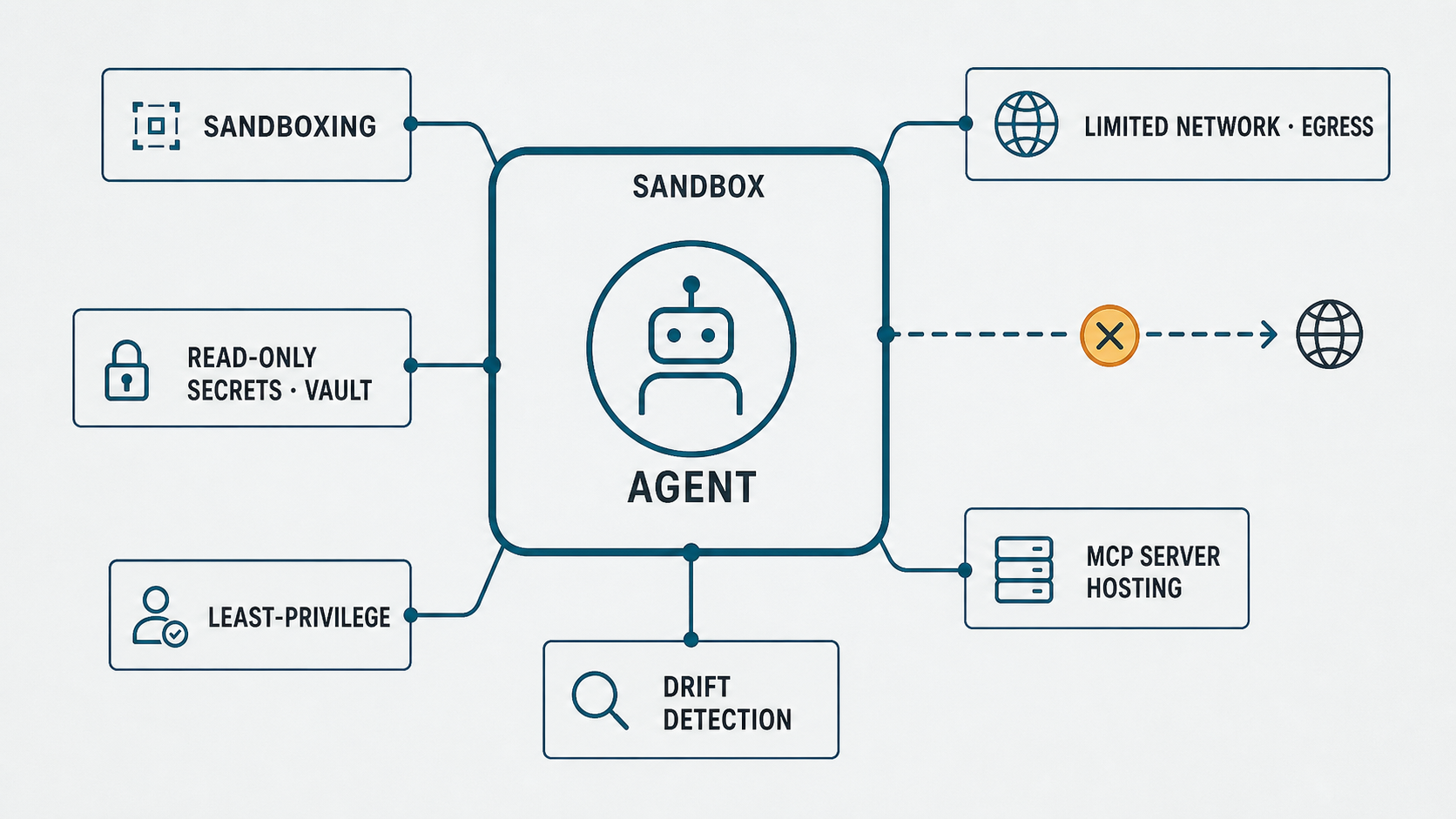
This is the headline of the redesign and the part the productivity framing has no language for. Once an agent is a background worker that executes on its own, opens PRs, runs commands, and touches systems, the question is no longer only "is the code it wrote safe." The question is "what is this agent allowed to do while it runs, and what stops it from doing more." The answer is an agent execution environment: a bounded room the agent operates inside, built and owned by DevOps.
A bounded execution environment has a small number of load-bearing properties, and each one answers a specific way the agent could go wrong.
Sandboxing isolates the agent's process from the host and from other workloads, so that a compromised or confused agent cannot reach beyond its own container. The blast radius of a mistake is the size of the sandbox, and the sandbox is something you sized on purpose.
Limited network access means the agent can reach the specific endpoints its task requires and nothing else. An agent that only needs to call your internal API and a model provider should not be able to open a connection to an arbitrary address on the internet. Egress control is how you make data exfiltration, whether malicious or accidental, structurally hard rather than merely discouraged.
Brokered short-lived secrets via a vault means the agent receives the credentials it needs through a vault that brokers access at runtime, never stored in the agent's environment, never written to its filesystem, never persisted in a place a leak could expose later. The agent gets a short-lived, scoped token to do its job and nothing it could carry away.
Least-privilege is the principle that ties the others together. The agent's identity is granted the minimum permissions its task requires and no more. This is the same discipline that has governed human and service access for years, applied to a new kind of identity that needs it more, because the agent acts faster and with less judgment than the humans the model was built for.
MCP server hosting is where this becomes concrete for teams building agentic workflows. The Model Context Protocol is how agents reach tools and data sources, and an MCP server is a thing that runs, holds credentials, and exposes capability. DevOps owns where those servers run, what they can reach, and how their access is scoped, because an MCP server is exactly the kind of high-value, agent-facing surface that least-privilege and network bounding exist to protect.
Drift detection closes the loop. The environment you defined and the environment that is actually running diverge over time, through manual changes, through agent actions, through entropy. Drift detection compares the live state against the declared state and flags the gap, so that the bounded room stays the room you built rather than slowly becoming something you no longer understand.
The threat model that motivates all of this, how an attacker actually gets into an agent-operated system and what they can do once inside, is its own subject. I covered the attacker's path in detail in the piece on how attackers get into Claude Code; the execution environment described here is the defensive answer to that threat model. The short version is that the agent runtime is now a primary attack surface, and a DevOps function that bounds the code but not the runtime has secured the wrong half of the system.
Secrets management shifts from "is it in the code" to "what can the agent reach"
The oldest secrets question in delivery is whether a credential ended up in the codebase. It is a real question and the scanning in the security section answers it. But the agent era adds a second question that is larger and that classical secrets hygiene does not reach: not "is the secret in the code" but "what can this agent reach with the access it has been given."
The shift is from secrets as strings to identity as a boundary. An AI-generated piece of infrastructure should never reach production without a secrets scan and a least-privilege IAM review, the same way a human-written one should not. That is the L0 and L1 security-first spine, and it does not change. What changes is that the same discipline now has to scale up to a question about autonomous action. When an agent has an identity, that identity is a set of permissions, and those permissions define the entire surface of what the agent can do to your systems. A credential the agent cannot access or redeem has a smaller blast radius, though disclosure can still matter in a chained attack, which is why secrets management still needs scoped issuance, rotation, revocation, and audit. A permission the agent does not have is an action it cannot take, no matter how it is prompted, confused, or attacked.
So secrets management for agents is really identity management for a non-human actor. Least-privilege IAM for agent identities is the mechanism: every agent gets its own identity, scoped to exactly the resources its task needs, with permissions that are auditable and revocable. The secrets boundary becomes the answer to the question "what can an autonomous agent touch," and that question is the one a DevOps lead can actually answer concretely, in a permission set, rather than gesturing at with policy. You stop hoping the agent behaves and start defining what behaving even allows.
What this means for the operating model
Step back from the four surfaces and the shape of the change is a role redesign, not a tool rollout. The DevOps lead is still the DevOps lead. What changed is what the role is responsible for building, and the change shows up in three places that are bigger than any one pipeline.
It changes the review and control standards, because the quality gate moved from a human event at the end to a machine-paced control at the start, and someone has to own that control as the standard the whole team's work passes through. It changes information and system access, because the question of what an agent can reach, what secrets, what environments, what permissions, is now a primary design surface rather than an afterthought. And it changes the operating cadence, because scanning and review moved from periodic approval to continuous, in-pipeline enforcement, which is a different rhythm of work for the function that runs the pipeline.
Those three are real components of an operating model, and a role redesign that touches them is how the operating-model change becomes concrete rather than a slide. The redesign of the DevOps role is not the whole operating model. But it is the part of the operating model that makes the AI transformation real at the delivery layer, because it is where the abstract promise of "we govern our AI" turns into a permission set, a blocking check, and a bounded runtime that either exist or do not.
So the Monday-morning version, the thing a DevOps lead builds, configures, and measures differently than they did a year ago, is this. You build the agent execution environment before you let an agent run unattended, not after. You configure the quality gates and the security scans as merge-blocking controls in CI, not as periodic passes someone runs by hand. You define least-privilege identities for agents the way you would for any new actor with production access, because that is what they are. And you measure governance as a property of the pipeline, continuously enforced, rather than as an approval someone granted once. The agent is not a faster version of the old work. It is a new actor in the system, and the DevOps job is to build the system it is allowed to act inside.
AI Transparency Notice: This article and its accompanying images were created with the assistance of generative AI. The author directed the content, contributed the underlying ideas and analysis, and reviewed the final publication.