AI Doesn't Fix Organizational Chaos. It Accelerates It.
Slow human execution used to absorb your org's ambiguity before anyone noticed. AI compresses that buffer, so thin specs, unclear ownership, and broken handoffs surface at speed. The fix is the operating model, not another tool.

Most teams expect AI to clean things up. They buy the tools, the engineers start shipping faster, the PMs draft stories in minutes instead of hours, and then something strange happens. The org feels worse, not better. More output, more rework, more decisions stuck in a queue, more meetings that end with someone asking who actually owns this. The instinct in the room is that the AI broke the process. That instinct is usually misdirected, and it sends leaders chasing the wrong fix for two quarters.
Quick answer: AI often exposes organizational dysfunction that slow execution previously gave people time to repair informally. It then amplifies that dysfunction by increasing the speed and volume at which unclear decisions, thin specifications, and broken handoffs propagate. AI can also introduce new technical and operational risks, so tooling controls still matter. But when the recurring failures concern ownership, standards, incentives, and handoffs, the durable fix is redesigning the AI operating model, not adding another model or prompt.
If you have already felt this, keep reading. If your rollout is still in its smooth early weeks, this article will read as abstract, and that is fine. The pattern only becomes legible once the speedup has run long enough to expose what was underneath. The leaders who recognize it are usually the ones who funded the program, watched the velocity numbers climb, and cannot square that with an org that feels more fragile than before.
Latency was the anesthetic, and AI took it away
There is a mechanism here almost nobody names. For years, the slowness of human execution acted as a buffer that absorbed organizational ambiguity. A spec was thin, but the developer building from it took three days, and somewhere in those three days a Slack thread, a hallway question, or a quiet assumption filled the gap. A decision had no clear owner, but the work it gated moved slowly enough that someone eventually stepped in before it became urgent. A handoff between two teams had no defined criteria, but the receiving team was busy with its own backlog, so the sloppy handoff sat in a queue and got cleaned up before it caused damage.

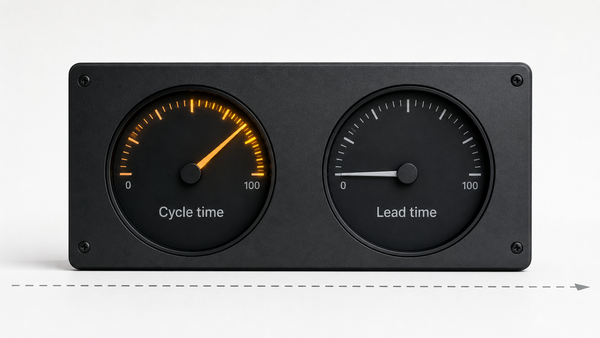
None of that buffering was visible. It read like a functioning organization because the friction never had time to accumulate into a pile. Slow execution created a repair window in which people clarified requirements, resolved ownership, and cleaned up handoffs informally. AI compresses that window, so the repair work must become explicit. The ambiguity and the latency were in equilibrium, and that equilibrium held only because the next person in the chain was slow enough to absorb whatever the previous person left unresolved.
Compress the latency and the equilibrium breaks. When a developer ships in an afternoon what used to take three days, the thin spec no longer has three days of incidental clarification poured into it. The model fills the gap instead, with a plausible-but-wrong implementation, and now there is more code to review, faster, against a spec that was never load-bearing. When AI drafts ten requirements in the time it took to write two, the unowned decision about which two mattered does not get made faster. It gets made ten times as often, and every one of those forks waits on the same missing owner. The ambiguity did not grow. The slack that used to hide it disappeared.
This is why the chaos feels new. It is not new. It is the same dysfunction the organization always carried, now arriving at the speed AI gave it, with none of the latency that used to keep it out of sight.
AI both exposes the mess and speeds it up, so aim the fix at what it reveals
The reframe is harder to hold than it looks: AI is part diagnostic and part amplifier. Unlike a thermometer, it does not passively report a temperature that was already there. It reveals the dysfunction the latency used to mask, it speeds that dysfunction up, and it can introduce failures of its own, hallucinated output, automation bias, new security and dependency exposure. Hold both halves at once. The recurring structural mess, though, is mostly the operating model surfacing at speed, not something the tool conjured from nothing.
This determines where you point the fix. Tooling-layer controls, tighter prompts, slower rollout, human-in-the-loop checkpoints, evaluations, model governance, do real work: they contain the risks AI itself introduces, and you should keep them. What they cannot do is repair the structural cause under the recurring mess, because that cause was never the tool. It is the operating model the tool stopped hiding. You need both, controls for the risks AI adds and redesign for the dysfunction it exposes.
There is evidence for where the durable gains actually sit. BCG's broader 2025-2026 transformation research found that higher-value organizations were more likely to redesign workflows, establish strategic workforce planning, and invest substantially more in structured upskilling. Read operationally, that finding says the differentiator is operating-model change, not tooling access, which is the same claim from the other direction: where the operating model does not change, AI tends to produce activity and expose friction rather than performance. The organizations that pull ahead are the ones treating AI as the trigger to redesign the work, not as the work itself.
The honest version of the diagnosis is uncomfortable for a leader who funded the program: the speedup is doing the organization a favor. It is converting years of accumulated operating-model debt into something legible. You can finally see which decisions have no owner, which specs are too thin to build from, which handoffs only ever worked because the receiver was slow. That visibility is expensive to live through and it is the most useful thing the rollout has produced.
The dysfunction surfaces in three places, and they map to three operating-model components
Picture the same weak operating model under two speeds. Slow, the cracks are invisible. Fast, they all open at once. The cracks are not random. They appear in three specific places, and each one is a component of the operating model that AI never created but suddenly made readable.
| What surfaces after AI | The pre-existing weakness | The operating-model component |
|---|---|---|
| Decisions stall, work forks, "who owns this?" repeats | Ownership and decision rights were never assigned; slow execution let an owner emerge before the gap mattered | Roles, responsibilities, and decision rights |
| AI fills spec gaps with plausible-but-wrong implementations; review load climbs | Specs were thin because a slow human builder closed the gaps informally | Review and control standards |
| Handoffs between teams produce rework and confusion at volume | Handoff criteria were never defined; the receiving team was slow enough to absorb the ambiguity | Workflows and handoffs |
The first surface is ownership. Before AI, an unowned decision that gated a week of work usually found an owner inside that week, because the pressure built slowly and someone reasonable absorbed it. After AI, that same decision gates an afternoon of work, and the question repeats every afternoon. The decision was always unowned. The latency was the only thing converting "unowned" into "fine."
The second surface is specs. A specification is a control standard, the thing that tells a builder what correct looks like before they build it. When a human built slowly from a thin spec, they filled the missing detail with judgment and conversation as they went. An AI builder fills the missing detail too, but it fills it instantly and confidently with the most statistically plausible interpretation, which is frequently not the one the business needed. The thin spec was always a liability. The slow builder was quietly underwriting it.
The third surface is handoffs. A handoff works when the sending role and the receiving role agree on what "done and ready to pass" means. Most organizations never wrote that down because the receiving team was busy enough to catch problems on intake by hand. Speed up the sender, keep the criteria undefined, and the receiver now gets a flood of handoffs that each technically arrived but none of which are actually ready. The handoff criteria were always missing. Slowness was the informal substitute.
Notice what these three have in common. None of them is a tooling problem. You cannot prompt your way to defined decision rights. You cannot configure a model into writing your handoff criteria. These are components of the AI operating model, and an operating model is not a single thing you can patch in one place.
Fixing one component is the most common way to feel busy and stay stuck
The trap that catches careful leaders is partial repair. You read the diagnosis, you accept that ownership is the problem, you spend a quarter assigning owners to every floating decision, and the chaos barely moves. An operating model is a system of interdependent parts, not a single lever. It is the design of roles and responsibilities, the decision rights that say who decides what, the workflows and handoffs that move work between roles, the review and control standards that define quality gates, the information and system access each role needs, the incentives and performance measures that say what each role is accountable for, and the operating cadence that sets the rhythm of review and recalibration.
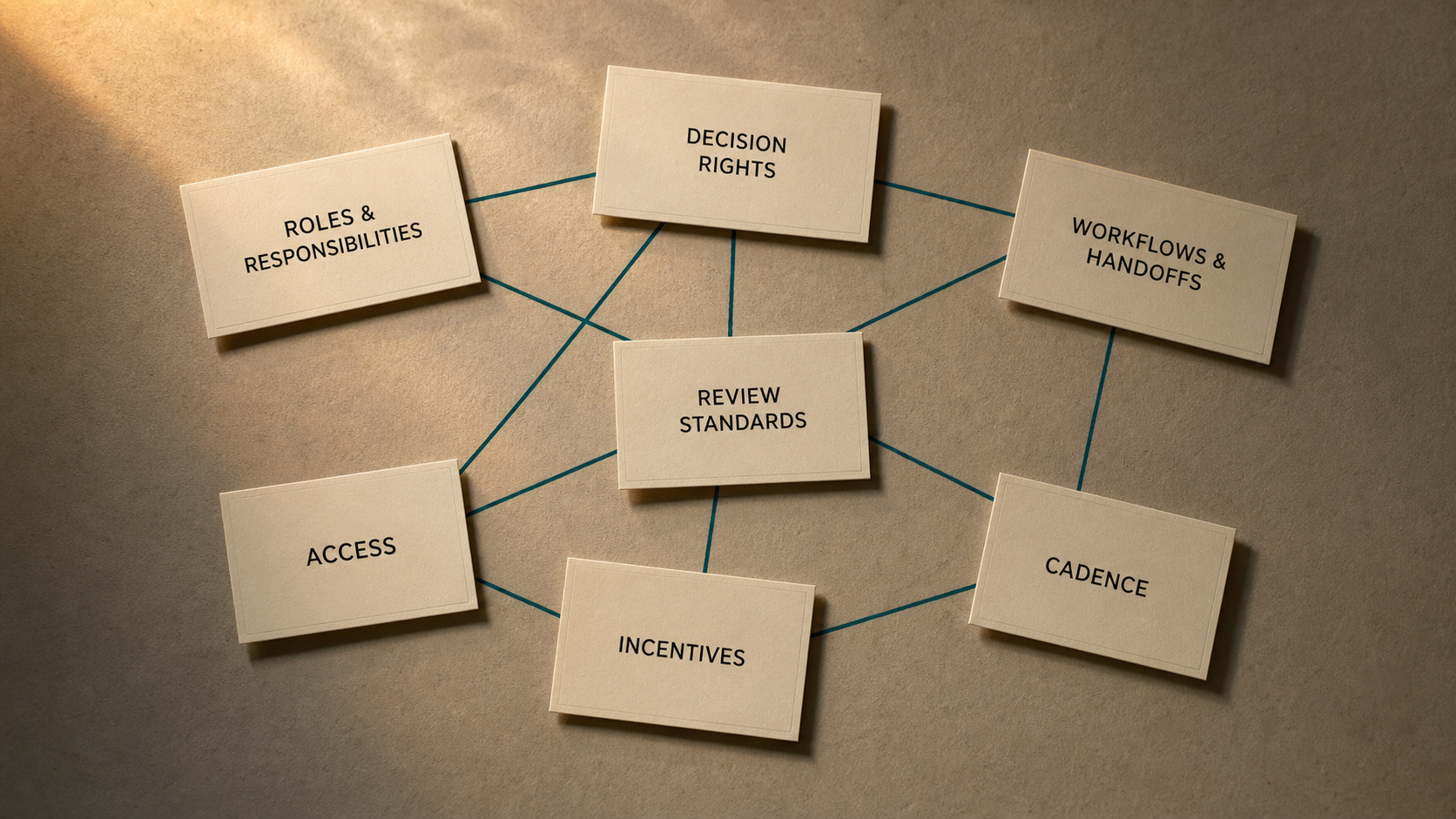
Assign owners to decisions but leave specs thin, and your new owners spend their authority arbitrating implementations the model guessed wrong. Sharpen specs but leave handoff criteria undefined, and the better specs pile up at a boundary nobody agreed how to cross. Define handoff criteria but leave incentives measuring the old activity, and the people doing the handoffs optimize for the metric that still pays them, which is throughput, not readiness. Each component you fix in isolation gets quietly undone by the components you left alone.
This is the distinction the market keeps collapsing. AI transformation is not tool adoption, and it is not a single role redesign or a headcount change either. It is a change to the system of components together. The reason there is no off-the-shelf reference model for it is that the components are interdependent, so the fix has to move several of them in a coordinated way, and most published advice operates one component at a time because that is what fits in a framework slide.
The way you can tell whether the operating model has actually moved is to look at what the work produces. Changed work leaves a trail. Specs get deeper and more structured when AI carries the implementation. Decision logs start to exist because someone now owns the decision and records it. Review patterns shift toward checking behavior and intent rather than syntax. Reading those artifacts, rather than reading a usage dashboard, is the most honest measure of whether the model changed. Reading those artifacts this way is what the Shift Harness Artifact Test does, and it is the difference between knowing people touched AI and knowing the organization works differently.
Worse numbers can mean two different things, and you have to tell them apart
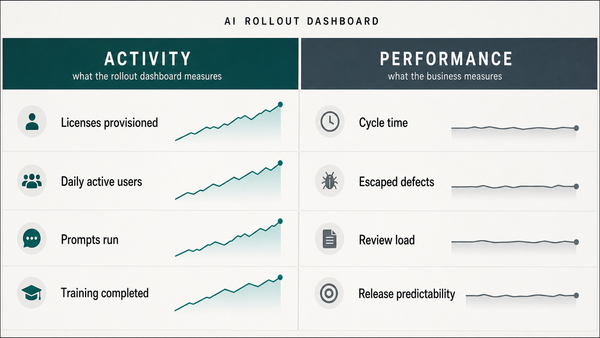
A failure mode that shows up in delivery orgs after AI lands is a widening gap between activity and performance. The activity metrics look great. Tool usage is high, more code ships, more stories get drafted, more tests get generated. The performance metrics refuse to move, or they move backward. Cycle time does not drop because the bottleneck was never typing speed, it was the unowned decision and the thin spec. Escaped defects do not fall because more tests against a vague acceptance bar is more noise, not more coverage. Review load climbs because the volume went up while the standard of what gets reviewed stayed informal.
Leaders read that gap as a sign the AI is not working. Sometimes it is exactly that, a rollout that genuinely degraded delivery, and that reading deserves a fair test before you dismiss it. But more often the gap is the measurement system finally catching the difference between people touching the tools and the organization changing. The middle layer felt this first and often gets blamed for it. A department head who quietly slow-walks the rollout is usually not anti-innovation. They are measured by the old operating model, and AI changed the work faster than anyone changed the measurement system, so resisting is the rational response to being graded on a scoreboard that no longer describes the game. That resistance is another reading on the same instrument: it tells you the incentives component has not moved yet.
So the worse-feeling numbers are not automatically a verdict on AI, and not automatically a vindication either. Once you have ruled out a genuinely failed rollout, they are usually the first clear signal that activity was never the same as capability. That is uncomfortable and it is progress, provided you act on the diagnosis instead of muting the instrument.
What to re-examine before you buy another tool
If the org got messier after AI, the productive next move is not a better model, a stricter prompt policy, or a slower rollout. It is an audit of the operating-model components the speedup just exposed. The work is structural and it is yours, not the vendor's.
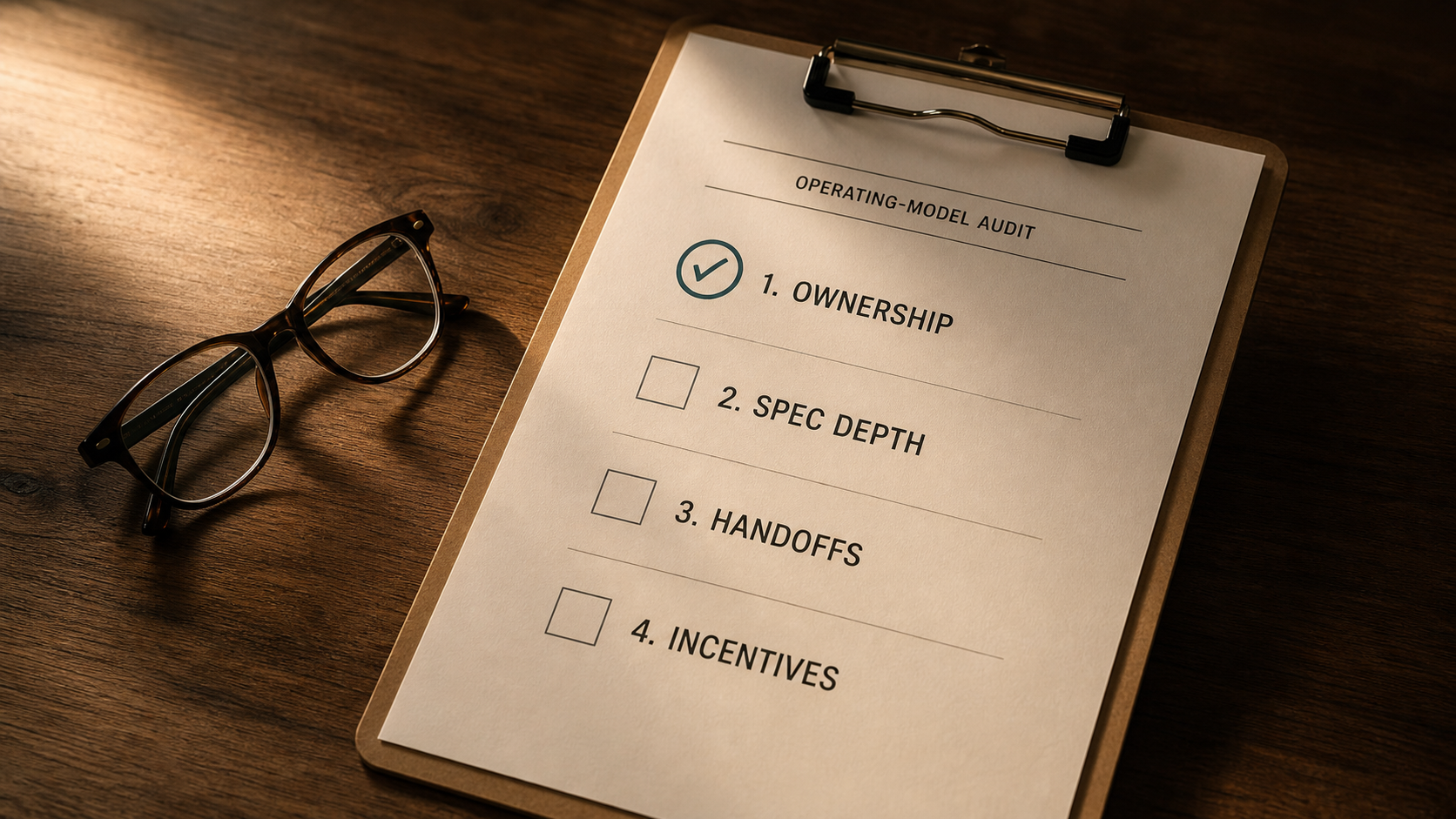
Start with ownership. Walk the decisions that keep stalling and ask, for each one, who has the authority to make it and whether that authority is written down anywhere or merely assumed. Every decision that fails that test is an ownership gap the latency used to cover.
Then look at spec depth. Take the work where AI most often produces plausible-but-wrong output, and read the specification it built from. If a careful human would have had to ask three questions before starting, the spec is too thin to be a control standard, and AI will keep filling those three gaps wrong, fast.
Then check handoffs. Find the team boundaries where rework concentrates and ask whether the sending and receiving roles share a written definition of "ready to pass." Where they do not, the handoff only ever worked because someone slow was cleaning it up on intake.
Then confirm the incentives match. If you redesign ownership, specs, and handoffs but the performance measures still reward raw throughput, the people doing the work will optimize for throughput and quietly undo the redesign. The incentive component has to move with the others or it pulls the system back.
None of this is exotic. It is the unglamorous work of designing how an organization actually operates, which is the work AI did not do for you and cannot do for you. What AI did was take away the latency that let you postpone it. The chaos you are feeling is the bill for operating-model debt, presented at the speed of the tool you just bought. The teams that come out ahead are the ones that read the bill as a diagnosis and go fix the operating model, not the ones that go shopping for a quieter instrument.
AI Transparency Notice: This article and its accompanying images were created with the assistance of generative AI. The author directed the content, contributed the underlying ideas and analysis, and reviewed the final publication.