Headcount Replacement Is Not an Operating Model
The cut was supposed to prove AI was working. The quiet rehiring is the proof that something else was. AI takes the task; it does not inherit the judgment, ownership, and review standard the seat also held.
A year ago, cutting roles and pointing at AI was the decisive move. It read as leadership. On the board deck, it looked like the company had finally turned AI from a line of spend into a lever. Then the same companies started rehiring, quietly, for roles they had publicly retired. That is the part worth sitting with. The cut was supposed to be the proof that AI was working. The reversal is the proof that something else was.
Quick answer: Cutting headcount for AI is a cost event, not a transformation. The ai operating model is the set of roles, decision rights, review standards, and cadence that turn AI capability into outcomes that compound. AI replaces tasks inside that model. It does not replace the model. When you remove the people who ran the model and assume the tool inherits their judgment, the model degrades and you rehire to repair it. Headcount replacement is not an operating-model change. It is the removal of the people who ran the model.
The wave of ai layoffs in 2025 and 2026 was justified almost everywhere with the same logic: the AI does the task now, so the seat is redundant. The logic is half right, which is what makes it dangerous. The AI does do the task. The seat was never only a task.
The reversal is not evidence that the AI failed
The easy reading of the rehiring is that the tool was not ready. The companies got ahead of the technology, the work slipped, and they walked it back. It is a comfortable story because it asks nothing of the org chart. Wait two more model generations, the reasoning goes, and the cut will hold.
I want to grant the opposite and watch what happens. Assume the AI is good. Assume it writes the report, drafts the ticket, summarizes the call, generates the test, and produces the first draft of nearly everything the removed role used to produce. Assume the tooling shortfall is not the problem at all. The cut still fails. That is the claim worth defending, because it is the only reading that survives better models. If your diagnosis is "the AI was not ready," every release that gets better quietly tells you to cut again. If your diagnosis is structural, you stop running the play.
What the easy reading misses is that a role and a task are not the same object. AI replaces tasks, not jobs is the phrase that has been doing the rounds, and it holds as far as it goes, but it gets deployed as reassurance rather than as a mechanism. The interesting question is the one the reassurance skips: if the task left the seat, what stayed in the seat? Whatever stayed is what you removed when you removed the person, and whatever you removed is what no model inherited.
A role holds more than the task the AI took
Walk through what a mid-level seat actually carried, beyond the visible output, and the gap becomes concrete. The tool inherits the typing. It does not inherit any of the surrounding work that made the typing safe to ship.
| What the seat held | What the AI can assist with | What it does not inherit by default |
|---|---|---|
| Producing the output (the report, the ticket, the test, the summary) | The output itself. This is the part the tool does well. | Little here. The tool genuinely covers the production. |
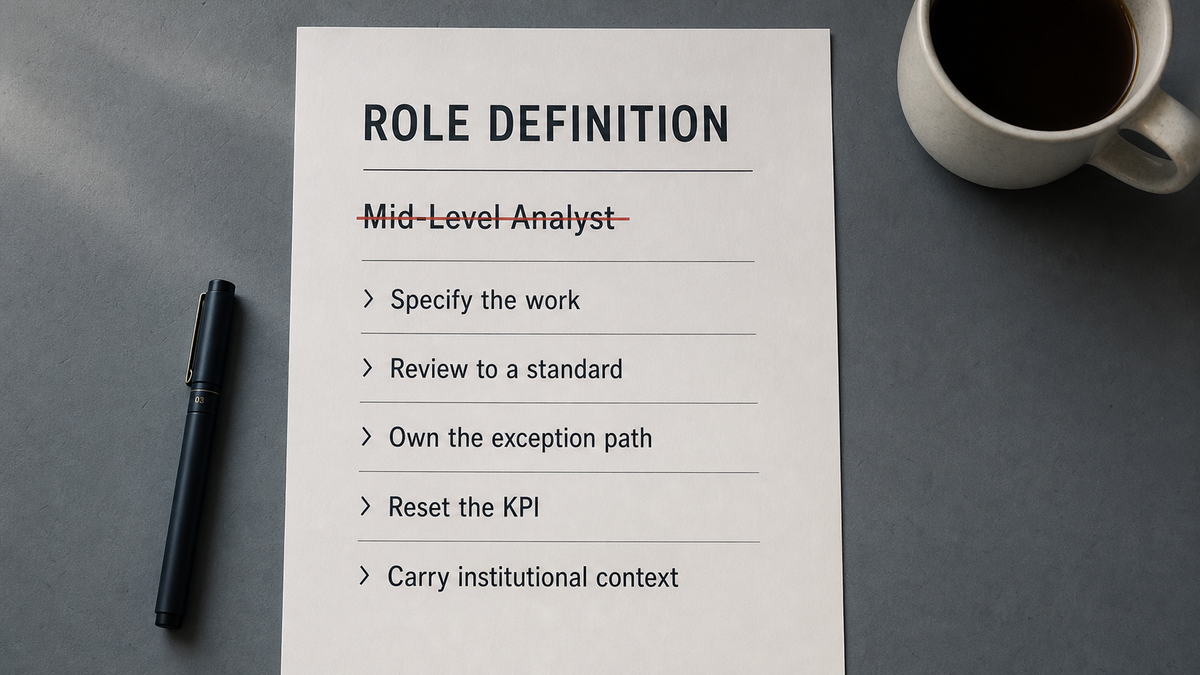
| Specifying the work | Drafting a first-pass specification from a request. | The accountable ownership of deciding what the request should be, and the authority to say the spec is wrong. The model executes; it does not own the decision. |
| Reviewing output to a standard | Running checks against an encoded bar: evaluation suites, schemas, policies, deterministic gates, reference examples. | The authority to own and revise that bar organizationally. A stable bar can be encoded; what the model cannot do is decide when the bar itself is wrong and change it. |
| Owning the exception path | Flagging anomalies and surfacing candidate exceptions. | Responsibility for the outcome when the edge case is mishandled. The model handles the median case and degrades on the edge; someone still has to be accountable for routing it. |
| Resetting the KPI | Analyzing the metric and proposing where it has drifted. | The decision right to declare the metric is measuring the wrong thing and reset it. The model reports; the owner decides. |
| Carrying institutional context | Persisting context across a session and recalling supplied history. | The accountable judgment of why the process is shaped the way it is, which customer breaks which assumption, and what the last failure cost, held by the person, not the context window. |
Read that third column again. The model can assist with every row. What it does not inherit by default is the same three things across the board: accountable ownership, decision authority, and responsibility for the outcome. The seat was a bundle of capability and accountability, and the cut treated it as a single line item of capability.
The failure shows up first in the work that has no obvious owner anymore. Someone still has to specify what the AI does, and that someone is now a senior person doing it between their own responsibilities, at a fraction of the attention the removed role gave it. Someone still has to review the output against a standard, and when no one owns the standard, the standard quietly becomes "it looks finished," exactly the failure mode a fluent model is best at producing. Someone still has to catch the exception, and the exception is precisely the case the model handles worst and surfaces least. This is the operating layer, and it stays invisible until it is gone.
There is a useful test for whether a claim about AI is operating-grade or just commentary: it has to survive Monday morning, not the strategy offsite. The Monday after the seat is empty, what does the org actually do differently? If the honest answer is "we assumed the tool would handle it," the cut did not change the operating model. It removed an operator from it and left the model running short a person.
The numbers describe degradation, not a tooling gap
The pattern is now visible enough that the analyst firms have it on record, and what they found is more useful as a mechanism than as a headline. In a 2026 survey of roughly 350 leaders at organizations above $1B in revenue that were piloting or deploying autonomous capabilities, Gartner found that about 80% had reduced workforce, and that there was no correlation between those reductions and higher AI ROI. The population matters: this is large enterprises moving on autonomous AI, not a claim about every AI-related headcount decision everywhere. Read within that population, the finding is a verdict on the cut, not on AI. If removing people produced returns, the data would show it, and inside this set it does not, because the cut removed the role-level judgment that turns AI capability into delivered work. The tool did the task. The org lost the operator who made the task count. No correlation is what it looks like when you optimize the cost line and leave the value line to fend for itself.
The rehiring confirms it from the other direction. In a 2026 Careerminds survey of 600 HR professionals, 32.7% of organizations that conducted AI-driven layoffs had already rehired a quarter to half of the eliminated roles, and a further 35.6% had rehired more than half, so roughly two-thirds of surveyed organizations had rehired at least a quarter of the roles they cut. Rehiring into the same function is a signal that the organization may have removed capacity before it had redesigned and validated how the work would operate without it. The org feels the degradation before it can name it, and the cheapest available repair is to put a person back into the seat the model could not fill. The rehire is the operating model asserting itself. It is the org discovering, expensively, which parts of the seat were never the task.
The sentiment data points the same way, though it is worth being precise about what kind of evidence it is. Forrester publicly predicts that more than half of AI-attributed layoffs will be quietly reversed, often offshore or at lower pay. The companion figure, that around 55% of leaders regret the cut, is supported mainly through secondary reporting, with the Careerminds survey landing at the same 55%. Treat these as reported sentiment and forecast, not as independent proof that operating-model degradation caused the reversals; the causal mechanism is the argument this article is making, and the regret numbers are consistent with it rather than confirmation of it. Either way, regret at that scale is not a story about bad luck or bad tools. It is a story about a decision made at the wrong layer. The cut was modeled as a finance move and executed as one, and the thing it broke was not on the finance model.
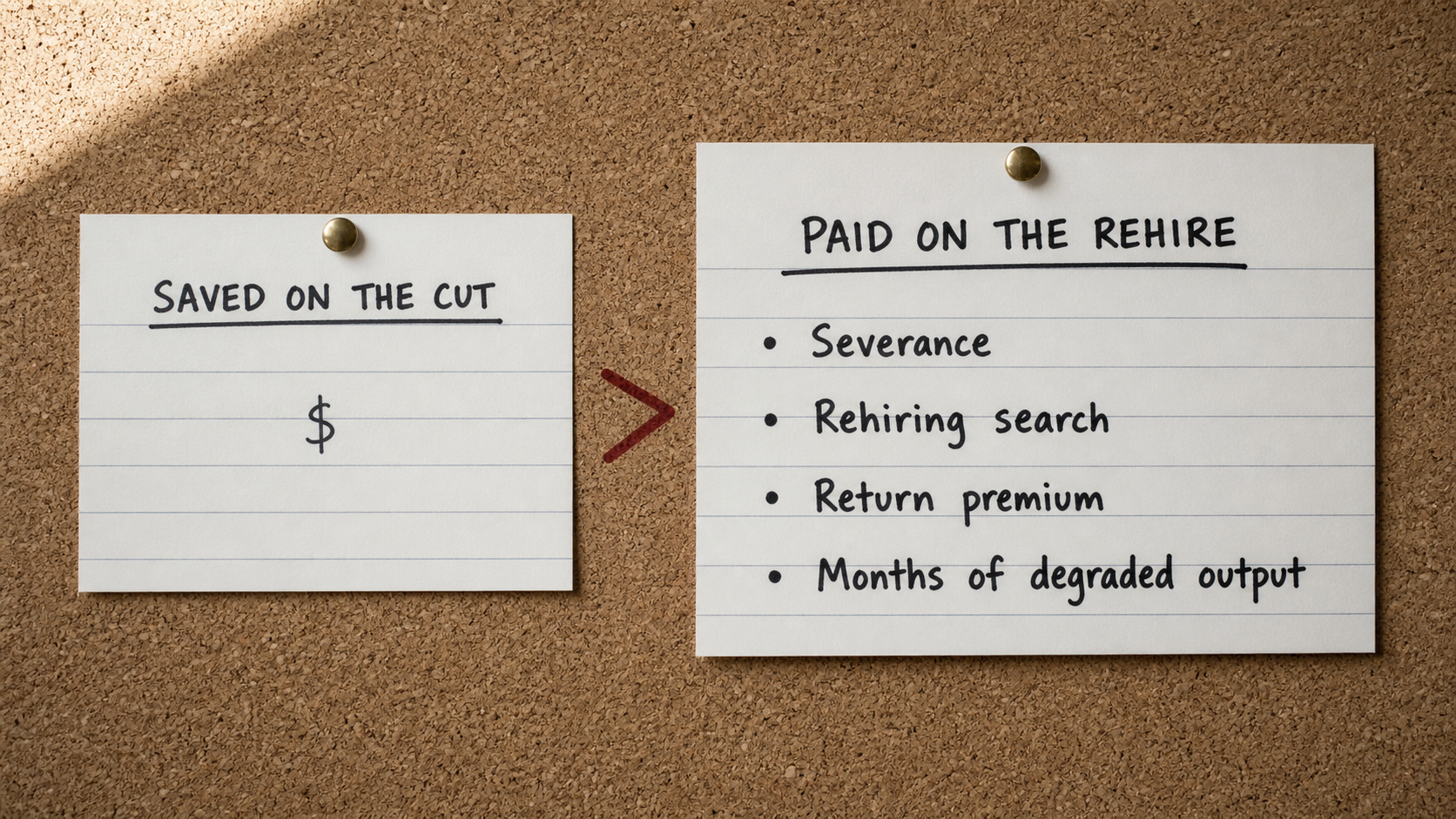
And in the Careerminds data the cost was often worse than a wash: 30.9% of surveyed organizations said rehiring cost more than the layoffs had saved, once you count severance, the rehiring search, the premium to bring back people who left under a cloud, and the months of degraded output in between. The savings were real on the spreadsheet and negative in the building. That gap, between the modeled saving and the operational result, is the whole subject of this article. It is the cost of mistaking the cost line for the operating model.
None of these figures depends on the AI being weak. They are exactly what you would expect if the AI were strong and the org-design assumption were wrong. A capable tool with no operator around it does not compound. It produces, the production quietly drifts off-standard, and the drift shows up two layers downstream as the metric that will not move.
An operating model is not a roster, and a cut is not a redesign
It helps to be precise about what an operating model is, because the cut treats it as a synonym for staffing and it is not. An operating model is a designed system of seven interdependent components: roles and responsibilities, decision rights, workflows and handoffs, review and control standards, information and system access, incentives and performance measures, and operating cadence. Headcount sits inside the first of those seven. A roster is one input to the machinery; it is not the machinery. Presenting a role redesign, or a headcount cut, as the whole operating model is exactly the collapse this article is about.
AI can change that machinery, and that is the part the layoff conversation drops. A model that drafts every spec, runs every first-pass review, and flags every anomaly does more than run tasks faster. It moves the work humans do up a level, from production to specification, review, and exception ownership. The roles shift, the decision rights shift, the handoffs and review standards shift, and the cadence shifts with them. That is a real ai workforce transformation: several of the seven components move at once.
A headcount cut moves none of them. It removes operators and leaves the other six components untouched, then hopes the tool closes the gap. The decision rights still need an owner; the cut left the seat empty. The control standard still needs a holder; the cut removed the person who held it. The cut touches the roster line and calls the whole system changed. A company that cut headcount and bought licenses has changed who is on the payroll and nothing else in the design. That is precisely the shape that produces the no-correlation result.
There is a second cost the spreadsheet hides. The people who hold review standards and own exception paths are usually mid-level operators and front-line managers, and they are the cheapest-looking headcount on it. Cut them and you have not only removed operators; you have removed the only people positioned to notice that the operating model needs to change and to actually run the change. The cut eats its own transformation owner.
The redesign the cut skipped
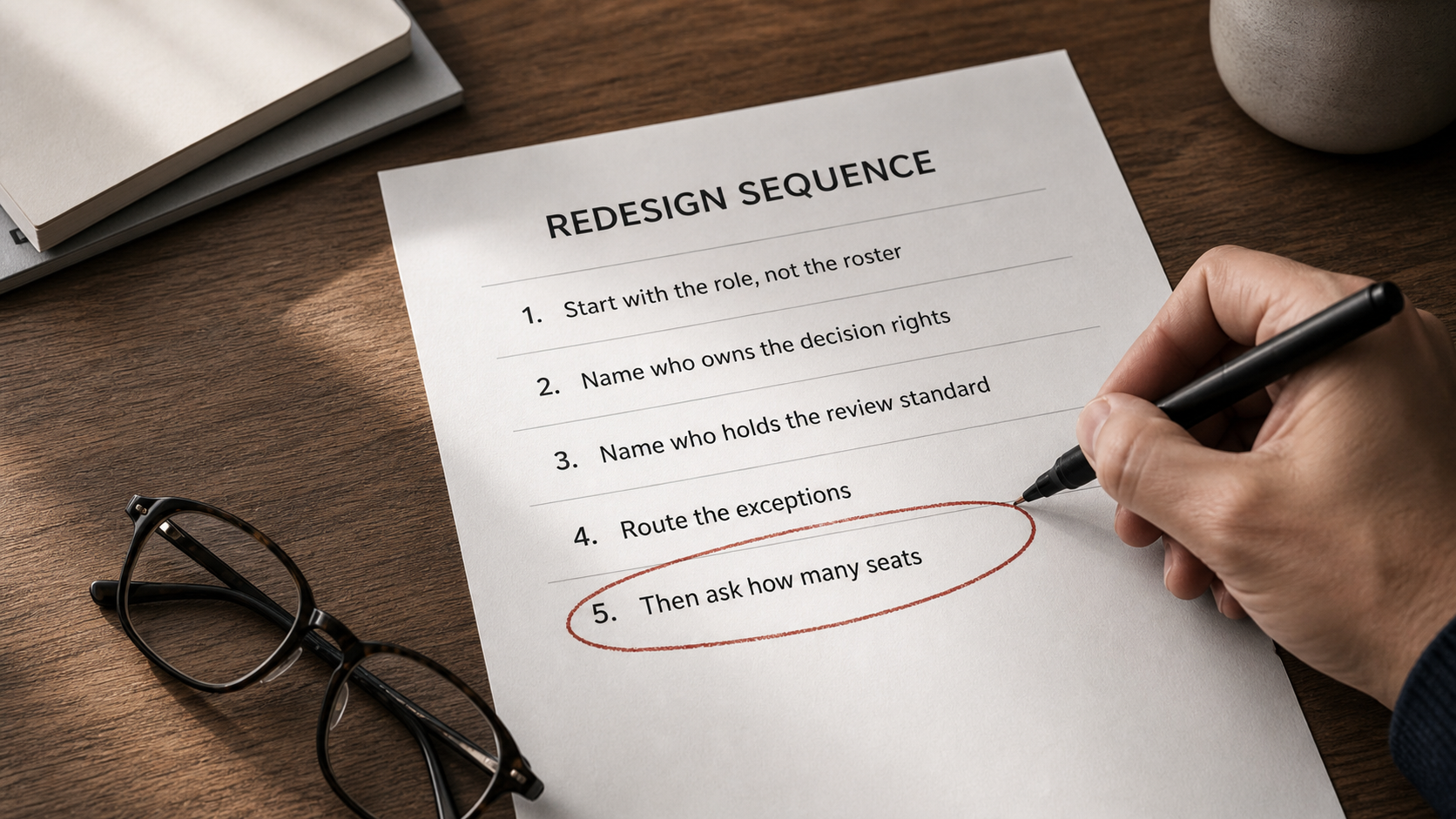
There was a version of this decision that worked, and it is not the version where you keep everyone. Replacing employees with ai can be a sound outcome. The error is making the replacement the strategy instead of the result. The fix is a sequence, run in order, that puts the headcount question last:
- Decompose the role. Break the seat into its production, judgment, control, coordination, and exception responsibilities. Most cuts treat the seat as one thing; it is at least five.
- Map AI's reach. Identify which of those responsibilities AI can perform outright and which it can only assist with. The line between "perform" and "assist" is where most of the surprise lives.
- Assign owners and decision rights. For everything AI does not fully perform, name an accountable owner and the authority to reject AI output. Unassigned accountability is what falls through the gap and becomes a rehire.
- Encode the standards. Write the review standards, evaluation thresholds, and escalation rules the model will be checked against. The bar a person used to hold in their head now has to live in suites, schemas, policies, and approval rules.
- Run it in shadow. Operate the redesigned workflow in shadow or controlled production before you commit headcount to it, so failures surface against the old baseline instead of in front of customers.
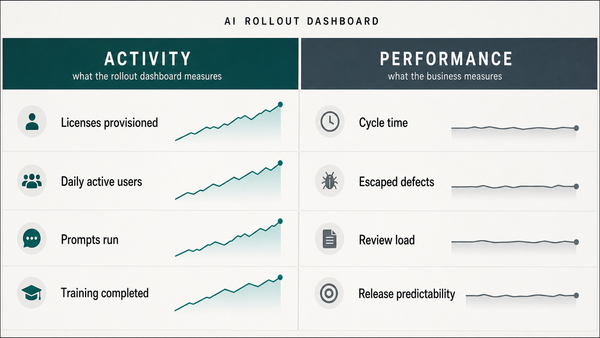
- Measure what matters. Track cost, quality, cycle time, exception load, and control failures, not just usage and output volume, which a busy dashboard will always show.
- Then size the team. Only after the redesigned model is running and measured do you determine the capacity and headcount it actually requires. Sometimes that is fewer seats. The reduction is the output of the change, not a substitute for it.
This is the article's real contribution: the cut is step seven, not step one. The companies in the reversal ran the sequence backward. They treated the cut as the transformation, executed it as a finance move, and found that an operating model does not respond to finance moves. The ones who get it right run steps one through six while the people who hold the standards are still in the building, then let the staffing question answer itself. That ordering is not slower in any way that matters. It is the difference between a saving that holds and a saving you pay back with interest two quarters later.
What this leaves on your desk
If you cut for AI and the numbers went the wrong way, the temptation is to read it as a tooling problem and wait for the next model. The data says that wait will not pay off, because the next model inherits the task and still inherits none of the operating layer the seat held. The problem was never the capability. It was the assumption that capability and the operating model are the same thing.
So the question to take into the next planning cycle is not "which roles can AI replace." It is narrower and more useful: for every seat you are tempted to cut, who will own the decision rights, the review standards, and the exception paths that seat is currently holding, once the person is gone. If you have a named answer, the cut might be a real operating-model change. If the answer is the tool, you are running a cost play and calling it a transformation, and the next cut will fail exactly the way this one did. The operating model is the unit of change. Treat the headcount line as the lever and you will keep paying to rehire the model you removed.
AI Transparency Notice: This article and its accompanying images were created with the assistance of generative AI. The author directed the content, contributed the underlying ideas and analysis, and reviewed the final publication.