The AI Operating Model: what actually changes when a tech company transforms
Most AI transformation programs are AI procurement programs in disguise. Tools change in days. The operating-model layer - roles, decision rights, workflows, metrics, governance - changes in quarters and rarely gets touched.

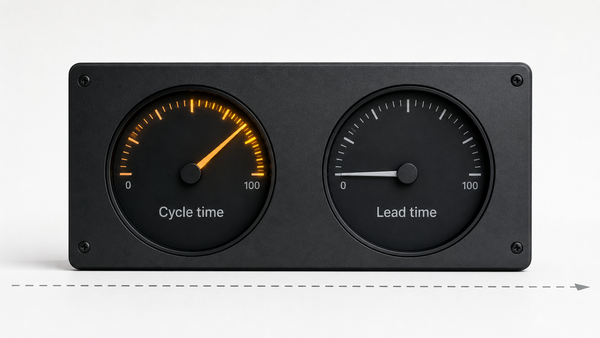
The CEO sits at the quarterly review and reads the same line from the same dashboard he read last quarter. Engineering has Copilot. QA has an AI test-generation tool. PMs have an AI assistant for spec writing. The license count is up. The training hours are logged. The transformation roadmap has green checkboxes from the December offsite. The delivery metrics, on the other hand, look exactly like they did before the program started. Cycle time is flat. Reopened-defect rate is flat. Story-scope shift is flat. The board update is in three weeks and there is nothing in the numbers to put in it.
This is the felt experience of a particular kind of AI transformation. Tools were bought. Roles were hired. Pilots ran and reported wins. The wins did not compound. The CEO can sense, without being able to name it, that the company is doing something other than what it set out to do. What it set out to do was transform. What it actually did was procure.
There is a specific layer of the company where transformation happens, and a specific layer where procurement happens, and they are not the same layer. The argument of this article is that AI transformation programs fail because the operating-model layer was never touched. Tools change in days. Roles, decision rights, workflows, metrics, and governance change in quarters. A company that has spent eight figures on AI tools and zero hours on operating-model redesign has not transformed. It has bought software. What follows is drawn from the AI-transformation work I lead with delivery organizations, where treating procurement as transformation becomes impossible to miss.
Procurement and operating-model change are not the same thing, and confusing them is the most expensive mistake in AI transformation today.
The tooling layer is the layer most leadership teams instinctively work on first, because it is the layer that is easiest to act on. Tools have vendors, contracts, license counts, rollout plans, and training curricula. Procurement and IT know how to run them. A CIO can show a board a slide with twelve logos on it and call it an AI strategy. The work is visible. The artifacts are concrete. The status updates almost write themselves.
The operating-model layer is everything beneath the tooling. It is the set of standing decisions about how the company actually runs: what each role does day-to-day, who decides what, in what order work moves through the system, what the dashboards measure, and what rules constrain the whole thing. The operating-model layer has no vendor. It cannot be licensed. It does not show up on the procurement budget. A CIO cannot show a board a slide with twelve operating-model components on it, because operating-model components do not have logos.
When companies say "AI transformation" they mean one of these two layers. Almost always, they mean the first. When they discover the program has not transformed anything, they are discovering, usually two or three quarters in, that they meant the second.
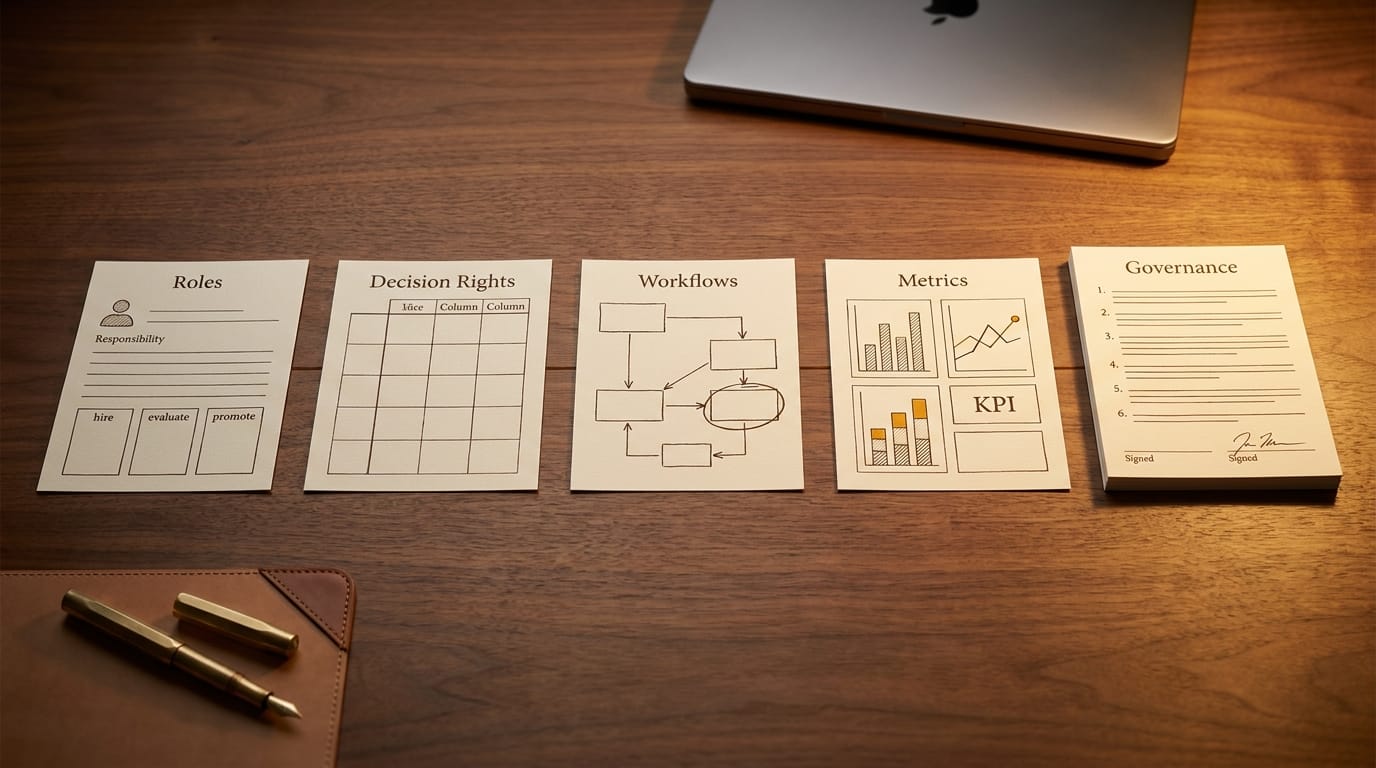
The five things that have to change together at the operating-model layer are, in the order I find it useful to enumerate them: roles (what each function actually does), decision rights (who decides what), workflows (the order and shape of work), metrics (what the dashboards measure), and governance (the rules under which AI operates safely and legally). These are not five independent initiatives. They are a single layer. When any one of them stays frozen, the other four cannot move. A new tool dropped into an unchanged role with unchanged decision rights and unchanged metrics gets used the way the old tool was used, measured the way the old work was measured, and produces the result the old work produced. The company is now paying for AI to deliver pre-AI performance. This is the felt-but-unnamed experience of most transformation programs I have seen.
The five components of an AI operating model each have a recognizable before-and-after, and you can audit each one without buying anything.
Roles. In a pre-AI delivery organization, a PM writes a spec by translating stakeholder conversations into a Jira ticket. A BA gathers requirements through interviews and writes a document. A QA designs a test plan by reading the spec and mapping it to known risk areas. A developer reads the ticket and implements. A solution architect reviews and approves. In an AI-redesigned delivery organization, the PM's day-to-day is different. The AI assistant drafts a structured spec from raw stakeholder notes, and the PM's actual work is reviewing the spec for missing acceptance criteria, identifying scope ambiguity, and deciding what the AI guessed about that needs to be made explicit. The role has shifted from author to editor-of-machine-output. The same shift, in different shapes, runs across QA, BA, SA, and Dev - the L1–L4 redesigned role definitions for each are documented in the role-specific frameworks at shiftharness.tech/frameworks. Tooling rollouts treat this as a productivity boost. It is not a productivity boost. It is a role redesign. The PM whose role has not been redesigned uses the AI assistant for a week, finds that it generates specs that are roughly right most of the time and subtly wrong in ways that take longer to fix than to write from scratch, and quietly stops using it.
Decision rights. In a pre-AI delivery organization, the decision rights are stable and unstated. The PM decides what the spec contains. The developer decides how to implement. The QA decides what passes. The SA decides what ships. In an AI-touched workflow, every one of those decisions has a new participant (the model), and every one of them needs an updated decision-rights statement. Who decides whether AI-generated code goes into the codebase without human review? Who owns the queue of AI-generated outputs that need human verification? Who signs off on a risky use case where the model might produce something a customer relies on? Who is accountable when the model is wrong? In most cases I've seen, none of these have been answered explicitly. The default answer becomes "whoever was already in the chair," which is a non-answer, because the chair was defined for a world without a non-human participant in the workflow.
Workflows. The shape of work changes when AI is genuinely embedded. The pre-AI delivery workflow is roughly: ticket → code → review → test → ship. The AI-redesigned workflow looks more like: spec → prototype → AI implementation → human review → quality gate → ship. The order has changed because the cheap step (a passable first implementation) has moved earlier, which makes the expensive step (specification and acceptance criteria) load-bearing in a way it was not before. Teams that have not redesigned the workflow will run the new tool inside the old order and find that the tool generates code from underspecified tickets, the underspecified code reaches review, the reviewer cannot evaluate it because the spec was thin, and the cycle time per story does not move. The tool is not failing. The workflow is.
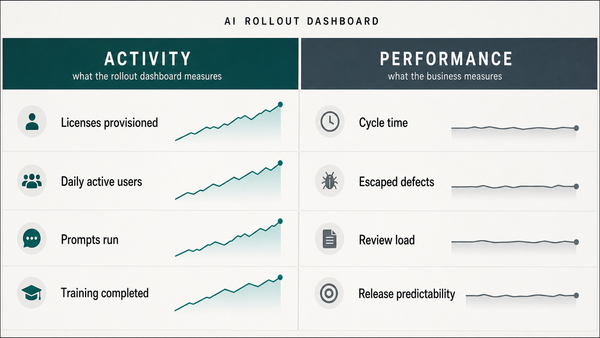
Metrics. Procurement-era AI metrics measure tooling adoption: license utilization, prompts per developer per week, percent of PMs using the AI assistant. On their own, these metrics do not demonstrate delivery impact. The operating-model-era metrics for the same delivery org measure workflow impact: implementation time per story, cycle time, reopened-defect rate, story-scope shift between sprint planning and sprint review, time from prototype to production-grade. These metrics are concrete, comparable across teams, and harder to game than adoption dashboards. They are also harder to instrument, which is why most organizations skip them and report on the license-utilization metrics instead. The dashboard is showing the wrong layer.
Governance. The fifth component is the layer that keeps the previous four controlled, auditable, and aligned with legal and security obligations. Governance is the set of policies, controls, and reporting structures that determine what data can flow where, which use cases are permitted at what level of human oversight, how AI products are evaluated continuously rather than at a single point of release, and how the company demonstrates compliance with regulatory frameworks like the EU AI Act and NIS2. Governance is not a single document. It is a recurring set of decisions that runs through every other component. A delivery organization with redesigned roles, clear decision rights, an updated workflow, and proper metrics, but no governance component, is a delivery organization one incident away from a board-level event.
The same operating-model layer shows up in four contexts, and the contexts are how most companies confuse themselves about scope.

The framework I have just described is built on delivery-team examples because that is the pillar where my own work runs deepest: leading AI-enabled transformation across PM, QA, Dev, BA, and SA roles in the rollouts I work on. The operating-model layer is the same shape, however, in three other contexts a transformation program touches. The shape is the same. The surface treatment is different.
Delivery teams (pillar 1). Role-level redesign, spec-driven development, decision rights for AI-generated artifacts, workflow reordering around the cheap-first-implementation property of AI, workflow-impact metrics rather than license-count metrics, governance over what gets pushed without human review. This is the pillar where the operating-model layer is most visible because delivery has the cleanest measurement loop, and where the components take concrete form as the AI engineering stack.
Business departments (pillar 2). The same layer applies to sales, marketing, HR, operations, and recruitment, but the surface treatments differ. A sales operating model redesigned around AI is not a sales team writing cold emails faster. That is the tooling layer. The operating-model layer for sales asks how the rep's role changes when the model handles research and outbound drafting, who decides what gets sent without review, how the qualification workflow reorders when the cheap step is now lead enrichment rather than discovery, what the dashboards measure other than emails-sent-per-rep, and how customer-data flow is governed. Marketing has the same five questions with different surface specifics. So does HR. So does operations. The pilot-stage problem I see in business departments is almost always a tooling-layer pilot inside an unchanged operating model. The pilot delivers a faster version of the old job, the department head reports a win, the win does not compound at the company level, and the program moves on to the next department.
AI product development (pillar 3). The operating-model layer for building AI products is different from the operating-model layer for using them internally. Here the components specialize. Roles include AI product manager and AI evaluation engineer. Decision rights cover release criteria for non-deterministic outputs. Workflows are eval-driven rather than spec-driven. Metrics include cost-per-call and drift over time alongside the classical product metrics. Governance distinguishes between the company's role as deployer, provider, or GPAI user, and maps the relevant obligations to controls, owners, and review cadence. AI products that do not make it past R&D rarely fail primarily at the model layer. They fail because the company has not installed an operating model for shipping non-deterministic software. The team builds a prototype with the old product-development discipline, hits a wall at the production-grade requirement, and stalls.
Security and governance (pillar 4). The fourth pillar is itself the governance component, expanded into a full operating model of its own. The roles include AI security and Head of AI Governance. Decision rights cover what data can leave the company through which AI tools and which use cases require legal review. Workflows include continuous evaluation of the company's own AI products rather than a single security review at launch. Metrics include exposure surface and incident rate. Governance recursively covers compliance with the EU AI Act, NIS2, and sector rules. Shadow AI is not a tool problem to be solved by buying a DLP scanner for ChatGPT. It is the visible symptom of a missing operating-model layer for AI safety.
Once you can see the operating-model layer, the failure modes become diagnostic rather than mysterious.
The pattern I want CEOs and accountable C-level executives to leave this article with is the ability to name failure modes by which operating-model component is frozen. The same program can be failing in several ways at once, and the failure modes are diagnostic in the sense that each one points to a specific component you can repair without rebuilding the program.
Tools rolled out without role redesign. This is the most common failure mode and the one that produces the felt experience the opening paragraph described. Engineers, PMs, QAs, BAs all have AI tools. None of their roles have been redesigned. Adoption is patchy, the seniors quietly drop the tools, and delivery metrics do not move. The component frozen is roles. The fix is not buying a different tool. The fix is role-level redesign for each function, paired with the tool the function actually needs in the redesigned role.
Pilots run without decision-rights change. A department head runs an AI pilot, reports a win, and the pilot does not propagate. The reason is usually that the pilot worked because the department head personally arbitrated every decision the AI touched. Scaling the pilot would require those decisions to be made by people other than the department head, and there is no decision-rights statement that makes that legal inside the company. The component frozen is decision rights.
Dashboards without workflow metrics. The company reports AI adoption metrics (license utilization, prompts per developer, percent of stories with AI assistance) and feels increasingly confused because the metrics are green and the delivery outcomes are flat. The component frozen is metrics. The dashboard is measuring the tooling layer, not the operating-model layer.
AI products built without governance. The product team ships a Gen AI feature. The feature is in production. The team is unsure whether it would survive a real security review, whether the data inputs are clean, whether the outputs are evaluated continuously, and what would happen if the model's behavior drifted next quarter. The component frozen is governance, and the failure mode is the one most likely to become a board-level incident.
Transformation programs run by procurement. The most expensive failure mode is structural: the transformation program is led by a function whose job is buying tools, and the program inherits the assumptions of that function. The deliverables are vendor selections. The status updates are license counts. The board reviews look at procurement progress. The operating-model layer has no owner, because no function inside the company is structured to own it. This is the failure mode where transformation has not started; it has been re-labeled as a procurement cycle. Naming it is half the fix. The other half is putting the program under an operating role with the authority and the accountability to redesign the five components.
A CEO can audit the operating-model layer of an AI program in a single half-day offsite, and the questions are artifact-level, not opinion-level.

The diagnostic I use to surface the state of the operating-model layer fits inside a half-day session and asks one set of questions per component. The discipline is that every question is artifact-level. "Is your PM team AI-ready?" is the wrong question, because the answer is a self-assessment. "Show me the PM playbook for an AI-assisted story" is the right question, because either the artifact exists or it does not.
Roles. Show me the redesigned role definition for the PM, QA, Dev, BA, and SA functions when AI is genuinely embedded in their day. If you cannot put a one-page redesigned role definition on the table for each of those functions, role-level redesign has not happened, and the team is using AI tools inside the old roles. Show me how each redesigned role is hired against, evaluated against, and promoted against. If the hiring rubric still describes the pre-AI role, the redesign exists on paper only.
Decision rights. Show me the explicit statement of who decides whether AI-generated code, AI-drafted specs, AI-summarized customer interactions, AI-classified support tickets, or AI-generated marketing assets ship without human review, with one-line human review, or with full human review. Show me who owns the review queue. Show me who is named as accountable when the model is wrong. If the answer to any of these is "we'll figure it out," decision rights have not been redesigned for an AI-touched workflow.
Workflows. Show me the workflow diagram for the most common piece of work in each delivery and business function, before and after AI embedding. The before diagram is easy. The after diagram is the one that exposes whether the operating-model layer has been touched. If the after diagram is the before diagram with a model icon stuck in the middle of one step, the workflow has not been redesigned.
Metrics. Show me the dashboard the executive team looks at monthly. If the top-line numbers are license counts, prompt counts, or training hours, the dashboard is measuring tooling. Show me the workflow-impact metrics: cycle time per story, reopened-defect rate, story-scope shift, time from prototype to production-grade, exposure surface for shadow AI. If those metrics are not on the dashboard, they are not being managed.
Governance. Show me the standing list of permitted and non-permitted AI use cases, who decides changes to the list, the continuous-evaluation policy for the company's own AI products, the data-flow map for what employee or customer data passes through which AI tools, and the evidence of how relevant obligations under the EU AI Act, NIS2, and sector rules are mapped to concrete controls, owners, and review processes. Show me the named role accountable for each of these. If any of these is "we have a policy somewhere," governance has not been built into the operating model. It has been promised to it.
Half a day. Five components. One set of artifacts per component. The half-day session is not where the work gets done. It is where the gap gets seen.
Operating-model change is harder than procurement, which is precisely why it is the only thing that produces compounding AI capability.
The implication for a CEO reading this is not flattering and not optional. The reason the AI program has not produced measurable outcomes is rarely that the tools are wrong, the people are wrong, or the strategy is wrong. The reason is that the work of redesigning roles, decision rights, workflows, metrics, and governance is harder than buying tools, takes quarters instead of days, requires authority that procurement does not have, and produces no visible artifact until the new operating model is partially in place. Programs that have not done this work are not slow versions of programs that have. They are different programs, doing different things, producing different outcomes. A company that names the operating-model layer can fix it. A company that does not name it will keep buying tools and wondering, quarter after quarter, why the numbers do not move.
Naming helps here too: I call this lens Shift Harness.
AI Transparency Notice: This article and its accompanying images were created with the assistance of generative AI. The author directed the content, contributed the underlying ideas and analysis, and reviewed the final publication.