AI Transformation Needs Infrastructure
Most executives describe the same moment in almost identical words: we have the tools, the team is using Copilot, but delivery numbers have not moved. What is missing is not tools or talent.
There is a specific moment most executives I work with describe in almost identical words: "We have the tools. The team is using Copilot. But I'm not seeing it in our delivery numbers." It rarely opens a planned conversation. It surfaces twenty minutes in, after the official update on the AI program, when the CEO finally says the thing that has been bothering them.
AI transformation infrastructure is the operating-model layer (policy, tools, training, processes, metrics, and review cadence) that sits underneath AI tool adoption and turns it into a repeatable organizational capability. Without it, adoption stays random.
That moment is not an anomaly. It is a category. Almost every mid-market technology company that committed to AI in 2024 or 2025 reaches it. They have the tools. They have champions. They have a "Center of Excellence" with a Notion page. And the delivery numbers (lead time, cycle time, throughput, change-failure rate) look more or less like they did before. What is missing is not tools, talent, or motivation. What is missing is infrastructure.
In AI-enabled delivery orgs, redesigning how PMs, QAs, developers, solution architects, and business analysts work with AI is what transformation actually requires. The pattern that produces "tools but not in our numbers" is consistent enough to name. Companies install the visible parts of AI adoption (licenses, training events, a Slack channel) and skip the AI operating model components that hold those parts in place. The result is what you would expect from running a delivery org without process: high variance, no compounding, no signal.
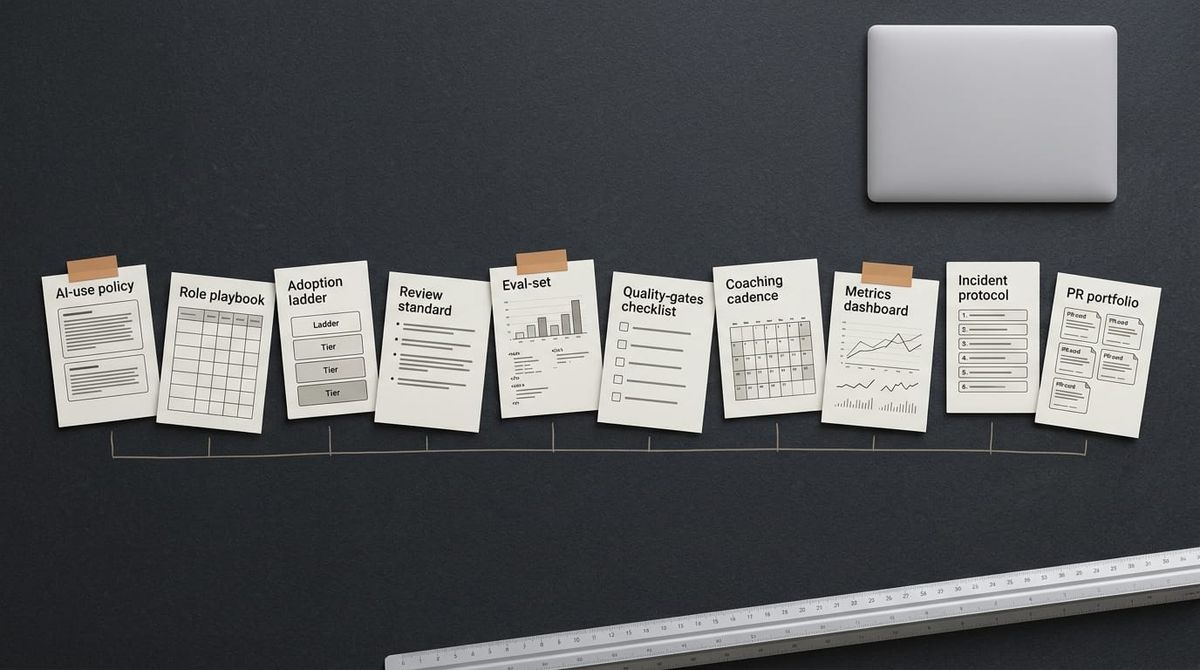
This article walks through the ten components a delivery organization has to install before AI usage becomes a system. Each one is small. None is hard in isolation. The difficulty is that they are load-bearing together. If you skip Component 1, Component 8 produces noise. If you skip Component 6, Component 3 produces risk. The whole system breaks at its weakest piece.
Why adoption stays random when the operating-model layer is missing
A useful mental model: AI tool rollout is a procurement event. AI transformation is an operating-model change. Procurement events end. Operating-model changes are systems, and systems need infrastructure to operate. When a delivery org buys Copilot, Cursor, or Claude Code seats, what actually changed at the operating-model layer? Usually nothing. The PM still writes the same kind of ticket. The QA still defines the same kind of test plan. The developer reads code review the same way. The reviewer applies the same gates. The metrics dashboard still tracks the same things.
In that environment, AI usage is a personal habit. Some engineers experiment. Some don't. Some QAs draft tests with AI and verify them carefully. Some don't draft anything. The senior people drop the tools because the marginal value of an autocomplete suggestion on code they already know is low. The junior people use it heavily but ship work the senior people then have to rework. None of this shows up in delivery metrics because the underlying delivery process (what gets written, reviewed, tested, and shipped, and against what standard) has not changed.
The pattern is consistent enough across the engagements I have run that I would now bet on it before walking into a new client. Tool licenses purchased. Training event held. Adoption claimed at the leadership offsite. Six months later, delivery metrics flat. The CEO is frustrated, the CTO is defensive, the head of delivery is skeptical. None of them are wrong. The system was never built.
What follows is the system. Ten components. Each one carries three things: what it is concretely, the failure mode it prevents, and what good looks like in practice.
Component 1 - A responsible AI policy that has decision rights
Every delivery org needs a written policy that answers three questions. What data may be sent to which AI systems? What AI outputs may go to which downstream consumers? Who decides when those rules change? Most companies have "an AI policy" that answers none of these. It is usually a one-page acceptable-use document that says employees should be careful and not paste customer data into ChatGPT. That is not a policy. That is a wish.
A real responsible AI policy at enterprise scale specifies data classes (public, internal, customer, regulated), permitted AI systems per data class (the approved-tool matrix in Component 2 inherits from this), permitted downstream uses of AI output (does AI-generated code need human sign-off before merge? does an AI-drafted customer email need review before send?), and decision rights: who can grant exceptions and who has to approve a change to the policy itself. The point is not the document. The point is that when an engineer asks "can I paste this snippet into the new model from vendor X" the answer is not a guess.
The failure mode this prevents is the one every CISO is now living through: shadow AI. Employees who do not have a clear sanctioned path will create an unsanctioned one. They will use their personal accounts. They will paste data into consumer tools. They will hit the API key of whichever model their browser extension makes easiest. Without a policy that has decision rights, there is no audit trail, no incident process, no consistent answer when legal asks what data is leaving the company. Good looks like this: every engineer can name the policy in one sentence, knows where to find the data-class table, and knows who to ask when something is unclear. Bad looks like this: the policy exists, no one has read it, and the answer to "is this allowed" is decided per-person, per-vendor, per-day.
Component 2 - An approved tool matrix, by role and data class
This component is operational. It is a single table that lists every AI tool the company has sanctioned, the data classes it can be used with, and the roles authorized to use it. Most companies do not have this table. They have a procurement list (every license the finance team has paid for) and an opinion about which tools are "the good ones," and the two do not match.
The approved tool matrix is the policy made operational. It typically lives in three columns. The first names the tool and its deployment mode (vendor SaaS, self-hosted, on-prem). The second names the data class it is approved for, anchored to Component 1's data-class table. The third names the roles authorized to use it. A row might read: "Claude Code (vendor SaaS, with the enterprise data control plane enabled), internal code and internal documentation, Developers, QAs, Solution Architects." A different row for the same product, deployed differently, would have a different scope.
The failure mode this prevents is tool sprawl with no defensible perimeter. If the procurement list has thirty tools and the engineering team has only ever heard about five of them, you have an unmanaged surface: every other tool is being used by someone, somewhere, for something, and the security team has no view into it. You also have an unmanageable training problem. You cannot write role-based training for tools the org has not committed to. Good looks like this: the matrix is short (under twenty rows for most mid-market companies), reviewed quarterly, and visible to everyone, not buried in a security wiki. When a new tool comes in, the question is whether it earns a row in the matrix, not whether someone is allowed to try it.
Component 3 - Role-based adoption levels: the Step 0 → Step 4 ladder
This component is the one most companies skip entirely, and it is the one that determines whether anything else works. AI adoption is not a binary. It is not "are people using the tools." It is a behavioral ladder, role by role. Without a shared ladder, leadership has no way to talk about progress that is not just license counts.

The ladder I use, refined across multiple delivery functions, has five steps. The labels are deliberately ordinal, not jargon:
- Step 0 - Has not started. The role has either no access to AI tools or no use of them. Sometimes that is a deliberate choice for that role (a security analyst on a regulated workload), but more often it is a gap. Step 0 is a category, not an insult.
- Step 1 - AI for narrow specific tasks. The role uses AI for clearly bounded sub-tasks: a developer accepts Copilot autocomplete suggestions inside a function they are already writing, a QA asks an AI to draft a meeting summary, a PM asks for an executive summary of a Confluence page. The work product is still primarily human-produced. The AI accelerates micro-tasks, not units of work.
- Step 2 - AI for whole units of work, with review. The role uses AI to produce an entire deliverable (a function, a test plan, a draft spec, a status update, a refactor) and then reviews it carefully before it ships. The unit of work is AI-produced; the unit of trust is human-applied. A developer asks the agent to implement a feature and reviews it before merge. A QA writes a full set of test cases with AI assistance, then verifies. A BA generates a discovery report from a transcript, then audits the citations.
- Step 3 - AI-first by default. The role's standard mode of working is AI-assisted. Specs are AI-drafted before they are human-revised. Plans, decompositions, and reviews are AI-assisted by default. The human role shifts from producer to orchestrator and reviewer. Quality gates have been calibrated for AI-generated work, not just adapted from human-generated work.
- Step 4 - The role is redesigned around AI. The workflow itself is built for AI participation. New patterns emerge that did not exist before: spec-driven development for engineers, AI-led discovery for business analysts, AI-assisted exploratory testing for QA. The role is not "the old role plus AI." It is a new role with new responsibilities, new outputs, and new metrics.
The failure mode the ladder prevents is the one every leadership team I have worked with has run into: confusing license counts with adoption. A team at Step 1 across the board can still report "100% of engineers are using Copilot." A team at Step 3 in development but Step 0 in QA has a quality risk that license counts cannot see. The ladder also makes the conversation honest. Senior engineers who are "at Step 1" (using AI for narrow tasks but not for whole units of work) are not failing; they are at Step 1, and the question is what would move them to Step 2. Good looks like this: each role has a defined target Step for the current quarter (not the same Step for all roles; QA's target may be Step 2 while Dev's target is Step 3), each role has named what "moving to the next Step" requires, and progress is reviewed at the same cadence as any other organizational change.
Component 4 - Training materials per role, not a generic AI deck
This component gets the most lip service and the least real investment. Training materials specific to each delivery role. The default move at most companies is a one-hour "Intro to AI for engineers" session, followed by an offer of optional self-study resources. That is not training. That is awareness.
Role-based AI training means a defined playbook per role (Dev, QA, PM, SA, BA, DevOps) that names what tasks in this role are AI-appropriate, what tasks are not, what the role's target Step is for this quarter, what specific techniques move the role to the next Step (prompting patterns, agent workflows, review rubrics), and where to find worked examples done by senior people in the role. A developer's playbook covers code review of AI-generated code, prompt patterns for refactors and migrations, and the team's standards for when to accept versus reject agent output. A QA's playbook covers AI-assisted test case generation, the verification cadence for AI-drafted tests, and how to detect over-fitting in AI-generated coverage. A BA's playbook covers AI-assisted discovery, citation verification, and how to handle AI hallucinations in domain-specific terms.
The failure mode this prevents is the most predictable failure mode in the entire system: adoption regressing to whoever was already curious. Without per-role training, the people who would have used AI anyway use it, and the people who would not have, do not. The "AI initiative" becomes a survey of pre-existing curiosity. Good looks like this: every role has a named playbook owner, the playbooks are versioned, and new hires receive their role's playbook in their first week with the same weight as the engineering onboarding doc.
Component 5 - A spec-driven development starter kit
Engineers underestimate this component and product leaders forget it exists. Spec-driven development with AI is the discipline of writing the contract before you write the implementation, then letting AI implement against the contract while you verify against it. Without specs, AI-assisted development is uncontrolled delegation. With specs, it is a contract you can verify against.
A starter kit, in practice, is small. It contains a one-page spec template (problem statement, acceptance criteria, out-of-scope, test cases, observability hooks), three to five worked examples at different scales (a single-function spec, a feature spec, a service-level spec), a review rubric for AI-generated implementations against the spec, and a set of prompting patterns that route the AI through "draft the spec," "challenge the spec," "implement against the spec," "verify the implementation against the spec." None of these artifacts are research. They are operationalizations of work the senior people on the team already do informally. The kit makes them shareable.
The failure mode this prevents is AI-assisted code that passes tests, looks reasonable, and quietly drifts from intent. When an engineer prompts an agent for "a function that does X" without a spec, the agent invents the contract from the function name. Six months later, the team has a layer of functions whose contracts were inferred by a language model. They will reread fine. They will not refactor well. They will not survive a model upgrade. Good looks like this: every non-trivial change starts with a spec, the spec is reviewed before the implementation, and AI is asked to challenge the spec before it implements it. Bad looks like this: the team treats specs as bureaucracy and lets the agent decide what to build.
Component 6 - A quality-gates checklist, calibrated tighter under AI assistance
This is where most companies go wrong in the opposite direction from where they think. AI quality gates under AI-assisted development have to be calibrated tighter, not looser. The instinct is the opposite: "the AI helps us go faster, so we can relax the review process." That is the instinct that produces production incidents.
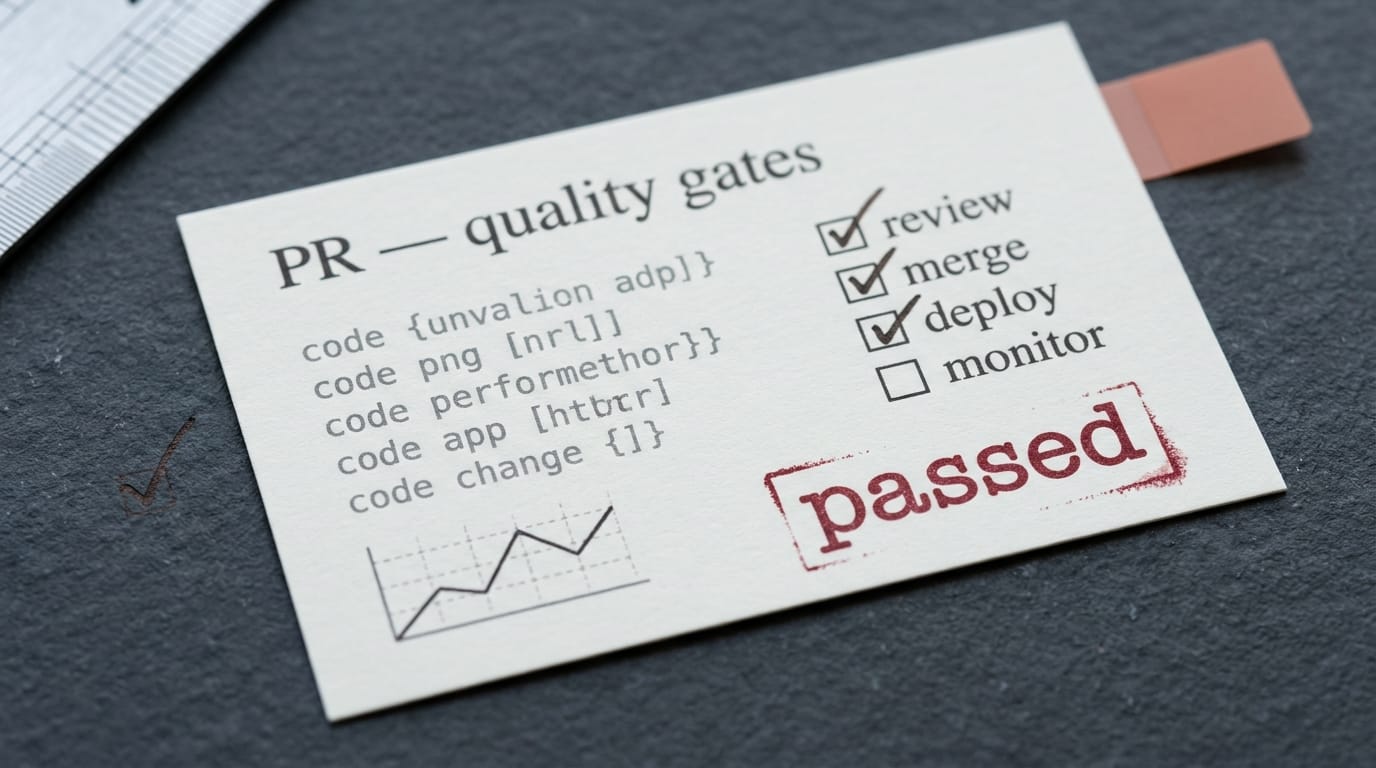
A quality-gates checklist for AI-assisted work names four sets of checks. What is verified before code review (does the implementation match the spec from Component 5; does it match the team's style and conventions; does it have tests at the agreed coverage). What is verified at code review (does the reviewer understand every line; does the reviewer agree that the change is the right change, not just a change that works; do the tests test the actual contract). What is verified before merge (CI passes; observability hooks are in place; the spec and the implementation are in sync). What is verified before deploy (release notes accurate; rollback plan exists; on-call is aware). For non-code work like specs, test plans, customer-facing copy, and ops runbooks, the equivalent set of gates exists.
The failure mode this prevents is the one that makes the news: AI-generated regressions reaching production because the team trusted the model's confidence as a signal of correctness. AI generates code that looks right. That is its job. The reviewer's job is to verify that it is right, not just that it looks right. If anything, the volume of AI-generated change makes it easier for things to slip past a reviewer who is skimming. The gates have to be visible, enforced, and the same for AI-generated and human-generated work. Good looks like this: every team can articulate its gates in one paragraph, the gates are enforced by tooling where possible (CI, pre-merge checks, observability requirements), and the team has explicit signals for when the gates have been relaxed and why. Bad looks like this: the gates exist in a wiki, no one reads them, and "the AI wrote it" becomes an implicit reason for lighter review.
Component 7 - An AI Adoption Evaluation skill and cadence
This component turns the Step 0 → Step 4 ladder from a poster into a measurement. Without a repeatable evaluation, claims about adoption are unfalsifiable. With an evaluation, the org can see where each role actually is, and where each individual is, not where they say they are.
The evaluation, in practice, is a structured assessment per role, run on a quarterly cadence by default. For a developer, it samples a few recent merge requests and asks: were these AI-assisted? at what Step level (narrow autocomplete, whole-unit-of-work-with-review, AI-first, or workflow-redesigned)? was the spec-driven discipline applied? did the quality gates fire correctly? For a QA, it samples recent test plans and asks the same kind of structured questions, calibrated to QA work. The evaluation is light enough to run quarterly without becoming bureaucracy, and structured enough that two evaluators would reach the same Step rating on the same person.
The failure mode this prevents is one I have watched destroy AI initiatives more than once: adoption claims that are louder than reality. Without an evaluation, the loudest voice in the room is the person who is most enthusiastic about AI, which is rarely the person doing the most production work with it. With an evaluation, the conversation shifts from "we're at Step 3 across engineering" to "Dev is at Step 2.5, QA is at Step 1.5, SA is at Step 3, BA is at Step 2." That second sentence is actionable. The first one is a slogan. Good looks like this: the evaluation is owned by a small team (often the AI-transformation leader plus two senior practitioners per role), the results are aggregated and reviewed, and individuals get private feedback on where they sit and what would move them. Bad looks like this: leadership asks once a quarter how AI adoption is going and the answer is whatever the most enthusiastic person says.
Component 8 - A metrics dashboard that measures transformation, not procurement
This is the dashboard everyone thinks they have and almost no one does. The dashboard most companies have built measures procurement: licenses purchased, logins per week, prompts per day, cost per seat. Those numbers are easy to collect and almost useless for understanding whether AI transformation is working. They tell you what the finance team paid for. They do not tell you whether the operating model has changed.
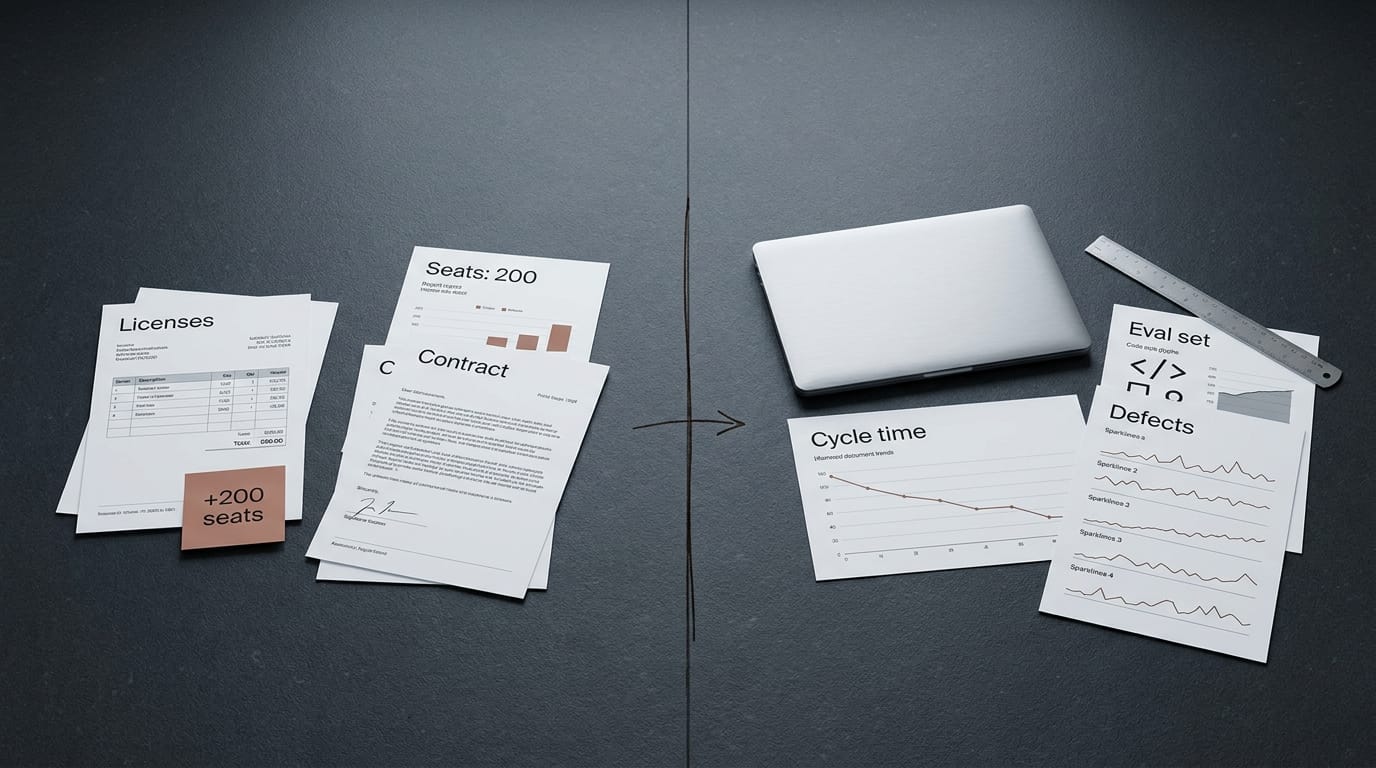
An AI adoption metrics dashboard that actually measures transformation has a minimum set of five things. First, lead time and cycle time per delivery team. These are the same metrics you used before AI, because the question is whether AI changed them. Second, change-failure rate, calibrated for the volume of change (more change can be net-positive even at a slightly higher failure rate, but only if you can see both numbers). Third, AI-assisted-work share: what fraction of merged code, drafted specs, and produced test plans had material AI involvement, by role. Fourth, role-level Step distribution from Component 7's evaluation, refreshed quarterly. Fifth, an exception register of incidents where AI-assisted work caused a regression, escaped a gate, or triggered a policy review.
The procurement metrics (licenses, logins, prompts/day) still have a place. They belong in a separate, much smaller frame: the operational health of the AI program, reported alongside cost. They should never be the headline metric in an executive update. Good looks like this: the executive view leads with delivery and Step distribution; the operational view leads with cost and usage; the two are visibly distinct, and no one confuses one for the other. Bad looks like this: the AI dashboard shows "10,000 prompts per day this week, up 12% week-over-week" and the leadership team mistakes that for a signal that anything has changed.
Component 9 - An internal support channel where learning compounds
This component looks soft and is in fact load-bearing. AI usage produces hundreds of small judgment calls per week per practitioner: which prompt pattern works for this kind of refactor, which agent works for this kind of discovery task, what does the model do when you push back on its first answer. Without a place to surface those judgments, learning happens in pockets and never compounds. With a place, the org gets a learning curve.
What works in practice is a single, named, visible channel (usually Slack or Teams) owned by the AI-transformation team and visibly read by senior practitioners across roles. The channel has a few simple norms: questions get answers within a working day, "the model said X, was it right" posts are welcome, sharing a prompt or workflow that worked is welcome, and there are no stupid questions. Periodically, recurring patterns get lifted out of the channel into the role-based training playbooks from Component 4. The channel is the input layer for organizational learning.
The failure mode this prevents is invisible until you measure it. Without a channel, the senior people who figure out a new prompting pattern keep it to themselves, the junior people repeat the same mistakes the senior people already learned past, and the AI-transformation team has no view into what is actually working. With a channel, you can see the questions, you can see the answers, you can see which questions repeat. The questions that repeat are the input to the next iteration of training. Good looks like this: the channel is busy, every role is represented, senior people post regularly, and the AI-transformation team reviews it weekly and lifts patterns into the playbooks. Bad looks like this: a Slack channel that nobody posts in, with three pinned messages from January.
Component 10 - An adoption review cadence that closes the loop
This final component is what turns components 1 through 9 from a snapshot into a system. AI adoption review cadence is a regular meeting, monthly or quarterly, where the evaluation data, the metrics dashboard, the exception register, the field reports from the internal support channel, and the policy questions are reviewed together, and decisions feed back into the policy, the tool matrix, the training playbooks, and the gates.
The agenda for a useful review is short. What does the Step distribution look like this quarter compared to last quarter, by role. What changed in the delivery metrics, and is the change attributable to AI or to something else (releases, hiring, scope shifts). What incidents occurred where AI-assisted work created risk, and what does the exception register suggest about gaps in the gates or the policy. What questions are recurring in the support channel, and what does that suggest about gaps in the training. What policy or tool-matrix changes are proposed, and what is the decision. The meeting ends with named owners and named dates.
The failure mode this prevents is the most common one in the entire system: a beautifully designed operating model that ossifies. Components 1 through 9 are point-in-time artifacts. Without a cadence that revisits them, the policy will go stale, the tool matrix will fall out of sync with what people are actually using, the training will lag the techniques the senior people are using, and the gates will not catch the new failure modes that emerge as adoption deepens. Good looks like this: the review happens on the calendar, on the same cadence as a quarterly business review, with the AI-transformation lead presenting, the heads of delivery, security, and at least one C-level present, and the meeting produces decisions, not just status. Bad looks like this: the review is scheduled, then quietly skipped for a quarter, then reanimated when something breaks.
The system, not the component
Walking through the ten components in order makes them look modular. They are not. They are load-bearing together, and the operating model breaks at its weakest piece.
Skip Component 1 (policy) and Component 2 (tool matrix) becomes a procurement list. There is no principle that says which tools belong on it. Skip Component 3 (the Step ladder) and Components 4 (training) and 7 (evaluation) lose their target. You cannot train someone toward a Step that does not exist, and you cannot evaluate progress toward a level that has no definition. Skip Component 5 (SDD) and Component 6 (gates) is firing into the dark. There is no contract to verify against. Skip Component 7 (evaluation) and Component 8 (metrics) becomes a dashboard of vibes. There is no role-level signal to populate it with. Skip Component 9 (support channel) and Component 4 (training) freezes. There is no input layer for the next iteration. Skip Component 10 (review cadence) and the whole system ossifies. Last year's operating model running against this year's reality.
The common failure mode I see is companies installing three or four of these components, declaring victory, and then being puzzled when adoption regresses. The components do not regress, because the components are fine. They regress because the system was never finished. AI usage finds the gaps the same way water finds the cracks.
What this means for your organization
If you have read this far and are recognizing your own company in the diagnostic (tools in place, training events held, dashboard showing license counts, delivery metrics flat), the move is not to spin up a new program. The move is to inventory what you have against the ten components and identify the gaps. Some of them will already exist in adjacent functions: a security team that has a policy framework, a delivery org with a metrics dashboard, an L&D team that knows how to build role-based playbooks. Most of them will be partial. A few will be entirely missing.
This is not a 90-day program. The first three components (policy, tool matrix, the Step ladder) can be drafted in a quarter. The next three (training, SDD starter kit, quality gates) take a quarter to draft and another to operationalize. Components 7 through 10 (evaluation, metrics, support channel, review cadence) are not built; they are run, and they earn their value over many quarters as the data accumulates and the decisions compound. The companies that get measurable AI delivery impact two or three years out are the ones that started, quietly, on this work two or three years ago. The ones still chasing "tools but not in our numbers" are the ones that mistook the tools for the system.
AI transformation is not a feature. It is an operating-model change. Operating-model changes need infrastructure to operate. Build the infrastructure, and adoption stops being random. Skip it, and the most expensive thing your company has bought this decade will sit on top of a delivery process that cannot tell whether it is helping.
AI Transparency Notice: This article and its accompanying images were created with the assistance of generative AI. The author directed the content, contributed the underlying ideas and analysis, and reviewed the final publication.