The AI Business Analyst's Real Job Moved Upstream, Into Business-Aligned, Testable Requirements
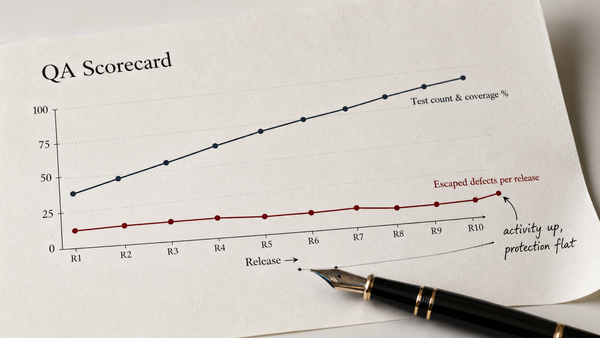
A business analysis function turns on AI story generation. Story count climbs, spec volume rises, time-to-draft falls. The one number that does not move is requirement-related rework. That is not a tooling problem. The BA role was never redesigned for a world where authoring is free.
A business analysis function turns on AI story generation. Within a sprint or two, story count climbs, spec volume rises, and time-to-draft falls. Every number on the activity dashboard moves in the right direction. The one number that does not move is the one the delivery team is accountable for: requirement-related rework, sprint reopens, defects traced back to a requirement that was ambiguous when it was written. You approved the AI tooling. The BAs are faster. Delivery looks the same. The gap between those two facts is the whole problem, and it is not a tooling problem.
Quick answer: what an AI business analyst actually does differently
An AI business analyst is not a BA who writes requirements faster. The fast part, authoring user stories and acceptance criteria from discovery notes, is the part AI commoditized first, which means it stopped being where the value lives. The scarce, role-defining skill is now analysis design: deciding what is worth building in the first place, and what "testable" and "complete" mean for this specific product once it is. That system runs more than one gate: a business-fit check that asks whether a requirement should exist before anyone writes it, a requirements quality gate that reads each story for testability before sprint commitment, and a multi-model review that checks the work the first model produced. Authoring requirements faster is not analyzing better. They are different jobs, and AI just made the difference impossible to hide.
More user stories is not more analysis. It is more typing.
Here is the trap built into the activity dashboard. Story volume measures activity. Requirement-caused rework measures performance. For years those two numbers tracked together, and it was reasonable to read one as a proxy for the other. They tracked together for a specific reason: a human decided what each story had to specify before they wrote it, and the deciding was the expensive, slow part while the writing was cheap and fast. Automate the writing and leave the deciding untouched, and the two numbers come apart. Authoring goes to near-zero cost. Analysis design stays exactly as hard as it was.
This is the same split a delivery org already learned in testing. Generating test cases is one job. Deciding which behaviors are worth testing, what "done" means for a feature, which ambiguities will cost a sprint if they reach an engineer unresolved, that is a different job, and it is the one that protects quality. The same line runs through business analysis. Authoring a requirement, turning a discovery transcript into a clean Given/When/Then story, is the cheap job AI does well. Analysis design, deciding which requirements actually matter and what a complete one looks like for this product, is the expensive job that decides whether delivery improves.
So the self-diagnostic for your own dashboard is simple. If story count is climbing and requirement-related rework is flat, the AI rollout automated authoring and left analysis design untouched. The function is producing more artifacts and the same amount of analysis. Nobody redesigned the role. They bolted a faster authoring tool onto a role still measured on output volume, and the volume went up exactly as advertised, attached to none of the quality the volume was supposed to signal.
The bottleneck moved from headcount to standards.
There used to be a planning-cycle conversation that asked for another business analyst. When requirement throughput was capped by analyst-hours, the ask was rational: more analysts, more requirements written, more of the discovery backlog cleared. AI made analyst-hours a non-constraint for the authoring layer. A function can now generate ten user stories a minute. So "we need more BA capacity" buys almost nothing, because the part that capacity used to buy, raw authoring, is the part that went to near-zero cost.
What is left is the constraint that headcount was quietly compensating for the whole time. Nobody owns the answer to a deceptively basic question: what should a complete, testable requirement look like for this product? When you had a queue of analysts each applying their own judgment, the inconsistency was diffuse and survivable. When you have an agent generating stories at volume against no shared standard, the inconsistency scales with the volume, and it surfaces downstream as three engineers building three interpretations of the same ambiguous story.
This is what reframes the role. The AI-enabled business analyst is not a document producer with a faster keyboard. The fitting title is analysis-system architect. The architect's output is not stories. It is the standard the agents follow, the rules that define a complete requirement for this domain, the quality gate that enforces them. The stories are downstream of that work, and an agent writes them.
There is a CTO version of this, and it is the more useful one for the person funding the function. When the report comes back that the BAs are using AI and delivery has not improved, the reflexive response is a tooling review: are they on the right AI requirements tool, do they need a better one, is the integration wrong. That is the wrong question. The right question is about standards and ownership. Who owns what a good requirement means for this product, do they have the authority to enforce it, and do they have the time to design the standard instead of spending their day authoring stories against a standard that does not exist? The answer is almost always that no one owns it, because the role was never redesigned to make that someone's job.
Before a requirement is testable, it has to be worth building.
There is a gate upstream of the testability gate, and AI makes it matter more, not less. A requirement can be perfectly testable, with clean Given/When/Then criteria a machine can check, and still be the wrong requirement. Testability tells you whether the thing will be built correctly. It says nothing about whether the thing is worth building at all. Those are different questions, and the second one is the one AI quietly makes easier to skip.
Here is the trap. AI can turn weak discovery into polished requirements. Feed it a thin, half-understood problem and it returns a clean, well-structured, testable specification, because formalizing is exactly what it does well; it is the same engine that spec-driven development for AI-assisted teams runs on. The polish is real and the structure is real, and neither has any connection to whether the underlying problem was worth solving. A function generating ten testable stories a minute against a misread problem is just producing failure faster, with better formatting.
So the redesigned role carries a second gate, and it runs before the testability one. Call it business fit, or outcome alignment. It checks the things a testable-but-wrong requirement sails straight past.
| Angle | What it checks |
|---|---|
| Business problem fit | What real business problem does this requirement solve? |
| Outcome traceability | Which metric, KPI, cost, risk, or user behavior should change? |
| Stakeholder alignment | Who agrees, who disagrees, and what trade-off was accepted? |
| Assumption validation | What must be true for this requirement to be valuable? |
| Solution challenge | Are we building the requested feature, or solving the underlying problem? |
AI changes how cheaply two of those get answered. Stakeholder alignment and the solution challenge used to wait on a build: you argued over a document, committed engineering time, and found out at the demo that two departments had pictured different things. A BA can now stand up a clickable prototype in an afternoon, without waiting on a developer, and put the actual interaction in front of the people who have to agree on it. Disagreement that a written requirement hides surfaces in minutes when someone clicks the wrong button and says that is not what I meant. The prototype is an alignment instrument, not a deliverable, and used that way it validates assumptions and forces the solution-versus-symptom question while changing the answer is still cheap.
The caution travels with the tool. A clickable prototype is as capable of looking right and being wrong as a testable requirement is. It moves fast, it demos well, and it can launder a misread problem into something that feels validated because it was clickable. A prototype answers whether people agree on this interaction. It does not answer whether this should exist. That second question stays where it was, with a human who owns the outcome.
This is why the job is not testable requirements. It is business-aligned, testable requirements, in that order. Testability is the second gate, and the QA AI playbook covers what happens once a requirement crosses it. Business fit is the first, and it is the one AI's fluency makes easiest to lose.
Quality moves left, into the requirement, before sprint commitment.
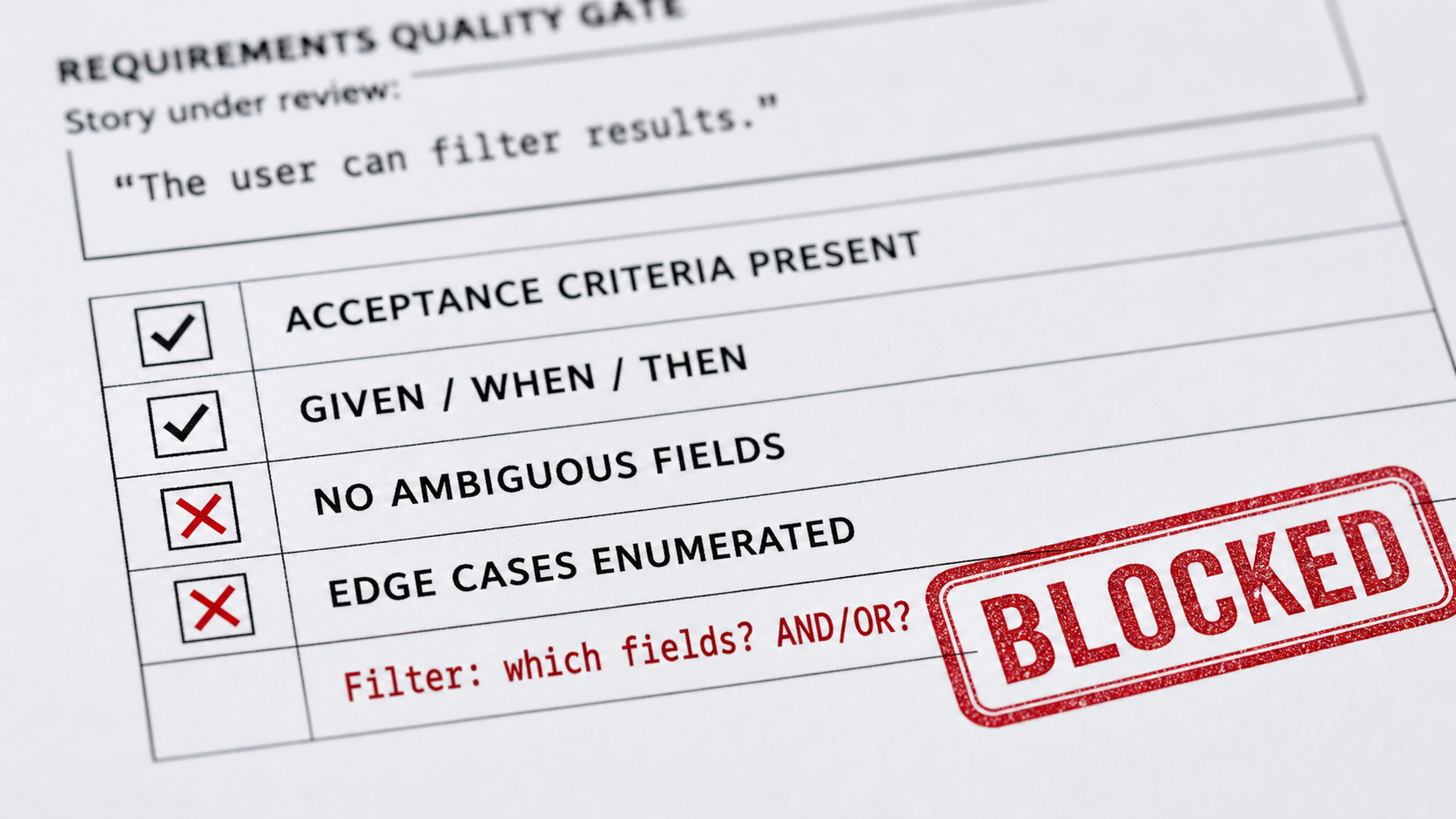
The highest-leverage place to put AI in business analysis is not authoring. It is a requirements quality gate that runs before a story is committed to a sprint. This is the single move with the largest effect on the rework number, and it is the one almost no AI-for-BA discussion reaches for, because it points the tool upstream of the artifact instead of at it.
The mechanism is an old one from software economics, and it is worth stating carefully, because the usual version of it is folklore. The widely repeated figure, a production defect costing about a hundred times what the same defect would cost caught in requirements, traces to an internal IBM training program, not a published study, and no one has been able to find the original data. Treat the precise multiplier as unsupported. The direction, though, is not in dispute: NIST's work on the economics of software testing and Capers Jones's data across thousands of projects both show the cost of fixing a defect climbing sharply with every phase it survives undetected, even as the exact ratio swings widely by project and defect type. The operational interpretation is the part that matters here. A requirement that is ambiguous when it is written, and stays ambiguous through sprint planning, becomes a defect that is discovered in code review, in QA, or in production, where fixing it costs a multiple of what it would have cost to catch the ambiguity while it was still a sentence in a ticket.
Reading every story for testability was always the right practice. It was also always too slow to run consistently by hand, so it got done for the high-stakes features and skipped for the rest, which is exactly the inconsistency that produces the long tail of requirement-caused rework. An agent does not get tired and does not skip the boring stories, which fixes the coverage half of the problem: every story gets read, not just the high-stakes ones. It does not fix the other half. The agent has systematic blind spots and tends to miss the same classes of issue every time, so it surfaces much of what a careful analyst would catch (ambiguities, missing acceptance criteria, untestable statements, implicit assumptions, conflicting business rules) but not all of it. It raises the floor on consistency. It does not replace the reviewer's judgment, and a human still has to backstop the cases the model is structurally blind to.
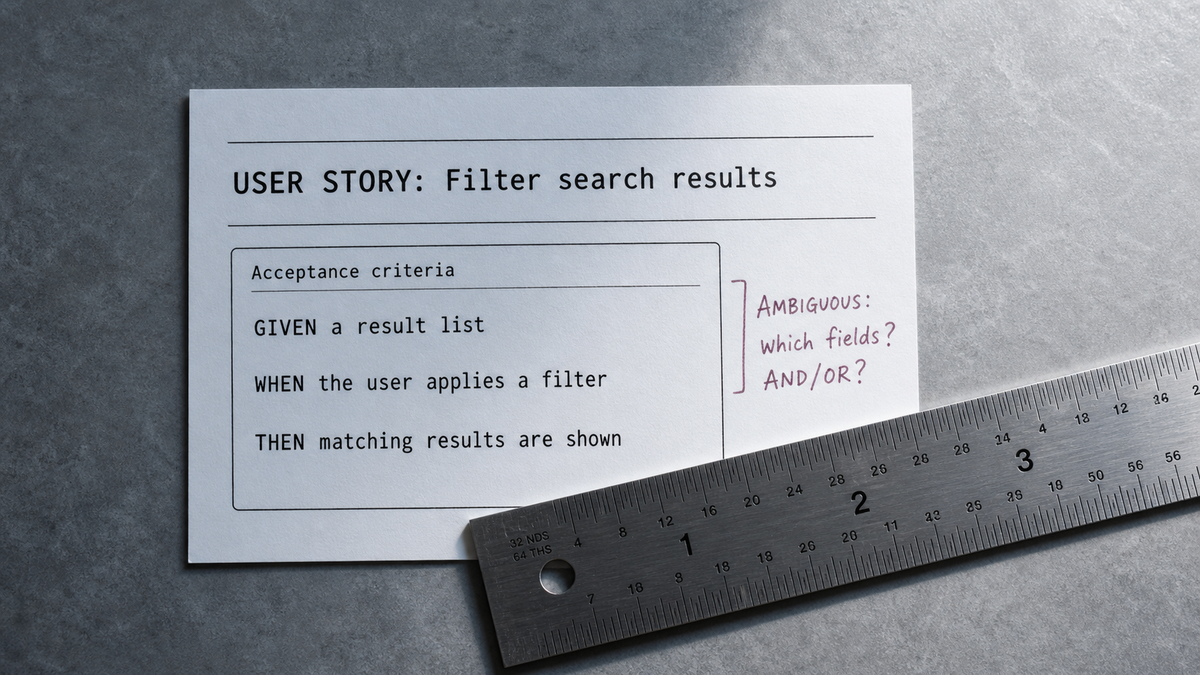
Take a requirement that passes a casual read. "The user can filter results." As written, it is untestable. Filter by which fields. What happens when the filter returns no matches. Does the filter persist across sessions, or reset on reload. Can filters combine, and if so with AND or OR semantics. None of that is in the sentence, and all of it is a decision someone will make, either deliberately at requirements time or accidentally at implementation time when an engineer picks whatever is easiest to build. A requirements quality gate catches the incompleteness while it is still cheap to fix, when the requirement is a sentence, not a shipped behavior three people have already built against three different guesses.
This is the clearest single signal that the BA role moved upstream. The old version of the job was clarifying requirements after the fact: the BA who gets pulled into the standup because three engineers built three interpretations and someone has to adjudicate which one matches the intent. The redesigned version makes the work testable at the start, so the adjudication never has to happen. This is what a requirements quality gate does: a validation step that checks each story for completeness and can block sign-off if the story lacks Given/When/Then. A requirement is not documentation. It is a contract a machine can check, and the gate is what enforces the contract before the contract goes to engineering.
Story and spec generation from discovery is table stakes now, not a senior skill.
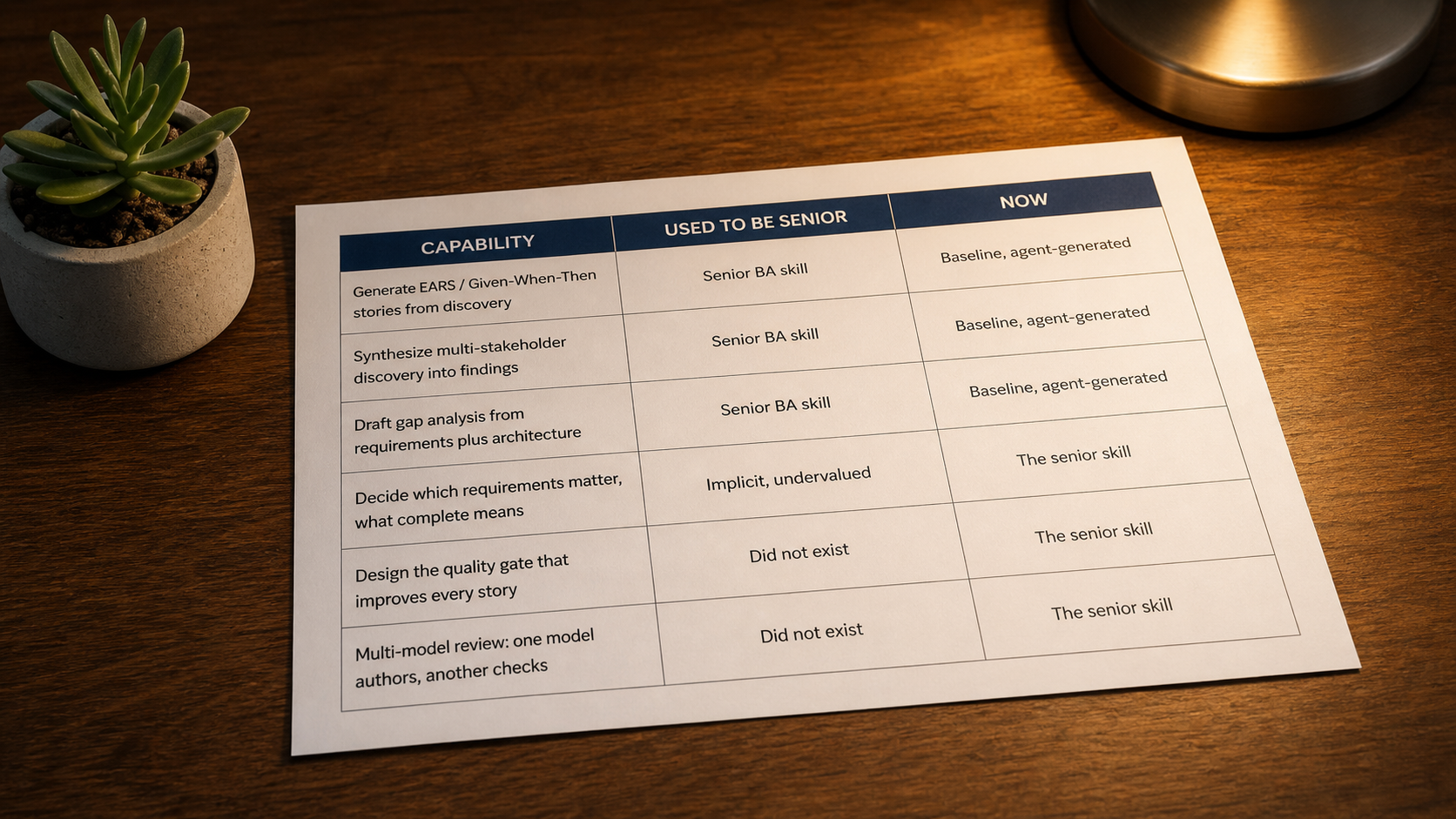
Two capabilities used to mark a senior business analyst. Generating well-formed requirements, EARS-format or Given/When/Then, from raw discovery transcripts. And synthesizing several stakeholder interviews into a single set of consolidated findings without losing the contradictions between them. A few years ago, doing both well was a differentiator. It is now baseline.
Agentic tools do both well enough that the capability no longer separates anyone. Claude Code and Codex are the ones I reach for; the point is not the specific tool but that the category exists and is good enough to make these tasks routine. The generated output is not perfect. It misses cross-system data flows that were never stated in the transcript, it defaults to generic role names where the domain has specific ones, it formalizes what the discovery material said and stays blind to what it left out. But it exercises the real discovery material and produces a reviewable draft in minutes, and the gaps it leaves are the gaps a reviewer should be looking at anyway.
The output also improves on its own as the patterns get codified. This is the compounding loop that earns the redesign: plan the analysis approach, delegate the authoring to the agent, assess what it produced, codify the recurring corrections into the agent's rules and context files so the next draft starts from a higher floor. The agent that knows this product's domain vocabulary, its recurring edge cases, its house format for acceptance criteria, produces a materially better first draft than a generic one, and it got there by absorbing the corrections a senior analyst made the first ten times.
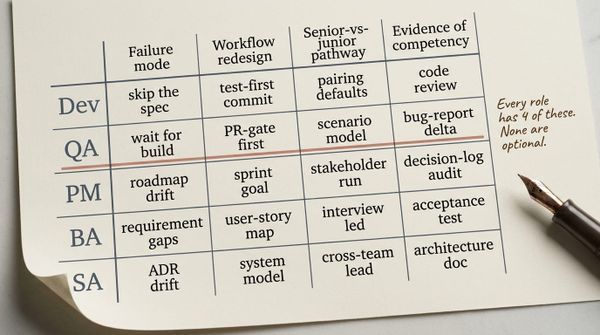
Which means seniority in business analysis is no longer defined by who writes the cleanest user story. It is defined by analysis-design judgment, and the line between what used to mark a senior BA and what marks one now has moved. The same shift is playing out across every delivery role in role-based AI playbooks for delivery teams.
| Capability | Used to be senior | Now |
|---|---|---|
| Generating EARS / Given-When-Then stories from discovery transcripts | Senior BA skill | Baseline, agent-generated |
| Synthesizing multi-stakeholder discovery into consolidated findings | Senior BA skill | Baseline, agent-generated |
| Drafting gap analysis or a proposal from requirements plus architecture | Senior BA skill | Assisted draft, still needs heavy human synthesis |
| Deciding which requirements matter and what "complete" means | Implicit, undervalued | The senior skill |
| Designing the quality gate that makes every generated story better | Did not exist | The senior skill |
| Multi-model review: one model authors, a different model checks testability | Did not exist | The senior skill |
One row deserves a caveat. Gap analysis and proposal drafting are further from solved than story generation is, because they lean on cross-system context an agent rarely has clean access to. The honest reading of that row is assisted draft, not finished artifact. The bottom three rows did not exist as named practices a few years ago. The top three were the marks of seniority. The whole table is the role redesign in one frame: the work that used to certify a senior analyst dropped to the floor, and the work that now certifies one used to be invisible.
A different model should check the requirements the first one wrote.

There is a failure mode in single-model analysis that is easy to miss because the output looks finished. A model generates a requirement, then validates its own work, and the validation passes, because the model that wrote the requirement is the worst possible reviewer of it. It is biased toward the gaps it created. The same reasoning that produced the missing edge case is the reasoning that fails to notice the edge case is missing. A confident, fluent, wrong requirement sails through self-review and lands in a sprint.
The designed practice that closes this gap is multi-model analysis, and it is the point where the BA is no longer just using AI but architecting how AI does the analysis. One model generates the requirements from discovery. A different model, ideally a different model family, reviews them with a specific brief: find the missing edge cases, the ambiguous acceptance criteria, the conflicting business rules, the untestable statements, the implicit assumptions the first model treated as obvious. Concretely, Claude Opus generates and Codex GPT-5 reviews, or the reverse. The point is that the author and the reviewer are not the same instance. A reviewer from a different model family, with a different training distribution, catches some of what the author's path was structurally unable to see. The ceiling is worth stating plainly, though: model errors correlate, and models that share training data and architecture share blind spots, so a second model is a partial check, not independent verification. The genuinely independent check is the one this whole piece argues for, a requirement written as criteria a machine can execute. Multi-model review catches the slice of errors a differently-trained reader still notices. The testable-criteria gate is what actually closes the loop.
This is cheap insurance against one of the more expensive failures in AI-assisted analysis: the requirement that is wrong in a way no human flagged because it read as fluent and confident, and that passes into a sprint where the cost of being wrong is now a multiple of what a second-model review would have cost. The reviewer model is not smarter than the author model. It just does not share all of the author's blind spots, which is enough to catch some of what self-review misses and not enough to lean on by itself.
What stays human is the judgment AI keeps making you confront.
This is the honest counter-section, and it is not a consolation prize for analysts worried about the role. The work that stays human is the work that got more central, not less.
Domain knowledge stays human. Stakeholder judgment stays human. Deciding which requirements actually matter, and where the scope boundary falls, stays human. An agent will generate a thousand correct variations of a requirement you describe. What it cannot do is form the suspicion that one specific, unremarkable-looking combination of business states is the one that has burned this domain before. Ask an agent to generate requirements for an insurance product and it will dutifully formalize what the spec describes, including the policy-state transitions, including the edge cases the spec mentions. It will not know that a particular combination of policy status, payment state, and coverage tier is the landmine, the one that produced a six-figure claims error the last time someone treated it as ordinary, because that knowledge is not in the spec. It is in the head of a business analyst who has worked the domain. The agent formalizes what the spec says. The human knows the spec is wrong about the one thing that matters, because the human carries the context the spec left out.
Domain intuition is not the whole list, either. Elicitation stays human: reading whether a stakeholder's objection is political or substantive, holding a room where two departments want contradictory things, hearing the requirement nobody said out loud. Accountability stays human: when a requirement is wrong in production, a person owns that call, and an agent cannot be on the hook for an outcome. And strategic judgment stays human: an agent converges on the typical requirement, the average of everything it has seen, and cannot tell a differentiated product decision from a mediocre one, because that call is about where this business should go, not what most businesses do.
That is precisely why the role moved up rather than out. The high-volume authoring work got automated, the judgment-heavy, context-dependent work concentrated, and the person doing that judgment is now more central to delivery quality, not a clerk who got automated away. AI did not thin the role. It boiled it down to the part that was always the actual job.
The BA bottleneck is now a leadership decision, not a hiring one.
Step back to the org level, where the function lead's reframe and the CTO's question turn out to be the same question seen from two seats.
AI gave the business analysis function near-infinite authoring capacity. That capacity did not solve the requirements-quality problem. It relocated it. The binding constraint used to be how many requirements you could write. It is now whether anyone has designed what a complete, testable requirement means for this product, and whether the measurement system catches ambiguity instead of rewarding volume. Authoring capacity does not touch either of those. It just makes the absence of a standard scale faster.
So the CTO question changed shape. It is no longer "are my business analysts using AI?" The answer is yes, and it did not help, and asking the question again will not change that. The question that moves delivery is harder: has someone been made responsible for whether a requirement is worth building before it is written testably, has someone redesigned what a good requirement means for this product, have they been given the authority to run both gates before sprint commitment, and have the metrics been reset to track requirement-related rework and sprint reopens instead of story count? Those three are a leadership decision about how the function is designed and measured. None of them is a tooling purchase, which is why the tooling purchase did not produce the result.
The function lead sees the mirror image. The path forward is not learning another AI authoring tool, because authoring is the part that is already solved and already commoditized. It is moving into the analysis-design and quality-gate work that the authoring capacity just made room for: from using AI assistance, to architecting automated analysis flows, to designing self-improving analysis systems. And it is bringing the measurement question to the CTO before the CTO brings the ROI question back the other way. The function that gets ahead of this is the one whose lead walks into the room with the standard and the gate already designed, and reframes the conversation from "are we using AI" to "here is what we now measure, and here is the gate that protects it."
Key takeaways
- AI commoditized requirements authoring, which means authoring stopped being where the BA's value lives. The scarce, role-defining skill is now analysis design: deciding what is worth building, and what testable and complete mean for this product.
- Testable is not the same as worth building. AI can turn weak discovery into a polished, perfectly testable specification, which is exactly why the redesigned BA role carries a business-fit gate (business problem fit, outcome traceability, stakeholder alignment, assumption validation, solution challenge) that runs before the testability gate. The job is business-aligned, testable requirements, in that order. A clickable prototype, which a BA can now build without waiting on engineering, is the fastest way to force the alignment and solution-versus-symptom questions early, as long as you remember it shows whether people agree on an interaction, not whether the thing should exist.
- The bottleneck moved from headcount to standards. "We need another BA" buys almost nothing now; what is missing is an owner for what a complete, testable requirement looks like for this product. Deciding who owns that standard is a question for the AI operating model, not the org chart.
- The highest-return single move is a requirements quality gate that reads each story for testability before sprint commitment, where a defect costs a fraction of what the same defect costs once it reaches production.
- Generating EARS or Given/When/Then stories from discovery, and synthesizing multi-stakeholder interviews, are baseline agent capabilities now, not senior skills. Seniority is analysis-design judgment.
- Multi-model review, where a different model checks the requirements the first one wrote, is the new senior practice, because the model that authored a requirement is the worst reviewer of it.
- Domain knowledge, stakeholder elicitation, accountability for the call, and strategic-differentiation judgment all stay human, and they got more central. AI generates variations of a known requirement; it cannot form the suspicion that a specific combination of business states is the landmine.
AI Transparency Notice: This article and its accompanying images were created with the assistance of generative AI. The author directed the content, contributed the underlying ideas and analysis, and reviewed the final publication.