The Developer AI Playbook: From Autocomplete to a Delegated Engineering Workforce
Most developers adopted AI and ran a delegated engineering workforce as a faster keyboard. Usage went up, review load went up, and cycle time barely moved. That is a role-design problem. The developer's new leverage is the harness the agent works inside, not the keystrokes per hour.
Most developers who adopted AI this year are running a delegated engineering workforce and using it as a faster keyboard. The terminal has Claude Code or Codex open. Copilot fills in the next line before they finish the thought. Pull requests come faster. And yet the lead looking at the dashboard sees the same thing the developers feel: usage is up, review load is up, and cycle time has barely moved.
Treating an AI coding agent as smarter autocomplete is the most common reason high AI usage produces flat delivery. The fix is not a better tool or a better prompt. It is a new developer discipline: engineering the harness the agent works inside, not typing faster inside it.
The standard read on this is an adoption problem. People are not using the tools enough, or not using them right, so the answer is more training, more seats, more prompt tips. That read is wrong, and it is wrong in a way that wastes a year. The deeper diagnosis is that the developer role was never redesigned. A developer who pulls in agentic coding for developers the same way they pulled in a linter or a snippet library is plugging a workforce into a job description written for a solo coder. The job description is the constraint, not the tool.
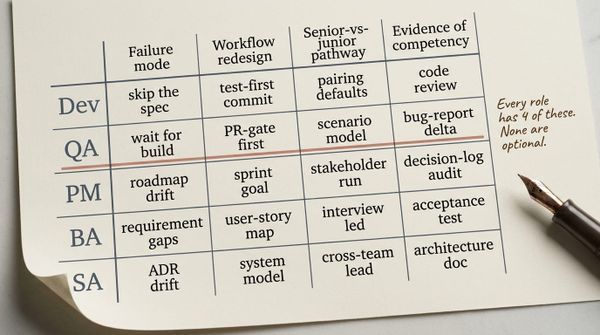
This is the Developer deep-dive of the Role-Based AI Playbooks for Delivery Teams survey. That piece maps the redesign across every delivery role at a high level. This one installs the Developer track in depth: the three disciplines that carry the shift, the maturity progression they map to, and the specific failure modes that keep teams stuck at the autocomplete layer. If you lead the QA function instead, the same role-redesign pattern is worked through in the QA AI playbook.
A delegated worker is not a faster editor
Picture two ways to use the same agent on the same ticket. In the first, the developer keeps their hands on the keyboard and lets the agent finish lines, suggest a function body, refactor a block on request. The agent is an editor with opinions. The developer is still the one doing the work, just with help. In the second, the developer writes a clear task with a goal, constraints, and a definition of done, hands it to the agent, walks away, and comes back to review what a worker produced against a standard. The agent did the work. The developer set the conditions and judged the result.
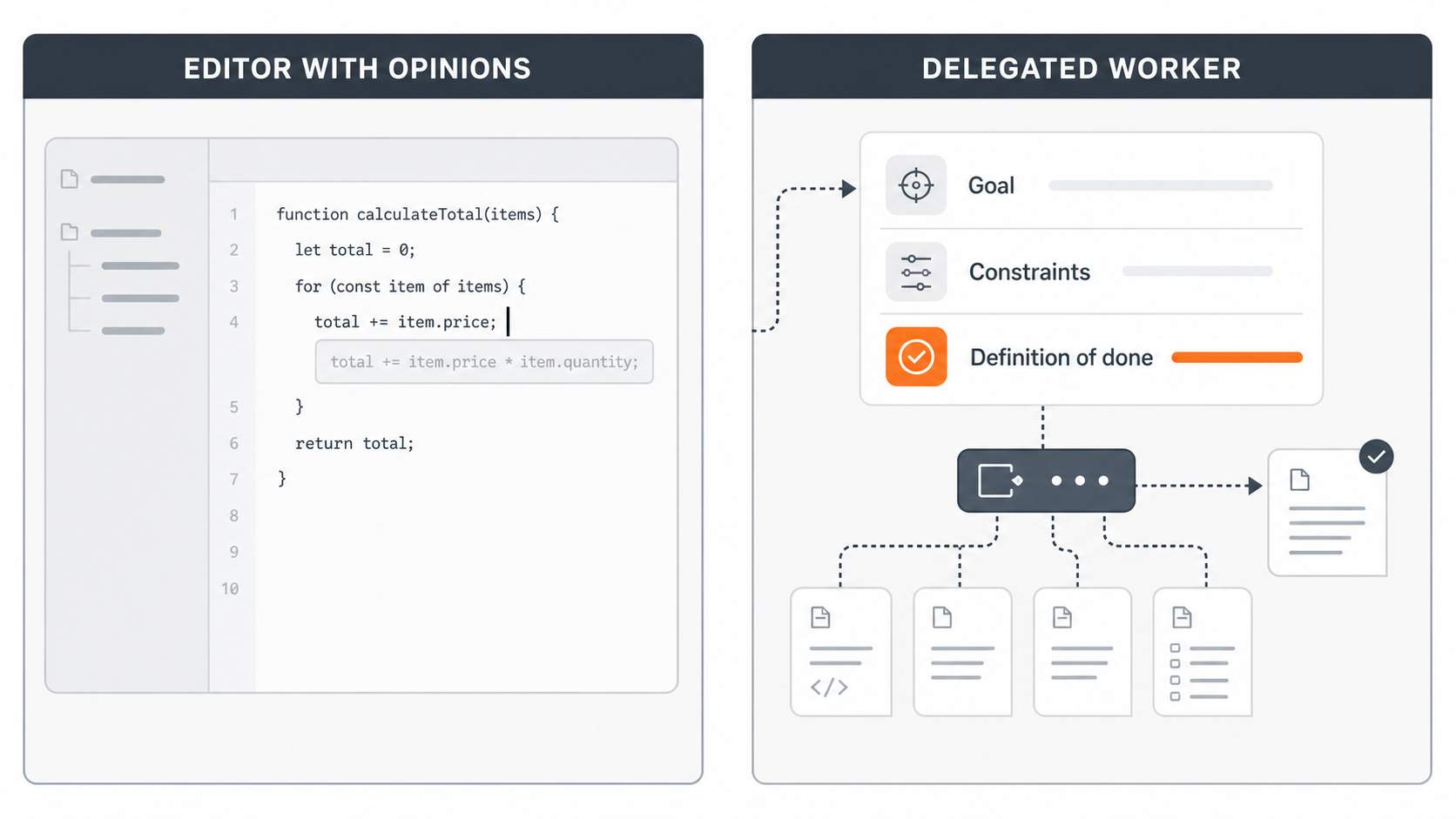
Only the second one is delegation, and delegation is what these tools became. AI coding agents crossed from autocomplete into autonomous, multi-step work over the last two release cycles. They can plan tasks, edit across files, run commands, and iterate on errors, but those capabilities are conditional rather than uniform. They work best on bounded tasks inside well-scaffolded codebases with reliable test loops. In legacy systems, ambiguous tasks, or weak harnesses, the same autonomy can amplify mistakes faster than it produces progress. The METR 2025 randomized trial that found experienced developers got 19% slower with AI tools on real pull requests in mature repositories is a useful reminder: agent capability is real, and it is also conditional on the conditions the developer creates. That is a workforce capability with operating constraints, and it changes what the developer's job is for. The shift looks a little like people management, but the analogy breaks down where it matters. A manager's team has memory, persistent identity, accountability, learning curves, and social feedback, none of which apply to agent workers. The closer model is autonomous-worker system design: high-throughput workers who show up to every shift with no memory of the last one, no accountability for outcomes, and uneven reliability across tasks. The developer's new job is not managing those workers in the people-management sense. It is engineering the operating conditions they succeed inside: bounded tasks, curated context, externalized correctness checks, constrained tool access, and clear ownership of the outcome they produce. The leverage has moved off the keyboard, but toward system design rather than toward team leadership.
This is why high usage with flat delivery is a role-design problem, not an adoption problem. When the role stays "person who writes code, now with a faster typing assistant," the agent's autonomy has nowhere to land. The developer reviews more output because the agent produces more, but they review it the way they always reviewed their own diffs, line by line, which does not scale to a worker's throughput. Review load rises, cycle time does not move, and the dashboard records heavy AI use with nothing to show for it. The pain is real and the misdiagnosis is expensive: teams respond by buying more seats when the binding constraint is the role-level redesign nobody scheduled.
The redesign has a shape. The developer's new leverage is the harness the agent works inside: the context it can see, the corrections that became durable rules, the tests and feedback loops that tell it whether the work is right. Three disciplines build that harness. Each one is a real skill, with its own techniques and its own failure modes, and together they are the developer AI maturity ladder that separates a team using a workforce from a team using a faster keyboard.
Discipline one: context engineering
The first new job is deciding what the agent gets to see. Anthropic's engineering team gave this a name in their 2025 engineering guidance: context engineering, defined as "the set of strategies for curating and maintaining the optimal set of tokens (information) during LLM inference, including all the other information that may land there outside of the prompts." Note what that definition rules out. It is not about writing a clever prompt. It is about governing the entire pool of information the model reasons over, of which the prompt is one small part.
The principle that makes it a discipline rather than a habit is counter-intuitive: more context is not better. Anthropic's framing is that good context engineering means "finding the smallest possible set of high-signal tokens that maximize the likelihood of some desired outcome." The reason is a measurable failure mode they call context rot: "as the number of tokens in the context window increases, the model's ability to accurately recall information from that context decreases." A model has what the same guidance describes as an attention budget, and that budget has diminishing returns, the way human working memory degrades when you hold too much at once. Dumping the whole repository into the agent's context does not make it smarter. It makes it forget the part that mattered.
The operational read for the developer is direct. Your first new skill is curation: feeding the agent the smallest set of high-signal information for the task in front of it, and nothing else. That splits into a few concrete techniques, which the Anthropic guidance lays out as retrieval strategies. Just-in-time retrieval loads information at runtime, by handing the agent file paths or URLs it can open when it needs them, instead of pre-loading everything. A hybrid model, the one a CLAUDE.md or AGENTS.md file enables, puts a small, durable set of project facts upfront and lets the agent explore the rest at runtime with its own tools. Upfront loading still has a place for speed-critical, stable domains where the same context is needed every time. For long-running work the guidance adds three more: compaction, which summarizes a full context window and reinitializes a fresh one before recall degrades; structured note-taking, where the agent writes durable memory to a file it can re-read later; and sub-agent architectures, where specialized agents do narrow work and return a condensed summary rather than their full transcript.

The developer who internalizes this stops thinking of the agent as a search box you fill with everything you know and starts thinking of it as a worker with a limited desk. Your job is to put the right three documents on the desk, not the whole filing cabinet. That is a real skill, it is teachable, and most teams are not teaching it because they never named it as part of the role.
Discipline two: compounding engineering
Here is the failure that quietly erases most of the value of context engineering: the developer curates a good context, the agent does good work, the developer corrects the two things it got wrong, the session ends, and tomorrow the next session makes the same two mistakes. The correction lived in the developer's head and in a closed terminal. Nothing compounded. A team can run a thousand good agent sessions and still be exactly as capable on day a thousand as on day one, because the learning never left the moment it happened.
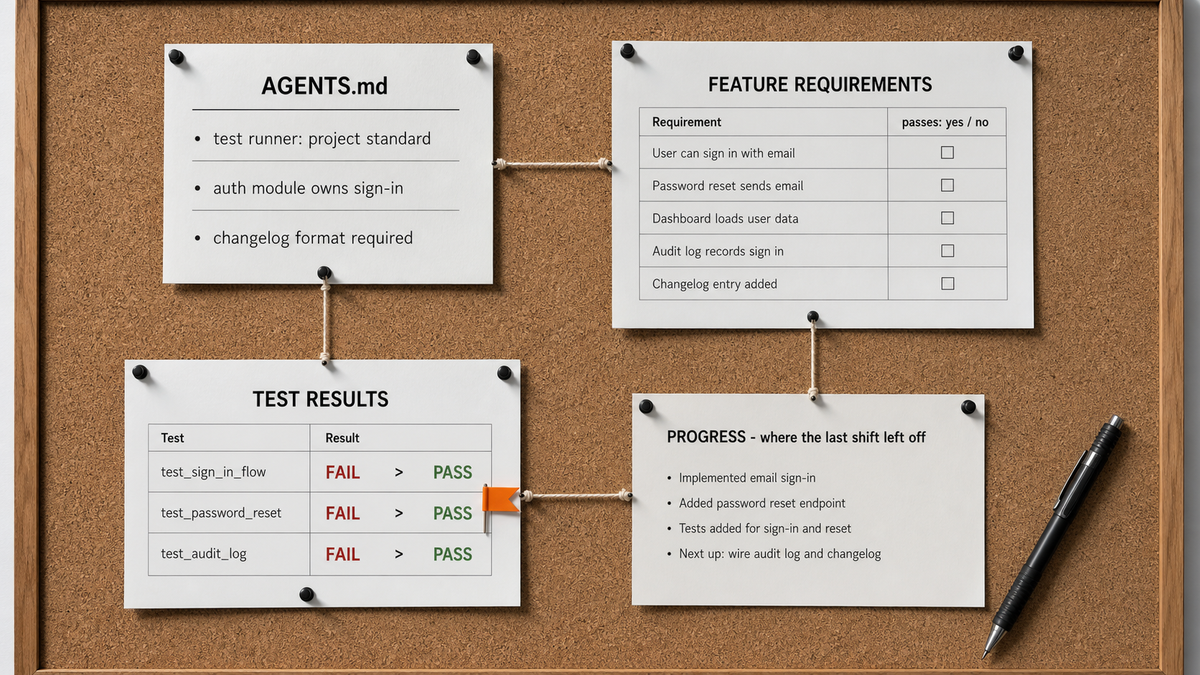
Compounding engineering is the discipline that fixes this: turning every correction the agent needs into something durable the next session inherits. OpenAI's Codex guidance names the primary vehicle. It describes AGENTS.md as "an open-format README for agents," and says it "loads into context automatically and is the best place to encode how you and your team want Codex to work in a repository." The key word is encode. When you find yourself telling the agent the same thing every session, that this repo uses a specific test runner, that this module owns auth, that PRs need a particular changelog format, you stop telling it and you write it down where it loads automatically. The correction becomes a standing rule.
AGENTS.md is a memory surface, not a control plane. The agent reads it and the rules influence behavior, but agents do not treat documented rules as inviolable constraints. Soft rules, formatting conventions, naming preferences, default approaches, belong in AGENTS.md, where the agent's general compliance is enough. Hard constraints, security rules, never-modify-this-file rules, deployment gates, belong outside the model: file permissions, pre-commit hooks, CI checks, protected branches, approval requirements, command allowlists. Compounding engineering done well codifies in AGENTS.md and enforces the critical subset at the harness level. Treating AGENTS.md as the whole control surface is how the same correction quietly comes back three sessions later.
The second vehicle is the skill. The same OpenAI guidance gives a clean trigger for when to build one: "if you keep reusing the same prompt or correcting the same workflow, it should probably become a skill." A skill packages a repeatable workflow so it is invoked by name instead of re-explained from scratch. The pattern across both vehicles is a loop: plan the task, delegate it to the agent, assess the result, and codify whatever the assessment taught you. Plan, delegate, assess, codify. The codify step is the one most developers skip, and it is the one that makes output compound.
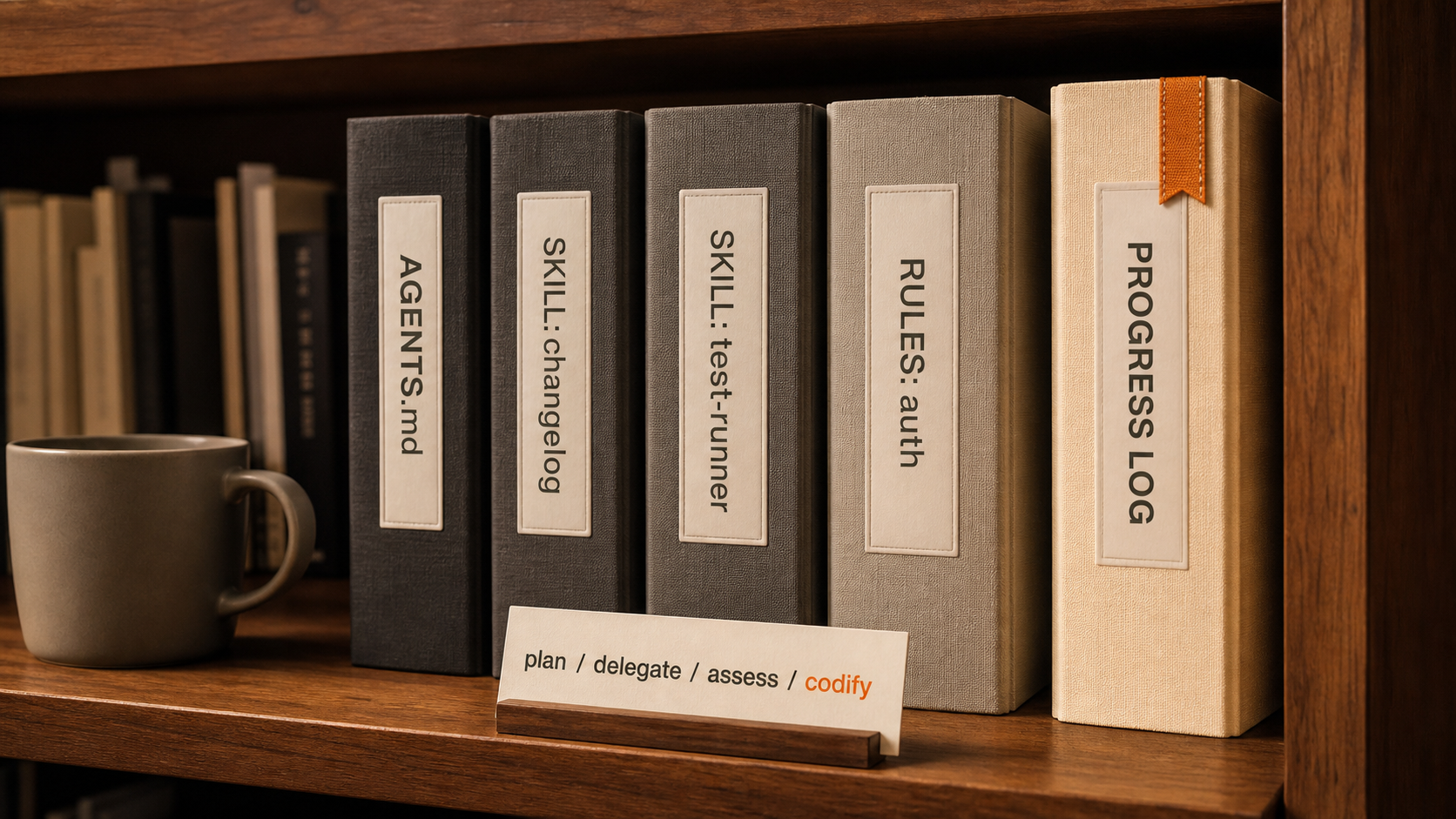
The operational read is a reframe of where a developer's output lives. In the old role, output was the code you shipped this sprint. In the redesigned role, a large part of your output is the harness you improved: the rule you added so the agent stops making a class of mistake, the skill you packaged so a common task runs the same way every time. That output keeps paying. A team practicing compounding engineering gets measurably better at delegation every week, because the harness absorbs the lessons that used to evaporate. A team that skips it stays at week-one capability forever, no matter how many agent sessions it runs.
Discipline three: harness engineering
It would be easy to read the last two sections and conclude this is just good test-and-CI hygiene with new vocabulary. It is not, and the difference is the whole point. Standard CI exists so that humans get a fast signal when they break something. Harness engineering is the discipline of building the environment, tests, and feedback loops for an agent that has no memory of the work, and that distinction changes everything about how the harness has to be designed. The harness is not for you. It is for a worker who shows up to every shift with total amnesia.
Anthropic's November 2025 guidance on long-running agents states the constraint plainly: agents "must work in discrete sessions, and each new session begins with no memory of what came before." Their analogy is engineers working shifts with no handoff. A human developer carries continuity in their head between Tuesday and Wednesday. An agent does not. Whatever the agent needs to know to continue the work has to exist in the harness, because it exists nowhere else. This is the genuinely new requirement, and it is invisible to a CI-hygiene reading, which assumes a human with memory is the consumer of the signal.
The guidance lays out a concrete pattern for working inside that constraint. An initializer agent runs once at the start and establishes the infrastructure: it lays down the project scaffolding and writes a comprehensive feature file. Subsequent coding agents pick up incrementally. The feature file is the clever part. It is "a comprehensive file of feature requirements," structured with acceptance criteria, and the coding agents are permitted to modify only the field that records whether a feature passes. They cannot rewrite the requirements to make their own life easier. That single constraint prevents the two classic agent failures: scope drift, where the agent wanders off the task, and premature completion, where it declares victory on work it did not finish. The same guidance enforces a related discipline, that agents "work on only one feature at a time," which addresses the agent's tendency to attempt too much in one pass.
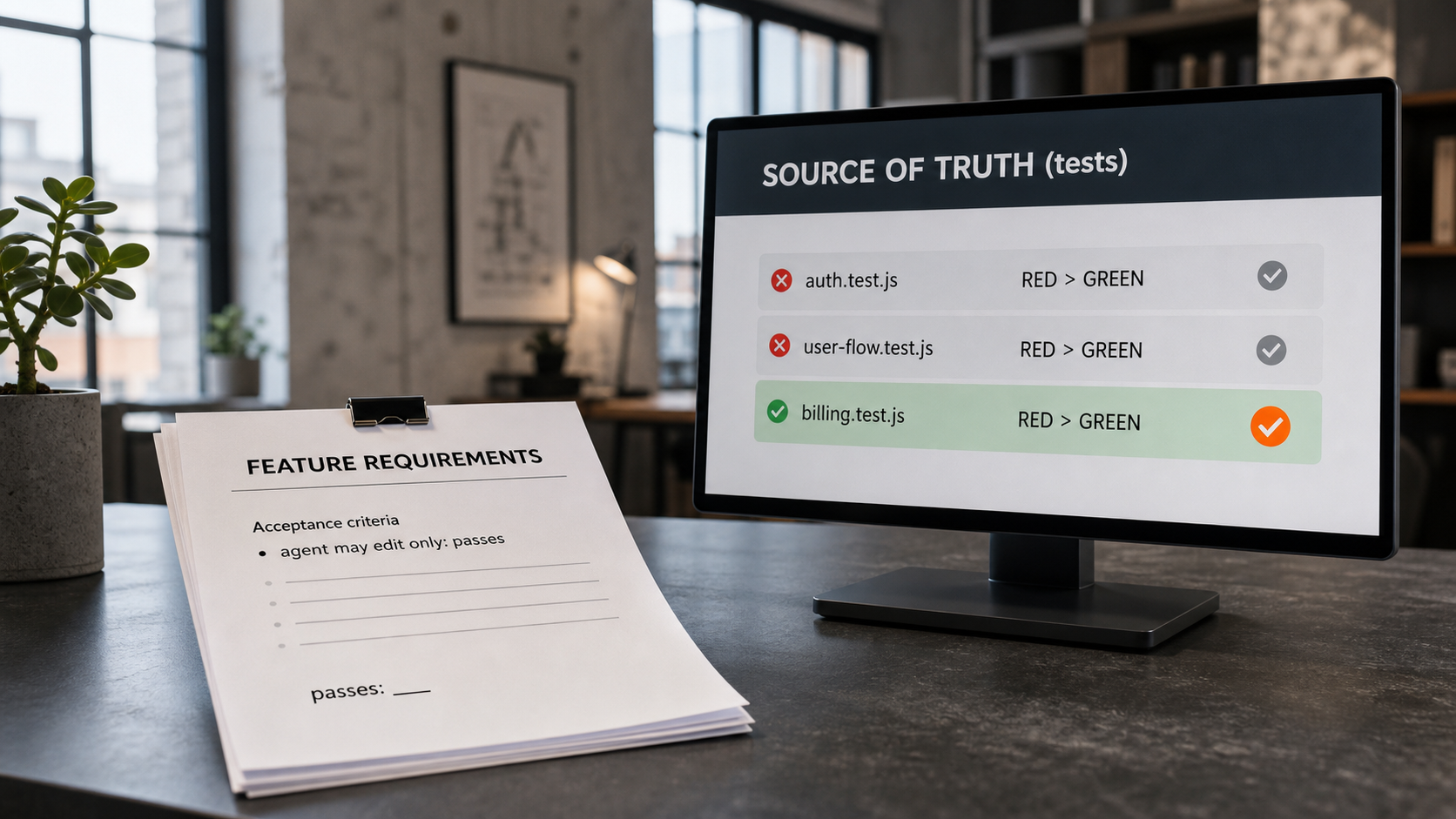
The other half of the harness is the feedback loop, and here OpenAI's Codex guidance names the mechanism precisely. Tests, it says, "create an external source of truth that stays accurate regardless of how long the session runs. Each red-to-green cycle gives Codex unambiguous feedback it can act on autonomously." Read that against the no-memory constraint and it clicks. Tests as source of truth are not primarily there to catch human regressions. They are there so an amnesiac worker can tell, without any memory of intent, whether the current state of the code is correct. A failing test is an unambiguous instruction the agent can act on alone. A passing suite is permission to stop. The developer's job is to make the source of truth external and exact enough that the agent never has to guess what "done" means.
The continuity techniques follow from the same logic. Anthropic's guidance has each session begin by reading the git log and a progress file, and running diagnostics, before it touches anything, so the memoryless agent reconstructs where the last shift left off. It pairs that with verification that mirrors reality: browser automation that tests the software "as a human user would," rather than trusting that green unit tests mean the feature works end to end.
Put the pieces together and the role inverts cleanly. The agent is the consumer of the harness. The developer is its engineer. The agent operates inside the environment, reads the tests, follows the feature file, and acts on the red-to-green signal. The developer builds and maintains all of it: the scaffolding, the acceptance criteria, the test suite that defines correctness, the progress files that bridge the memory gap, the verification that checks the work the way a user would. That is not CI hygiene with a fresh coat of paint. CI hygiene serves a human who remembers. Harness engineering serves a worker who never does, and designing for that consumer is a discipline a developer has to learn on purpose.
The harness is simple by design, not by accident
A predictable wrong turn at this point is to reach for a framework. If harness engineering is this important, the reasoning goes, surely there is an agent platform that does it for you. Anthropic's own research on building agents points the other way. Their finding, after surveying real implementations, is that "the most successful implementations use simple, composable patterns rather than complex frameworks." The harness that works is not an elaborate orchestration platform. It is a context file, a feature list, a test suite, a progress file, and a verification step, each of which a developer can read, understand, and change.
The operational read matters because it keeps the discipline honest. Harness engineering is not "adopt the heaviest agent framework you can find." It is the disciplined design of a simple, inspectable working environment. Every part of a good harness is something a new team member, or a new agent session, can open and reason about. The moment the harness becomes a black box the team cannot inspect, it has stopped being an asset the developer engineers and started being a dependency the developer hopes works. Simple and composable is not a compromise for small teams. It is the property that makes the harness maintainable as the work scales.
The maturity ladder you can take to your CTO
The three disciplines are not a checklist a developer either has or lacks. They arrive in an order, each one assuming the one before it, and that order is the reference artifact worth installing as a role-level expectation. The ladder below is the inspectable version: four levels of developer AI maturity, what the developer actually does at each, and what the harness looks like when they are there. It reads as a method a function lead can adopt, not a score to grade people on.
| Level | What the developer does | The harness at this level | What is still missing |
|---|---|---|---|
| L1 - AI-assisted foundations | Uses structured prompting and plan mode, verifies every output, stays aware of hallucination risk. Treats the agent as a capable but unreliable assistant whose work always gets checked. | Mostly absent. Context is whatever the developer types per session. Corrections live in the developer's head. | No durable context, no compounding, no automated feedback. Output does not survive the session. |
| L2 - Context curation and compounding | Curates the smallest high-signal context for each task. Codifies recurring corrections into AGENTS.md rules and reusable skills. Runs the plan, delegate, assess, codify loop. | A maintained context file, a growing rules set, a small skills library. Corrections become standing assets. | Verification is still manual and human-paced. The agent cannot yet tell on its own whether work is correct. |
| L3 - Harness engineering and agent autonomy | Builds the feature list with acceptance criteria, the tests-as-source-of-truth feedback loop, the progress files that bridge sessions, and verification that checks work as a user would. Delegates whole features and reviews against the standard, not line by line. | A full harness: scaffolding, feature requirements, external source of truth, continuity files, end-to-end verification. The agent operates inside it with significant autonomy on bounded work. | Single-agent throughput. No orchestration of multiple agents, no cost and quality controls at scale. |
| L4 - Frontier orchestration | Coordinates multiple agents and sessions against a shared harness, with explicit cost and quality controls. In 2026, genuinely rare in production engineering organizations, closer to research frontier than achievable destination. | The frontier harness, where it exists, is designed for many consumers: sub-agent patterns, compaction strategies, cost budgets, quality gates across parallel work. | Most teams should not aim here until L3 is boring. Multi-agent orchestration before stable L3 typically introduces cost and complexity without proportional value. |
One note on the ladder. L4 is the frontier, not the next normal rung. In 2026, very few production engineering organizations are running mature multi-agent orchestration reliably, and the marginal return on getting there from a stable L3 is uncertain compared to investing more deeply in L3 itself. Most teams reading this ladder should aim at L3, treat L3 as the operating destination, and treat L4 as a research direction to track rather than a maturity target to chase.
The diagnostic value of the ladder is that it separates AI activity from AI capability. A developer can be heavy on agent usage and still sit at L1, because usage is not the same as harness. A team can read its own level honestly by asking what survives a closed terminal. At L1, nothing does. At L3, the next agent session can pick up the work cold, because the harness holds everything it needs. That single test, what survives the session, is the cleanest read on where a developer actually is, and it is the read a lead can take upward without translating it into vendor-speak.
Where teams stall, and what it costs
Most teams that are stuck do not fail at all three disciplines at once. They fail at one specific link, and the failure has a recognizable shape. Naming the failure modes is more useful than naming the disciplines, because a lead can usually spot which one their team is in.
| Failure mode | What it looks like | What it costs | The discipline it skips |
|---|---|---|---|
| The agent as autocomplete | Hands stay on the keyboard. The agent finishes lines and suggests blocks, but never receives a delegated task with a definition of done. No harness exists because the developer never stopped being the one doing the work. | High usage, flat delivery. The workforce capability is paid for and used as a typing assistant. | All three. The role was never redesigned. |
| Context overload | The developer pastes the whole module, or the whole repo, into every session, believing more context is safer. The agent's recall degrades from context rot and it confidently uses the wrong part. | Subtle wrong answers that pass a quick read, plus slower, more expensive sessions. | Context engineering. |
| No codification | Good corrections happen every session and none of them are written down. Tomorrow's session repeats yesterday's mistakes. | Permanent week-one capability. A thousand sessions produce no compounding improvement. | Compounding engineering. |
| Trust without a loop | The developer accepts agent output because it looks right, with no external source of truth to check it against. Correctness is a vibe, not a signal. | Defects that ship because nothing failed loudly. Review load rises to compensate, eating the time the agent was supposed to save. | Harness engineering (the feedback loop). |
| Framework substitution | The team adopts a heavy agent platform instead of building a simple harness, hoping the platform supplies the discipline. The platform becomes an un-inspectable dependency. | Lock-in plus a harness nobody on the team understands or can fix. | Harness engineering (the simple-and-composable principle). |
| The unguarded harness | The harness gives the agent real power, to run commands, edit files, call tools, without treating that execution surface as something to secure. | The harness becomes an attack surface as much as a capability. The same autonomy that delivers features can be turned against the codebase. | Harness engineering (the security dimension). |
That last row is worth dwelling on, because it is the one most easily forgotten in the rush to delegate. A harness that can run arbitrary commands and edit files on the agent's behalf is a powerful execution surface, and a powerful execution surface is a security concern, not just a productivity feature. The same properties that let an agent ship a feature autonomously, command execution, file access, tool calls, are the properties an attacker would want. Treating the harness as an attack surface, with the same care a team gives any system that can execute code, is part of harness engineering done well, not an optional add-on. The security considerations specific to agentic coding tools are worked through in the Claude Code Security piece; the point here is only that the harness you engineer for capability is also a surface you have to engineer for safety.
High usage is not high performance
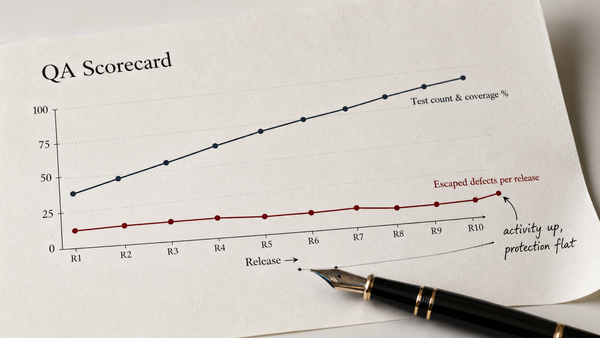
The stakes of getting this wrong are not abstract. A year spent measuring AI adoption instead of AI capability is a year of dashboards that look healthy while delivery stays flat, and the gap is invisible until someone asks the question the numbers cannot answer: did the team get better, or just busier? The developer who treats a delegated engineering workforce as AI autocomplete is not making a small mistake. They are running expensive capability at a fraction of its value and reporting the usage as progress.
The redesign closes that gap by changing what the role is built around. A developer at L3 is not a faster coder. They are an engineer of the conditions an autonomous worker succeeds in: the context it sees, the rules it inherits, the tests that tell it the truth, the agent feedback loops that let it correct itself without a human in the inner loop. That is what makes an AI operating-model change real at the delivery layer. Funding the tools moves the usage number. Funding the role redesign moves the capability.
For the lead or the CTO weighing where the next budget goes, the implication is specific. The spend that matters is not more seats. It is the time and the expectation-setting that turn harness engineering into a standing part of how developers work, with the L1 to L4 progression installed as a role-level standard rather than a thing a few strong engineers do privately. Measure whether the harness exists, not whether the agent was used. Usage is the easy number. The harness is the capability.
There is a single diagnostic that cuts through all of it. Take your team's last five shipped features and ask: how many could a fresh agent session continue safely from the harness alone, with no living engineer to explain what was meant? At L1, almost none. At L3, routine bounded features start to pass this test, while complex cross-domain features still need human judgment, but the harness carries enough state that the next agent session is not starting from zero. If the answer is consistently zero across five features, your team is still using a delegated workforce as a faster keyboard, and the dashboard has been telling you a story about adoption when the real story is about a role that has not been redesigned yet. The next thing worth building is not another tool. It is the harness the next developer, and the next agent, inherits.
AI Transparency Notice: This article and its accompanying images were created with the assistance of generative AI. The author directed the content, contributed the underlying ideas and analysis, and reviewed the final publication.