Diagnosing a Failing AI Program: Four Org-Design Signals Executives Miss
AI programs that are not working are rarely broken at the tooling layer. They stall at one of four positions in the org-design where ownership of a load-bearing decision right ended up in the wrong chair.
The CEO sits in the quarterly review and reads, again, the same line he read last quarter. License counts are up. Training hours are logged. The AI program roadmap has green checkboxes from the December offsite. Two department heads have demos. The board update is in three weeks, and the delivery dashboard does not look any different from the one he was reading in May. Cycle time is flat. Reopened-defect rate is flat. The sales conversion ladder is flat. The roadmap shows progress; the metrics that matter show nothing.
The instinct is to read this as a tool problem, a training problem, or a particular department head problem. It is rarely any of those. In AI rollouts in delivery orgs, AI programs that "aren't working" are rarely broken at the tooling layer. They are stalled at one of four specific positions in the company's org-design, where ownership of a load-bearing decision right ended up in the wrong chair. The stall is structural, not behavioral. The corrective is re-chairing the decision, not coaching the person currently sitting in it. And an initial read runs in under an hour against your last board update and operating-review materials.
In AI rollouts in delivery orgs, I keep watching the same four positions misfire. They have recognizable executive-level signatures, they each have an org-design root cause, and they each have a corrective move that is executable inside one quarter. If you have already worked through what a real AI operating model looks like, this article picks up where that left off. The operating model is the what. This article is about which of the four positions the operating-model layer keeps getting stalled at, and the move that frees it.
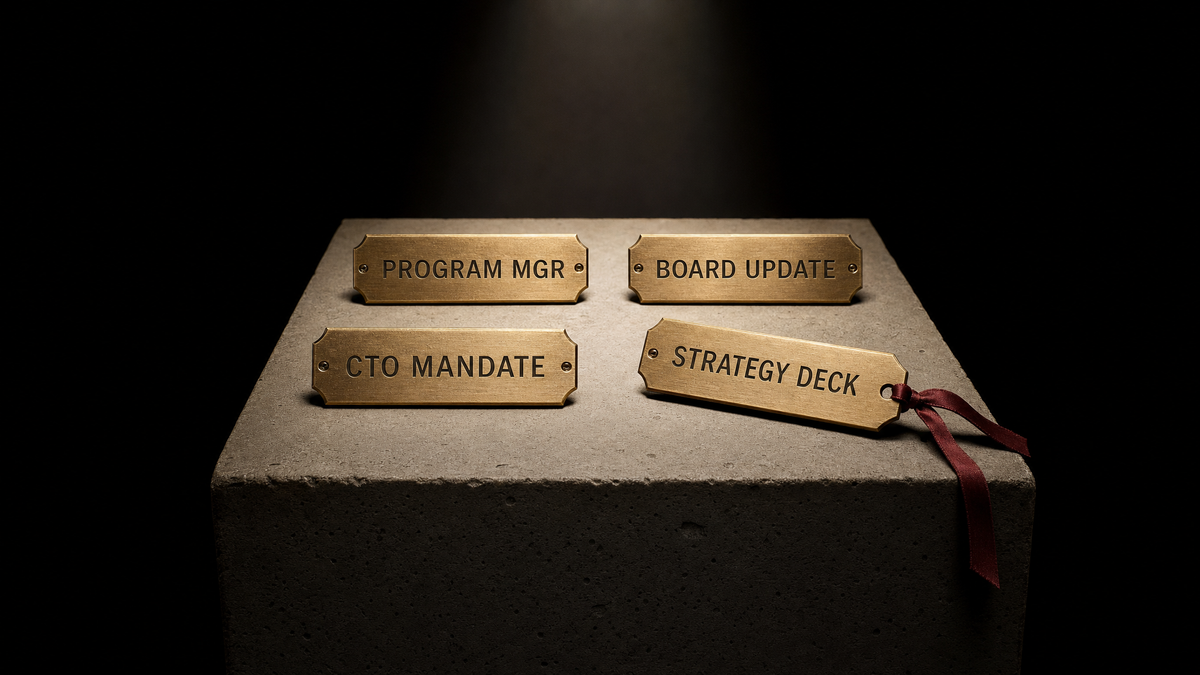
Quick answer. Four signals tell you an AI program has stalled at the org-design layer rather than the tooling layer: (1) the program manager came from procurement, not delivery; (2) board updates count pilots instead of capability; (3) the CTO owns AI tools but was never authorized to redesign a workflow; (4) the AI strategy decks were polished, approved, and never instrumented in the operating review. Each has a recognizable signature at the executive level, a specific org-design failure underneath, and a corrective move that re-chairs ownership of the right decision. Name which signal is firing in your organization and you know which redesign comes first.
The program manager came from procurement, not delivery - and the program is moving at procurement's cadence
How it shows up at the executive level. The AI program reports up through procurement, vendor management, or a shared-services function that historically owned IT contracts. Status updates emphasize contract milestones, license utilization, training attendance, and "vendor SLA compliance." Cross-functional conflicts get routed as vendor-management escalations: "the BAs are pushing back on the AI assistant rollout - we need to schedule additional training and re-clarify the contract scope." The program manager is competent and well-respected; they have shipped large procurement programs before. They have never run a delivery team, and it shows the moment the conversation moves from contract to capability. The CFO is comfortable; the CTO is increasingly frustrated; the COO is not in the room often enough to notice.
The org-design failure underneath. AI transformation, when it is real, is a redesign of the delivery system. It changes what a PM does day-to-day, what a QA designs, how a BA validates, how a developer works against a spec, how DevOps handles incidents, how review standards shift when a fraction of the code in front of a senior reviewer came from a model. Routing the program through procurement means the program manager owns the vendor contract - the easiest layer - but does not own role redesign, workflow change, decision-right reallocation, or governance updates. The decision right "what does this program ship?" sits in a chair that was built to ship contracts, not capability. No amount of competence in the seat compensates for a chair that is structurally wrong for the work.
The corrective move. Re-chair the program-management role. The program manager needs to be a senior delivery or transformation lead - someone who can convene PM, QA, Dev, SA, BA, and DevOps in a room and own workflow-level outputs across that span. Procurement stays in scope for contracts, vendor evaluation, license commercials. It does not own program outcomes. The CEO conversation, the one that has to happen out loud and with both people present, is straightforward: "Who can write next quarter's program plan in delivery-metric language rather than procurement-milestone language?" Within one quarter, the status updates change shape. The contract-milestone slide becomes an appendix. The lead slide becomes cycle time and reopen rate. The change is visible from the operating-review chair.

Board updates count pilots, not capability - and the count keeps going up while delivery stays flat
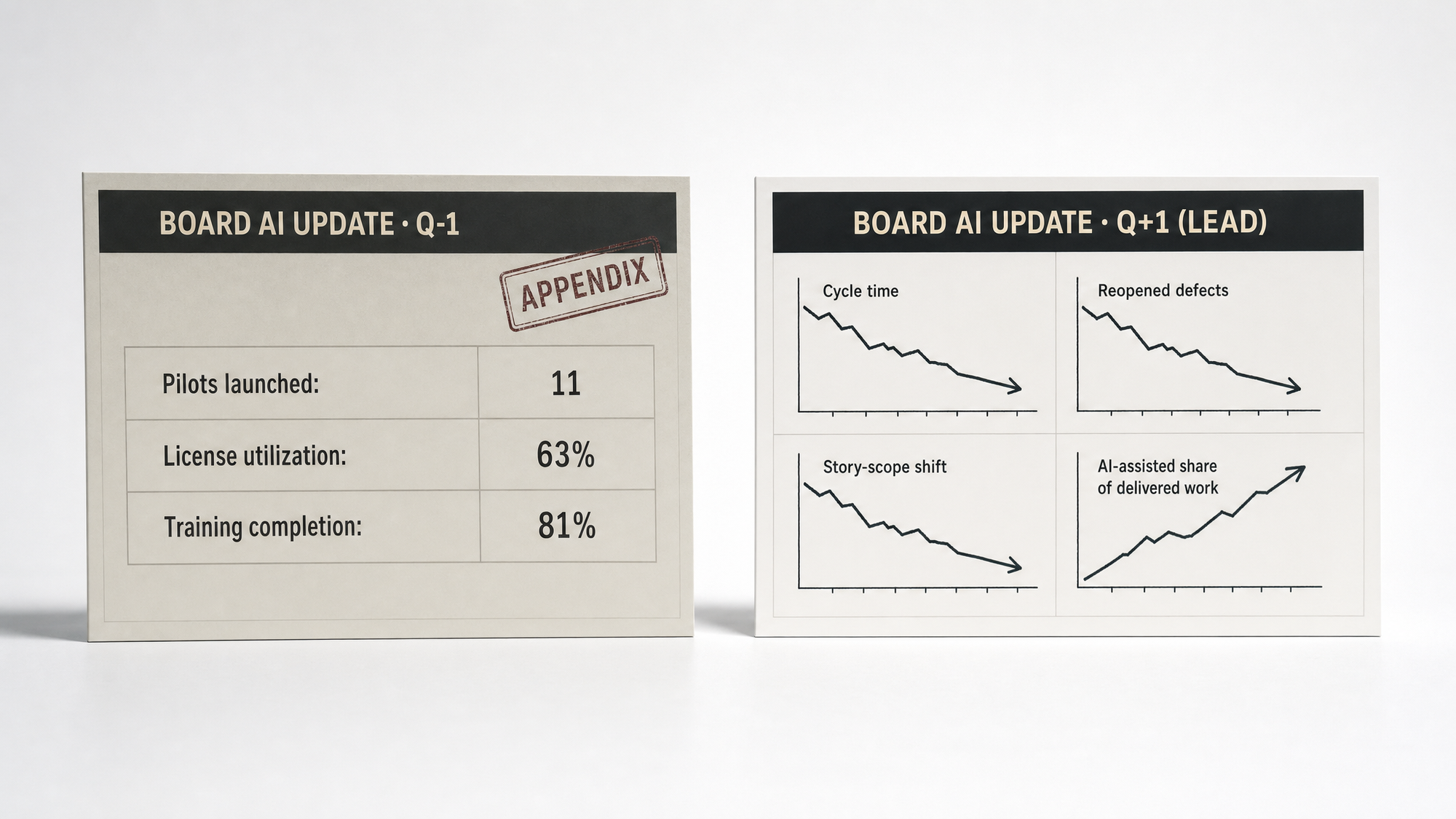
How it shows up at the executive level. Every board AI update is a list. Six pilots last quarter, eleven this quarter. License utilization is at sixty-three percent. Training completion is at eighty-one percent. Two new AI champions joined the program. The CIO presents these as progress, the audit committee accepts the framing, and the board's measurement system for AI is the slide template that came out of the original program proposal. The metrics that connect AI to the P&L - cycle time, throughput, reopened defects, story-scope shift between sprint planning and sprint review, sales-conversion ladder, hiring-cycle compression, support-ticket deflection - are nowhere on the AI dashboard. They sit on the COO's operating-review deck, in a completely separate meeting, run by people who are not in the AI program governance.
The org-design failure underneath. Pilot-counting is measurement-system misallocation. It answers "is the program busy?" - and it answers that question precisely, with a number that goes up quarter over quarter. It does not answer "is the company changing?" The CFO has not been asked to build the AI performance metric ladder; the CTO is reporting from the program's own dashboard, which was designed to demonstrate activity to the people who funded the program; the board's measurement system was inherited from the program pitch and has never been redesigned. The decision right "what does this program get measured on?" sits in the program's own chair. That is the wrong chair. A program should not grade its own homework and report the result to the board without something quietly going wrong.
The corrective move. Re-instrument the board update. The next AI update reports workflow-level outcomes: cycle time, throughput, reopen rate, story-scope shift, AI-assisted share of delivered work, time from prototype to production-grade, the same metrics the operating review is already running on. Pilot count moves to an appendix; the license-utilization slide moves to an appendix; the training completion slide moves to an appendix. None of those numbers are deleted. They are just no longer the lead. The CEO conversation that re-chairs the decision is short: "What changed for the customer or the cost line this quarter that the program is responsible for?" If the answer is "we ran six new pilots," the program is still stalled, no matter what the activity dashboard says.
The CTO owns AI tools but has never been authorized to redesign a workflow - and AI cannot land without workflow redesign
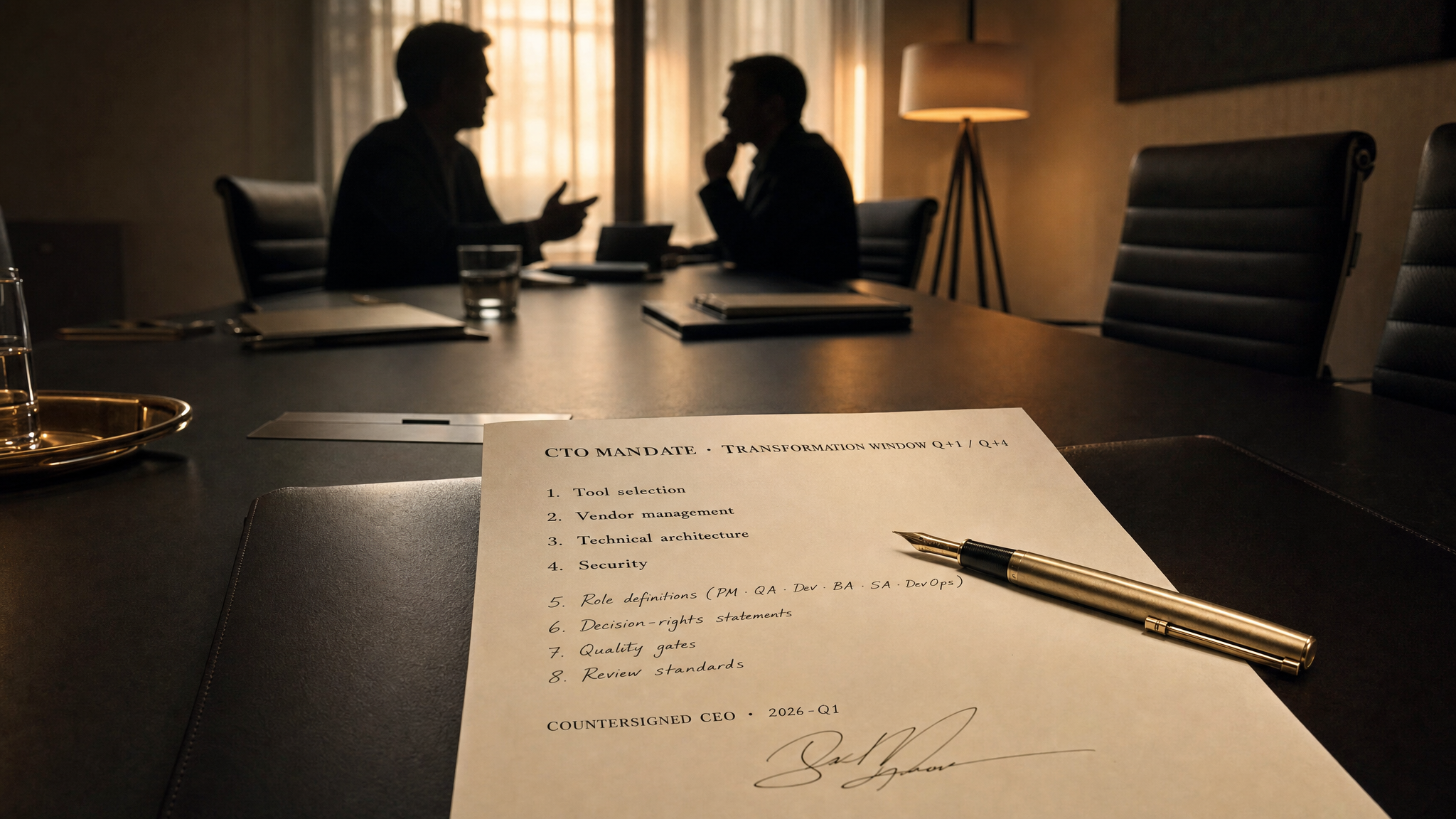
How it shows up at the executive level. The CTO is the public AI owner. The CTO signs the vendor contracts, presents at the board, attends the industry events, takes the AI-related questions from analysts. Internally, the CTO's mandate is "buy and deploy AI tools," not "redesign how delivery roles work." Workflow redesign sits inside the COO's territory, or it sits inside the business-unit heads' territory, or it sits in some matrix arrangement that needs the consent of three other people before a single role definition can change. Tools land. Adoption surveys come back positive. The tools get used the old way, inside the old workflow, measured against the old KPIs, and they produce the old result. The CTO can name what is happening but cannot fix it without a fight they cannot start.
The org-design failure underneath. Mandate misallocation. The CEO delegated the AI program but did not delegate the authority to change how work is done. The CTO's chair has the right reporting line and the wrong decision rights. This is the most common single org-design failure I see in mid-market transformation programs, and it is the one that consistently surprises CEOs because they assume "I made the CTO accountable for AI" is the same statement as "I authorized the CTO to redesign delivery roles." It is not the same statement. Accountability without the corresponding decision right produces a CTO who can be blamed for outcomes that depend on choices the CTO is not permitted to make. The chair is correctly named and incorrectly empowered.
The corrective move. Re-issue the CTO mandate, with the CEO present in the room, to explicitly cover workflow-level redesign authority during the transformation window. The mandate names role definitions, decision-rights statements, quality gates, and review standards inside delivery functions as in-scope for CTO decision-making. Department heads remain consulted and remain accountable for execution within their units, but the CTO is the decision-maker for delivery-system redesign for the duration of the program. The CEO conversation, the one that closes this signal, is the question that should have been asked at the start: "Does our CTO have the authority to change how PM, QA, Dev, BA, SA, and DevOps actually work? Or only the authority to buy tools they use?" If the second answer is the honest one, the mandate has not yet been issued.
AI strategy decks are not AI capability - and the gap shows up six months after the decks land
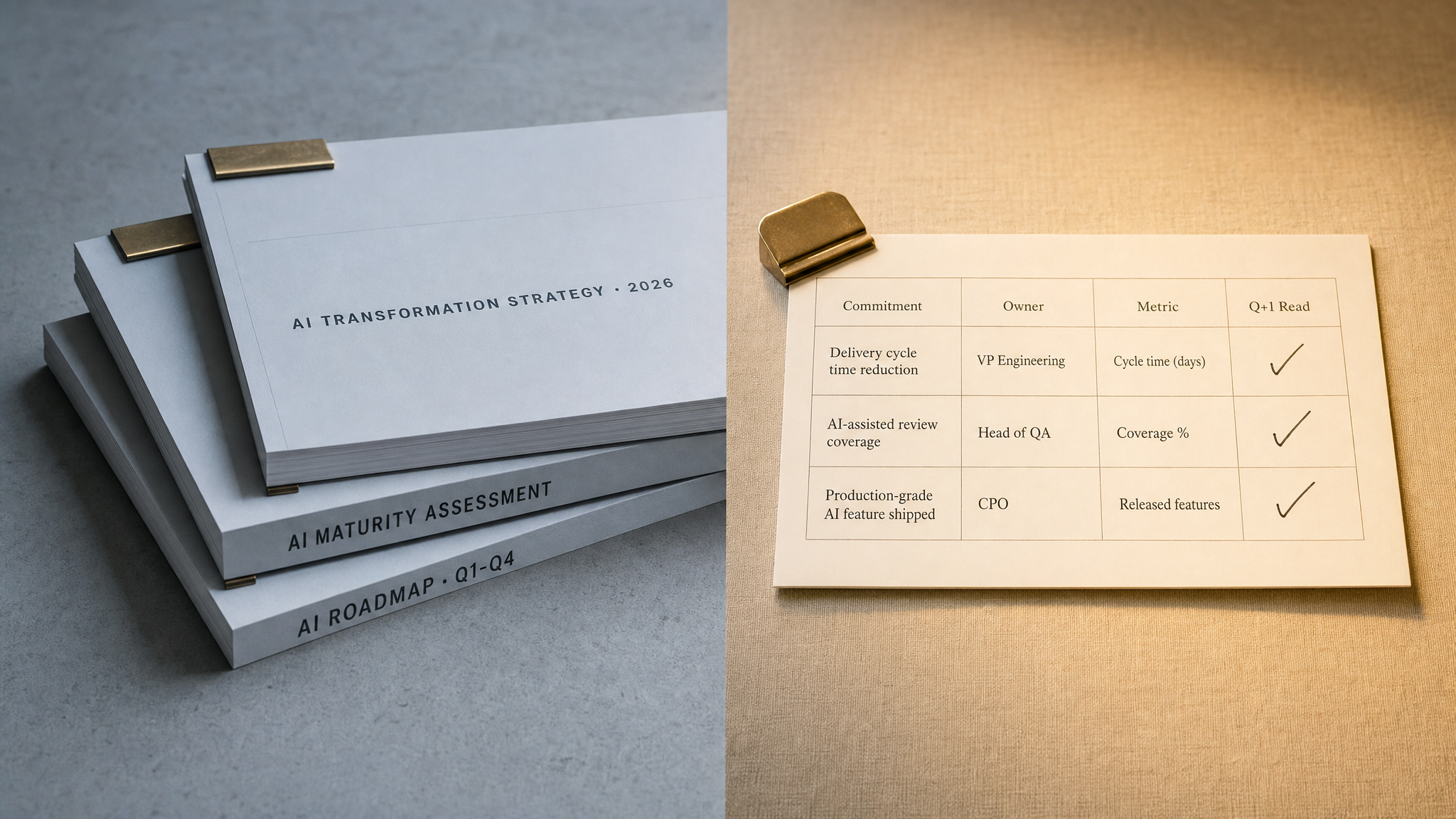
How it shows up at the executive level. The company has invested heavily in strategy work. A consulting engagement. An internal strategy team. An AI center-of-excellence with a steering committee and a charter. An AI maturity assessment that produced a three-page summary with a radar chart. The decks are polished, the frameworks are coherent, the roadmap was approved at the offsite. Execution sits in a different building, with different people, on a different cadence. Six months later, the strategy is still being "operationalized." Decks circulate at offsites and quarterly all-hands. The metric layer of the strategy was never built. The operating review continues to run on pre-AI metrics, the AI program continues to run on its own activity metrics, and nobody is responsible for connecting the two.
The org-design failure underneath. Delivery-instrumentation misallocation. The decision right "what gets instrumented at the workflow layer?" sits in the strategy team's chair. Strategy teams produce strategy. They are good at producing strategy. They are not built to instrument operating reviews - that work belongs to the people who run operating reviews, which is a different chair entirely. Strategy and operating review run in parallel, with no instrumentation connecting them. Strategy explains intent. Capability shows up in delivery. The two have not been wired together because nobody owns the wiring, and the people who would normally do it have not been told that wiring it is their job. It is a quiet failure mode that takes two to three quarters to become visible at the executive level, by which point the strategy work has been priced into the program's credibility and no individual deck is to blame.
The corrective move. Pull a small set of strategy commitments - the four-to-six load-bearing ones, the ones the board is going to ask about - into the operating review, with named owners, instrumented metrics, and a quarterly read. The rest of the strategy deck is allowed to remain a deck. The CEO conversation, the one that closes this signal in real time, is brutal in its simplicity: "Which three commitments from the AI strategy would I bet a quarter's executive bonus on showing measurable change next quarter? Are those three instrumented in the operating review?" If the honest answer is no, the strategy work has not yet become capability. It has remained a deck.
Two engagements where the diagnostic ran
In one such rollout, the firing signal was the procurement-led PM. The program manager was a competent contracts professional who had run a large data-platform migration the year before. Status updates ran on contract milestones and license utilization, and they ran on those metrics for nine months while the COO's delivery dashboard stayed flat. The corrective move was straightforward to name and hard to execute politically: the procurement lead stayed in place for vendor commercials, and a senior delivery lead - someone who could convene PM, QA, Dev, SA, and BA in a room - picked up the program ownership. Within one quarter, the program status meeting reported cycle time first and contract milestones third. Within two quarters, the program was producing measurable workflow-level change. The tools had not changed. The chair had.
In another engagement, the firing signal was the CTO authority gap. The CTO was visibly the program owner externally and internally, was signing vendor commitments and presenting at the board, and was not authorized to change a single delivery role definition without the consent of three department heads who had no incentive to grant it. The CEO had not realized this was the state of affairs until I walked through the four diagnostic signals at an offsite and we landed on this one. The corrective move was the CEO re-issuing the CTO mandate at the next leadership meeting, on the record, to explicitly cover workflow redesign authority for the duration of the transformation window. The fact of the mandate change was visible in the first cross-functional working session two weeks later. The program had not gained any new tooling, any new vendor, any additional budget. It had been given the missing decision right. That was enough to change the program's operating behavior inside the next cycle.
Both engagements share a structural feature I keep noticing: the corrective move was small in scope and large in effect. Re-chairing a single decision right is cheaper than another consulting engagement, faster than another vendor evaluation, and more likely to change the metric line than the next tool rollout. The cost is political, not financial, and the political cost is paid in a single conversation between two named people. The diagnostic identifies who those two people are.
Pitfalls - five ways the diagnostic gets misread
The diagnostic is structural, but its conclusions are easy to misapply if the executive reading it is in a hurry or wants the answer to be a personnel question rather than an org-design one. Five recurring missteps:
- Reading one signal as another. The board pilot-counting signal is regularly misread as a CTO authority problem ("the CTO should fix the board update") when the root cause is a measurement-system question that belongs at the CFO + operating-review level. The CTO authority gap, in the other direction, is sometimes misread as a measurement problem when the real issue is the missing mandate. The signal name has to match the chair the corrective belongs in, not the chair that is most convenient to call.
- Treating signals as personnel issues. The instinct, when the procurement-led PM signal is firing, is to say "we need a better program manager." The signal is not telling you the person in the chair is the wrong person. It is telling you the chair itself is the wrong chair for the work. Swapping the person without re-chairing the role guarantees the next person will produce the same outcome.
- Reading more than one signal at once and attempting a full reorganization. When two signals are firing - typically the procurement-led PM and the CTO authority gap, which often appear together - the corrective is to sequence the moves, not to redesign the whole org. The sequence matters. Re-chair the program management first, because it produces the cleanest visible feedback in one quarter, then re-issue the CTO mandate, because the CTO's authority is most credibly exercised over a program that is already showing workflow-level change.
- Naming the firing signal and then not acting on the corrective move in the same quarter. The diagnostic decays. An executive who runs the diagnostic at a Tuesday offsite, identifies the firing signal, and does not have the named corrective conversation inside the next thirty days has paid the cost of the diagnostic without buying the benefit. The diagnostic is cheap and the corrective is the entire point.
- Skipping the read on whether the operating-model layer has a real owner. If no single person owns the operating-model layer end-to-end - and in many mid-market programs no single person does - then any of the four signals can re-fire after a successful corrective. The diagnostic identifies which position is firing now. It does not, by itself, install the ownership that prevents the position from re-firing later. That has to be a separate decision and a separate conversation.
Key takeaways
- AI programs that "aren't working" are rarely broken at the tooling layer. They are stalled at one of four org-design positions where ownership of a decision right ended up in the wrong chair.
- The diagnostic is structural, not behavioral. The corrective is re-chairing a decision right, not coaching the person currently in the chair.
- If more than one signal is firing, sequence the moves. Re-chair the program management before re-instrumenting the board update, and re-issue the CTO mandate before pulling strategy commitments into the operating review.
- The diagnostic decays if the corrective is not executed in the same quarter. Naming the signal without acting on it is a more expensive form of staying stalled.
- The operating-model layer needs a single owner. Without one, the four signals can re-fire after a successful corrective and the program returns, quietly, to where it was before.
AI Transparency Notice: This article and its accompanying images were created with the assistance of generative AI. The author directed the content, contributed the underlying ideas and analysis, and reviewed the final publication.