Managers Must Change Behavior for AI Transformation to Land
Adoption metrics say AI is in. Delivery metrics say nothing changed. The gap lives in one place: the manager layer. Five behaviors to redesign before the next quarterly readout.
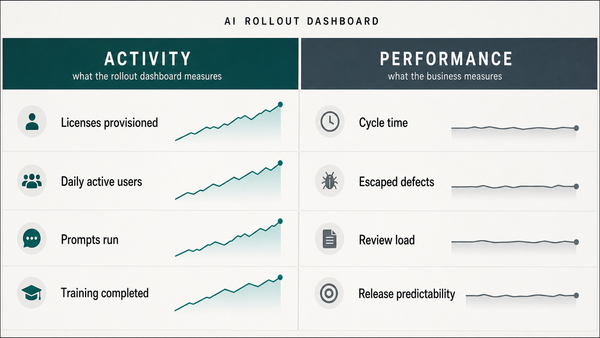
Six months into the AI rollout, the dashboard says adoption is up 64%. The engineering survey says everyone is using Cursor at least three times a week. The QA team has Claude Code wired into their test-plan tool. The product managers have an AI assistant inside their spec template. By every measurement the company committed to, AI is in.
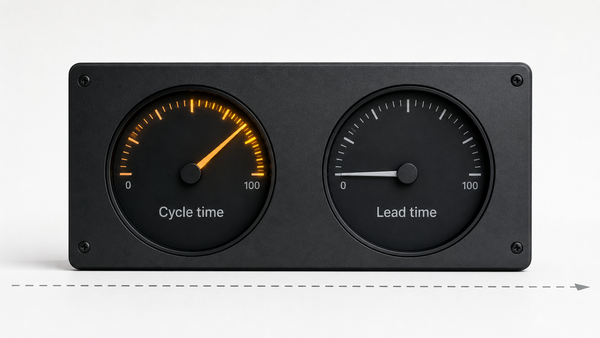
Look closely at a quarterly delivery readout in this state and something the dashboard cannot explain shows up. Pull request review cycles have not moved. Defect rate post-deploy is the same as a year ago. The time it takes a business analyst to get from a vague request to a written spec is, if anything, slightly worse. The adoption curve and the delivery curve have decoupled, and the dashboard is happy about it.
The owner in this situation says the line that surfaces in rollout after rollout: "We have the tools, the team is using Cursor, but delivery hasn't changed." It is the most under-discussed sentence in AI transformation. Owners say it quietly because they are not sure who to say it to. They have already spent the budget. They have already announced the strategy. The tools are in. And nothing has changed in the numbers that matter.
The reflex is to blame the tools. The next reflex is to blame the team. Both reflexes are wrong. The tools work. The team is using them. What has not changed is the layer between them and the operating model: the manager. Managers are still measuring the work the way they measured it before AI existed. They are still asking the same questions in standups. They are still inspecting the same artifacts in the same way. They are still funding the same kinds of capability work. The dashboard says adoption is up because the survey question is still "are you using the tool"; the dashboard cannot say delivery is up because nobody redesigned what delivery means after AI landed.
This is not a tooling problem and it is not a training problem. It is an operating-model problem at the manager layer. Until managers change five specific behaviors, AI transformation stalls inside the survey and never reaches the work.
Managers are the missing layer in AI transformation, not the tool layer
The standard story of AI transformation, the one most companies are running, has three layers. There is the tool layer: Cursor, Claude Code, Codex, AI test generators, AI assistants inside the spec template, AI summarizers inside the CRM. There is the role layer: the engineer who writes code differently, the QA who designs tests differently, the BA who structures requirements differently. And in between, theoretically, there is the manager layer (the lead engineer, the QA lead, the head of product, the delivery manager) who is supposed to translate the tools into the new way the role works.
Most transformations skip the middle. They invest heavily in the tool layer and run training for the role layer. The manager layer is given a quarterly all-hands and a Slack channel and is told to "support adoption." Support adoption is not a behavior. It is a slogan. It contains no mechanism. A manager who is told to support adoption goes back to their team and runs the standup the same way, reviews PRs the same way, runs the retro the same way, and measures the work the same way. The new tools enter the team and the existing managerial cadence absorbs them with no detectable signal at the operating-model layer.
Across AI rollouts in delivery orgs, the pattern is consistent. Adoption metrics climb. Delivery metrics flatten. The CEO senses the asymmetry but cannot name it. The transformation lead burns political capital arguing with department heads who have started to slow-walk further investment. The trigger phrase from the operating-model pain pattern surfaces almost word for word: "Everyone is using the AI tools but I can't see it in our delivery metrics." Or in the founder voice from the audience research I keep returning to: "We have the tools, the team is using Cursor, but delivery hasn't changed."
The mechanism behind that trigger phrase is the one most discussions miss. AI does not improve delivery directly. AI changes which step in the delivery line is expensive and which step is cheap. Drafting a function used to be expensive and reviewing it used to be cheap; now drafting is cheap and reviewing is the expensive step. Drafting a test plan used to be slow and inspection used to be fast; AI inverts that. Writing the first version of a spec used to take three days and clarifying it used to take two; AI inverts that too. The shape of the delivery line changes when AI lands. The bottleneck migrates from the step that is now cheap to the step that has not changed.
The manager layer is the only layer that can see the new bottleneck. The tool layer cannot see it; the tool only knows whether someone called the API. The role layer feels it but cannot reorganize the work alone; an engineer does not get to redefine what the lead engineer asks for in standup. Only the manager has the authority and the proximity to redesign which questions are asked, which artifacts are inspected, which experiments are funded, and which metrics are tracked. If the manager layer keeps measuring the old delivery shape, the team's AI fluency vanishes into noise.
The five behaviors below are the five places where the manager layer has to redesign what they actually do, week to week, with their team. They are not five new initiatives bolted onto the existing role. They are five replacements: an old behavior comes out, a new behavior goes in. Until that swap happens, the transformation lives inside the tools and never reaches the operating model.
The first behavior: collect different metrics, not faster versions of the old ones
The instinct after an AI rollout is to keep the existing delivery metrics and add a few adoption metrics on top. Lines of code shipped, tickets closed, story points completed, sprint velocity: these stay. To them the dashboard adds AI calls per engineer per week, percentage of PRs touched by an AI assistant, share of QA test plans that came through the AI tool. The implicit theory is that the old metrics measure delivery, the new metrics measure AI adoption, and somewhere in their correlation a story will emerge.
The story never emerges. The old metrics are not measuring what the manager thinks they are measuring after AI lands. Story points were a proxy for engineering effort, calibrated against the years when drafting was expensive and review was cheap. When AI inverts that, a 5-point story can be drafted in twenty minutes and then sit in review for three days because the reviewer is the new constraint. The story point completion rate looks normal. The reviewer queue, which the dashboard is not measuring, is destroying delivery throughput. The same logic applies to tickets-closed and to lines-of-code. Both metrics were proxies for the part of the line that AI has now made cheap. They continue to measure the cheap part and continue to report green while the expensive part (the part that has not changed) silently grows.
The first behavior managers have to change is what they measure. The change is not "measure adoption alongside delivery." The change is "stop measuring volume signals and start measuring artifact-quality signals." A short, partial list of what actually moves after AI lands:
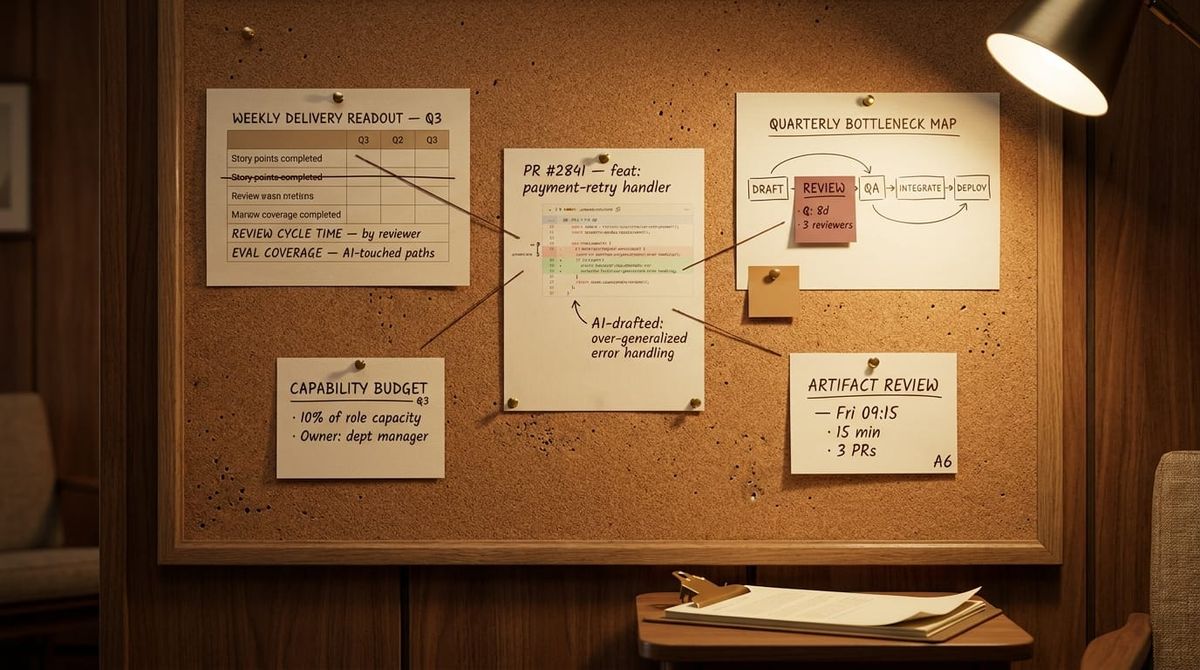
- Pull request review cycle time, by reviewer. Not by author. Authors are no longer the constraint. Reviewers are. A team where the median review cycle has lengthened post-AI is a team where the bottleneck has migrated and nobody has acknowledged it.
- Eval-harness coverage on AI-touched code paths. If AI is drafting code, the discipline that catches the new failure modes is the eval harness, not the unit test suite. Coverage of the eval harness on the code paths the AI is touching is the load-bearing signal.
- Post-deploy defect rate, segmented by AI-touched and human-only changes. The segmentation is the point. If the AI-touched changes have a higher defect rate, the review step is not catching what it used to catch and the manager needs to know.
- Time-to-decision in BA and SA work. When AI drafts the first version of the spec or the architecture, the question is no longer how long it takes to write the document; it is how long it takes the human to decide which version of the document is the right one. That decision time is the new bottleneck and it is not on any dashboard I have seen ship by default.
Make this swap halfway through a rollout that is outwardly successful and inwardly stuck, dropping story points from the weekly readout entirely and adding review cycle time and eval coverage, and within two weeks the conversation in the lead-engineering meeting changes. Before, the conversation is about whether the engineers are using the tools enough. After, it is about why three particular reviewers are eight days deep in a queue and what the team can do to redistribute review load. That is the conversation the transformation was supposed to produce in the first place. It only becomes possible after the metrics stop pointing at the cheap step.
A manager who keeps measuring volumes is not measuring delivery anymore. They are measuring how much of the cheap thing the team produced. The new metrics are not optional add-ons. They are the replacement.
The second behavior: ask where AI was used, at the artifact, not in the survey
The default question managers ask after an AI rollout is some variant of: "How often did you use AI this week?" It goes into a weekly self-report survey, an engagement pulse, a Slack form, or, in the worst case, a verbal check-in at the end of standup. The data feeds a dashboard. The dashboard shows the adoption curve. The adoption curve goes up.
The question is asymmetrically biased in ways the manager rarely surfaces. Engineers who are most fluent with AI tools tend to underreport, because for them the AI is no longer a discrete event they remember; it is the default mode of how they write code. Asking them "did you use AI this week" is like asking them whether they used their IDE. The answer is yes, the answer was always yes, and the answer is no longer informative. Meanwhile engineers who are least fluent, who used the tool twice and disliked it, tend to overreport, because the survey is visible, because the rollout has executive backing, because saying no on a public form has a status cost. The survey collects the wrong signal at both ends of the distribution.
The replacement behavior is simple to state and harder to do. Stop asking. Inspect the artifact.
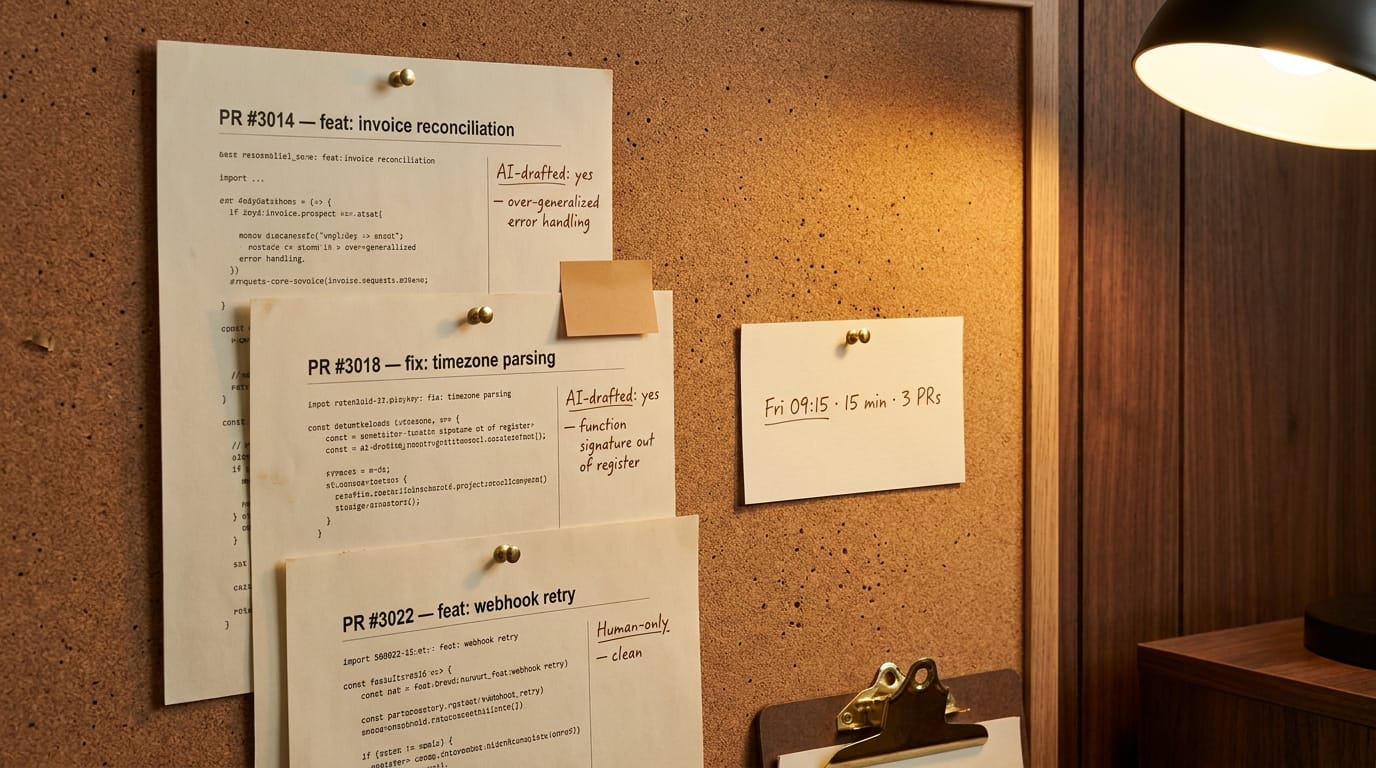
Look at the pull request. The AI fingerprint or its absence is in the code. Patterns that come out of AI-drafted code are recognizable to an experienced reviewer: the over-generalized error handling, the over-commented obvious lines, the function signatures that are syntactically correct but semantically out of register with the rest of the codebase. None of this is bad on its own; the point is that it is visible. A pull request that came through an AI tool reads differently from one that did not, and a manager who reviews three or four PRs per week from each engineer can see the pattern within a month.
Look at the test plan. AI-drafted test plans tend to over-enumerate happy paths and under-enumerate the integration edges. They tend to repeat the structure of the example the team showed the tool. They tend to miss the implicit assumptions in the requirements document that the human QA absorbed but the tool did not. None of this requires sophisticated tooling to detect. It requires the QA lead to actually read the test plans, the way they used to before the tool existed.
Look at the spec. The architecture document. The ADR. Each artifact tells a story about whether the AI was used at the right step or at the wrong one. A spec that came out of an AI assistant with no human structural editing reads as a long, fluent surface with no decision spine. A spec that was drafted by AI and structurally edited by a human BA reads tighter, sometimes shorter, with the decisions clearly load-bearing. The first one is AI being used as a typewriter. The second one is AI being used as a draftsman. The difference matters for delivery; it does not show up on the survey.
In AI rollouts in delivery orgs, the most useful operational change at this layer is a weekly artifact review that the manager runs themselves: fifteen minutes, three artifacts from different team members, read with the AI-fingerprint question explicitly in mind. It produces information the survey cannot produce. It surfaces engineers who are fluent and underreporting (the people the team should learn from) and engineers who are claiming adoption without producing the artifact-level evidence (the people the team needs to understand differently). The artifact tells the truth the survey cannot.
The deeper point is structural. Self-report is a tool the manager layer reaches for when they cannot or will not inspect the work directly. AI transformation surfaces the cost of that habit. A management cadence built on self-report cannot see whether AI is being used at the artifact, only whether the survey was answered.
The third behavior: re-inspect the bottleneck after AI lands, then again every month
Most AI transformations include a bottleneck-mapping exercise before the rollout. A consultant or an internal lead maps the current delivery line, marks the slow steps, identifies where AI could compress them, and the rollout is justified against those compressions. Then the rollout happens. The bottleneck-mapping document goes into the archive. Nobody opens it again.
The mistake is not the mapping. The mistake is doing it once. AI does not compress the bottleneck and leave the rest of the line unchanged. AI eliminates the old bottleneck and surfaces a new one, usually a step that was previously invisible because it was upstream or downstream of where the team's attention sat. The manager who does not re-inspect the line after AI lands keeps optimizing the step that is no longer the constraint, while the actual constraint silently builds queue.
The pattern that repeats across departments is the same. Engineering: drafting was the bottleneck, AI compresses it, review becomes the bottleneck. Most engineering managers do not adjust the review process because the dashboard still says velocity is up. QA: test plan authoring was the bottleneck, AI compresses it, test plan inspection and integration edge coverage become the bottleneck. Most QA leads do not re-staff for inspection because the dashboard says test plans are being produced faster. Product: writing the first draft of the spec was slow, AI makes it fast, deciding which of three competing drafts is the right one becomes the slow step. Most product managers do not formalize the decision step because it does not look like a decision; it looks like a meeting, and meetings have always existed.
The replacement behavior is a calendar item, not a methodology. Once a month, the manager re-walks the line their team owns and asks one question at each step: "Has AI changed how long this step takes, and if yes, where is the time going now?" The walkthrough takes ninety minutes. It produces a different answer in month one than in month four. By month four the new bottleneck has usually fully formed and the manager can see it; by month one it is starting to form and the manager can pre-empt the queue.
A second discipline runs alongside the monthly walkthrough: bottleneck signal in the weekly readout. Not as a metric, as a paragraph. "Here is where the line is slowing this week, here is what we think is causing it, here is what we are trying." The manager who writes that paragraph for their own team every week stays oriented in the new shape of the delivery line. The manager who does not write it loses the line within one or two quarters and starts conflating "people are busy" with "delivery is healthy."
In a common version of this pattern, a QA function looks outwardly successful for three months. Test plan output has doubled. The dashboard celebrates. In month four the integration defect rate spikes, because the AI-drafted test plans have been steadily under-covering the integration edges and no one has re-inspected for it. The bottleneck has moved from "writing test plans" to "ensuring test plans cover the integration boundaries," and the QA lead has not redrawn the line. The fix is operational, not technical: a monthly integration-coverage audit, owned by the QA lead, separate from the test plan output metric. After the audit lands, defects come back to baseline within two months. The dashboard was wrong for a quarter and the only correction was the manager re-inspecting the line.
The general rule is that AI introduction is not a one-time bottleneck event. It is a quarterly migration. The manager who treats it as a one-time event optimizes a step that has stopped being the constraint while the new constraint quietly absorbs the gains.
The fourth behavior: fund capability-building inside the department, with the manager's own budget
When AI training fails (and most AI training programs do fail, in the sense that they do not show up in delivery metrics six months later) the failure mode is rarely the curriculum. The failure mode is that the training was generic and the department-specific operating standards that would have made the training stick were never built. A generic Cursor workshop tells engineers what the keyboard shortcuts are. It does not tell them what the team's PR review template should look like when the PR was AI-drafted. It does not tell the QA lead what the eval scaffold for the team's most common integration patterns should be. It does not tell the BA team what the spec template needs to become when AI is drafting the first version. Generic training cannot do any of those things, because those things are department-specific and they only emerge from inside the department, by experiment.
The fourth manager behavior is to fund those experiments, with the manager's own budget, inside their own department, on the assumption that the workflow standards the team needs cannot be bought from outside.
The reflex against this is that capability-building is HR's territory or learning-and-development's territory or the AI center of excellence's territory. The reflex is wrong, because none of those functions can see the team's workflow at the level a department manager can. HR can run a workshop. L&D can produce a course. The AI CoE can produce a deck. None of them know what the team's PR template should say about review checklists for AI-touched code, because they do not read the team's PRs. The manager does. Only the manager can decide that the team will spend two weeks of slack capacity building out a PR template specifically tuned for AI-assisted submissions, then trial it, then iterate it.
What that looks like in practice is small. It is not a quarter-long initiative. It is a budget line: a fraction of the manager's discretionary time, plus a couple of person-weeks of engineering time per quarter, allocated to building out workflow scaffolding the team will use every day. An effective playbook budgets roughly ten percent of each role's quarterly capacity for this. Some quarters it goes into a new PR review template; another quarter it goes into an eval scaffold for a new product area; another quarter it goes into a spec-template revision tied to a new AI assistant. None of these are large projects. All of them compound. By the end of the year the team is operating against a set of standards that did not exist a year earlier and that no external vendor could have provided.
The mechanism is simple. Top-down training programs land generically because they have to land everywhere. Manager-funded experiments land specifically because they are tuned to one team's actual workflow. Specificity is the load-bearing property. A spec template that was tuned by the team that uses it, against the AI assistant they actually have, will outperform any external best-practice template by a factor that surprises people who have not seen it.
The downstream effect is on retention and on department identity. Teams that build their own standards develop an internal pride in the standards. Teams that import standards develop a relationship of grudging compliance with whatever the CoE published last quarter. The first relationship compounds. The second decays. For owners and C-levels who are asking why AI transformation in one department feels alive while it stalls in another, the answer is almost always at this layer: one manager funded the capability-building and the other did not.
The behavior change is small. It is a budget line and a calendar commitment. It produces the largest compounding effect of the five.
The fifth behavior: replace self-reported adoption with evidence-based oversight at the artifact
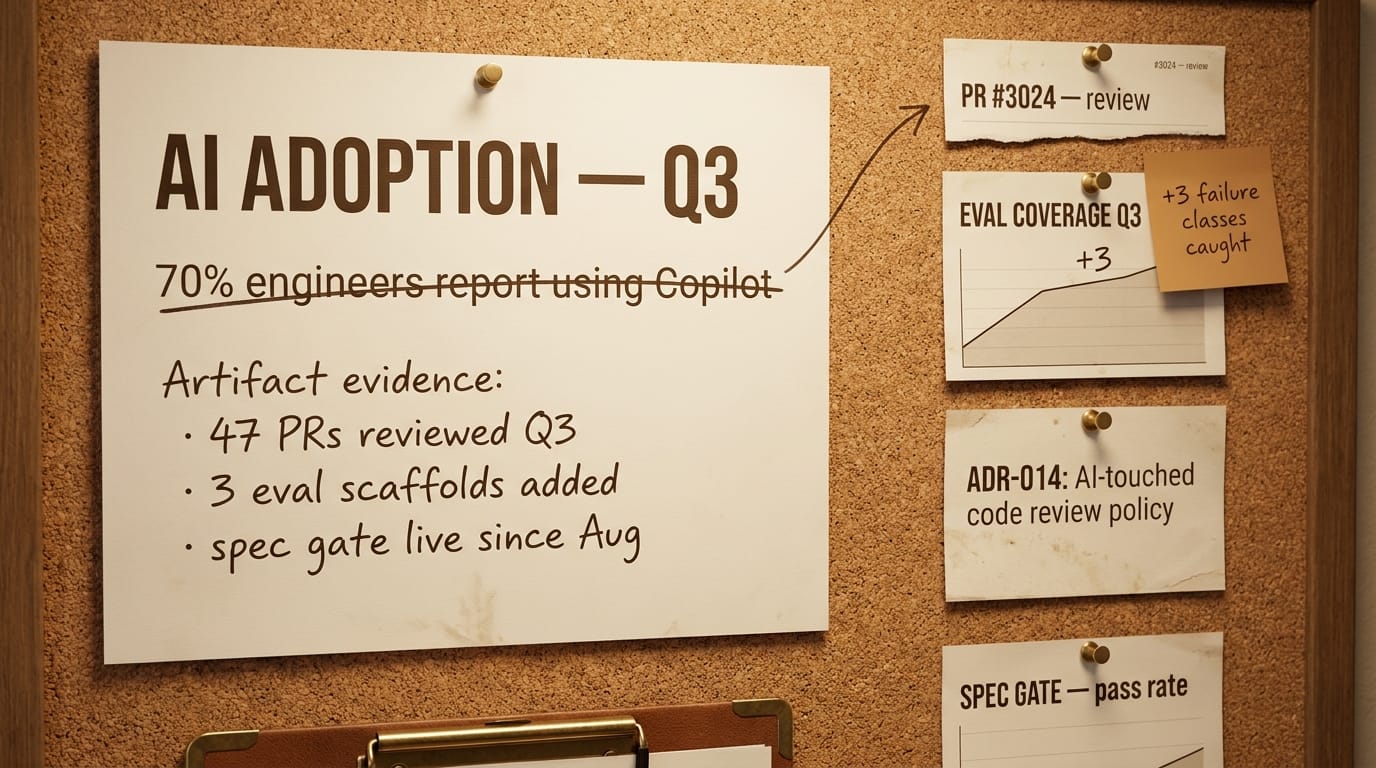
The board update on AI transformation almost always rests on a number that sounds authoritative and means almost nothing: "Seventy percent of engineers report using Cursor at least three times a week." Variants are everywhere. Eighty-three percent of PMs are using the AI assistant. Two-thirds of QAs are using the AI test generator. Every number is a self-reported survey response, aggregated, presented as if it were measurement.
The replacement behavior is evidence-based oversight: every claim about AI adoption is anchored to an artifact the manager can inspect. Not a survey response, not a usage log from the tool vendor, not an interview with the engineer. An artifact. A pull request, an eval harness, a spec gate, an architecture decision record, a dashboard that reads those artifacts directly.
The shift is harder than it sounds because it changes who in the org has the credible story about AI. When adoption is measured by survey, the story belongs to the function that aggregates the surveys, usually a transformation office or an enablement function. When adoption is measured by artifact, the story belongs to the manager who has actually inspected the artifacts. The transformation office can still report; but the report is now derivative of what managers see, not authoritative on its own.
The mechanism is that an artifact-reading discipline forces the manager into the work. Counting reports does not require knowing the work. Inspecting artifacts requires knowing the work intimately: what an AI-drafted PR looks like, what a strong eval harness contains, what a healthy ADR cadence looks like, what a spec gate is actually doing. The discipline produces managers who are operating closer to the work than they were a year earlier. That proximity is itself the operating-model upgrade most transformations are pretending they are buying with tooling.
The companion piece to this article, on what an honest AI adoption dashboard actually contains, works through how to build one. Briefly: it reads pull request metadata for AI-touched signals, it reads eval-harness coverage diffs, it reads ADR cadence, it reads spec-gate pass-rates, and it reads post-deploy defect segmentation. Each of those is an artifact a manager can also inspect manually before the dashboard exists. The dashboard scales the discipline; the discipline does not require the dashboard. Managers who wait for the dashboard before changing oversight will wait the entire year they had to make the operating-model shift. Managers who start with manual inspection and then formalize what they keep finding into a dashboard get the discipline immediately and the scaling later.
The deeper point is about the kind of trust an organization can credibly report. Survey-anchored adoption stories are believed for one or two quarters and then they are not. The CEO senses the asymmetry (the survey says yes, the delivery numbers say nothing) and starts asking different questions. The first time the CEO asks "show me what changed in the actual PRs" and the answer is "we have not looked," the trust in the transformation function collapses. The replacement is evidence the manager can actually walk into the room with: a stack of recent PRs annotated for AI fingerprint and review quality, a spec template that exists today and did not exist last quarter, an eval scaffold that catches three classes of failure the test suite was missing, a dashboard the manager built that reads the artifacts.
The org that can produce that evidence has done AI transformation. The org that can only produce the survey has done AI procurement.
The five behaviors are one operating-model shift
The five behaviors above are not five separate initiatives. They are one shift in what managers actually do, every week, with their teams. The old role of the delivery manager was to be a delivery accountant: to track volumes, aggregate progress against milestones, summarize the state of the work for executives, and protect the team's capacity. The new role, after AI lands, is to be a delivery inspector: to read the artifacts the work produces, to maintain accurate maps of where the constraint actually sits, to fund the small capability experiments that compound into department-specific operating standards, and to anchor every claim about adoption in evidence the manager has personally seen.
Accountancy and inspection are different jobs. They use different skills, they require different time allocations, they produce different artifacts of their own. An accountant produces reports. An inspector produces judgments, anchored in evidence, that the rest of the org can act on. AI transformation needs the latter and most organizations are still hiring, promoting, and supporting the former.
What it looks like when an org makes the shift is not dramatic. The delivery readout gets shorter. The metrics on it change. The questions in standup change. The retro looks at the line, not the velocity. The manager's calendar has a recurring item called "artifact review" that did not exist a year earlier. Capability-building lives inside the department's quarterly plan with a budget line attached. The board update contains numbers anchored to artifacts the executive could inspect themselves if they asked.
What it looks like when an org does not make the shift is also not dramatic. The tools stay. The dashboards stay. The survey-based adoption numbers stay. The delivery numbers stay flat. The founder keeps asking why, in different words, every quarter. The transformation lead keeps building decks that explain why adoption is high but delivery has not moved. The department heads start slow-walking the next phase of investment. Two years after the rollout the company has spent the budget, hired the tools, run the trainings, and produced no compounding operating capability. The story externally is that AI is hard. The story internally is that the manager layer was the missing layer and nobody redesigned it.
For the owner or C-level reading this and recognizing the asymmetry (the adoption curve up, the delivery curve flat) the work is not to buy more tools or to run more training. The work is to redesign what your managers do. The five behaviors above are the redesign. Treat them as the operating model, not as suggestions; fund them through quarterly planning, not through enablement; and measure them at the manager layer, not at the team layer. The org that makes the shift sees AI transformation. The org that does not keeps buying tools.
AI Transparency Notice: This article and its accompanying images were created with the assistance of generative AI. The author directed the content, contributed the underlying ideas and analysis, and reviewed the final publication.