Your AI MVP Doesn't Need More Features. It Needs One Proven Outcome
Most AI products do not stall for lack of features. They stall because they ask users to build the machine before it does anything, then never check whether anyone comes back. The fix is an outcome-first shape: one valuable result, proven.
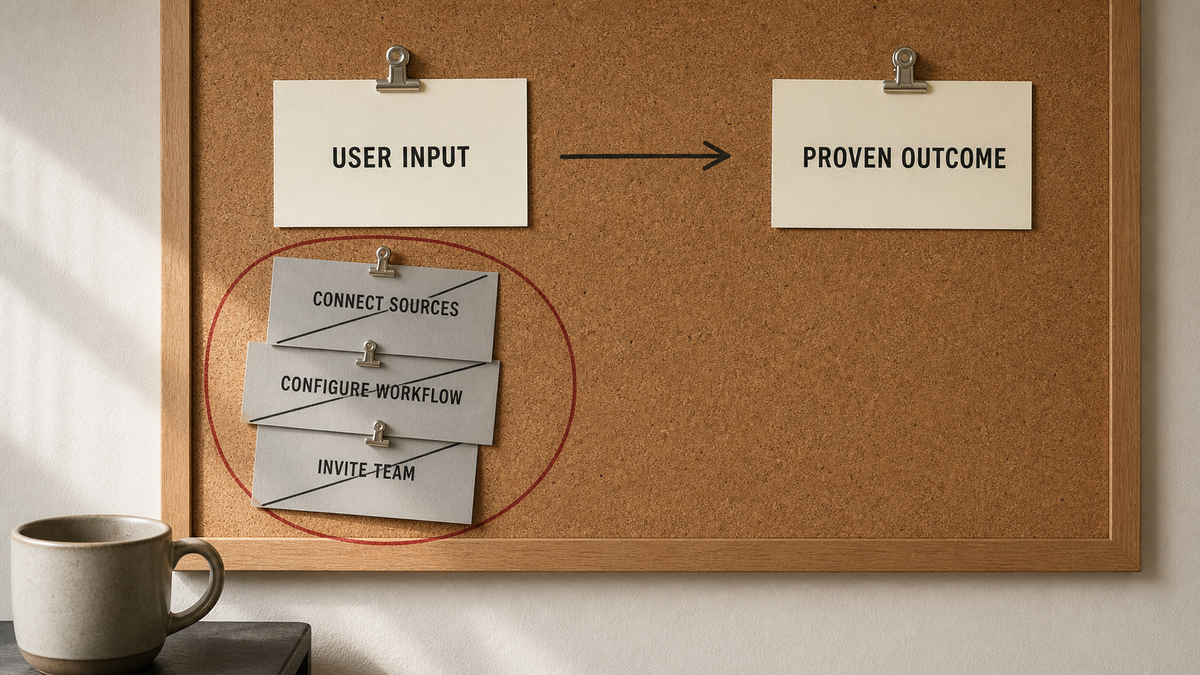
You built the product. It demos beautifully. Yet every sprint ends the same way: almost ready, not quite shippable, one more integration before it counts. The team is not lazy and the model is not the problem. The product is stuck in R&D, and the usual fix, more features, keeps making it worse. That gap between a great demo and a product nobody ships is the symptom this piece is about.
The principle this piece argues: an AI product should optimize for the shortest trusted path to one valuable outcome, then validate technical quality and repeated customer value separately. Treat that as the product shape, not a polish step.
A lot of noise right now says SaaS is dead, or that the MVP is dead. Neither is true. Eric Ries framed the MVP around validated learning, the fastest way to test a hypothesis with real users, and that idea is alive and correct; this piece relies on it. The subscription-software model still works too, and plenty of products that front-load onboarding are fine, because their buyer is a team that expects a configuration project. What fails is narrower: the feature-complete-first implementation of an outcome-promising product, the one that gates a generated or automated result behind a week of manual setup. The MVP as a learning mechanism is not the problem. Reading "minimum viable" as "smallest feature-complete system, then let users in" is.
Two terms here have a history worth getting right, because I am about to use one of them more narrowly than its authors did. Minimum Lovable Product (MLP) was coined by Brian de Haaff at Aha! in 2013 as a counterpoint to the MVP; in his framing, lovable means a product customers love, recommend, and are willing to pay for, with delight and differentiation as the bar. Henrik Kniberg published a related idea, the Earliest Lovable Product, in 2016: a marketable product customers love, the smallest thing that is genuinely lovable rather than merely tolerable. Both center customer love and delight.
I am using MLP more narrowly than that conventional meaning. Here it means an outcome-first product shape: one valuable result, a defined quality threshold for that result, and the shortest credible path to experiencing it, with evidence of repeated value tracked separately. Call it Outcome-First MLP to keep the distinction clean. The de Haaff and Kniberg versions are about delight and differentiation; mine is about one load-bearing outcome plus the evidence that it is correct and that people come back to it. I am borrowing the word, not their definition, and it is worth saying so out loud rather than letting the reader assume I mean what they meant.
The argument has three moves. The bar for outcome-promising products moved, and a particular MVP shape struggles against it. Outcome-First MLP is best understood not as a delight upgrade but as an R&D operating constraint, the thing that makes a stalled product visible earlier. And the discipline is a mechanism with three parts, each preventing one failure mode. None of this requires you to believe SaaS or the MVP is finished. It requires you to look at what your product asks a user to do before it does anything for them.
The bar moved for outcome-promising products, and a familiar MVP shape struggles
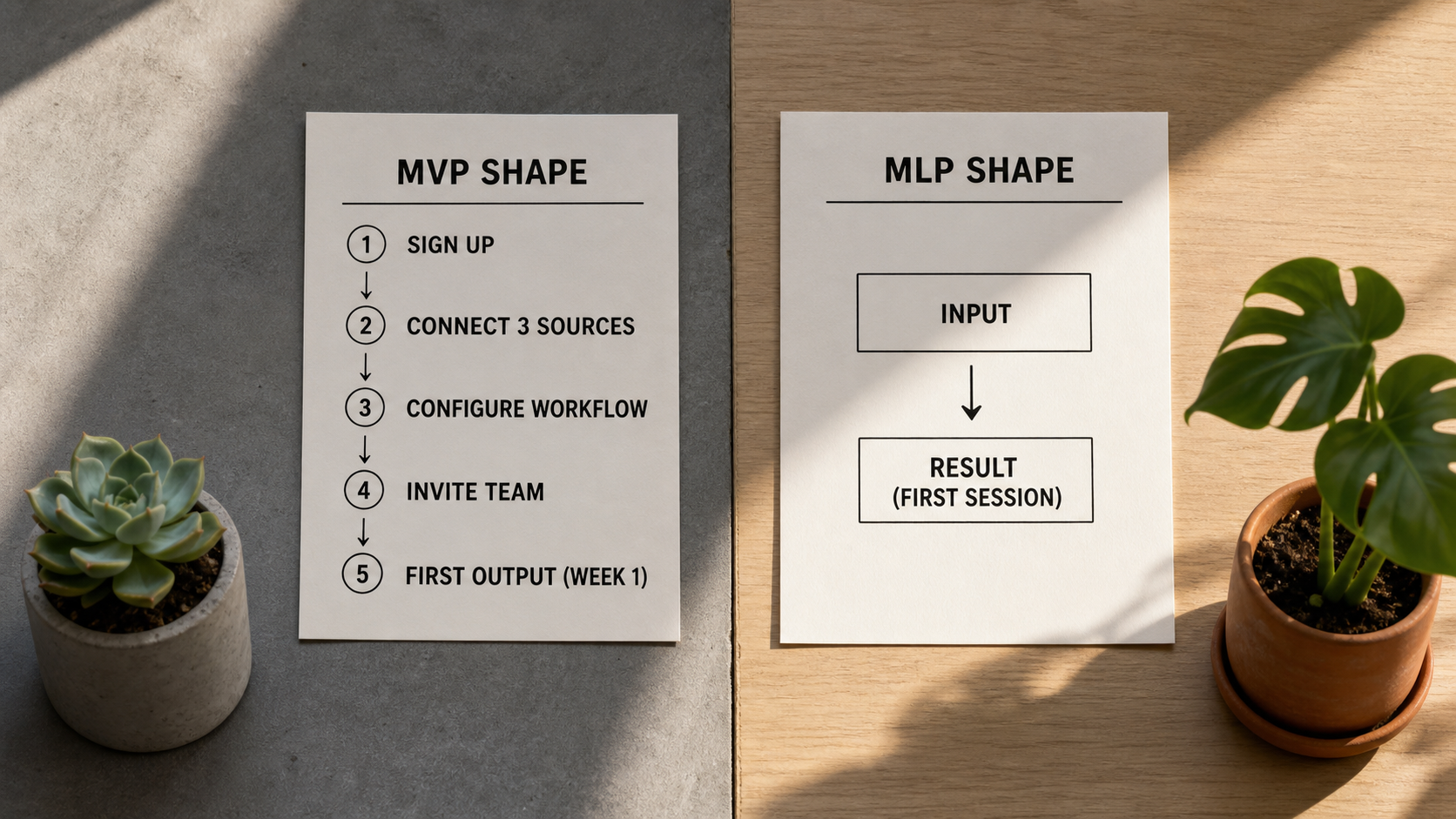
Picture two onboarding flows. In the first, a user signs up, connects three data sources, configures a workflow, invites their team, and a week later the product produces its first useful output. In the second, the user pastes one thing in and gets a result they would have paid for, before connecting anything. Five years ago the first flow was normal and the second was rare. For products whose pitch is an immediate outcome, that ordering now reads backwards, and the first flow reads as friction the user will not finish.
In my own product work I take this as an observed operator thesis, not a measured fact: AI-native users have a new reference point for what a product can do on the first try. They have watched a tool turn a prompt into working code, a paragraph into a summary, a messy spreadsheet into a chart, without a setup project. That experience resets what they will tolerate. There is no clean public dataset proving the expectation flipped on a date, so I am not going to pretend there is one. What I can say from building these products is that when the pitch is a generated or automated outcome, a configure-then-maybe-value flow now feels like being asked to assemble the machine before seeing whether it works.
The MVP-vs-MLP distinction is not a maturity ladder where lovable comes after viable. That is the framing most product writing reaches for, and it misleads here. The MVP, in its learning-oriented framing, is the smallest build that tells you whether anyone wants the thing. That goal is sound. The failure is in the common implementation: teams build the smallest feature-complete system, then gate the learning behind the setup that a feature-complete system needs. For an outcome-promising product you can ship something feature-complete and still learn nothing, because no user reaches the outcome that would have told you whether they want it.
So the useful question is not which shape is more mature. It is which shape lets a user reach the proven outcome fast enough to tell you the truth. That is a different axis from delight, and it is the axis that decides whether the product gets out of R&D at all.

Outcome-First MLP is an R&D constraint, not a design garnish
Most explainers treat the lovable part as the point: add personality, smooth the edges, make the experience delightful so users prefer you and stop shopping around. That is real product work and none of it is wrong. But it sits downstream of a harder question, and putting it first is how teams end up polishing a product that still cannot ship. The harder question is whether the product has committed to one outcome it can deliver reliably, and the delight framing skips past it.
Here is the operative idea. The magic-button outcome is the single user input that produces the product's promised result without the user configuring the full system first. Paste in the messy data, get the clean chart. Drop in the contract, get the risk summary. Describe the bug, get the candidate fix. The "magic moment" language that floats around product writing points at the same feeling, but I use magic-button outcome deliberately, because it names a structure rather than an emotion: one input, one result, nothing required between them.
Committing to one magic-button outcome forces the team to define correct output for that outcome, but only when the outcome is tied to a quality threshold and a named owner. The threshold answers "what counts as a correct result here," in terms specific enough that two engineers would grade the same output the same way. The owner is one person accountable for whether that outcome works, not a committee that can each assume someone else is checking. Without the threshold and the owner, "pick one outcome" is a slogan the next planning meeting widens back into a feature list.
A caution that the rest of this piece turns on: two engineers agreeing on a rubric is evidence that grading is consistent. It does not prove the outcome is valuable. That is why correctness and value are two separate questions, and conflating them is the most common way a team convinces itself a product is working when only half of it is. Hold that distinction; the validation section below splits on it.
With the threshold and owner in place, the constraint bites. A configure-then-maybe-value surface lets a team stay busy and feel productive while the question "is the core outcome actually correct" goes unanswered, because there is always another integration to build, another setting to expose, another edge case to handle first. That is the deeper diagnosis behind the familiar complaint that the demo works but nobody can define correct output. The demo works because a demo is a single happy path. Correct output stays undefined because the product never had to commit to one outcome and grade it. The discipline does not motivate the team to commit. It removes the place to hide.
Front-loaded setup is one thing that lets the stall stay invisible
I want to be careful not to overclaim. Front-loaded setup is not the single master reason an AI product stuck in R&D never ships. Products stall for plenty of reasons: a model that is not good enough yet, a market smaller than the pitch, a team that loses the thread. What front-loaded setup does is quieter and, in practice, more dangerous. It can delay exposure of the core outcome to real users, and it lets integration progress substitute for evidence that the outcome is valuable.
Those are two distinct hazards and worth separating. A team can in fact build evals and test representative inputs before any onboarding flow exists; nothing about a configuration project prevents technical-quality work. So front-loaded setup does not automatically mean the outcome is ungraded. The reliable damage is on the value side: as long as the result sits behind a setup wall, no real user is reaching it, so behavioral evidence of value never accumulates, and the team reads "the integration shipped" as progress toward a product people want. It is not. It is progress toward a product people could reach, which is a different and weaker thing.
Shorten the path and you change when the value question arrives. If a user reaches the outcome early, behavioral evidence starts accumulating early, while the surface is small and the core is cheap to fix. If the outcome is gated behind a configuration project, that evidence does not start until the surface is large, when fixing the core is expensive and politically hard. Same product, same model. The difference is when real usage, and the truth it carries, shows up.
This connects to a sibling problem I have written about separately: getting an AI feature from a working prototype to reliable production usually fails on evals and reliability, not on the idea. That is the technical-quality side of the same stall, whether the outcome holds up across the real distribution of inputs. The product-shape side is whether the path is short enough that real users reach the outcome and tell you, through behavior, whether it is worth returning to. The two reinforce each other. Shorten the path to surface the outcome; build evals to catch and correct drift in that outcome as usage grows.
The discipline is three moves, each preventing one failure mode
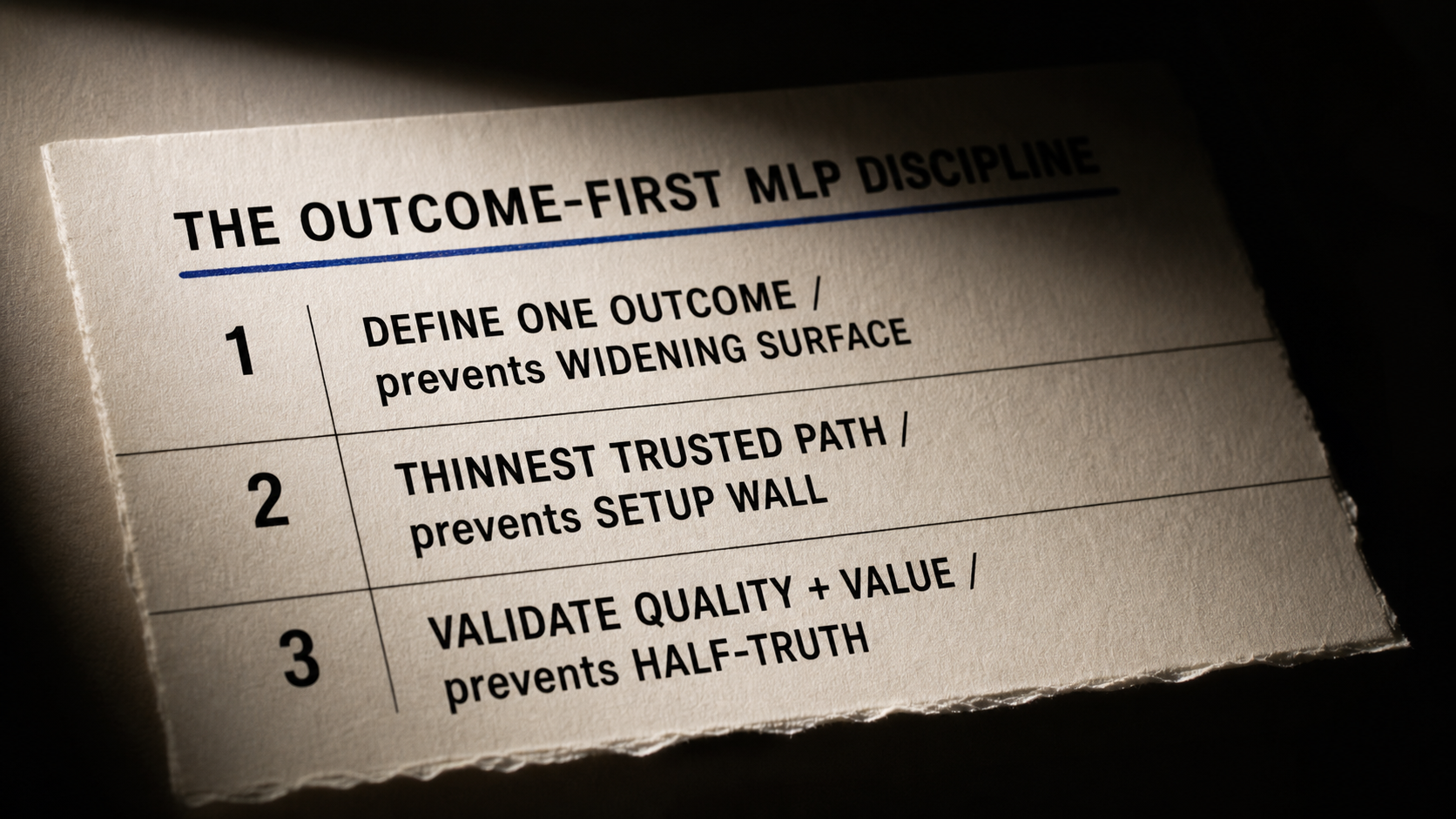
None of this is motivational. It is a mechanism with three parts, each preventing a specific way products stall. The moves are ordered: you cannot shorten the path to an outcome you have not chosen, and you cannot validate value before users can reach it.
| Move | What you do | The failure mode it prevents |
|---|---|---|
| 1. Define one valuable outcome | Name the single result the product must deliver, the job it proves, and tie it to a quality threshold and a named owner. | The widening surface. A team with no committed outcome keeps adding breadth and never has to define correct output for anything. |
| 2. Build the thinnest trusted path | Reduce the steps between the user's first input and the result to as little as is genuinely necessary for correctness, trust, and risk control. | The setup wall. A user who must assemble the system before seeing value abandons before the product gets a chance to prove itself. |
| 3. Validate quality and repeated value, separately | Run the quality gate (is the result correct and reliable?) and the value-evidence gate (do qualified users come back, complete the job, pay, or replace a workflow?) as two distinct checks. | The half-truth. Grading consistency without behavioral evidence, or activation without correctness, each reads as success while the product is only half-validated. |
Take the first move. Defining one valuable outcome sounds obvious until you watch a roadmap meeting, where the gravity is always toward "and also." The discipline is the refusal: for this release, the product is the one outcome, everything else is a setting we may add later. The quality threshold makes the refusal stick, because once you have written down what correct output means, you can see plainly that the second and third features do not have thresholds yet, which means they are not committed outcomes, which means they wait.
The second move, building the thinnest trusted path, is where most of the engineering lives, and it is unglamorous. The rule is not "remove the steps." It is: eliminate, automate, or defer every setup step that is not necessary for correctness, trust, or risk control. That qualifier matters, because frictionlessness is not the goal and chasing it introduces its own failures. Inferring a schema instead of asking the user to map it can encode a wrong assumption. Auto-defaulting permissions can expose data the user did not mean to share. Processing a document the instant it lands can act on incomplete context, or return a confident answer that is wrong. So you shorten the path where shortening it is safe, and you keep the step where the step is what makes the result trustworthy. The test is precise: can a brand-new user reach the proven outcome with no more setup than correctness and safety genuinely require? If a step is there only because it was easier to build that way, it goes. If it is there because removing it makes the result wrong or unsafe, it stays.
The third move, validating quality and repeated value separately, is the one that makes the whole thing a constraint rather than a preference, and it is the move teams most often collapse into one. The two gates ask different questions and take different evidence.
The quality gate asks: is the result correct, safe, and reliable enough? Evidence is the threshold rubric plus a representative set of real cases the result is graded against. This is where two engineers grading the same output the same way matters. But pass this gate and you have proved consistency, not demand.
The value-evidence gate asks: do qualified users actually keep using it? Evidence here is behavior, not stated intent. Asking a user "would you come back" or "would you choose this again" is weak evidence; people are generous in surveys and honest in their calendars. So watch what they do: a second use within an interval that fits the job, successful completion of the target task, repeat use on a different real input, willingness to pay or to continue paying, replacement of an existing manual workflow with this one, an output-acceptance rate that beats the correction rate. First-session activation tells you the path is short enough to reach the outcome once. It does not establish durable value. Durable value is a returning pattern, and you only see it by leaving the gates separate and reading the behavioral one over time.
"Lovable" is a bar for shippable, not a coat of polish
So what does the lovable word actually do here, once you strip the personality reading off it. In de Haaff's and Kniberg's sense it means customers love and recommend the product. In the Outcome-First sense I am using, it collapses to two gates passing: the one outcome clears its quality threshold on real inputs, and qualified users keep returning to it. That is a higher bar than "it works in the demo" and a lower bar than "the product is complete," and unlike delight it is measurable, because both gates produce evidence.
Setting that bar changes two things inside the team that the polish reading never touches. The first is the review standard. Once shippable means "the outcome cleared the quality gate and the value-evidence gate," your review of a release stops being "did the team ship the features" and becomes "is the outcome correct, and are users returning to it." That is a stricter gate, and it is the one that catches a product that is busy but not shippable. The second is decision rights. The named owner is the person who can say "not yet" when either gate is unmet, and mean it, even when the calendar says launch. Without a clear owner, "lovable" decays into a vibe everyone interprets differently and no one can enforce.
Keep this honestly scoped. Defining one outcome, shortening the path, and running two gates do not redefine how your whole company operates. They are a product and R&D discipline, not a new operating model, and treating them as more is its own overclaim. There is more to shipping than one magic-button outcome: pricing, support, the second and third outcomes you add once the first is proven, the operating cadence that keeps quality from drifting as you scale. Outcome-First MLP gets the first outcome correct, reachable, and validated. It is a foundation for the rest, not a replacement for it.
What changes in how your team decides shippable
If you take one thing from this, make it a change to how the team decides what counts as done, not a new line on the roadmap. The stall you are fighting is rarely a shortage of features. It is a product that has never had to say, out loud and early, which single outcome it is willing to be graded on, and whether anyone keeps coming back to it. That avoidance feels safe and is expensive, because the bill comes due as a product that demos forever and ships never.
So the operating change is small to state and uncomfortable to adopt. Before the next release, the team names the one valuable outcome, writes the quality threshold that defines correct output for it, and assigns one owner who can hold the line. It builds the thinnest path that lets a real user reach that outcome without sacrificing correctness or safety. Then it runs both gates honestly: is the result correct on real inputs, and are qualified users returning. The first gate is an eval, and the eval-driven path from AI prototype to production shows how to build it. If either gate is unmet, that gap is the work, and it comes before anything you were going to add next.
That is the whole move. Not a redesign, not a tools checklist, not a tagline. A constraint that makes the stall visible while it is still cheap to fix. SaaS is not dead and the MVP is not dead. The product that asks a user to build the machine before it does anything for them, and then never checks whether anyone returns, is the shape that struggles. Optimize for the shortest trusted path to one valuable outcome, then prove quality and repeated value separately, and the product stops hiding in R&D.
AI Transparency Notice: This article and its accompanying images were created with the assistance of generative AI. The author directed the content, contributed the underlying ideas and analysis, and reviewed the final publication.