AI Did Not Shrink the QA Role. It Moved It Upstream.
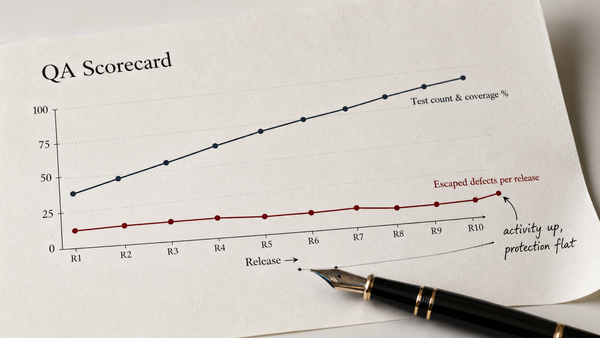
A QA function turns on AI test generation. Test counts, suite size, coverage all rise. Escaped defects stay flat. The team was promised faster quality and got faster activity instead. That is not an adoption problem. It is a design problem AI made visible.

A QA function turns on AI test generation. Within a sprint or two the numbers that go up are obvious: test count, suite size, coverage percentage on the dashboard. The number that does not move is the one the team is actually accountable for. Escaped defects stay flat. Reopens stay flat. The review queue gets longer, not shorter, because someone still has to read all those generated tests. You were promised faster quality and you got faster activity instead.
AI QA testing is the use of AI agents to generate, execute, and maintain software tests from requirements, specs, and recorded flows. The capability is real and now near-free. The trap is treating it as the whole job. AI commoditized test execution, so the scarce, role-defining skill is now test design, deciding what "tested" actually means for this product.
This is not an adoption problem. The team adopted AI. It is a design problem that AI made visible. When execution was expensive, the constraint on quality was tester-hours, so "we need more QAs" was a rational thing to ask for. AI removed that constraint completely. What is left is the constraint that was always there, hidden behind manual labor: nobody owns a quality strategy that says what good looks like for this specific product. The QA role did not get smaller. It moved to where the leverage is, which is upstream of the test, in the decision about what to test and why.
More tests is not more quality. It is more execution.
Start with the gap that shows up on the dashboard, because it is the thing the reader has already felt. A team writes ten times more tests with AI and the escaped-defect rate does not improve. The instinct is to assume the tests are low quality, or that the team needs to write even more of them. Both readings miss the mechanism.
Test volume measures activity. Escaped defects and reopens measure performance. Those two numbers track together only as long as a human is deciding what each test should cover, because the deciding is the expensive part and the writing is cheap. The moment you automate the writing without changing the deciding, the two numbers decouple. You are now producing test execution at industrial scale on top of the same test design you had before, which means you are testing the same things you already knew how to test, just more of them.
This is the test design vs test execution distinction, and it is the whole article in one line. Execution is the part AI is good at: turn this acceptance criterion into a test, turn this recorded flow into runnable code, turn this API spec into a request-and-assert suite. Design is the part AI cannot do for you: decide that the payment-retry path matters more than the settings page, decide that "tested" for a checkout flow means concurrency and partial failures and not just the happy path, decide which of the ten thousand possible tests are the fifty that would actually catch the bugs that reach users.
A useful way to read your own dashboard: if test count is climbing and escaped defects are flat, you have automated execution and left design untouched. That is not a failure of the tools. It is a signal about where the work moved.
The bottleneck moved from headcount to strategy.
Picture the budget conversation that used to happen every planning cycle. Coverage is thin, the backlog of untested features is growing, and the QA lead asks for another two testers. The ask was rational because the binding constraint was real: test coverage was limited by how many tester-hours you could buy. More people meant more tests meant more coverage. The math held.
AI broke that math, and it is worth being precise about what it broke. It did not make testers unnecessary. It made tester-hours a non-constraint for the execution layer. An agent can generate a week of a junior tester's test-writing output in an afternoon. So the old ask, "we need more QAs," now buys you almost nothing, because the thing you were buying with it, raw execution capacity, is the thing that just went to near-zero cost.
What is left is the constraint that headcount was always quietly compensating for. Somebody has to decide the quality strategy: what risks this product carries, which failures are unacceptable versus merely annoying, what the regression surface actually is, what "done" means for a feature before anyone writes a line of test code. That work never scaled with headcount. You could hire ten testers and still have no one who owned the answer to "what should we be testing and why." Manual labor hid the gap because the testers were busy enough that the absence of a strategy looked like a capacity problem.
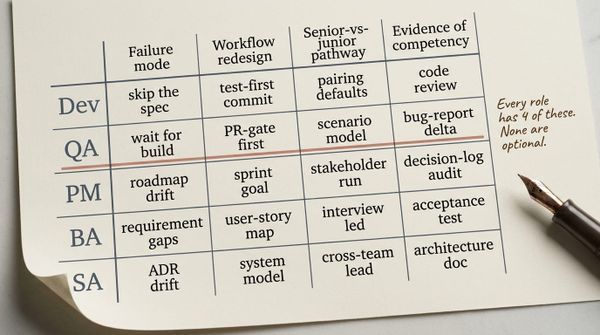
This is why the role label that fits the AI-enabled QA is test-system architect, not manual executor. The architect's output is not tests. It is the design that decides which tests are worth generating, the rules that the agents follow, the standards that define acceptable coverage for each kind of feature, and the judgment about where to point near-infinite execution capacity. An architect who can write a sharp rule that makes every future generated suite better is worth more than a team of people each writing tests by hand, and the gap between those two is now the gap that determines whether your quality numbers move.
The CTO version of this: the right response to "our QAs are using AI and quality hasn't improved" is not a tooling review. It is asking who owns the quality strategy, and whether that person has the authority and the time to design it instead of executing against it.
Quality moves left, into requirements, before a line of code ships.
The highest-leverage place to put AI in QA is not where most teams put it. Most teams point it at the build: generate tests for what we just shipped. The move that actually changes the escaped-defect number points it earlier, at the requirements, before sprint commitment. This is left-shift testing, and AI is what finally makes it cheap enough to do on every story instead of only on the big ones.
Here is the mechanism. A defect caught in requirements is generally cheaper to fix than the same defect caught in production, because by production it has been built on, shipped, and worked around, so unwinding it means touching everything downstream of the original mistake. The popular version of this claim comes wrapped in a precise-looking multiplier, often a 100x figure pinned to a decades-old IBM study, and that specific number does not survive scrutiny: the original data has never been reliably traced, and recent work questions whether the cost curve is anywhere near as steep or as universal as the folklore claims. Strip the false precision and the durable part is modest and still useful: catching a defect while it is still a sentence in a ticket is usually cheaper than catching it after three engineers have built on it. The reason QA rarely captured that saving is that catching defects in requirements was always too slow to run consistently, because it meant a human carefully reading every user story looking for what was missing. So it got done for the high-stakes features and skipped for the rest, which is where a lot of escaped defects actually originate.
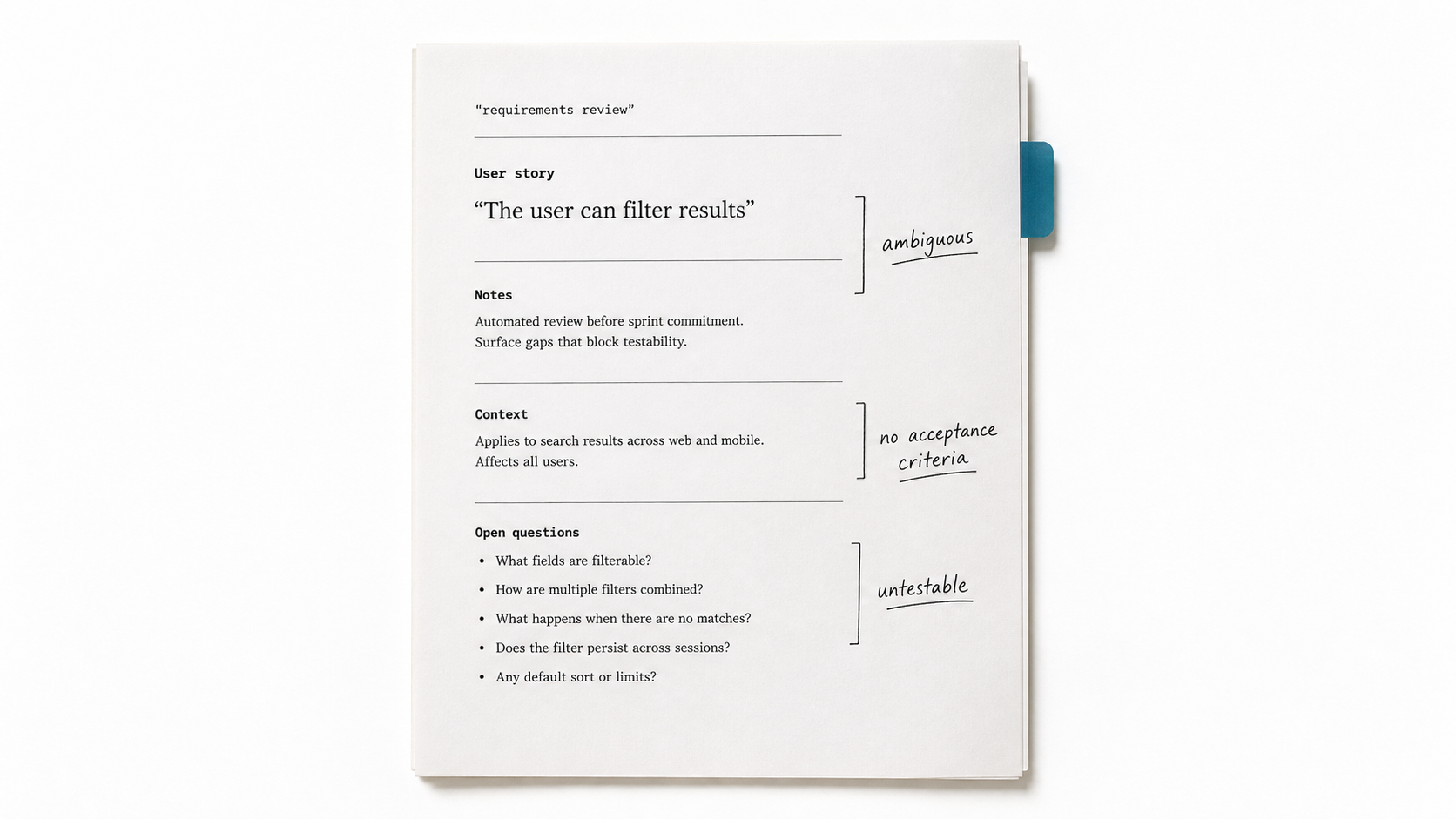
AI changes the economics of that read. You can run a requirements quality gate as an automated step: an agent reads each user story before it is committed to a sprint and surfaces the ambiguities, the missing acceptance criteria, the untestable statements, the implicit assumptions nobody wrote down. "The user can filter results" is untestable as written. Filter by what fields? What happens with no matches? Does the filter persist across sessions? The gate catches that the criterion is incomplete while it is still a sentence in a ticket, not after three engineers have built three different interpretations of it.
The reframe for the QA role is the part that matters. When the requirements quality gate runs before commitment, the QA lead is no longer the person who finds bugs at the end. They are the person who makes the work testable at the start, which is a more senior position in the delivery process. You are shaping what gets built, not just verifying what got built. Name that practice plainly when you install it. It is the clearest single signal that QA has moved upstream, and it is the workflow with the highest return on the escaped-defect number, because the defects it prevents never get written.
API and UI autotests are table stakes now, not a senior skill.
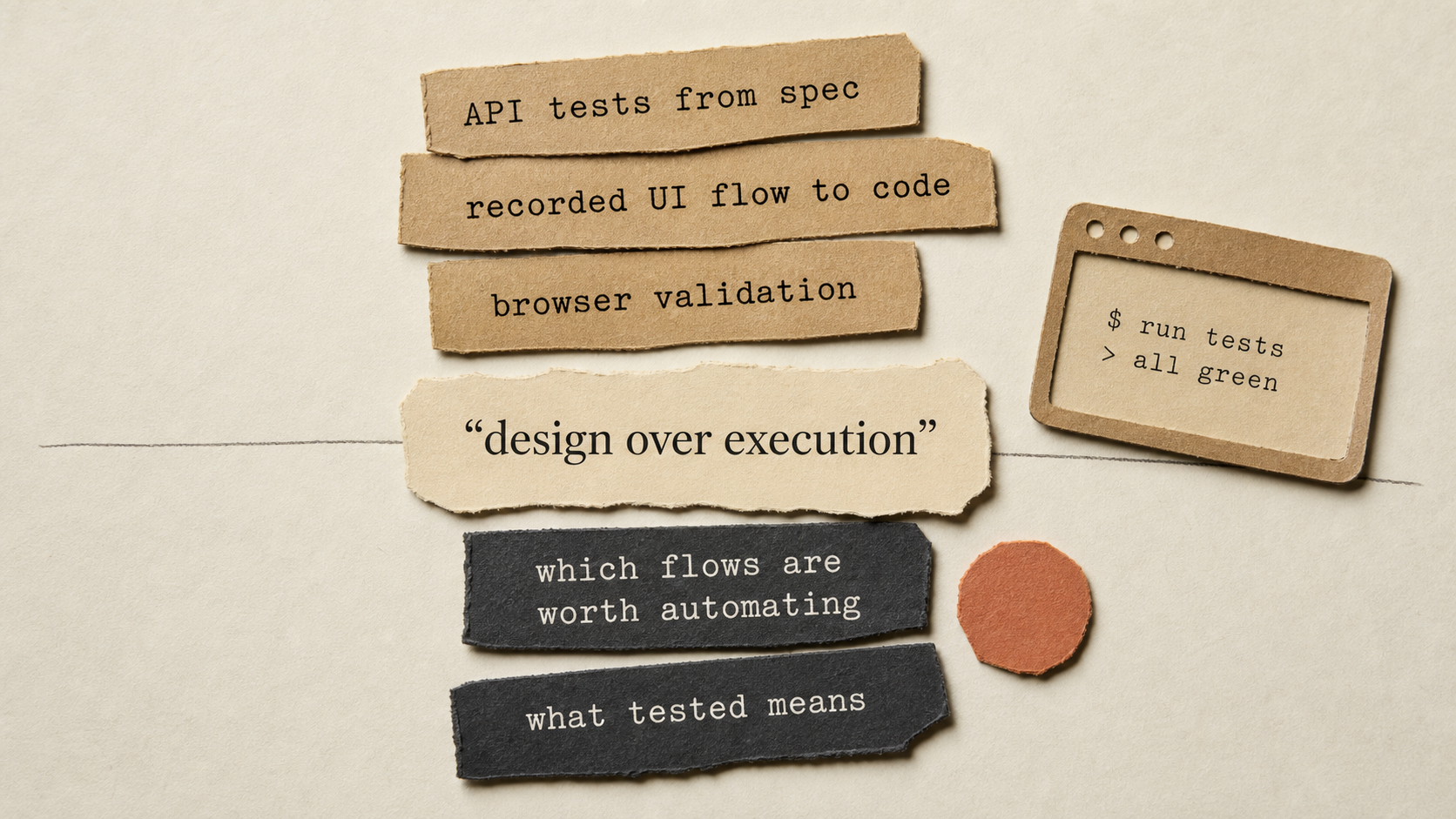
Two capabilities that used to mark out a senior automation engineer are now baseline, and treating them as advanced is part of how teams misread where the value is. The first is generating executable API tests directly from specs. The second is producing UI end-to-end tests without hand-writing every selector. Agentic coding tools (Claude Code, Codex, Cursor are the ones I reach for) do both well enough that the capability itself no longer differentiates anyone.
On the API side, the workflow is direct. Point an agent at an API contract or an OpenAPI/Swagger spec and it generates a runnable test suite in whatever framework the team uses, covering response schemas, status codes, auth, error handling, and rate limiting. The generated tests will not be perfect. They will have the occasional redundant assertion and miss an edge case or two. But they exercise the real API, run in CI, and catch the bugs that matter: a broken serializer, a missing validation rule, an auth path that silently allows what it should reject. As you codify patterns into the agent's rules, the generated code gets better on its own, which is the compounding part most teams skip.
UI testing is where the tool conversation usually goes wrong, so be deliberate here. The capability is what matters, not the specific framework. AI-generated UI autotests work across the major end-to-end frameworks. A record-and-convert workflow, where you record a flow once and an agent converts the raw output into clean project-specific test code, exists for Cypress, Selenium, and Playwright among others. Agent-driven browser validation, where an agent navigates the application directly, inspects the DOM, fills forms, and captures state, is similarly tool-agnostic and available through the browser-automation integrations those frameworks expose, though how reliably it runs against real authentication, session handling, and dynamic DOMs still varies a lot from one stack to the next. Whichever framework your team already standardized on, the AI-generated-UI-test capability is available for it. The framework choice is a team preference. The capability is the table-stakes part.
Here is what is now baseline versus what is genuinely senior, because the line moved and a lot of hiring and leveling has not caught up:
| Capability | Used to be senior | Now |
|---|---|---|
| Writing API tests from a spec | Senior automation skill | Baseline draft, agent-generated; covering what the spec leaves out is still senior |
| Converting a recorded UI flow to maintainable code | Senior automation skill | First draft is baseline; hardening it against DOM and timing churn is still senior |
| Agent-driven browser validation of a flow | Advanced, rare | Crossing into baseline, reliability still varies by stack |
| Deciding which flows are worth automating at all | Implicit, undervalued | The senior skill |
| Defining what "tested" means for a risky feature | Implicit, undervalued | The senior skill |
| Designing the rules that make every generated suite better | Did not exist | The senior skill |
Read the right column as where the floor is moving, not as a census of where every team already stands. The transitions are partial and the qualifiers are load-bearing: a generated suite is a first draft, and making it maintainable is still the work. Plenty of competent QA functions do not yet have agent-driven browser validation running reliably against real auth flows and dynamic DOMs, and they are not behind for it. "Baseline" here means the skill stopped being a differentiator, not that every org has it wired up.
The point is not that automation engineers are obsolete. The point is that seniority in QA is now defined by design judgment, not by who can wire up an end-to-end framework, because wiring it up is something an agent does in an afternoon. If your leveling rubric still rewards "can build a Selenium or Playwright suite" as a senior signal, it is measuring a commodity.
Testing the AI itself is now core QA work, not a niche.
There is a genuinely new responsibility that did not exist on the QA job description three years ago, and most teams are still treating it as a specialist's hobby. Nearly every product now ships a feature with a GenAI component: a summarizer, a chat assistant, a classifier, a copilot, a generated-content surface. That component does not behave like the rest of the software. It is non-deterministic. The same input produces different outputs, and a model upgrade can silently change the quality of every response without a single line of your code changing.
Deterministic regression tests do not cover this. A test that asserts an exact string passes today and fails tomorrow for a response that is actually fine, or worse, passes on a response that has quietly degraded. So LLM output testing becomes a QA responsibility. It has two practical shapes, and it is worth being honest that neither is as turnkey as the tooling demos make them look.
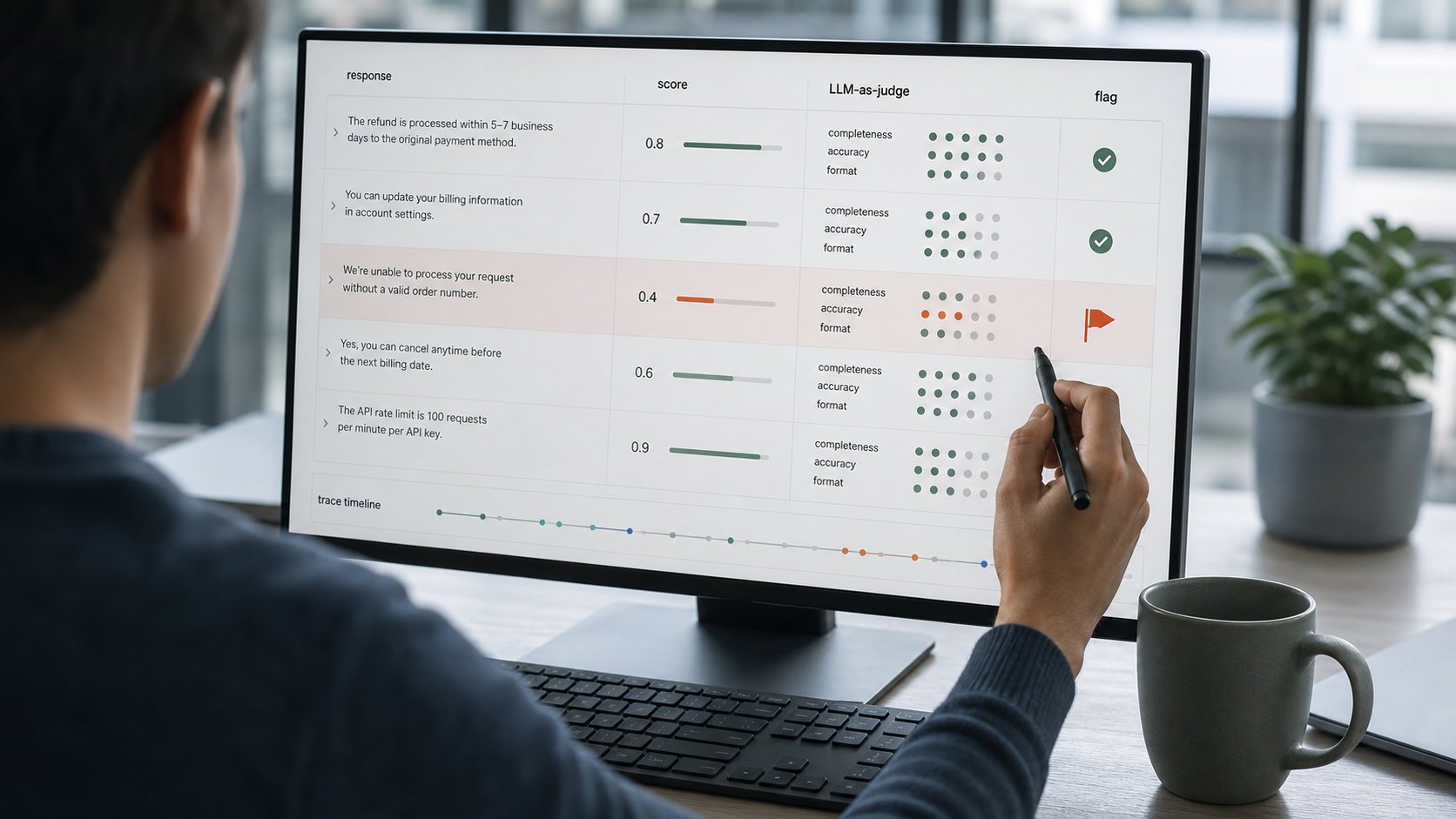
The first is automated suites that assert response quality rather than exact output. You send a set of representative prompts to the AI feature, parse each response, and assert on what matters for that feature. The trap is that the assertion categories shade from easy to genuinely hard, and treating them as one bucket is how teams underestimate the work. Checking that required elements are present is straightforward pattern matching. Checking that the format matches a template is tractable for structured output and fuzzy for free text, where "correct" depends on the use case. Checking that the answer does not contradict known facts is the hard one: it needs a ground-truth answer to compare against, a source document the response has to stay grounded in, or an LLM-as-judge that itself drifts between model versions. Checking that the tone is in range leans on classifiers that are themselves a moving target. None of this is point-an-agent-at-it work. Deciding which failure categories matter, curating the evaluation set that exercises them, and setting acceptance criteria that survive a model upgrade is test design applied to a probabilistic system, and it is at least as senior as test design for a deterministic one. Done well, the payoff is real: when the team upgrades models, the suite tells you whether output quality degraded before the change reaches users. That regression safety net is what prompt evals are for, and building one that actually holds is months of work, not an afternoon.
The second is observability and trace scoring in production. Tools like Langfuse let you score live traces with an LLM-as-judge against criteria you define (completeness, accuracy, format compliance) so quality drops from a model update, a prompt change, or an infrastructure shift get flagged automatically instead of discovered through user complaints. The same tooling supports evaluation datasets, input-and-expected-output pairs you run experiments against when you change a prompt, so prompt iteration becomes a measured cycle instead of ad hoc editing.
Frame this as a core QA responsibility, because that is what it is, and resource it as the senior design work it actually is rather than a checkbox a generalist adds in a spare afternoon. If your product ships a GenAI feature and no one in QA owns its output quality, you have an untested surface that your existing test suite is structurally incapable of covering, and the day a model upgrade degrades it, the first person to find out will be a customer.
What stays human is the judgment AI keeps making you confront.
The honest version of this argument has to say what AI does not take over, and it is not a consolation prize. Exploratory testing, edge-case judgment, requirement testability analysis, and domain knowledge are still human work, and they are the work that decides whether everything above actually catches anything.
One observation keeps surfacing about where AI-generated tests fall down, and it is easy to state too strongly. AI is excellent at covering the cases someone already thought of and wrote into a requirement or a spec. It is weakest at the probing that starts from a hunch: what happens if I do this in the wrong order, what happens at the boundary nobody specified, what does this feature do to that other feature that shares its data. That is exploratory testing, and it is a thinking activity rooted in domain experience, not an execution activity. The honest version is not that AI cannot find a bug nobody wrote a test for. It can, by a different route: property-based tests with generated invariants, fuzzing with adversarial inputs, differential testing across versions, and brute exploration of state spaces no human could walk by hand all surface failures nobody specifically anticipated. What AI does not do is form the suspicion. It reaches the unanticipated bug through systematic coverage; the human reaches it through a directed guess that comes from having watched this kind of product break before. Those two routes catch different defects, and a function that runs both is materially stronger than one that leans on either alone. The human side is bounded too, worth admitting: an exploratory tester only forms hypotheses inside their own experience, so the failure mode they have never seen a version of is the one they will not think to chase either.
Domain knowledge is the other piece that does not transfer. An agent generating tests for an insurance product does not know that a specific combination of policy states is the one that has burned the company before. A QA engineer who has worked the domain does. The agent dutifully tests what the spec says; the human knows the spec is wrong about the thing that matters, because the human has the context the spec left out. This is why the role moved up rather than out: the judgment-heavy, context-dependent work concentrated, the deterministic high-volume work got automated, and the person doing the judgment is now more central to quality, not less.
So the division of labor is clearer once you see it, even if the boundary is not a clean wall. AI handles execution and a brute-force kind of exploration: generating, running, and maintaining the tests for the things you already know to check, and grinding through input and state spaces wider than any human could. The human handles design and the directed exploration that starts from a hypothesis: deciding what is worth checking, defining what good means, and chasing the failures that experience says are lurking where no spec looked. A QA function that automates the first and neglects the second ships a large, fast, confident test suite that still misses the bugs a person with a hunch would have gone looking for.
The QA bottleneck is now a design decision, and a harder kind of hire.
Step back to the org level, because this is where the QA lead's reframe and the CTO's question meet. AI gave QA near-infinite execution capacity. That did not solve the quality problem. It relocated it. The binding constraint on quality is no longer how many tests you can run. It is whether anyone has designed what quality means for this product and reset the measurement to catch design gaps instead of activity.
Calling that a leadership decision rather than a staffing one is half right, and the half it gets wrong matters. The constraint did not stop being a hiring question. It moved upstream, from "buy more execution hours" to "find or grow someone who can own test design," and that second hire is harder, not optional. The person who can decide what quality means for a product and write the standards every generated suite follows is rarer than another competent test-writer, and the testers already on the team were often hired and leveled for execution skill, which does not convert to design ownership on its own. So the CTO question is no longer "are my QAs using AI?" because the answer is yes and it has not helped. It is "does someone own what quality means for this product, with the authority to set test-design standards and run a requirements quality gate before commitment, and have we reset the metrics so we track escaped defects and reopens instead of test count?" If the answer is no, more AI tooling and more execution headcount both keep producing more activity and the same flat quality line, for a reason that has nothing to do with the tools.
The QA lead's version is the mirror of that. The path from here is not learning to wire up another end-to-end framework. It is moving into the test-design and requirements work the execution capacity now makes room for, and bringing the measurement question to the CTO before the CTO brings the ROI question to you. The role did not shrink when AI arrived. It moved to the part of the job that was always the hard part, and that part now decides whether the quality numbers move.
Key Takeaways
- AI commoditized test execution. The scarce, role-defining skill is now test design: deciding what "tested" means for this product. Automating execution without changing design is why test volume rises and escaped defects stay flat.
- The QA bottleneck moved from headcount to strategy. "We need more QAs" used to buy coverage; now it buys near-nothing, because execution capacity is the part that went to near-zero cost. The unmet constraint is ownership of the quality strategy.
- The highest-return AI-QA workflow is upstream: a requirements quality gate that runs before sprint commitment, where AI surfaces ambiguities and missing acceptance criteria while they are still cheap to fix.
- AI-generated API and UI autotests are baseline now, not a senior skill, and they are tool-agnostic across the major frameworks. Seniority is defined by design judgment, not by who can build a suite.
- Testing GenAI output (prompt evals, LLM output quality suites, trace observability) is core QA work because nearly every product now ships a non-deterministic feature your deterministic tests cannot cover.
- Exploratory testing, edge-case judgment, and domain knowledge stay human. They are the work that decides whether the automated suite catches the bugs that actually reach users.
AI Transparency Notice: This article and its accompanying images were created with the assistance of generative AI. The author directed the content, contributed the underlying ideas and analysis, and reviewed the final publication.