Quality Gates Under AI-Assisted Development
Code generation throughput rose. Review capacity did not. By the time the defect graph moves, the quality gate posture is months behind. Seven gates, in pipeline order, with named human owners, before the human reviewer is asked to catch everything AI generated.
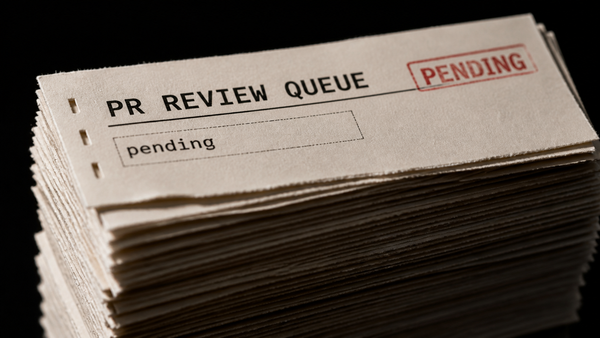
In the engineering org I run, the most useful early-warning signal of an AI-assisted-development problem is not a defect spike. It is a quietly stretching review backlog while the PR-volume chart bends upward. The team feels faster. The numbers, the ones a CTO defends to the board, do not yet move. By the time they do move, the upstream gate posture is months behind.
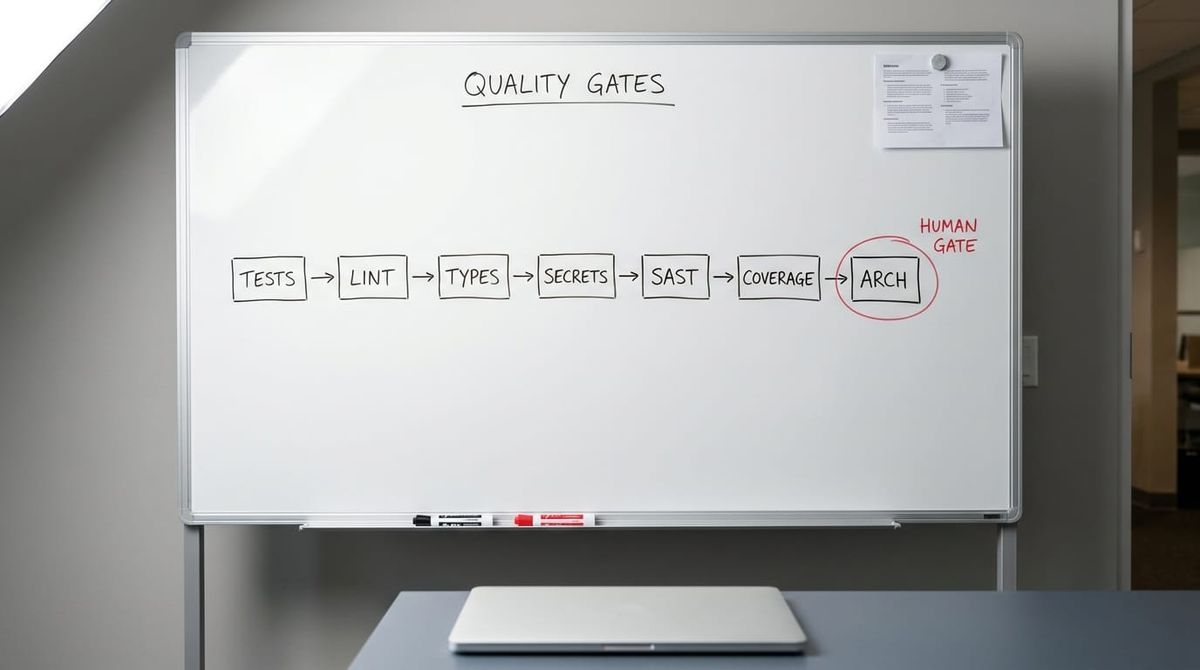
Quick answer. AI-assisted development does not remove the need for quality gates. It makes them load-bearing. Code generation throughput rose much faster than human review capacity, so the bottleneck moved onto the reviewer. Seven gates (unit and integration tests, linting and format checks, static type checks, secrets scan, SAST, coverage and mutation testing, architectural review) need to be enforced in pipeline order, with named human owners, before the human gate at the end is asked to catch everything. Human accountability stays mandatory. AI does not appear in the accountability lattice.
The misconception worth naming early is the comforting one. It says: with enough automation, AI-generated code can be reviewed by AI; the gates we already have will scale; if the tests pass and the linter is green, the AI was probably right. None of that survives contact with a fast-shipping AI-assisted team for very long. The mechanism this article works through is why, and what to install before the defect graph turns.
This is Pillar 1 work for me: AI enablement of delivery teams, not the tool-adoption layer. The piece is a long-form anchor for a companion LinkedIn post; the post compresses the taxonomy and the reviewer-overload argument into a few hundred words. This article carries the full mechanism.
The bottleneck moved. Most quality systems did not.
The shape of AI-assisted development is remarkably consistent across the teams that describe it publicly and the AI-transformation work I do. Implementation cost compressed. Specification cost expanded. Review cost exploded. The asymmetry is the story.
Generation throughput per developer-hour rose under tools like Copilot, Cursor, and Claude Code, but the strongest 2025 evidence shows the gain is concentrated in code-volume metrics rather than delivery outcomes. GitClear's analysis of 211 million changed lines (2020–2024) found refactoring's share of changes dropped from 25% to under 10% and post-commit code churn nearly doubled (GitClear, 2025). METR's randomized controlled trial of experienced open-source developers in their own repositories found AI-using developers took 19% longer than without, while self-estimating a 20% speedup (METR, July 2025). More code is being committed; more of it is being reverted, cloned, or quietly degrading the codebase. Review capacity did not rise to match the commit volume. The visible symptom is the reviewer who used to clear ten PRs a day and now has thirty in queue. The invisible symptom is the calibration of the reviews that do get done: skim-approval rates climb under load, deference-to-CI rises, the mental shortcut "this came from an AI so it is probably consistent with the codebase" becomes a permission slip the team grants itself.
Most engineering orgs optimized the first half of this equation. They installed AI tooling, told developers to use it, and watched commit volume rise. The second half, what verification looks like when commit volume rises while quality signals degrade, was not rebuilt at the same pace. That gap is what quality gates have to close.
The piece this article companions is When AI Speeds Up Coding and the Bottleneck Moves. That piece names the bottleneck movement. This one names the operating-model response.
The ai code review process that worked in 2022 is not the one your org needs in 2026. Code review was a judgment activity layered on top of a generation rate the reviewer could keep up with. That precondition no longer holds, and most quality systems still assume it does.
What a quality gate actually is (and what it is not)
A definition that holds up under board scrutiny: a quality gate is an enforceable check between two stages of the delivery pipeline that can block progress on a defined failure mode.
Three properties have to be true at the same time, or the gate is theatre.
It must be enforceable. The pipeline halts on fail. A check that emits a report nobody reads is not a gate. A check that emits a warning the team has learned to ignore is not a gate either. The enforcement is the gate's load-bearing element; everything else is the rationale for the enforcement.
It must be blocking. The failure has consequences for what ships. A coverage threshold that lives in a quarterly quality-report PDF and stops nothing is not a gate. A SAST tool that finds high-severity issues nobody triages within an SLA is not a gate either. Block-or-be-blocked. The middle ground rots.
It must be defined. The gate states explicitly what it catches and what it does not. A SAST gate catches a specific class of patterns: known-vulnerability shapes. It does not catch business-logic auth flaws. A type checker catches type-shape mismatches; it does not catch type-correct-but-semantically-wrong code. The honest gate names its own blind spots. The dishonest gate lets the team assume it catches more than it does.
What gates are not:
- Code review is not a gate. It is a judgment process. A gate enforces a check; a judgment process evaluates the un-encodable. They live next to each other; they are not interchangeable.
- A test-coverage percentage without test-design discipline is not a gate. It is a metric. AI generates code that hits coverage thresholds without asserting meaningful behavior. The number rises; the catch rate falls.
- An installed SAST tool without a triage SLA is not a gate. It is a queue. Queues that nobody processes turn into noise that everyone learns to dismiss.
The accountability invariant. A gate enforces a check; a human owns the decision. The decision is what to do when the gate fires, what tolerance to set, and what counts as a justifiable bypass. The human stays accountable for that decision regardless of how automated the check is. This is the seed of the human-accountability argument that closes the article; it is also why the seven-gate stack below has a named owner for every gate.
The seven-gate stack runs in pipeline order
The order matters. Each gate is cheap relative to the next. Cheaper gates run first because they fail faster and they reduce the load on the gates that follow. The human gate at the end (architectural review) is the most expensive cognitive resource the org has. Putting it last, after six automated gates have already stripped out the mechanical failure modes, is the operating-model choice that determines whether the reviewer is doing judgment work or janitorial work.
A note on tools. I am intentionally not naming specific vendors below. Vendor hot takes are off-strategy for this work, and the gate categories outlast the tools that implement them. What matters is the gate's contract, not the brand under which it ships.
Gate 1 - Unit and integration tests
Catches: regression on known behavior the test suite already covers.
Does not catch: behavior the AI did not write a test for; behavior the spec did not specify; behavior the test asserts incorrectly because the test and the implementation share an assumption.
Stakes-shift under AI generation: the AI also writes the tests. If both the implementation and the test come from the same generation pass, the test asserts what the AI assumed instead of what the spec required. This is the failure mode QA leadership has to design against directly. An effective QA discipline treats AI-generated test suites as draft material that earns a test-design review before being merged, not as finished work. The L3+ QA framework for AI adoption teams carries that disposition explicitly.
Owner: SE + QA collaboration. The SE owns the test passes for code they wrote; the QA function owns the design integrity of the suite as a whole.
Enforcement posture: pipeline-blocking on fail. Mandatory test-design review on AI-generated test suites before merge. No warning-only path.
Gate 2 - Linting and format checks
Catches: stylistic drift, low-grade pattern violations, formatter divergence.
Does not catch: semantic mistakes that lint correctly. The bar is "is this well-formed code in the team's house style," not "does this code do the right thing."
Stakes-shift under AI generation: AI-generated code lints clean because it was trained on lint-clean code. Clean lint output is no longer a meaningful quality signal. It is the baseline; the AI hits it by default. A team that was treating low lint counts as a proxy for code quality should stop. The signal moved.
Owner: SE.
Enforcement posture: pipeline-blocking; treated as non-judgment automation. No exception process needed for any normal codepath; if the linter is wrong, fix the linter.
Gate 3 - Static type checks
Catches: type-shape mismatches, nullability slips, contract-shape errors at module boundaries.
Does not catch: types-correct-but-semantically-wrong code. This is the AI's specialty: the function signature matches the call site, the return type is right, the value the function returns is wrong.
Stakes-shift under AI generation: type-checking buys less per line of code than it used to, because AI is fluent at type-correctness. A typed codebase is still a meaningfully better codebase than an untyped one; the marginal catch rate per type annotation just dropped. Adjust expectations; do not abandon the gate.
Owner: SE.
Enforcement posture: pipeline-blocking; no warning-only mode. Type errors are still cheap to fix and the failure mode they catch is structural; let them be structural.
Gate 4 - Secrets scan
Catches: hardcoded keys, tokens, credentials, recognizable AWS/GCP/Azure secret patterns, recognizable database connection strings.
Does not catch: secrets embedded in indirect constructs (env-var defaults in source, secrets templated into config files at build time, secrets referenced by a name the scanner does not recognize).
Stakes-shift under AI generation: the AI confidently completes hardcoded-credential patterns from prior code it has seen. The failure mode is not "the AI invented a credential"; it is "the AI saw the context look like the prior commit had a hardcoded credential and helpfully completed the pattern." This makes pre-commit hooks more important than CI scans alone. By the time CI fires, the secret has been pushed to the remote and the scope of the leak widened.
The provisioning side of this gate matters. An AI tools provisioning policy names the baseline expectation: what kinds of credentials AI tools should never see. The secrets-scan gate is the runtime enforcement of that policy posture.
Owner: Security + SE. Security owns the rule set and the SLA; SE owns the pre-commit-hook coverage.
Enforcement posture: pipeline-blocking on detection. Pre-commit hook in addition to CI scan. Triage on detection has an SLA measured in hours, not days.
Gate 5 - SAST (static application security testing)
Catches: known-vulnerability shape classes: SQL-injection patterns, command-injection patterns, deserialization risks, XSS shapes, path-traversal shapes. The catalogue is finite and well-published.
Does not catch: business-logic vulnerabilities, authorization-logic gaps, novel patterns the SAST ruleset does not encode, multi-step exploits that emerge from the interaction of correct-looking individual functions.
Stakes-shift under AI generation: AI-generated code surfaces a meaningfully higher rate of mid-confidence SAST findings than human-written code for the same problem space. Veracode's 2025 review of 100+ models found AI coding assistants introduce known vulnerabilities in roughly 45% of cases, with cross-site-scripting and log-injection pass rates collapsing into the 13–15% range while SQL-injection and weak-cryptography detection held at 82–86% (Veracode, 2025). The triage queue grows faster than the security team. Block-on-HIGH-or-CRITICAL is the only enforcement posture that scales; MEDIUM findings need a triage SLA, or they accumulate into a backlog the team learns to ignore.
Owner: Security.
Enforcement posture: pipeline-blocking on HIGH and CRITICAL severity. SLA-bound triage on MEDIUM. No warning-only mode on HIGH.
Gate 6 - Coverage and mutation testing
Catches: untested code paths (coverage); tests that exist but do not actually test (mutation testing kills mutants that the existing suite fails to detect).
Does not catch: spec-level missing cases. Coverage and mutation testing operate on the code-and-tests pair the team has written. The case nobody wrote a test for because nobody thought to write the spec for it stays uncaught.
Stakes-shift under AI generation: coverage threshold gaming is easier under AI. The AI generates tests that hit lines without asserting meaningful behavior; the coverage number rises; the actual catch rate of the suite does not. Mutation testing is the gate that catches this. It inserts deliberate bugs into the code and checks whether the suite catches them. Mutants that survive the suite are the honest measure of test quality, not coverage percentages. This is a Goodhart's-Law shift: when coverage became a target, it stopped being a measure. Mutation testing restores the measure.
Owner: QA.
Enforcement posture: coverage as a soft floor (block on a drop below the floor; do not gate on absolute level above the floor). Mutation testing as a monthly audit job, not per-PR. It is too slow to run on every PR. The audit-job output triggers a remediation backlog the QA function owns.
Gate 7 - Architectural review (the human gate)
Catches: violations of the system's structural contract that no automated check can encode: boundary crossings, layer-rule breaks, novel external dependencies, services taking on responsibilities that belong elsewhere, contract drift on internal APIs.
Does not catch: nothing automatable. This is the judgment gate by design. Its function is to catch what the upstream gates structurally cannot.
Stakes-shift under AI generation: the AI writes plausible-looking code that does not fit the architecture. The shape is local-correct; the placement is wrong; the dependencies are imported when they should not have been; the abstraction layer was crossed because the AI's training data crossed it. The architectural-review gate is the only one that catches this, and the L3 Solutions Architect designation in AI adoption frameworks names "agentic-framework configuration, project structure, quality gates" as this role's explicit responsibility. The Solutions Architect or the staff engineer who owns the system's structural contract is the named owner here. This cannot be delegated to automation, and it should not be delegated to a junior reviewer who lacks the system-shape context.
Owner: Solutions Architect, staff engineer, or whoever explicitly holds the contract for the system's structural integrity.
Enforcement posture: PR-blocking on contract violation. Bypass requires the contract-owner's explicit sign-off, recorded in the PR thread, not just an approval click. The bypass record becomes input to the next architectural-contract revision.
The reviewer-overload mechanism is the load-bearing argument
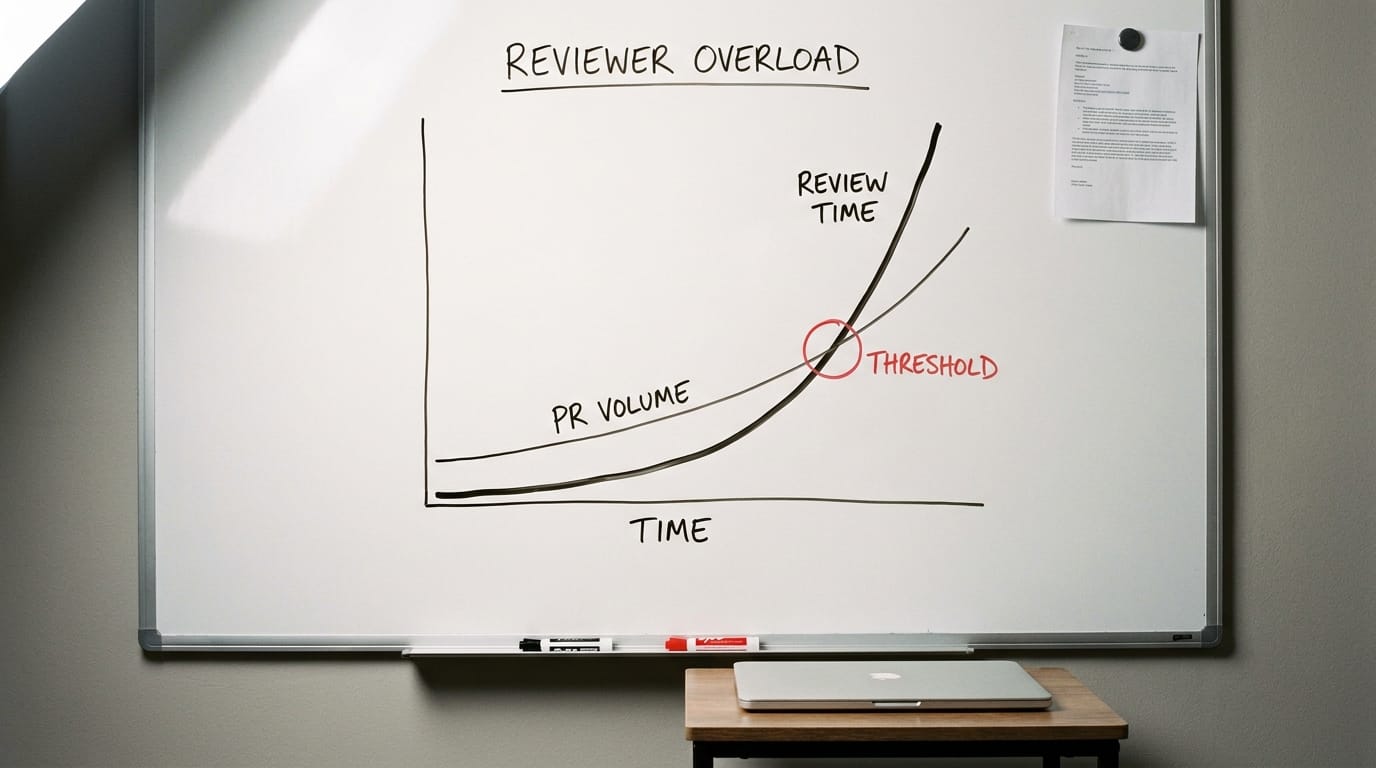
If the seven-gate stack collapses to the human reviewer at the end without the upstream gates running properly, every failure mode the upstream gates exist to catch lands on the same person at the same time. This is the load-bearing argument of the article, and it is the reason "AI does not remove the need for quality gates" is the wrong framing. The right framing is: AI raises the cost of an under-gated pipeline by routing every defect through the slowest, most expensive part of the system.
Three sub-mechanisms compound, and any one of them alone would justify the gate stack. Together they are decisive.
The first is queue-theoretic. Review time grows superlinearly with PR rate past a threshold determined by reviewer capacity. The textbook reference is Little's Law and Donald Reinertsen's Principles of Product Development Flow: Second Generation Lean Product Development (Celeritas Publishing, 2009); the engineering implication is that once your review queue runs above a certain utilization point, average review time and queue length spike together and the system has no smooth recovery path. AI-assisted development does not change the math; it changes the input rate. Holding reviewer capacity constant and meaningfully raising commit volume puts the queue past the threshold faster than the team's culture can adapt.
The second is cognitive. Review fidelity drops in proportion to context-switch frequency. A reviewer who jumps between PRs every six minutes does not retain the system-shape mental model required to catch the architectural-fit failures the human gate exists for. The canonical citation is John Sweller's Cognitive Load During Problem Solving: Effects on Learning (Cognitive Science, 1988), which shows that working memory is the constraint, not motivation. AI-driven PR throughput forces more context switches per hour. Catch rate per PR drops. The reviewer's experience of the work is "I am working harder and finding less." That is the felt symptom; it is also the literal truth of what the math predicts.
The third is trust-calibration. The reviewer's mental model of "what AI typically gets wrong" is itself drifting because the underlying models keep improving. A reviewer who learned a year ago to look hard at AI-generated error-handling because it was often wrong cannot trust that the same heuristic still applies; the next model release might have closed the gap, or opened a new one elsewhere. The honest answer is that reviewer heuristics calibrated to a frozen tool become stale the moment the tool is updated. Without upstream gates absorbing the mechanical failure modes, the reviewer is asked to maintain a calibrated trust model against a moving target, on top of doing the judgment work the gates structurally cannot encode. The trust model drifts, the catch rate falls, and the org reads steady review throughput as evidence that the system is fine.
The compound effect is what shows up in any AI-assisted dev pipeline with weak upstream gates: the symptom is not a defect spike. It is a slow loss of catch rate the team rationalizes as "AI got better." Reviewers keep approving at the same pace. PRs keep merging. The bugs the human gate was supposed to catch start landing in production at a slightly higher rate, then a meaningfully higher rate, then in numbers that the board can see. By then the upstream gate posture is two quarters behind the PR-rate curve.
The seven-gate stack is what keeps the reviewer doing reviewer work. Without it, the reviewer is doing the linter's job, the type-checker's job, the SAST tool's job, the secrets scanner's job, the coverage tool's job, the test designer's job, and the architectural-contract-owner's job, all at the same time, on every PR. The math does not work. It was not designed to work.
Human accountability stays mandatory
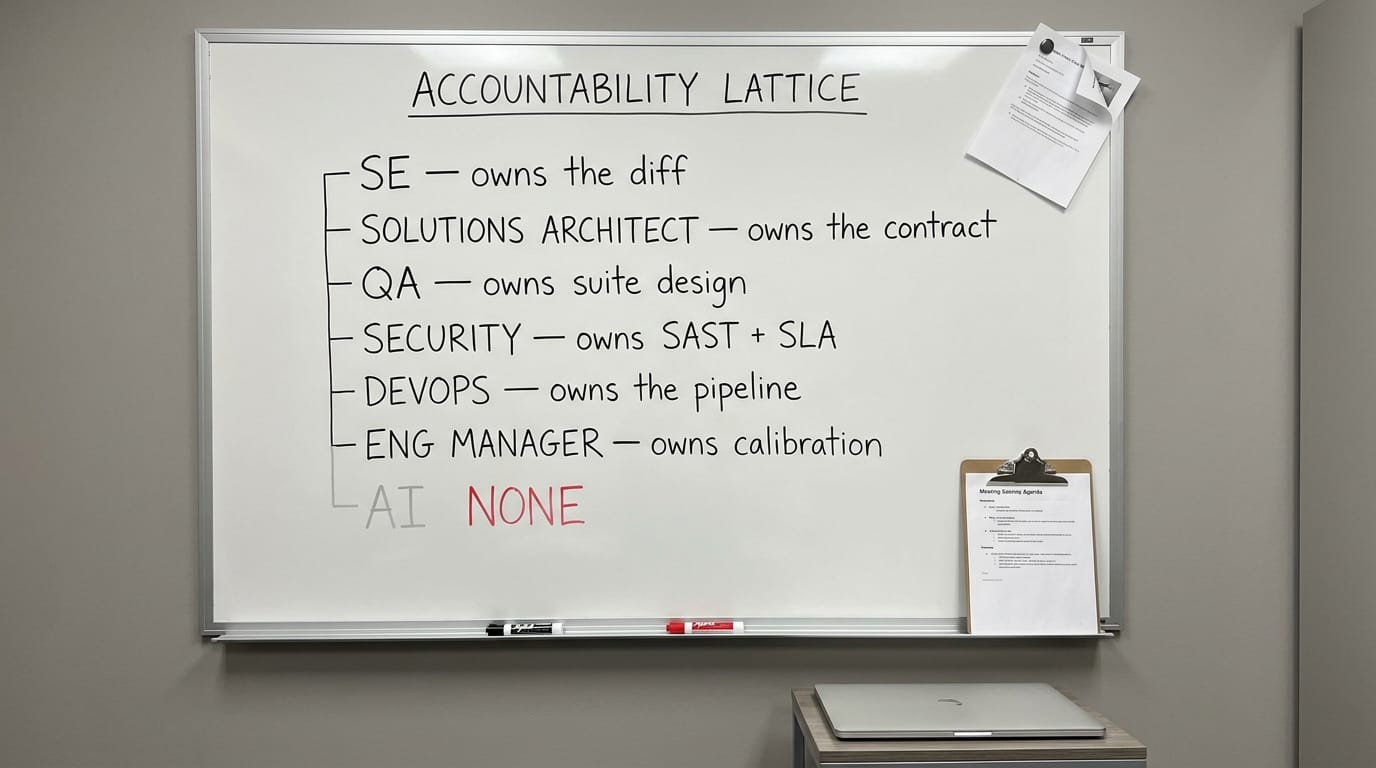
Gates enforce checks. Gates do not own outcomes. Outcomes are owned by named human roles in a lattice that does not include the AI.
The accountability lattice for the seven-gate stack:
- SE owns the diff. Every line in a PR has a human author of record, even if the AI generated the candidate text. The author of record is accountable for what the diff does in production.
- Solutions Architect owns the architectural contract, the rules the diff has to fit. Bypasses of the architectural-review gate go through the SA.
- QA owns the test suite's design integrity, not just its pass rate. A high-coverage suite that does not catch real bugs is a QA-owned problem.
- Security owns the SAST and secrets-scan posture, the severity thresholds, and the triage SLA. The volume increase under AI generation puts pressure on this role first; budget and headcount usually need to follow.
- DevOps owns the pipeline that runs the gates. A gate that exists in policy but does not run in CI is not a gate; the pipeline is where the policy becomes real.
- Engineering Manager owns the calibration: the threshold settings, the bypass review cadence, the meta-question of whether the gate stack is catching what the team needs it to catch.
The AI does not appear in this lattice. The AI is a generator. It produces candidate code, candidate tests, candidate review comments, candidate threat models. None of those are accountability-bearing artifacts on their own. The accountability stays with the named human role at every gate, by name, with their name on the PR or on the policy document.
This is the same argument from Who is accountable for AI output? The person who ran the agent., applied to the specific surface of quality gates. The four accountability-laundering moves to refuse, restated here for the gate context:
- "The model hallucinated." The SE who ran the model and merged the diff owns the hallucination.
- "The prompt was off." The PM or SE who wrote the prompt owns the prompt.
- "The gate did not catch it." The role that owns the gate's calibration owns the miss, and the calibration becomes a remediation item, not an excuse.
- "The AI did it." Nobody whose name is in the lattice gets to say this and keep their accountability standing.
The accountability lattice is the reason the seven-gate stack works. Without named owners, the gates are policy theatre; with named owners, the gates are an operating model.
Calibration: gates that warn versus gates that block
A design choice that often gets skipped, and that is usually the difference between a gate stack that holds for six months and one that decays into noise.
Block-only is brittle. Every false positive blocks a PR; the team learns to engineer bypasses; overrides accumulate. Within a quarter, the gate is advisory in practice, even though it is "blocking" in the YAML. The official posture and the operational posture diverge, and the official posture is the one that gets reported to the board, which is now a misleading number.
Warn-only is lazy. The team learns to ignore warnings the way it learns to ignore the noisy smoke detector, by getting used to it. The gate is effectively absent; it just produces a quality-report PDF for the audit folder.
The mature posture is mixed and explicit. Block on the failure modes the gate catches with high confidence (linting clean, type errors absent, no detected secrets, SAST HIGH and CRITICAL clean, tests passing). Warn on the probabilistic findings (SAST MEDIUM, coverage drop below soft floor, mutation-test surviving mutants from the monthly audit). Bind every warning to a triage SLA owned by the role accountable for that gate, so warnings do not silently rot in a backlog nobody owns.
The calibration is not a one-time decision. It is a quarterly conversation between the engineering manager and the gate owners, informed by the bypass log (how often is the block being overridden, by whom, for what reason) and the warning-triage SLA performance (are warnings being processed within the window, or are they accumulating). The calibration is itself a gate, a meta-gate, and the engineering manager owns it.
What changes when you actually install this
Three shifts the CTO has to be able to defend to the board, because the board is going to ask what changed when AI delivery shipped its first real quarter of numbers.
The first shift is what the org's review capacity is spent on. Pre-AI, review capacity went heavily into linter-equivalent and type-checker-equivalent judgment work: reading diffs for stylistic consistency, for structural correctness, for the things automated gates now catch reliably. Post-AI, that work is automation work; the human review capacity needs to be moved up the stack to judgment work the gates structurally cannot encode (architectural fit, contract evolution, gate calibration itself). This is a reallocation, not an expansion. The headcount does not necessarily grow; the work shape changes. If the engineering manager cannot describe this reallocation in concrete terms, the org is still spending senior reviewer time on linter work, which is a quiet form of senior-engineer burnout.
The second shift is Security headcount and SLA. The SAST queue and the secrets-scan queue grow with PR throughput. The Security function is the role most likely to be under-resourced under AI-driven throughput, because Security's catch rate sets the floor on what is allowed to ship. If the SLA on MEDIUM SAST findings was 30 days pre-AI and PR rate has risen meaningfully, the SLA either tightens (which usually means more Security headcount) or it loosens (which means the warning queue silently grows and the gate decays into noise). Either is a defensible board answer; neither happens by itself.
The third shift is the engineering ladder. Most engineering ladders reward people who write code that ships. An AI-assisted delivery org needs a promotion path that explicitly rewards the staff engineers and Solutions Architects who calibrate the gates, own the architectural contract, and design the test discipline. If the ladder does not name this work, the org will train its best people to avoid it, and the gate stack will be calibrated by whoever has the least seniority to defend an opposing view. Within a year, the calibration drifts toward whatever is least likely to block any PR, because the people doing the calibration are not the people whose names will be on the production incident.
The implication for the operating model is not a tools checklist. It is an org-chart change. The first quality-gate failure mode most engineering orgs hit under AI-assisted development is not technical; it is that the org has not yet decided to name and pay the people who own the gates. AI does not remove the need for quality gates. It makes the people who calibrate them the most load-bearing role in the engineering org.
AI Transparency Notice: This article and its accompanying images were created with the assistance of generative AI. The author directed the content, contributed the underlying ideas and analysis, and reviewed the final publication.