Your SDLC Is One Stage Behind Your AI Tools
Ticket, code, review, test worked when senior engineers carried the goal, the architecture, and the risk in their heads. Coding agents cannot read minds. The work those four stages hid now has to become explicit, or the agent guesses.
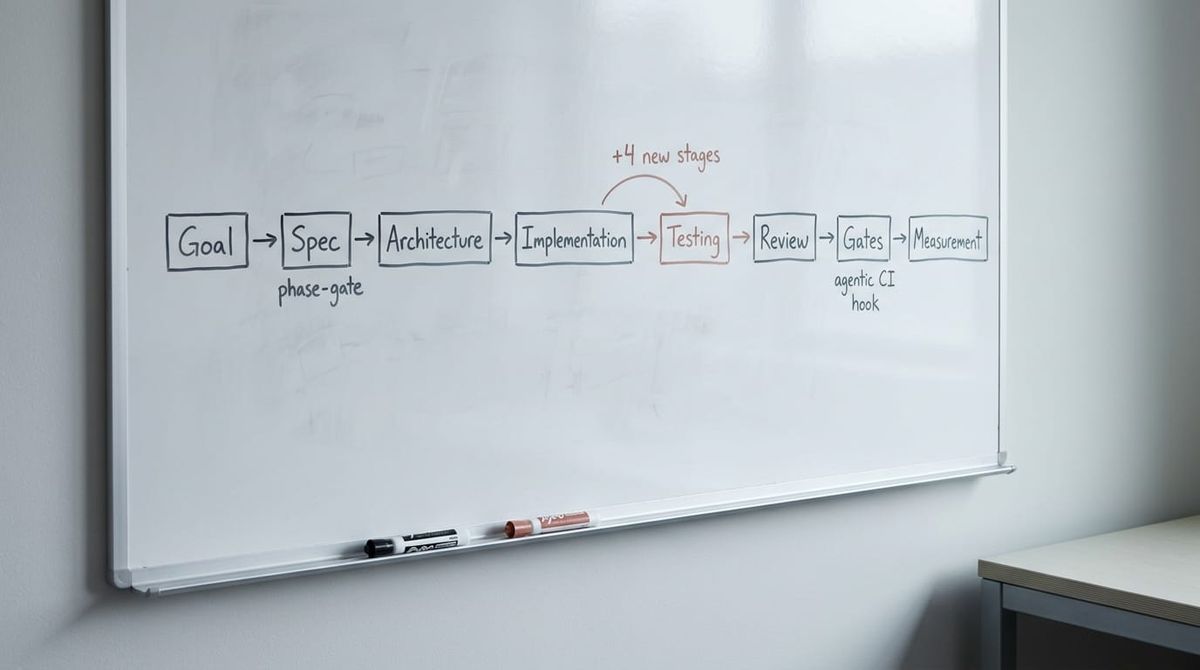
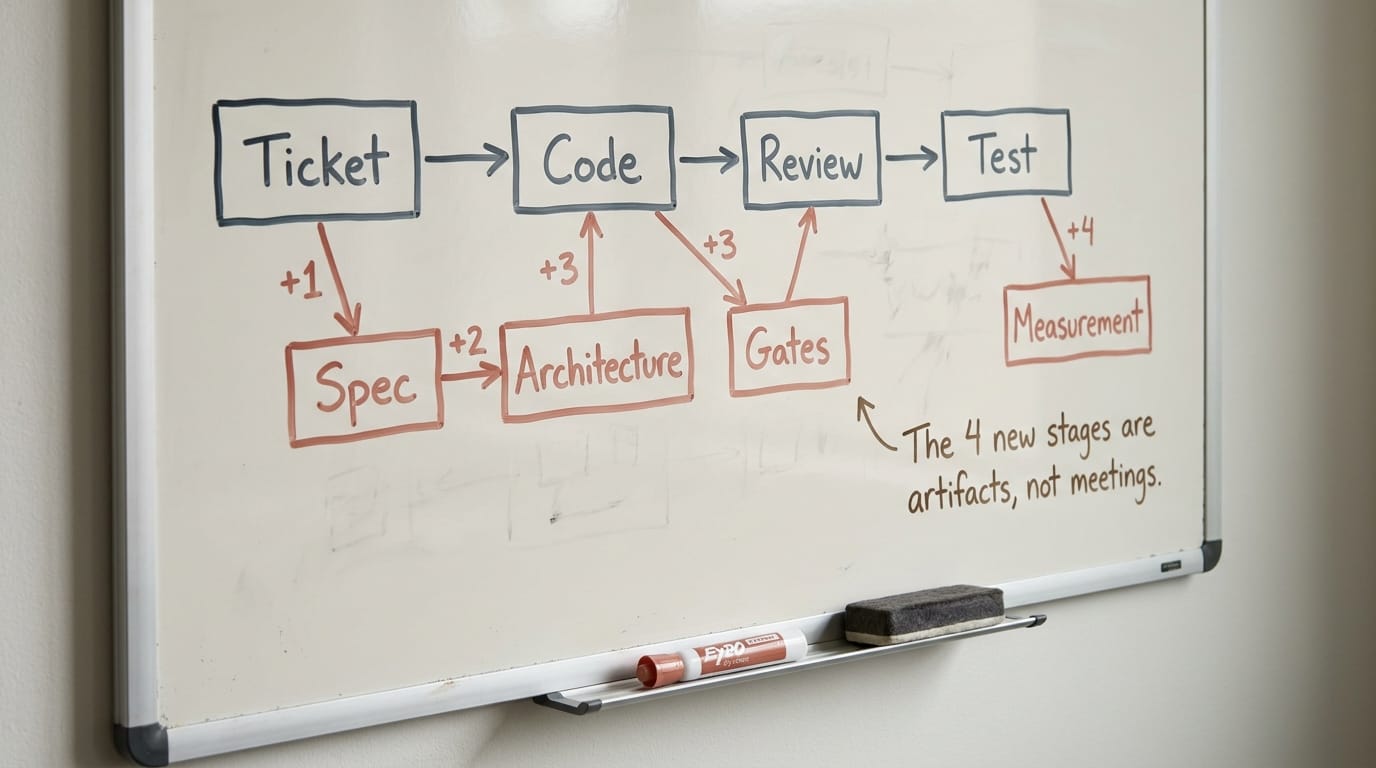
Why delivery organizations now need eight explicit stages, not ticket → code → review → test.
Most engineering organizations still describe delivery as four stages: ticket → code → review → test. That model worked when humans carried the missing work in their heads. Goal clarity, architecture judgment, quality risk, and post-ship learning were implicit. Senior people supplied them through experience.
Coding agents break that arrangement. An agent cannot infer the PM's intent, the architect's trade-off, the QA's risk memory, or the staff engineer's instinct that a number feels wrong. If the judgment is not written down, the agent guesses.
That is why the AI-enabled SDLC has eight stages, not four. The transformation is not that agents write code faster. The transformation is that hidden human judgment becomes versioned, reviewed, and gated.
The eight stages at a glance
| Legacy SDLC | AI-enabled SDLC | Primary owner | Artifact |
|---|---|---|---|
| Ticket | Goal definition | PM | Structured intent |
| Ticket / requirements | Spec | BA | Versioned spec |
| Informal design | Architecture | SA | Trade-off doc / architecture sketch |
| Code | Implementation | SE | Agent-generated implementation |
| Test | Testing | QA | Eval harness |
| Review | Review | Lead / senior engineer | Adversarial review record |
| Release | Gates | DevOps | Gates-as-code |
| Retros / metrics | Measurement | Delivery / AI transformation | Outcome loop |
In smaller teams, one person may own multiple stages. The point is not the job title. The point is that every stage needs an accountable owner and a versioned artifact.
The 4-stage SDLC was a human assumption, and agents broke it
When teams describe their SDLC as "ticket, code, review, test, deploy," they are not describing the work. They are describing the visible artifacts a human used to produce. The actual work always included goal-setting, spec-writing, design choices, quality judgment, and post-ship learning. Those things happened in the background of every senior engineer's brain. They never got named because they never had to be transferred.
A coding agent forces the transfer. The agent cannot read a senior engineer's brain; it can only read text. So every judgment that used to be implicit has to be written down, or it gets approximated, badly, by the agent guessing. The architectural trade-off the senior would have made silently is now a paragraph in a design doc the SA writes before the agent starts coding. The acceptance criteria the PM would have negotiated in a hallway conversation are now structured intent statements with explicit out-of-scope boundaries. The test plan the QA used to author in their head is now a documented eval harness the agent's test-generation pass runs against.
Externalization is not bureaucracy. It is how human judgment becomes executable by agents.
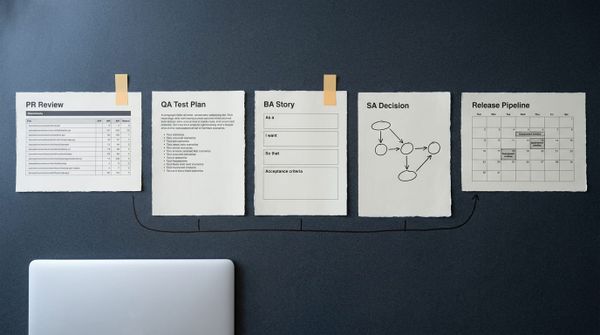
In a well-designed set of L1–L4 role frameworks for SE, QA, BA, SA, PM, and DevOps, every one of these new stages has a named owner with progression behaviors. The role frameworks were written because the new stages were unstaffed, and a senior PM cannot suddenly own intent specification without a model of what L3 looks like for that responsibility. The 4-vs-8 gap is the operating-model gap, and the operating-model gap is fixed at the role level, not the tool level.
Stage 1: Goal definition is now part of the SDLC, not a precursor
In the old loop, goal definition lived above the SDLC. A product manager wrote "as a user I want to filter by status" on a ticket, handed it to engineering, and the team treated that one-line intent as sufficient input. The actual goal - what success looks like, what acceptance evidence the team will accept, what is deliberately out of scope, what the failure modes are if this ships wrong - lived in the PM's head, the engineer's intuition, and a few Slack threads.
Coding agents have access only to text. So the PM's job has shifted from "write a ticket throughput-efficiently" to "specify intent so the agent cannot misread it." The right phrase is structured intent specification: a document that names the goal, the success criteria, the acceptance evidence, the out-of-scope boundaries, the failure modes, and the user state before and after. It is shorter than a PRD and longer than a ticket. In the PM role framework I work with, this artifact is the L3 PM's primary output, not "tickets per sprint."
The ticket still exists, but it stops being the source of truth. The structured intent becomes the source of truth. The agent reads the intent specification before writing a single line of code. If the intent is ambiguous, the agent produces ambiguous code. If the intent omits a failure mode, the agent ships without handling that failure mode. A senior PM may produce fewer artifacts per week than a junior PM, but each one carries more delivery weight, because each one is the input the agent actually consumes.
The first signal that an organization is still running the four-stage SDLC is that goal definition is still treated as something that happens "before engineering starts." In the eight-stage SDLC, goal definition is engineering. The agent reads its output directly, and the artifact is versioned, reviewed, and stored alongside the code.
Stage 2: The spec, not the ticket, is the load-bearing artifact
Once goal definition is structured, the spec becomes the unit of work the organization tracks. Not the ticket. Not the user story. Not the PRD section. The spec - a single document that names what the system must do, what it must not do, and what evidence proves it does - is what the agent reads, what the BA refines, what the SA designs against, what the QA tests, and what the DevOps engineer gates against. Every artifact downstream is generated from the spec or validated against the spec.
This is a structural change. In the four-stage SDLC, the ticket was a routing instrument: it told the team who was working on what. The spec is a load-bearing artifact: it is the source of truth for whether the work was done correctly. A team that tracks "tickets closed" is measuring routing efficiency. A team that tracks "specs satisfied" is measuring work outcome.
The role that changes most here is the BA. In the BA framework I work with, the L3 BA is the spec author - not as a documentation function but as the load-bearing engineering role that determines whether the agent produces correct code. The BA writes the spec from the PM's structured intent, validates it against existing system behavior, and walks the agent through ambiguities before code generation starts.
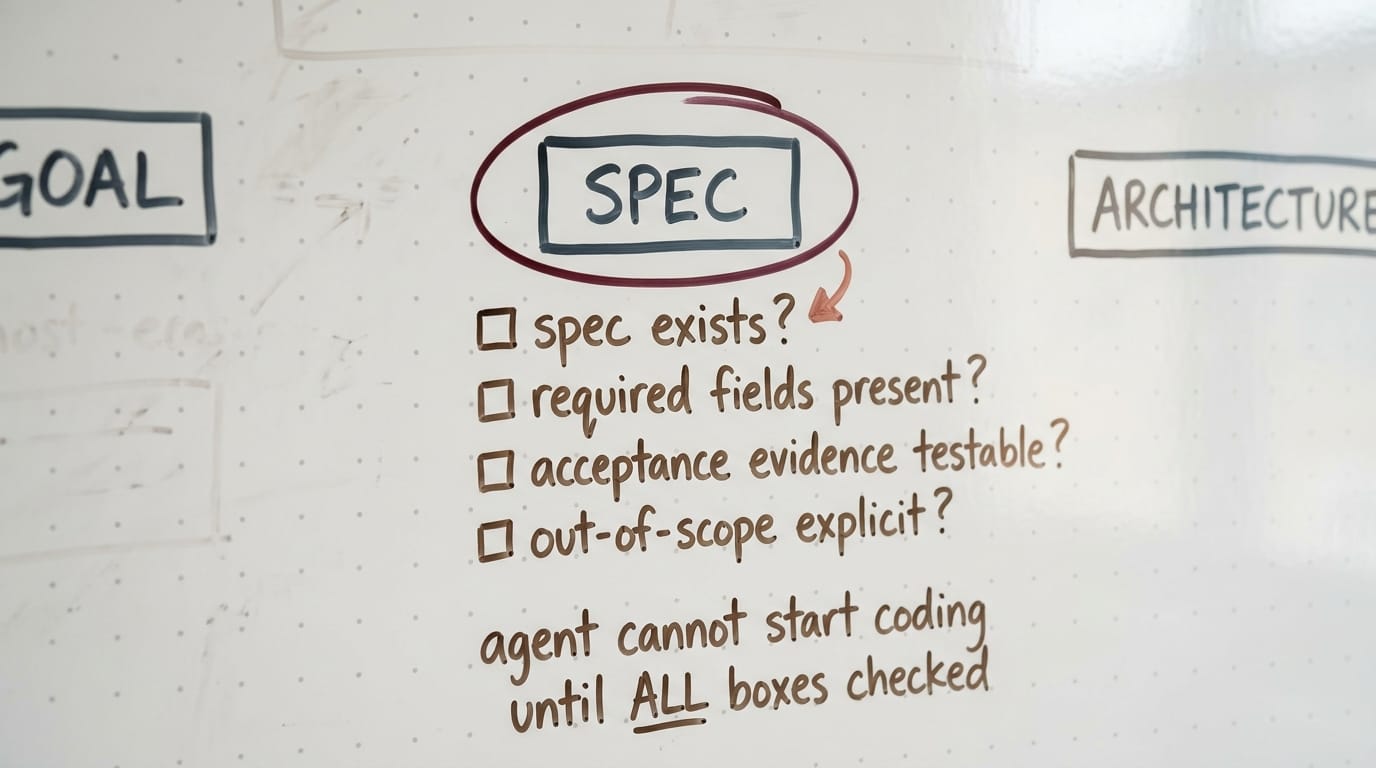
Spec-driven tooling can codify this as a phase gate. The gate is a hook in the agentic CI pipeline that checks whether the spec exists, has the required fields, has testable acceptance evidence, and names its out-of-scope boundaries explicitly. GitHub Spec Kit is one example of this pattern; the pattern matters more than any single tool. The cost is one extra hour upstream; the saving is days of downstream rework.
The signal that an organization is still on the four-stage SDLC is that the spec is treated as documentation. It lives in Confluence, gets read by humans, and is updated when someone remembers. In the eight-stage SDLC, the spec is treated as code: versioned, tested, gated, and reviewed. That distinction sounds small. It is not. It is the difference between a delivery system that can absorb agent throughput and a delivery system that gets buried by it.
Stage 3: Architecture is AI-sketched and human-owned
Coding agents can sketch architectures. Given a spec, an agent will produce a component diagram, name the services, choose a data store, and propose a deployment topology. The output is usually plausible and occasionally good. It is rarely sufficient architecture for your organization, because the agent has no model of your existing systems, your cost constraints, your platform team's preferences, your compliance posture, or the seven historical reasons your last attempt at this pattern failed.
The SA's role has to redesign around that gap. The SA is no longer the person who produces the architecture; they are the person who constrains the architecture so the agent's sketch is useful instead of misleading. In the SA framework I work with, the L3 SA's primary outputs are the agentic-framework configuration (which agent does what, with what context, under what guardrails) and the project structure (the file layout, the boundary conditions between services, the seams the agent is allowed to cross and the ones it is not). The SA is writing the meta-architecture inside which the agent's sketches become safe.
The mechanism is trade-off articulation. The agent proposes a sketch. The SA names the trade-offs the sketch implies (latency versus cost, build versus buy, evaluated versus production-grade, sync versus async, monolith versus split) and documents the decision for each one. If the trade-offs are named, the agent's next pass produces code that respects them. If they are not named, the agent guesses, and the guesses tend toward whatever is most common on the public internet - which is rarely what your organization actually wants.
The visible artifact at the end looks similar to before: an architecture document. The process that produced it is inverted. An SA still drawing diagrams by hand in an AI-enabled SDLC is doing a job the agent could have done in three minutes. An SA articulating trade-offs and constraining the agentic framework is doing the only work in this stage that humans can still do.
Stage 4: Implementation is the most visible stage, but not the highest-leverage redesign
The implementation stage gets all the attention. It is where the visible tools live (Copilot, Cursor, agent-coding harnesses), and it is the stage executives ask about when they say "are we using AI yet?" It is also the stage where the operating model moves least - which is the inverse of what most organizations assume.
The reason is that typing was never the bottleneck. Senior engineers do not produce dramatically more correct code when the agent types for them unless the upstream stages (intent, spec, architecture) are sound. Without sound upstream artifacts, the agent generates plausible code that drifts from intent, and the engineer spends the day correcting it. The implementation speed-up is real, but it is downstream of the operating-model change, not a substitute for it.
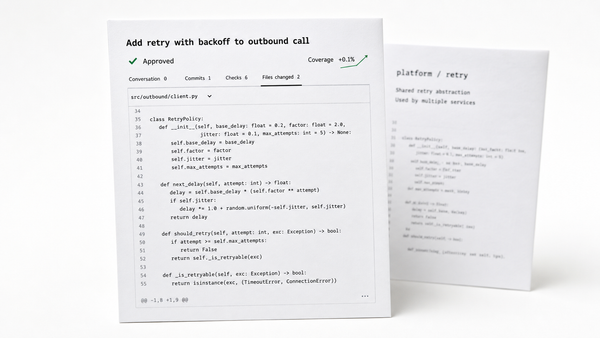
What does change is the engineer's craft. The engineer's job is no longer "type the code that satisfies the spec." It is context engineering (giving the agent the right files, the right examples, the right constraints, in the right order, so the agent's first pass is closest to correct), compounding (reusing what the agent learned in this session in the next, instead of starting cold), and harness engineering (writing the hooks, eval loops, retry policies, and rollback paths that make the agent's output safe to ship). In the SE framework I work with, those three disciplines define the L3 SE.
The risk is over-investing here. An organization that pours its AI transformation into "let's all use Copilot well" is investing in the stage with the lowest leverage. The leverage is upstream, in PM, BA, and SA, and downstream, in QA, DevOps, and measurement. Treating implementation as the center of the transformation produces tool adoption without role redesign - exactly the pain pattern most organizations have already lived through. Tool adoption stalls. Senior engineers quietly stop using the agent. The transformation narrative collapses. The diagnosis is always the same: the SDLC was still four-stage, and the new four stages were never staffed.
Stage 5: QA owns the eval harness, not the test-case spreadsheet
Quality assurance is the stage with the largest delta between what most organizations are doing and what the role now requires. The common pattern is "give the QA an AI assistant." The result is a QA who writes test cases slightly faster, against a spec the QA did not author, validating an implementation generated by an agent the QA did not constrain. The bottleneck has moved. The QA's role has not.
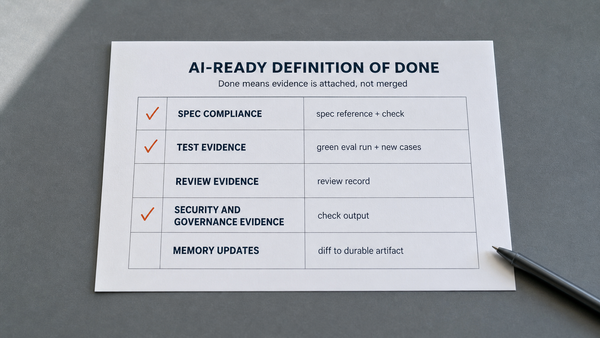
The eight-stage version reframes the QA's job. QA's primary value is no longer writing every test case by hand - the agent writes routine cases from the spec. The QA owns the eval harness: the named set of behaviors the system must exhibit, the data fixtures it must handle, the regression suite that runs on every change, and the UI/API validation surface. The QA also owns the test taxonomy: what gets tested at unit level, what at integration, what at contract level, what at end-to-end, and which class of failure each level catches.
QAs still write critical tests by hand. Compliance-heavy systems, high-risk domains, complex business rules, flaky E2E areas, security-sensitive flows, exploratory testing - those stay human-authored. The shift is that the QA is no longer the producer of every test case; they are the curator of the testing system that the agent populates.
In the QA framework I work with, the L3 QA's primary output is the eval harness configuration and the test-data strategy. The L4 QA can articulate, for every spec, what evidence will count as "passed" and what evidence will count as "shipped, but with a known gap." This is the part the agent cannot do, because the agent does not know what counts as evidence in your domain. The agent can write a test that exercises the code; only a human with domain context can say whether that test passing actually means the system is correct.
The signal that an organization is still running stage five as "QA augmented by AI" is that the QA team is still measured by test-case count, defect-detection rate, or test-execution time. The eight-stage version measures the QA team by the strength of the eval harness: does it catch the failure modes the spec named, does it block the deploy when a regression appears, does it produce evidence the spec author can act on.
Stage 6: Review becomes adversarial because the author is no longer accountable
Code review in the four-stage SDLC was a collaborative exchange. A human wrote the code, another human read it, and they negotiated style, design choices, and edge cases as peers. The reviewer's stance was constructive. The implicit trust was that both parties shared context - the author's intent, the team's conventions, the codebase's history - and the review was a refinement, not an interrogation.
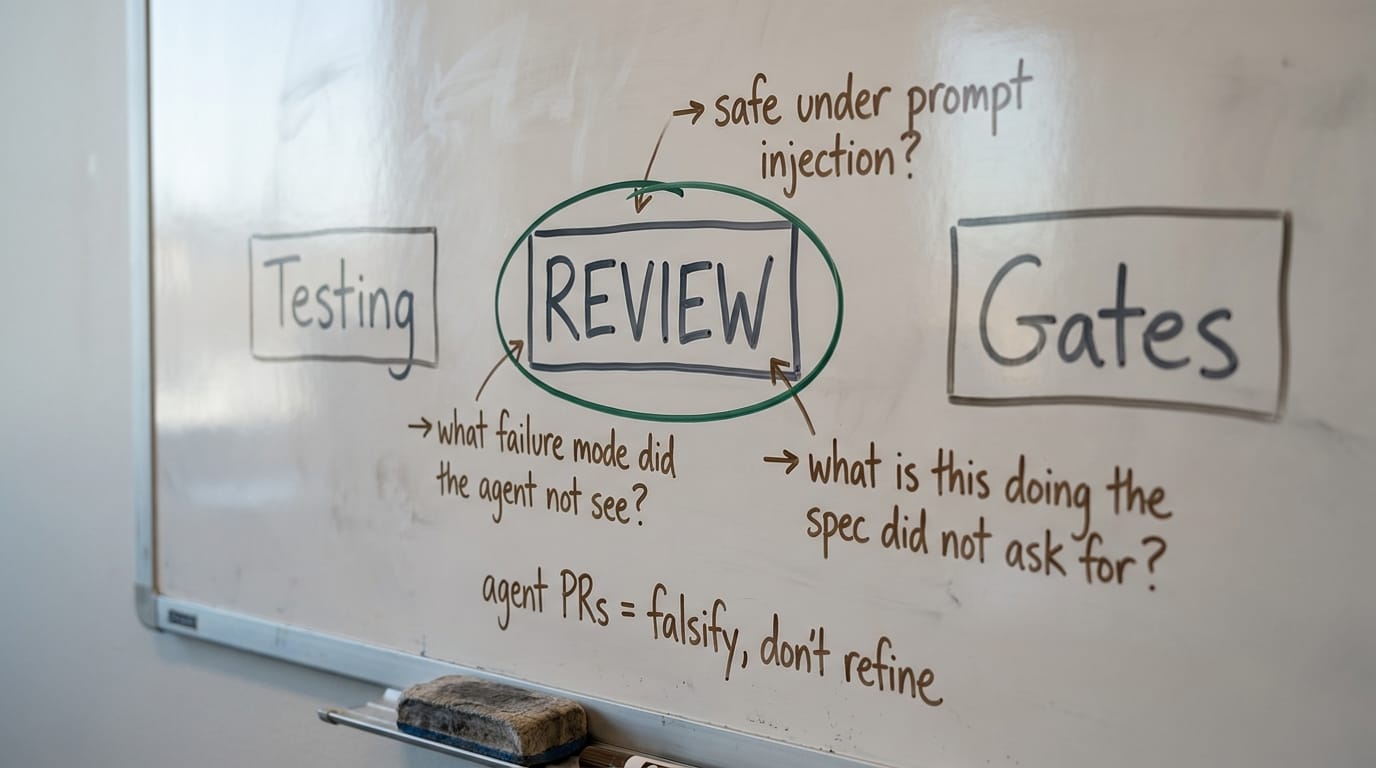
When the author is an agent, that trust does not exist. The agent has infinite confidence in plausible-looking output and zero memory of the team's last three incidents. Every PR from an agent is, effectively, a PR from a stranger with a strong writing style and no skin in the game. The reviewer's stance has to shift from collaborative to adversarial. Not hostile, but unsentimental, treating the code as a hypothesis that must be falsified rather than a contribution to be refined.
Adversarial review asks different questions. Not "is this readable?" but "is this safe under prompt injection?" Not "did you handle the happy path well?" but "what failure mode did the agent not see?" Not "do you want me to suggest a refactor?" but "what is this code doing that the spec did not ask for?" The reviewer is looking for the agent's blind spots: hallucinated APIs, plausible-but-wrong data handling, missed edge cases, secrets handled carelessly, dependencies pulled in without vetting, security assumptions the agent borrowed from its training data.
Adversarial review is slower per PR than collaborative review, but the volume of agent-generated PRs is much higher than human-generated PRs, so the team has to absorb both effects at once. The answer is not to review less carefully; it is to push as much verification as possible into the automated quality gate (stage seven) so human review can focus on the questions only humans can answer.
The role-level redesign here is at the staff and lead-engineer level. The senior reviewer is no longer "the person who catches style issues"; they are the person who decides what level of risk this change carries, given the agent's known failure modes and the spec's known ambiguities. That judgment is the human's lasting contribution in an AI-enabled SDLC, and it is the contribution organizations under-train for most consistently.
Stage 7: Quality gates are configuration, not ceremony
Phase gates used to be meetings. The QA lead signed off on the build, the DevOps engineer approved the deploy, the security review happened once before launch. The agent does not respect meetings. Every commit can produce hundreds of lines of code, and the only way to keep the floor intact is to encode every gate as an automated check that runs on every change.
In the eight-stage SDLC, the gate is a hook in the agentic CI pipeline. The DevOps engineer's primary output is the gate configuration: which checks run, in what order, what failure mode blocks the merge versus warns the author, and how the gate behaves when the agent attempts to bypass it.
A useful frame is minimum-viable gates versus mature gates:
- Minimum floor: lint, type-check, unit tests, secrets scan, SAST, dependency audit.
- Mature floor: eval-harness checks, integration and contract tests, license checks, policy compliance, coverage ratchet, agent permission boundaries, rollback validation.
Each gate is a versioned hook. The hooks are reviewed and tested like any other code. When the gate configuration changes, the change goes through the same review process as application code. The result is that the floor of quality is itself a code artifact - falsifiable, debuggable, and improvable.
The DevOps role redesign is significant. In the DevOps framework I work with, the L3 DevOps engineer's primary output is the gate configuration plus the agent execution environment: what tools the agent has access to, what permissions it operates under, what the rollback path looks like when the agent's output makes it to production and fails. The L4 is designing the policy layer that determines which agentic actions are auto-approved, which require human review, and which are blocked outright.
The signal that an organization is still running stage seven as a four-stage process is that the gates are inconsistent. Some teams have unit tests in CI; others rely on the QA running them manually. Some teams gate on coverage; others do not. Some teams have a security scan on main; others run it quarterly. In an AI-enabled SDLC, this variance is fatal. The agent will produce code at a rate that overwhelms any team relying on manual gating, and the long tail of incidents will be impossible to diagnose without consistent floor evidence.
Stage 8: The measurement loop is the stage most orgs don't run yet
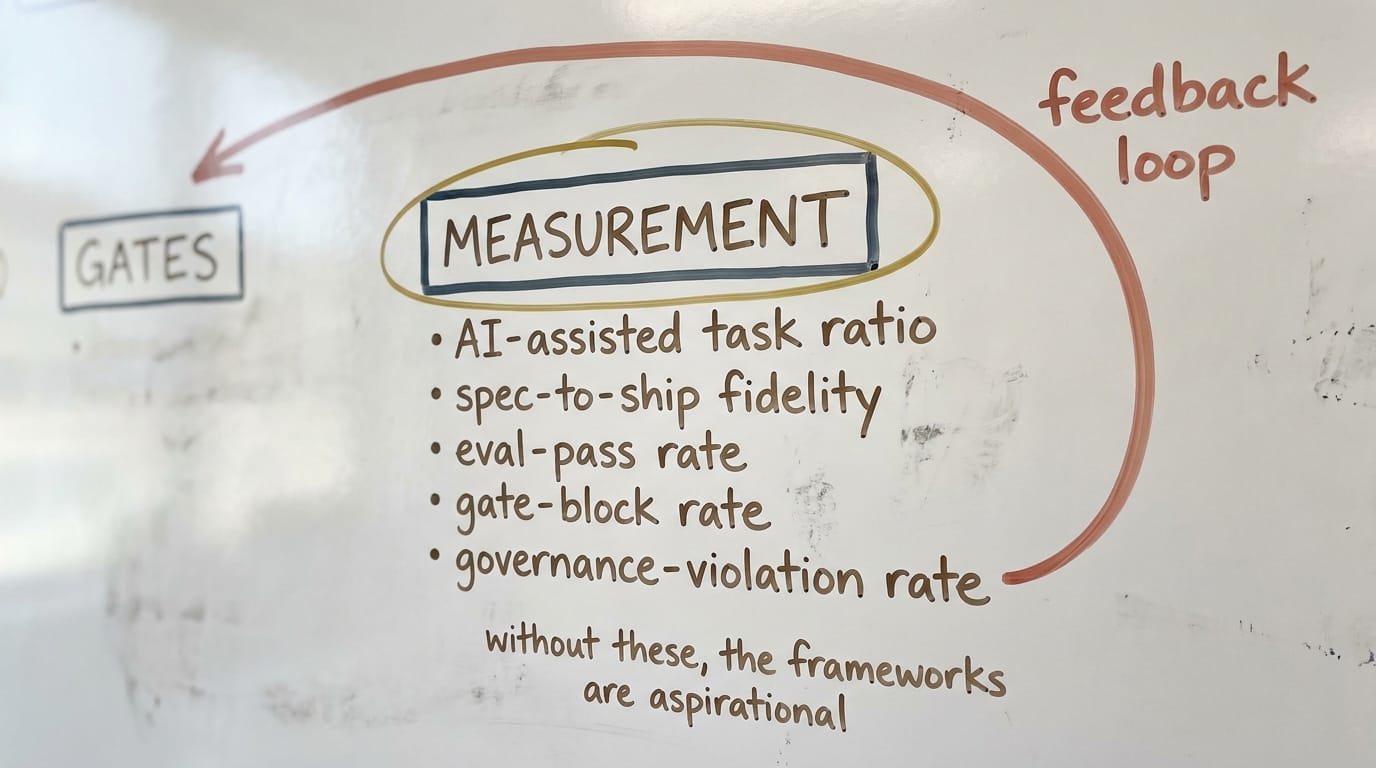
The eighth stage is the one most organizations have not built, and it is the stage that determines whether the previous seven compound into capability or stay as a collection of improvements. The measurement loop is what closes the SDLC: it feeds the outcome of the just-shipped work back into the spec for the next iteration, the architecture choices for the next service, the eval harness for the next regression, and the role-redesign work for the next quarter.
Most organizations measure the wrong things. They measure tool adoption (active licenses, weekly active users, prompts per engineer). They measure activity (PRs opened, tickets closed, story points completed). They measure speed (lead time, cycle time). None of those tell you whether the operating-model redesign is working, because all of them can improve while the underlying work gets worse - more incidents, more rework, more security findings, more agent-induced drift from the spec.
The load-bearing metrics for an AI-enabled SDLC are outcome-based and role-aware:
- AI-assisted task ratio - what fraction of completed work was agent-produced versus hand-coded.
- Spec-to-ship fidelity - how often the shipped behavior matches the spec the agent worked from.
- Eval-pass rate over time - is the eval harness catching more or fewer failure modes per quarter.
- Gate-block rate - are the gates catching agent errors, or are agent errors landing in production.
- Governance-violation rate - how many incidents involve the agent doing something the policy layer should have blocked.
- Rework rate from spec ambiguity - what fraction of agent-induced rework traces back to a spec the upstream gate should have caught.
- Agent-induced defect rate - share of post-ship defects whose root cause was agent output the review and gates missed.
The last two are the ones that connect measurement back to stages one, two, and six. If rework keeps tracing back to spec ambiguity, the spec gate is too lax or the L3 BA progression is incomplete. If agent-induced defects keep landing, the adversarial review is collaborative in practice, or the gates have not absorbed the verification work review cannot scale to.
The measurement loop also has to feed the role frameworks. If L3 PMs cannot get their structured intent specifications past the spec gate, the issue might be that the gate is wrong, that the L3 PM behavior is under-defined, or that the team has not yet built the L2 to L3 progression path. If L3 QAs cannot articulate eval-harness coverage, the issue might be that the eval framework is missing, that the QA's authority to block deploys has not been institutionalized, or that the role framework's L3 behaviors are too abstract. The measurement loop is what keeps the role frameworks honest.
This stage is where most AI transformations stall. The org has bought tools, redesigned a few roles, and shipped some agent-produced code. The measurement layer never gets built. Without measurement, the team cannot tell whether the operating-model change is working, so the next budget cycle has no evidence to fund the next round of investment. The transformation narrative collapses - not because the work was wrong, but because the loop was never closed.
The diagnostic: count your artifacts
Look at your last sprint. For each stage, ask one question: did it produce a versioned, reviewed, gated artifact?
Goal. Spec. Architecture. Implementation. Testing. Review. Gates. Measurement.
If four or fewer produced artifacts, your AI tooling is ahead of your operating model. If six or seven, you have started the redesign but have not yet built the missing stage - most often, measurement. If eight, you have an AI-enabled SDLC, and the next question is whether the role frameworks underneath each stage have L3 behaviors strong enough to support compound throughput at L4.
The first step is not to implement all eight stages perfectly. The first step is to identify which stages currently have no artifact and no owner. The next investment is not another coding tool. It is the first missing artifact, and the role owner responsible for making it real.
The four-vs-eight gap is the operating-model gap. AI does not eliminate SDLC judgment. It forces judgment to become explicit, versioned, reviewed, and gated.
AI Transparency Notice: This article and its accompanying images were created with the assistance of generative AI. The author directed the content, contributed the underlying ideas and analysis, and reviewed the final publication.