AI Doesn't Just Make Developers Faster - It Changes What Complexity Means
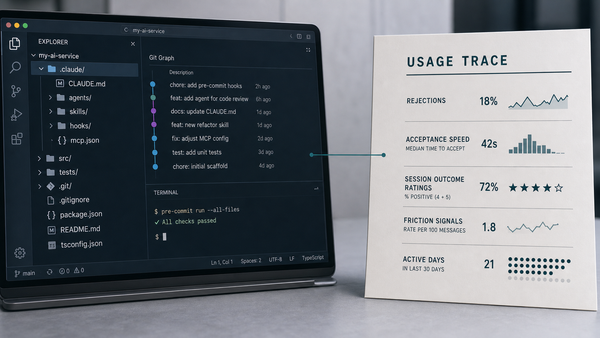
Eighteen months into the agentic-coding wave, the question CTOs are asking has shifted from which tool to why the delivery numbers have not moved despite real adoption and real developer speed gains.
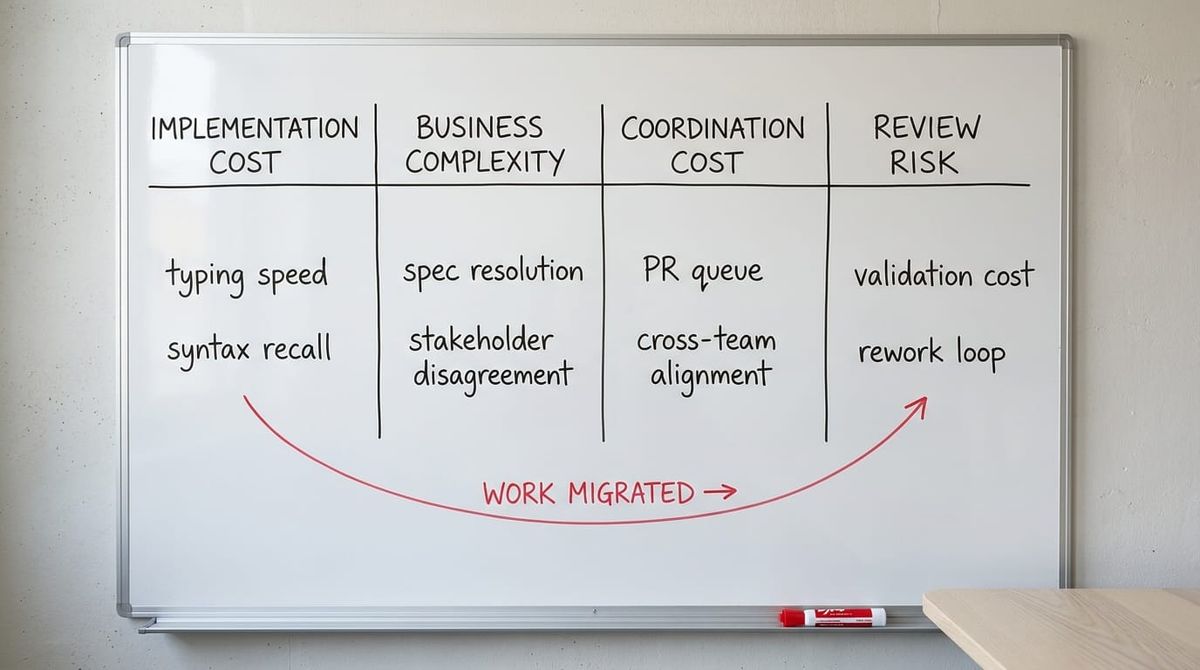
Delivery cost has four components: implementation, business complexity, coordination, and review risk. AI compresses the parts of implementation that are bounded, specifiable, and reviewable. It does not compress decision authority, dependency ownership, or validation capacity at the same rate. That is why developer speed can rise while delivery throughput stays flat - and why a system that still treats implementation as the binding constraint after AI lands was never measuring the right constraint.
The Gap That Won't Resolve
Eighteen months into the agentic-coding wave, the question CTOs are quietly asking each other has shifted. It used to be which tool. Then it was how do we get adoption to stick. Now it is something narrower and harder: the engineers say they are faster - why does the system ship at the same pace?
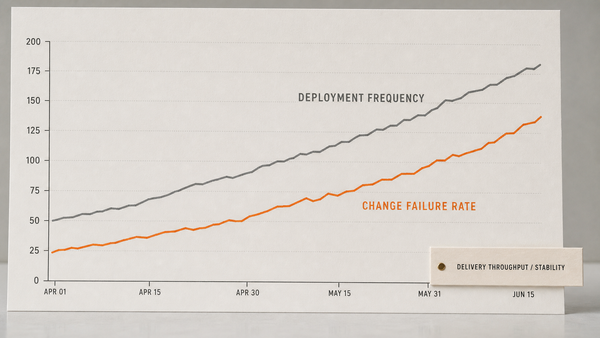
The pattern is consistent enough that it has stopped feeling like a coincidence. AI tool usage dashboards show green. Engineer sentiment is, by most internal pulse surveys, positive. Internal champions have done the work, the tooling is paid for, the training rotations have run. And the delivery numbers - cycle time, throughput per quarter, release predictability, escaped-defect rate - are flat or barely moved. Sometimes they are worse, in ways no one wants to write down on a slide.
The friction is not that nobody can explain this. The friction is that every available explanation has already been tried and discarded. The tooling? They switched once. The team's effort? Usage data shows real adoption, not theatre. The rollout pace? It has been long enough that "we are still ramping" is no longer the answer anyone believes at the board table.
What is left, when those three are ruled out, is a feeling rather than a frame: the gap between what engineers experience and what the delivery system produces has hardened into something structural. Boards have stopped accepting ramp-up as a sufficient explanation, and they are right to stop. Eighteen months is enough time for a structural pattern to have shown itself. The pattern has shown itself. The mistake has been looking for it inside the tooling layer.
This article is about a different layer. The gap between adoption and delivery is real, it has nothing to do with how well the rollout was run, and it shows up at almost every delivery org that has installed AI seriously for more than a few quarters. The explanation, once it lands, is uncomfortable in a specific way: it says the delivery system was already measuring the wrong constraint before AI arrived, and AI did not create the problem so much as make it impossible to keep hiding.
Implementation Was Always the Cheap Part
The productivity narrative that has carried AI rollout decks through the agentic-coding wave rests on a hidden assumption almost nobody states out loud. The assumption is that implementation cost - the time engineers spend at keyboards producing the artifact a deployment pipeline can move - was the binding constraint on delivery throughput. Compress that cost with AI, and delivery throughput rises in lockstep. The deck implies a straight line: faster typing equals more shipping.
For most delivery orgs, this was never true. The expensive parts of getting a feature into production were always somewhere else. They were invisible because implementation cost dominated the experience of building software. Engineers spent visible hours at keyboards. The cost of keyboarding felt like the cost of delivery. The rest of the cost was distributed across calendars, conversations, and review queues in ways no dashboard ever surfaced.
Here is the mechanism that hid the other layers. When implementation cost was high, every decision that depended on something being built had to wait for an implementation cycle before it could be tested against reality. Every alignment conversation referenced an implementation backlog as the gating fact. Every review queue could blame the upstream pace for its own lag. The other layers' true cost was embedded inside the implementation cycle's clock. Because that clock dominated the timeline, the other layers' contributions to delay looked like noise around a signal that was unambiguously implementation-bound.
The pivot is this. When AI compresses implementation cost - and the 2026 evidence base, mixed as it is, supports the direction that for well-bounded implementation tasks under controlled conditions, AI-paired developers complete artifact-production in a fraction of the prior time - the other layers do not shrink with it. They become visible. Not louder. Not worse. Visible. The same costs that were always there, finally measurable because the cycle that hid them has collapsed.
This is the point at which the productivity narrative stops being useful. It explained the past, when implementation cost was the visible constraint. It does not explain the present, when the implementation layer has just been compressed to the point where it no longer dominates the timeline. What dominates now was already there. AI compresses the bounded, specifiable, reviewable parts of the work. It does not compress decision authority, dependency ownership, or validation capacity at the same rate. For delivery-system diagnosis, four components are usually enough to explain the gap, and only one of them moved.
The Four Components of Delivery Cost
The cost of getting a feature into production is not one number. It is four. Naming them correctly is the load-bearing move of this piece. Every diagnostic that follows depends on the decomposition being clean.
Quick Take. Delivery cost decomposes into four components:Implementation cost - producing the artifact.Business complexity - deciding what the artifact should do.Coordination cost - aligning the people whose work the artifact touches.Review risk - the probability and cost of the artifact failing validation.
AI compresses the first dramatically. The other three are constant or growing.
III.1 Implementation cost
Implementation cost is the cost of producing the artifact itself. Typing the code, writing the integration shim, configuring the deploy pipeline, generating the test scaffold, wiring the feature flag, drafting the migration script. It is the part of delivery that takes place at the keyboard, in the IDE, against a specification that has already been written.
What this category does not include is doing the upstream work of deciding what the artifact should do, validating whether it is the right artifact to produce at all, navigating the consequences of producing it, or confirming that what was produced is actually correct. Those are different categories, and historically they have been confused with implementation because they appeared on the same Jira tickets and the same engineer's calendars.
AI agentic-coding environments - Copilot, Cursor, Claude Code, Codex, and their peers - compress this category dramatically in controlled-experiment conditions. GitHub's 2022 controlled experiment on a bounded HTTP-server-in-JavaScript task found Copilot users completed the work 55.8% faster than the control group (95% CI 21–89%). But the picture is sharply different on real work. METR's 2025 randomized controlled trial of 16 experienced open-source developers on 246 real PR tasks in mature repositories (averaging 5 years of prior experience per repo, repos averaging 23,000 GitHub stars) found that allowing AI tools made the work 19% slower on net, even as the developers themselves estimated, after the fact, that AI had sped them up by 20%.
The evidence does not say "AI always makes developers faster." It says AI helps most when the work is bounded, local, and easy to validate. On mature repositories, ambiguous tasks, and work owned by experienced maintainers, the effect can shrink or reverse. That distinction is exactly why implementation speed cannot be used as a proxy for delivery-system throughput.
The compression is real where the task is well-bounded and the codebase is unfamiliar enough that AI assistance lands as net help, and the compression is weaker, zero, or reversed where the developer's existing expertise already encodes most of what the AI would be predicting. The productivity narrative's straight-line extrapolation from "ticket-to-PR is faster in a controlled experiment" to "delivery throughput is faster across the system" relies on a layer-confusion this article spends the rest of its length naming. The gap between developer perception of speed and measured throughput is itself part of the pattern.
III.2 Business complexity
Business complexity is the cost of deciding what the artifact should do. Resolving conflicting stakeholder requirements. Navigating regulatory and contractual constraints. Choosing between mutually exclusive product directions when both have credible cases. Distinguishing the actual job-to-be-done from the proxy metric that triggered the request in the first place.
The mechanism that matters here is that this layer is dominated by conversations between humans who hold different mental models. A faster keyboard does not resolve a disagreement that has its root in two people meaning different things by the same word. The cost of this layer is bounded by how long it takes to align mental models, not by how long it takes, afterward, to encode the aligned model into specification. AI can improve the artifacts around business complexity - meeting summaries, requirements drafts, decision logs - but it does not remove the human decision conflict inside it. The constraint is human-cognition, not artifact-production.
III.3 Coordination cost
Coordination cost is the cost of getting the right people in the room - at the right time, with the right context - and then keeping their decisions consistent across the duration of the work. It is the cost of dependencies. Of calendars. Of asynchronous communication channels that do not converge fast enough. Of the moment when a downstream system owner discovers, two weeks in, that an assumption they were never asked about is now load-bearing.
This category scales superlinearly with the number of independent decision-owners and the number of dependent systems an artifact touches. It is bounded by calendars, attention, and the limits of asynchronous communication. AI can reduce coordination overhead at the margins - better meeting notes, faster status synthesis, lighter context-handoff - but it does not remove dependency ownership, decision rights, or calendar-bound authority. In some adoption patterns AI expands coordination cost, because the higher implementation throughput means more decisions need to be made per quarter to keep up with what implementation can now produce. More artifacts in motion equals more coordination per quarter. The denominator just got bigger.
III.4 Review risk
Review risk is the probability that the artifact, once produced, fails validation, and the cost of the rework loop that follows. Security review. Design review. Code review. QA validation. Regulatory audit. Post-deployment incident.
This layer changes asymmetrically when AI lands. The volume of artifacts entering review rises sharply when implementation cost drops. AI does not make individual artifacts dramatically safer in expectation; per-artifact failure probability is broadly comparable to pre-AI baselines on real PR work. Even if per-artifact failure probability stays flat, the volume effect alone is enough to overload review. A delivery system that did not redesign the review layer to handle higher artifact volume sees its review queues lengthen and its review-related incidents rise, even as individual engineer output improves.

What Becomes Visible When the Cheap Part Gets Cheaper
The four-component decomposition is useful only if it makes a specific prediction about what a delivery system does when implementation cost drops. The prediction is precise enough to be falsifiable, and it matches the pattern almost every CTO is currently looking at without a frame to interpret.
When the implementation layer compresses, its throughput rises faster than the other three layers can absorb. The result is a backlog at the layers that did not change. The symptoms are predictable.
Symptom 1: more code is written, less code reaches production. Pull-request volume rises. Merge rate per PR falls, or stays flat at a higher absolute number that nevertheless does not produce proportionally more shipped features. The bottleneck moved from "we cannot write it fast enough" to "we cannot decide what to write fast enough" or "we cannot review it fast enough." The work-in-progress numbers say the system is busy. The throughput numbers say it is not.
Symptom 2: engineers report feeling faster, delivery metrics report being the same. Both are true at the same time. The engineer's experience is dominated by the implementation layer, where they personally work. When that layer's clock compresses, they feel the compression in their own day. The delivery metric is dominated by the throughput of the whole system: implementation plus business complexity plus coordination plus review. If only one of four layers moved, the system-level metric reflects an average that has barely shifted. There is no contradiction between the two reports. They are measuring different things.
Symptom 3: more pilots, fewer shipped products. Pilots have low coordination cost: small team, narrow scope, contained review surface. Shipped products require alignment across stakeholders, regulatory review, operational handover, and downstream system integration. Pilots can keep up with AI-compressed implementation. Shipped product cannot. The result is a delivery organization that produces a steady stream of demos, prototypes, and internal showcases, and a slower stream of features that survive contact with production. ICP language for this state usually arrives as a complaint: our AI strategy is basically a list of pilots.
The diagnostic question for the reader is short. Which of the four layers is currently the binding constraint on your delivery? If the answer is still "implementation," the organization is either (a) at a maturity level where implementation genuinely was the bottleneck - possible, but increasingly rare in 2026 across the delivery orgs that have installed AI seriously - or (b) measuring activity at the implementation layer and mistaking it for delivery-system throughput. The 4-Level AI Adoption Evaluation Model draws the distinction cleanly: most orgs that show flat numbers are not failing to adopt. They are succeeding at adoption while still measuring the constraint that no longer binds.

The Work Did Not Shrink - It Migrated
A four-component cost decomposition is diagnostic, not prescriptive. This article does not propose a complete operating-model redesign. That work belongs in an engagement, not in an essay. What can be said in essay form is what redesign means in direction at each of the three layers AI did not compress. The direction matters because each layer has a different binding constraint and therefore a different leverage point. Mistaking one layer's leverage point for another's is the most common second mistake delivery orgs make, after the first mistake of believing implementation compression was the whole game.
At the business-complexity layer, the binding constraint is the speed of mental-model alignment between the people who hold decision authority. Faster alignment requires one of three things: reducing the number of distinct mental models in play (consolidating decision authority into fewer hands), raising the shared context base so fewer mental models need to be reconciled from scratch each time (better written documentation, shared dashboards, shared definitions of done), or shortening the alignment cycle (more frequent shorter syncs, asynchronous decision protocols with explicit deadlines and named decision-owners). AI tooling helps marginally here, through assisted documentation and meeting summarization, but the constraint is fundamentally a human-coordination problem, not an artifact-production problem.
At the coordination layer, the binding constraint is calendars and attention. Redesign means reducing the number of decision-owners per artifact, reducing the number of dependencies per artifact, or raising the cadence of coordination touchpoints so that decisions do not wait for the next quarterly review to be made. None of these are tool-installs. All are operating-model choices about how decision rights are distributed, how dependencies are managed, and how often the system is permitted to converge on a state.
At the review layer, the binding constraint is reviewer capacity per unit time, against an artifact volume that just rose. Redesign means raising reviewer capacity (adding reviewers, which is the costly path), or compressing per-artifact review cost through tooling and asynchronous review protocols, or reducing the volume of artifacts that need full human review through risk-tiered routing and better pre-review filters. The second and third of these are the AI-leverage points at the review layer. Not "AI replaces reviewers" - which is the wrong framing and produces predictable failure modes when attempted - but "AI changes which artifacts need full human review, and accelerates per-artifact review for low-risk artifacts." The role-based AI playbooks for delivery teams treat this distinction as central. Tool adoption without role redesign creates activity, not transformation, and the review layer is where that pattern shows up most obviously when implementation throughput rises.
The unifying observation across the three layers is that AI changed where the leverage is. The work did not shrink. It migrated. A delivery system that did not migrate with it is operating at the old constraint and measuring whether the old constraint moved, which it did, in the layer that no longer binds.

The Constraint Migration You Already Accepted in Theory
Most CTOs already know, in the abstract, that bottlenecks migrate when you remove one. The Theory of Constraints has been on the operator-reading list since Goldratt's 1984 The Goal. The mechanism is not controversial at the level of generality at which it is usually discussed. What is hard is not the theory. What is hard is recognizing the migration when it happens to your current bottleneck - when the constraint that moved was the one your delivery system was organized around measuring, and the new binding constraint is one your dashboards were never designed to see.
The quiet claim in this piece is that the migration has already happened in most AI-adopting delivery orgs. The organizations that show flat delivery numbers despite real AI adoption have not yet reorganized around the new constraint. The organizations that show genuine throughput gains have, even if they do not describe what they did that way, and even if they cannot articulate which of the four layers they redesigned. They are running the new constraint. The others are still running the old one.
The diagnostic the reader can act on is operational, not strategic. Look at where your delivery organization currently invests its highest-leverage effort. Which of the four layers receives the most senior attention, the most tooling spend, the most operating cadence? If the answer is still implementation (better IDEs, faster CI, more agentic-coding rollout), the optimization is happening downstream of where the bottleneck now lives. The work is being done in the layer that no longer binds. The leverage is in one of the other three. The next move belongs in the AI operating model, not the next tool upgrade.
AI Transparency Notice: This article and its accompanying images were created with the assistance of generative AI. The author directed the content, contributed the underlying ideas and analysis, and reviewed the final publication.