AI Workforce Transformation Is a Delivery-System Redesign, Not a Training Budget
You have two dashboards. The first is green: license utilization, course completion, internal NPS on AI tools. The second has not moved: cycle time, throughput, escaped defects, cost per workflow. AI workforce transformation is a delivery-system problem, not a training-budget problem.
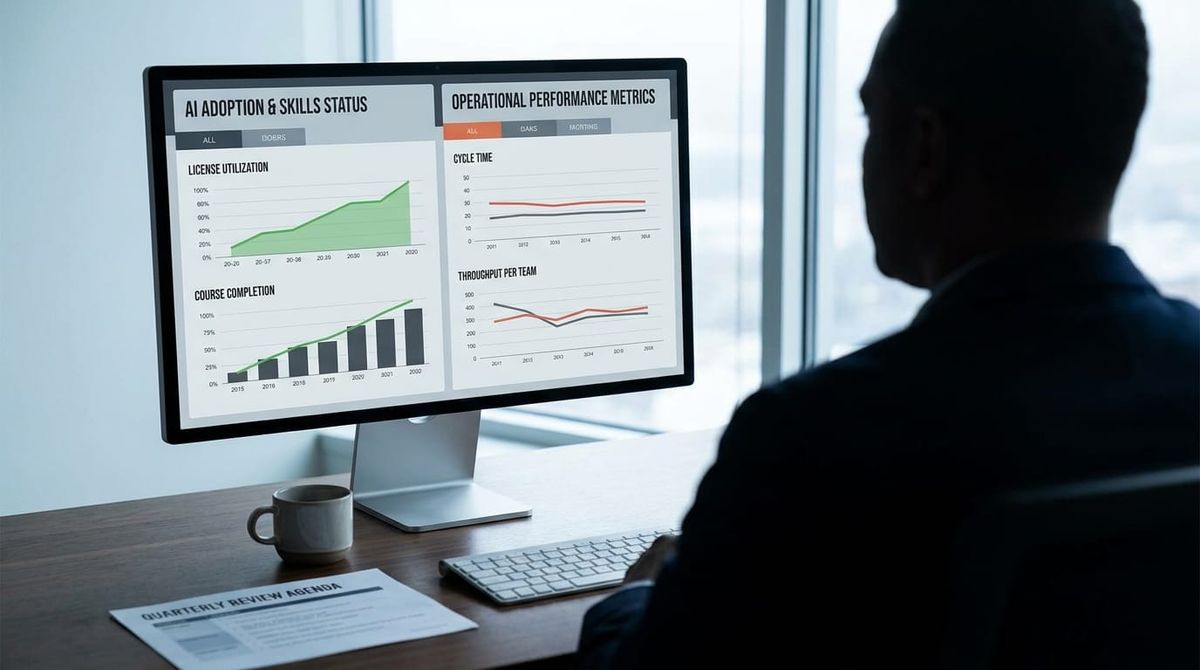
You are sitting in front of two dashboards.
The first one is green. License utilization is up. Course completion is moving the right direction. The prompt library has more entries than anyone expected. Internal NPS on the AI tools came back stronger than your last engagement survey on anything. Your Head of People is happy. Your CIO is happy. The board slide that summarises the AI program writes itself.
The second dashboard has not moved. Cycle time is the same as a year ago. Throughput per team is flat. Escaped defects are inside the same band you were quoting last cycle. Sales conversion did not benefit. Hiring speed did not benefit. Cost per workflow is exactly where it was when you approved the program.
The thought you are not yet saying out loud, and the one your CFO is going to say for you next quarter if you don't, is the verbatim line your peers say to each other once they stop performing optimism. We have the tools, the team is using Copilot, but delivery hasn't changed.
This is the problem the rest of this piece is about. It is not a training-budget problem. AI workforce transformation is a delivery-system problem, and the gap between your two dashboards is the most legible symptom of the misdiagnosis.
The falsifiable version of the claim, said the way the BCG AI Radar 2026 cohort effectively says it: if you double workforce upskilling spend without changing roles, workflows, decision rights, KPIs, career paths, and management cadence, your delivery and product-throughput metrics will not move in the same quarter - and likely will not move in the next four. The piece is wrong if individual-capability spend alone produces durable, measurable movement in workflow-level performance metrics inside companies that left their operating model untouched. I do not think it does, and the strategy houses publishing most rigorously on this effectively don't either.
Quick answer. AI workforce transformation programs miss their performance numbers because they invested in training without redesigning the delivery system around it. The delivery system is six elements - roles, workflows, decision rights, KPIs, career paths, and management cadence - and upskilled operators default back to those elements when they remain unchanged. Until all six are redesigned together, the activity dashboard will stay green and the performance dashboard will stay flat.
The activity dashboard is green and the performance dashboard hasn't moved
Two dashboards is the right mental model because, at most companies that ran a workforce-AI program in the last cycle, two dashboards are being maintained. They get reviewed in different forums by different functions, and almost nobody owns the seam between them.
The activity dashboard lives where the program lives. People & Culture or L&D usually owns it. It tracks the legible artifacts of a training program. License utilization for the AI assistant. Course completion percentage by cohort. Number of prompt-library contributions. Internal NPS on the AI tools. AI champion meeting cadence. Number of role-specific workshops delivered. The dashboard is honest about what it measures: it measures exposure, access, and program compliance.
The performance dashboard lives where P&L lives. Cycle time and lead time on delivery. Throughput per team. Escaped defects and quality-gate pass rates. Sales conversion. Hiring speed. Cost per workflow. Customer-NPS, separated from internal-NPS. This dashboard is honest about what it measures too: it measures whether the way the business actually produces value got faster, cheaper, or better.
The structural reason these decouple is mechanical, not motivational. Activity metrics move when a tool lands and people are told to use it. Performance metrics move when the workflow that uses the tool changes shape. A Copilot license is a tool landing. A course completion is exposure to a tool. Neither one changes how the team sizes a pull request, how the manager runs the standup, how the PM scopes a sprint, how QA structures a regression pass, or how account executives qualify a call. Those are workflow questions, not capability questions, and capability spend does not reach them.
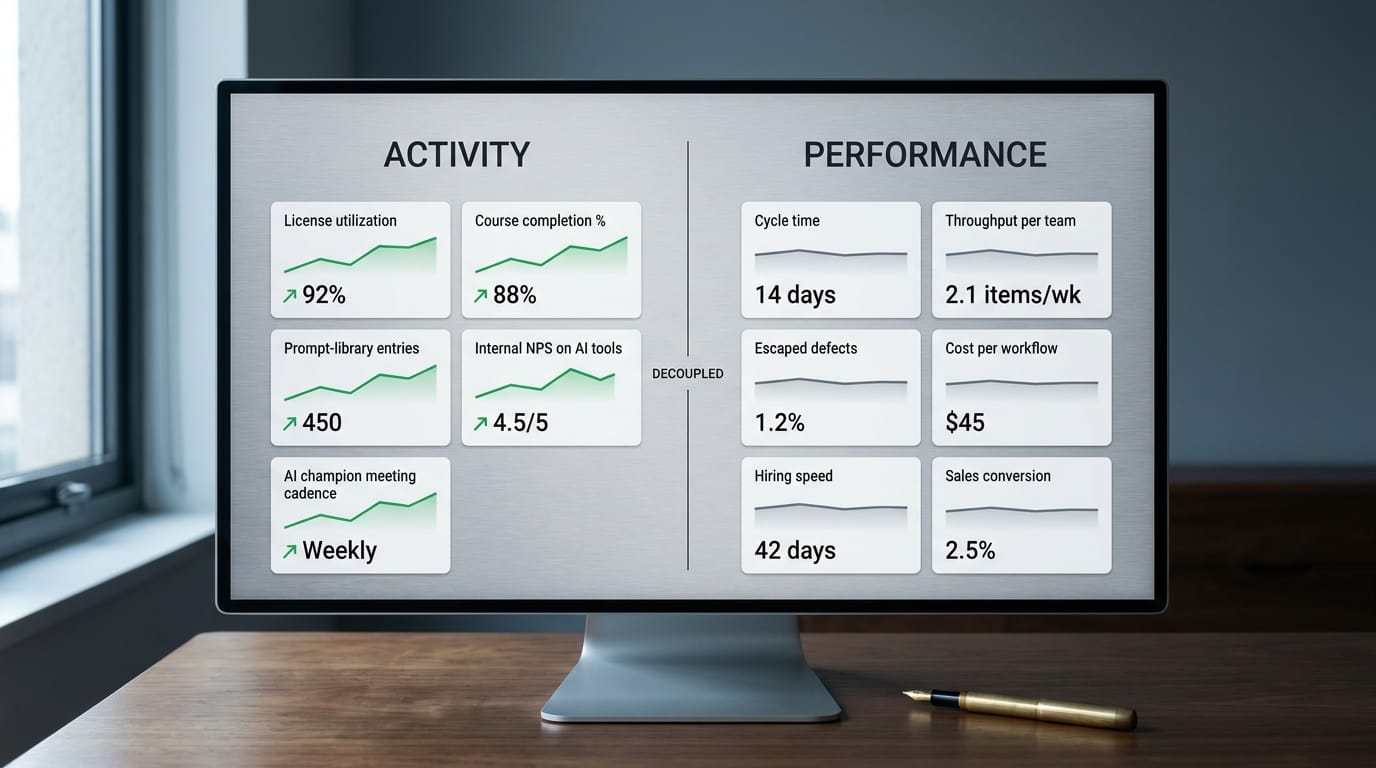
Worth being precise about which side measures which thing, because the decoupling lives inside the seam:
| Activity measured | What it tracks | Performance NOT measured | Why the gap matters |
|---|---|---|---|
| License utilization | Tool access | Workflow-level throughput | Tool access ≠ workflow change |
| Course completion % | Individual exposure | Cycle time / lead time | A trained operator inside an unchanged process |
| Prompt-library entries | Activity volume | Quality of work output | Volume ≠ outcome |
| Internal NPS on AI | Sentiment | Cost per workflow | Sentiment ≠ economics |
| AI champion meeting cadence | Process compliance | Decision throughput | A meeting ≠ a decision |
The activity dashboard is not lying. It is reporting accurately on the thing the program was set up to measure. The point is that the program was set up to measure the wrong thing. The CEO is paying for a workforce-transformation outcome and being shown a workforce-training outcome. The two are not the same, and the chart that proves the difference is the one on the other side of the room.
That is the symptom. The cause is operating-model, not pedagogy.
Upskilling spend without redesign creates AI-fluent operators inside an unchanged operating model
The mechanism, said slowly:
A training program arrives. It is well-designed. The curriculum is current, the labs are real, the role-specific modules are credible. The operator goes through it. By the end of the program, the operator is more capable. They can prompt better, they can read AI-assisted output more critically, they know when the model is bluffing. As a unit of capability, the operator is a different person than they were before the program.
Then Monday morning happens.
The operator walks into the same standup that the team has been running for the last three years. The manager asks the same three questions in the same order. The board has the same columns. The story-point conventions are the same. The PR-review template is the same. The QA hand-off is the same. The promotion conversation that was scheduled for Q3 still references the same artifacts (code quality, design-document depth, story-point velocity, ticket throughput) that it referenced when AI was not in the workflow at all.
The operator absorbs the training, walks into the unchanged measurement system, and does what any rational operator does inside an unchanged measurement system. They produce the artifacts the system rewards. If the system rewards story-point velocity, AI helps them produce story-point velocity. If the system rewards thick design documents, AI helps them produce thicker design documents. None of that touches cycle time. None of that touches escaped defects. None of that touches cost per workflow.
This is the operating-model layer of the problem, and it is the layer that BCG's 2026 "AI Transformation Is a Workforce Transformation" piece names as a CEO-level mandate without quite naming the mechanical pieces. The piece you are reading is one altitude below that, naming what the pieces are.
Two things make this layer invisible to the program-owner during the first three quarters of a rollout. The first is that the activity dashboard is moving for real. Course completion is real. License utilization is real. People are not faking enthusiasm. That looks like progress, and inside the activity logic, it is progress. The second is that no single function owns the seam where individual capability meets organizational measurement. The CFO sees a training-spend line item growing. The CHRO sees a curriculum that is being delivered to budget. The CIO sees tools that are being adopted. Nobody is looking at the standup, the role definition, the KPI rubric, and the promotion document and asking whether any of those changed shape after AI landed. They did not.
In the AI rollouts I run, before the operating model is redesigned, the pattern is consistent: capable operators inside an unchanged measurement system, doing more activity that the workflow does not convert into performance. That is the layer this article is asking you to make a budget decision about. The master-thesis version of the operating-model argument is in The AI Operating Model; the workforce-spend application of it is what you are reading.
The delivery system is six elements, and the budget must move all six
If the failure mode is "training without redesign", then the natural question is: redesign of what?
The answer is six elements that, together, constitute the delivery system - the machinery through which an organisation actually produces work. Most workforce-AI programs touch one or two of these and leave the others untouched. That is the structural reason the performance dashboard does not move.

Roles - what each role does after AI is in the loop, not just what tools they have
Adding a tool to a role is not the same as redesigning the role. A QA engineer with Copilot is still a QA engineer if the role definition still says "write test cases and execute regression". The redesign question is: given that the AI can draft test cases, what is QA for now? Is QA the authority on which AI-drafted tests are valid? On which categories of defect the model will systematically miss? On where the AI-drafted regression coverage has blind spots the team needs to verify by hand? Those are different responsibilities than the pre-AI definition. If the JD did not change, the role did not change.
Workflows - how work moves between roles when AI produces drafts of intermediate artifacts
A workflow is not just the work, it is the hand-off. AI changes the shape of the hand-off because AI now produces drafts of intermediate artifacts: a draft PR, a draft test plan, a draft RFP response, a draft customer reply. Who reviews the draft? At what point in the workflow does a human commit to the draft as the team's position? What happens to PR size, batch size, and review queue depth when the upstream artifact is AI-drafted in minutes instead of human-drafted in hours? If the workflow diagram on the wall has not been redrawn to reflect those new hand-offs, the workflow has not changed.
Decision rights - who decides what, given that AI now drafts the decision
This is the element programs forget most often, and it is the element that hurts most when forgotten. AI produces drafts of decisions, not just drafts of artifacts. The draft architecture proposal. The draft hiring rubric. The draft pricing recommendation. The draft customer-segmentation cut. Someone now has to decide whether to commit to the AI-drafted decision, modify it, or reject it. That is not a tooling question, it is a decision-rights question, and it has to be allocated explicitly. The default is for the AI-drafted decision to land somewhere in the org and quietly become the decision because no one had the formal authority to push back on it. That is not transformation; that is decision-rights abdication wearing a tool.
KPIs - what counts as performance now that activity is cheap
This is the lever the CFO understands fastest. The pre-AI KPI set assumed activity was scarce; every artifact cost human time to produce. AI made activity cheap. If you measure the operator by activity volume now (lines of code, tickets closed, draft documents produced), you will measure them as wildly more productive, and you will be wrong about what that productivity bought you. The redesign question is: which existing KPIs do you retire because they no longer measure scarcity, and which new ones do you add because they now measure the actual scarcity (judgement, integration, taste, decision-quality, customer-perceived value)? If your KPI document is unchanged, your performance dashboard is measuring the wrong thing.
Career paths - what gets you promoted when the artifact was AI-assisted
This is the slowest-moving lever and the one that quietly determines whether the redesign survives the year. A career path rewards specific artifacts. If your senior-engineer rubric still says "ships X production features", and AI now drafts most of the code, then either (a) more people will hit that bar superficially, (b) the bar will inflate without explicit decision, or (c) the rubric will quietly stop being a reliable signal and the promotion conversations will become political. None of those is the redesign you want. The explicit version is to rewrite the rubric to name what an AI-assisted engineer's evaluable work looks like: what judgement they showed, what tradeoffs they navigated, what they refused to ship. Otherwise the career path will continue to reward last year's outputs and the org will continue to optimise for them.
Management cadence - how managers run standups, 1:1s, and reviews around AI-assisted work
This is the most operationally visible element and the one most managers are not equipped to change without explicit support. The standup needs new questions: what AI-assisted draft are you committing to today, what are you NOT trusting the model on, what did you reject yesterday and why? The 1:1 needs new questions: where did AI accelerate the work this week, where did it create false signal, where did it slow you down? The review needs new questions: what does this person's judgement look like when their first draft is no longer their own? If the standup, the 1:1, and the review look the way they did 12 months ago, management cadence has not changed. And if management cadence has not changed, the redesign has not reached the floor.
The six elements have to move together because they reinforce each other. A new KPI without a new career path becomes a metric people game without consequence. A new workflow without new decision rights produces drafts that never get authorised. A redesigned role without new management cadence is a JD that nobody enforces. This is why workforce-spend without delivery-system redesign produces fluent operators and unchanged numbers: the redesign is a coupled system, and capability spend touches one element of it at most.
Two examples of the decoupling, each held by a different missing element
The patterns below are generic instances of the decoupling, not company-specific stories. They are useful because each names the specific element that did not change, which is where the diagnostic value lives.
The Copilot-at-scale rollout where cycle time didn't move
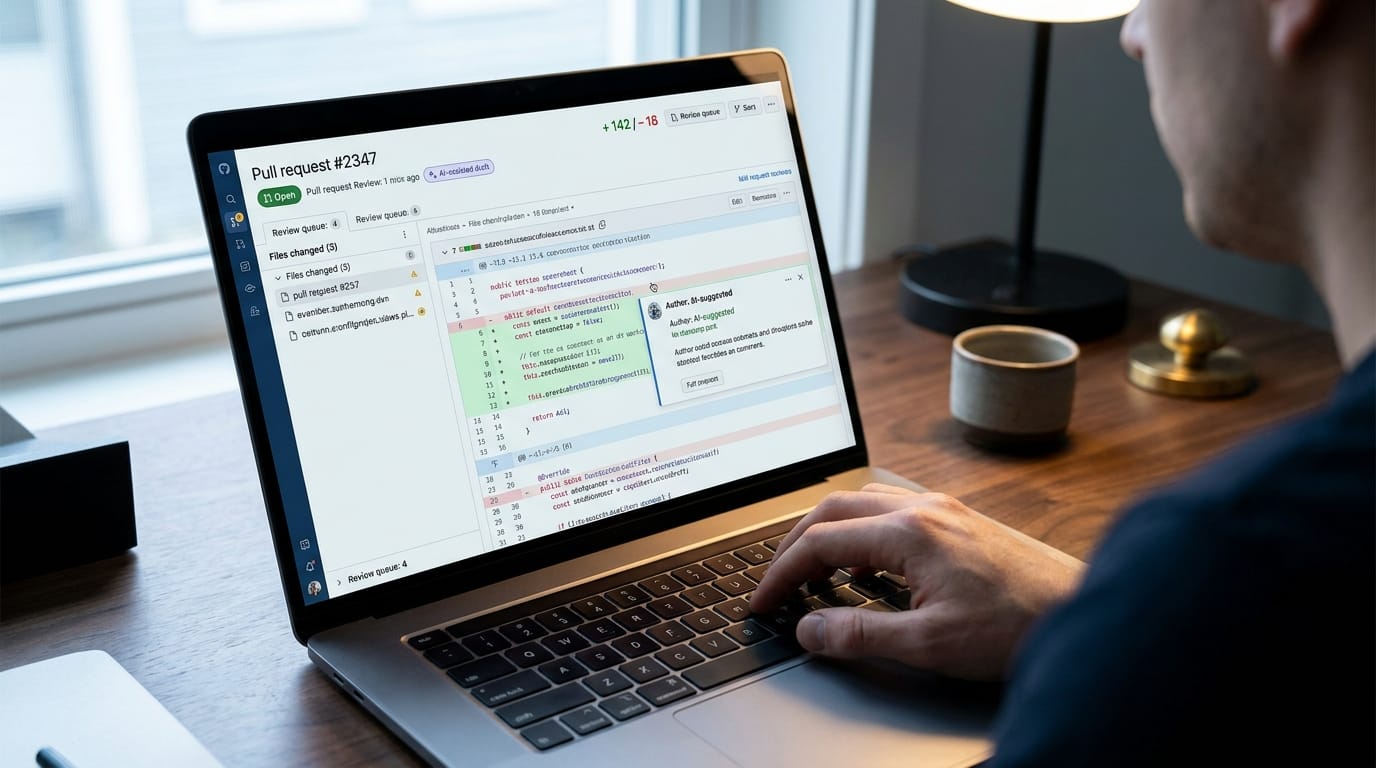
A technology company licenses an AI coding assistant for its full engineering organisation. The rollout is well-run. Course completion is high. Engineers report the tool as useful in surveys. Individual code-generation speed is measurably faster on the artifacts where AI helps: boilerplate, tests, refactors. The CFO and the CTO both look at the activity dashboard and conclude that the program is working.
Six months in, team-level cycle time is unchanged. The reason is mechanical: cycle time is governed by review-queue depth, PR sizing, deployment cadence, and quality-gate latency, not by typing speed. AI made individual-author throughput faster. It did not make the reviewer faster. It did not change the PR-sizing convention, which is still "one ticket per PR". It did not change the team's deployment cadence, which is still daily. It did not change the quality-gate latency, which is still bounded by the slowest gate in the chain.
What didn't change here was the workflow - specifically, the hand-off between author and reviewer. The role got faster. The workflow did not. The natural follow-on is to redraw the workflow: larger reviewable chunks because review is now cheap to set up; shorter chunks because the reviewer has more time to think; or a different reviewer-allocation pattern because the reviewer is now the bottleneck. Any of those would move cycle time. None of them are training questions. They are workflow questions, and the workforce-AI program did not have authority to answer them.
The AI champions cohort where the org chart didn't change
A company stands up an AI champions cohort of 30 senior practitioners across delivery, sales, and operations. The cohort runs for six months. The champions ship internal demos. They run brown-bag sessions. They write playbooks. They are visible. The activity dashboard for the program is full.
At month nine, almost none of the cohort's output has become production capability. The demos are demos. The playbooks are in Confluence. The org chart looks exactly the way it did before the cohort started. Nobody formally owns "AI integration for the customer-onboarding workflow". Nobody formally owns "AI-assisted account research for sales". There is no KPI on the org chart that the cohort's output rolls up into. There is no review at the senior level that asks whether champion-produced changes shipped to customers.
What didn't change here was decision rights, and to a degree roles and management cadence, because no role formally owned the cohort's output, no KPI tracked the cohort's workflow-level effect, and no management forum had the authority to commit. The cohort produced everything except the structural decision that would make their output durable. That decision required moving boxes on the org chart, and the program never had the authority to do it.
The thing both examples have in common is that they were judged a success by the activity dashboard and a failure by the performance dashboard, and the discrepancy is explained by which delivery-system element did not change. That is the diagnostic move: when the dashboards disagree, ask which of the six elements stayed the same. The role-by-role version of this argument is in Role-Based AI Playbooks for Delivery Teams. That piece names what specifically changes inside each role's playbook when AI lands; this piece names the system the playbook sits inside.
Three pitfalls that look like progress and aren't
These traps recur in workforce-AI programs that are otherwise well-run. They feel like progress because the activity metrics agree. They are not progress because the workflow has not changed.
Mistaking license utilization for adoption. Utilization tells you that operators have access and have opened the tool. Adoption is workflow change: the AI assistant is in the loop of how a piece of work actually gets produced, reviewed, and shipped. A license can be at 95% utilization with zero workflow change; that means people are using the tool around the edges of their existing process, not inside it. The diagnostic question is not "are people using the tool" but "did the standup change, the PR template change, the review cadence change". If those did not change, the utilization number is reporting on a different thing than the program was set up to deliver.
Counting AI champions instead of redesigned roles. A champions cohort is a precondition for a redesign, not the redesign itself. Champions are useful as the first set of operators who can articulate what a redesigned role should look like, what a redesigned workflow should look like, what KPI should retire and what should take its place. The mistake is treating the existence of the cohort as the outcome. The cohort is the input. The outcome is whether any role definition, workflow diagram, KPI document, or career-path rubric was actually rewritten on the basis of what the cohort learned. If those documents are unchanged at the end of the cohort program, the cohort did not produce the outcome the budget was approved for.
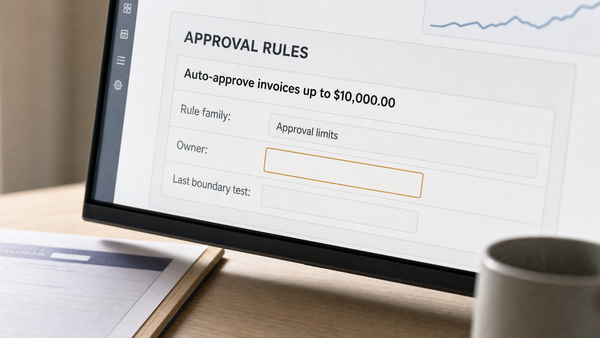
Running upskilling as an L&D program instead of a CEO operating-model program. This is the structural pitfall. L&D can credibly own a curriculum. L&D cannot credibly own changes to role definitions, workflow diagrams, decision-rights allocations, KPI selections, career-path rubrics, and management-cadence questions, because none of those are L&D's authority. Those six elements are CEO-and-CXO authority. When the program is run as L&D-led, the program will deliver everything L&D has authority over (exposure, capability, sentiment) and nothing it does not. Team-level redesign of workflow and management cadence can happen below the CEO sanction line and is often where the first compounding wins show up; the load-bearing claim is that org-wide performance will not move without CEO authority, not that team-level experimentation has to wait. The fix is not to give L&D more budget. The fix is to put the CEO or a sanctioned executive proxy on the operating-model side of the program, with the explicit authority to change all six elements together. BCG's 2026 "Work Reinvention as CEO Mandate" framing is naming exactly this.
What good looks like - the six-question test you can run on your current program
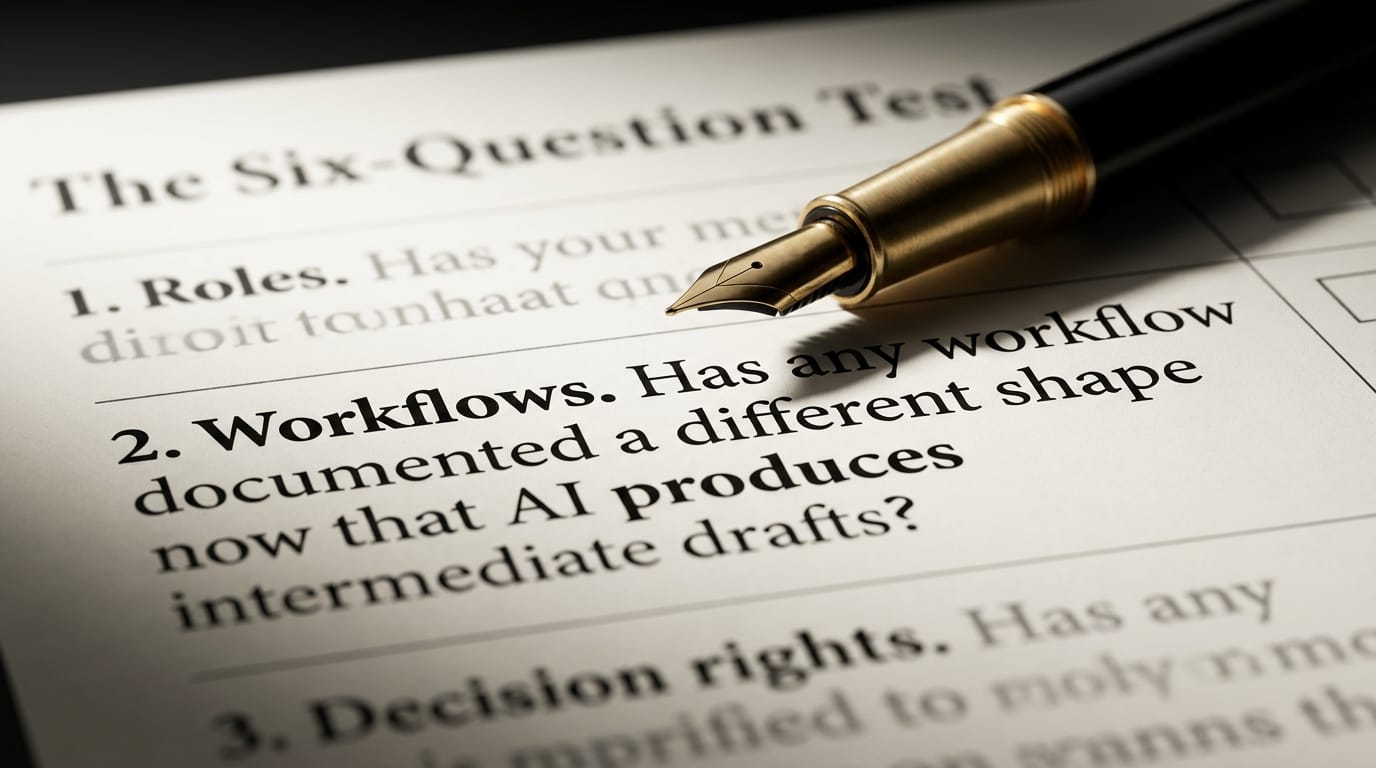
If you are reading this in the middle of a program that already exists, the useful move is not to rewrite the strategy but to diagnose where in the six elements the program currently has authority and where it does not. Run the checklist below.
- Roles. Has any role formally changed responsibilities since AI landed? Read the job description against the version from 18 months ago. If "we trained them on AI" is the answer, the role did not change.
- Workflows. Has any workflow documented a different shape now that AI produces intermediate drafts? Look for the workflow diagram on a wall or in the team handbook, not in a strategy deck. If you cannot find the redrawn diagram, the workflow did not change.
- Decision rights. Have any decision rights moved? Is anyone now formally reviewing AI-drafted decisions rather than originating them? Has any approval chain been rewritten? If decision rights look the way they did pre-AI, decisions are still being abdicated to the model by default.
- KPIs. Has any KPI been retired because AI made it a poor measure, or added because AI changed what was measurable? If the KPI document is unchanged, the performance dashboard is measuring the wrong thing.
- Career paths. Has any promotion rubric been rewritten to name AI-assisted artifacts as evaluable work? If the rubric still names the same artifacts as a year ago, the career path is rewarding pre-AI behaviour and the org will continue to produce it.
- Management cadence. Has the standup, the 1:1, or the review added a question that did not exist 12 months ago about AI-assisted work? If management forums look the way they did, the redesign has not reached the floor.
If five or six answers are no, the article's central claim applies to your program: the spend went to pedagogy; the redesign has not started. If three or four answers are no, the redesign is partial. Capable operators are doing AI-assisted work inside a measurement system that still rewards the pre-AI behaviour, and the performance dashboard is going to keep underperforming the activity dashboard until the remaining elements move. If one or zero answers are no, you are likely already capturing measurable workflow-level outcomes, and the next conversation is about how to compound them, not how to start them.
A separate question, and one worth answering directly because it is the question post-purchase CEOs ask: this is not an argument for stopping upskilling. The BCG AI Radar 2026 finding is that the companies capturing the most value from AI have the most ambitious upskilling programs, and the most aggressive operating-model redesign sitting underneath them. Upskilling without redesign produces the activity-versus-performance decoupling described above. Redesign without upskilling produces the opposite failure mode: workflows that demand AI-fluency the workforce does not yet have. The argument is for pairing, not substitution. If your program is heavy on upskilling and thin on operating-model change, what is being asked is not to cut the upskilling line. It is to fund the redesign that turns the upskilling into a measurable workflow change. That is a CEO budget call, and it is the one the next quarterly review is going to test.
Returning to the two dashboards - and what the CEO does next
The two dashboards in front of you have a specific structural relationship. Activity precedes performance by a quarter or two, but only when the workflow that converts activity into performance has been changed. When the workflow is unchanged, activity is decoupled from performance permanently, regardless of how much more activity you produce.
That is the decision in front of the next budget cycle. You can defend the program at the curriculum altitude (where the metrics are activity) and the activity dashboard will keep being green for one more quarter. Or you can reframe the program at the delivery-system altitude (where the metrics are performance) and put authority for changing roles, workflows, decision rights, KPIs, career paths, and management cadence on the same desk that approved the original program. The first option is easier in the next review and harder in every review after that, because the gap between the dashboards grows. The second is harder this quarter and changes what is possible in the next four.
If you want the role-by-role specifics of what changes inside each delivery role when AI lands, Role-Based AI Playbooks for Delivery Teams is the next read. If you want the master operating-model thesis that this article is the workforce-spend application of, The AI Operating Model is upstream of everything here.
Key takeaways
- Activity dashboards measure tool reach; performance dashboards measure workflow change. They decouple when nobody redesigns the workflow.
- The delivery system is six elements: roles, workflows, decision rights, KPIs, career paths, and management cadence.
- Upskilling spend without delivery-system redesign produces fluent operators inside an unchanged measurement system.
- Training-ROI formulas measure individual capability; they cannot measure the workflow-level performance the CEO is being asked about.
- The redesign is a CEO mandate, not an L&D program. Only the CEO can change all six elements together.
AI Transparency Notice: This article and its accompanying images were created with the assistance of generative AI. The author directed the content, contributed the underlying ideas and analysis, and reviewed the final publication.