The PM AI Playbook: From Personal Productivity to AI Delivery Governance
The dashboard says ninety percent of the team is using the AI tools. More code is shipping than last quarter. Cycle time is flat, the review queue keeps growing, and a tester just flagged a defect that should have been caught two stages earlier.
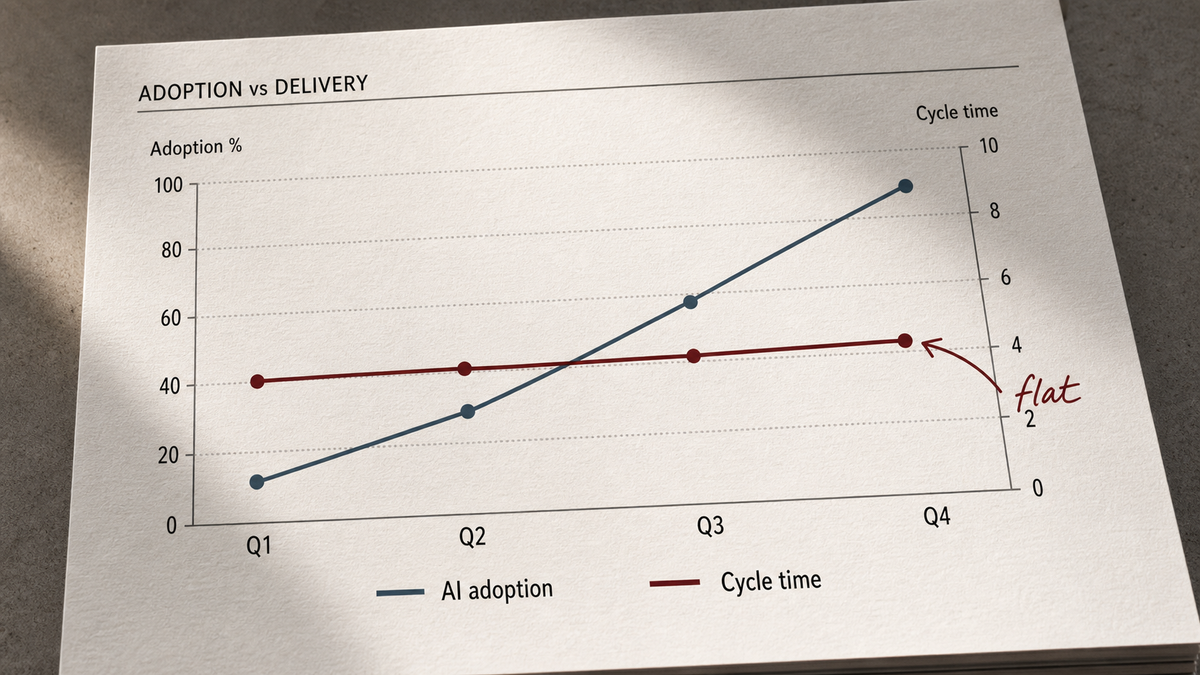
The dashboard says ninety percent of the team is using the AI tools. More code is shipping than last quarter. And cycle time is flat, the review queue keeps growing, and a tester just flagged a defect that should have been caught two stages earlier. If you fund delivery, or you run the project that delivery moves through, this is the gap worth losing sleep over: you can prove the team adopted AI, and you cannot prove the team got better.
The Project Manager is the role that closes that gap, or fails to. Not by writing status reports faster. The PM's AI value is governing whether the team's new AI speed quietly lowered the delivery quality bar, measured with data rather than status meetings. That is the move almost no one is making, because most writing about AI project management comes from tool vendors describing features, and the actual job is a governance job.
Quick answer: The PM has a dual AI responsibility no other role carries. The PM uses AI for personal delivery work, and the PM governs whether the team's AI adoption improves delivery without lowering quality. As AI lands, the PM's value moves from coordinating and status-tracking to governing project-level delivery quality with data. The mechanism has three moves: measure adoption as behavior change rather than tool logins, govern quality gates without implementing them, and find where the bottleneck moved after AI compressed the implementation step.
The PM has a dual AI responsibility, and it changes what the role is for
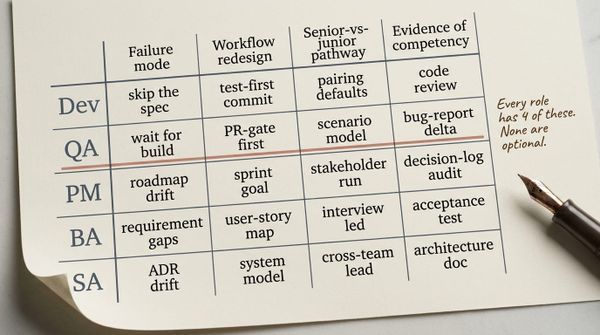
Every role on a delivery team is being asked to redesign its own work around AI. The engineer rethinks how code gets written and reviewed. The QA engineer rethinks where testing happens in the flow. The business analyst rethinks how requirements get shaped. The PM has that same job for the PM's own work, plus a second job no other role has: helping the team adopt AI in a way that improves outcomes without lowering quality. Use AI personally, and govern the team's AI-assisted delivery. The first half is productivity. The second half is AI delivery governance, and it is where the role's leverage actually sits.
I find it useful to treat the PM's progression as a ladder, because it separates "the PM is busier" from "the PM's value moved." The L1-L4 (PM AI maturity ladder) is not a checklist of features to adopt. It is a map of where the PM's value sits at each level.
| Level | Name | Where the PM's value sits |
|---|---|---|
| L1 | AI-Assisted PM Foundations | Personal productivity: the PM uses approved AI tools for recurring delivery work and reviews the output critically. |
| L2 | Automated PM Workflows and Team Enablement | Repeatable workflows plus team support: the PM makes AI part of the project's operating rhythm and tracks where team adoption is strong, stalled, or blocked. |
| L3 | AI-Driven Delivery Governance | Measurement and governance: the PM governs the full AI-assisted delivery system with data, quality-gate evidence, and forecasting accuracy. |
| L4 | Cross-Project Influence | Role expansion: the PM applies delivery patterns across projects and connects business intent to delivery execution. |
At L1, the value is the PM's own output. A repeatable meeting-summary workflow turns a recurring client meeting into decisions, action items, and open questions in a consistent structure. Structured prompting replaces vague requests. The PM keeps a small set of reusable workflows for the recurring work and verifies every AI-generated artifact before it goes to a stakeholder. This is real, and it is the floor, not the ceiling. An org that stops here has bought a faster status-tracker.
The migration starts at L2 and completes at L3. That migration is the whole argument of this piece. By L3 the PM is no longer measured on how quickly status got reported. The PM is measured on whether the team's AI-assisted delivery is provably better, and on the PM's ability to show the evidence.
To govern that well, the PM has to understand the discipline the team's AI work actually runs on. Boris Cherny's framing of context engineering, compounding engineering, and harness engineering is the right substrate here. Context engineering is the practice of giving an AI system the right information to act correctly. Compounding engineering is the practice of building so each AI-assisted increment makes the next one cheaper and safer, rather than each one adding a little more entropy. Harness engineering is the surrounding system of agents, checks, and standards that the team's AI work moves through. The PM does not write the harness. But the PM has to understand it well enough to tell the difference between a team whose AI work is compounding and a team whose AI work is just churning. A team that ships more code into a weaker harness is not transforming. It is accumulating risk faster.
This article is the PM deep-dive of a broader reference. If you want the overview of how every role's playbook fits together, the role-based AI playbooks for delivery teams piece is the parent. What follows is the PM-specific governance mechanism: the three moves that turn the role from coordinator into delivery-quality governor.
Measuring AI adoption is measuring behavior change, not tool logins
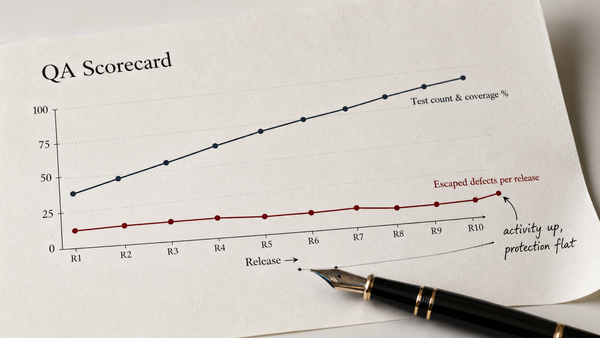
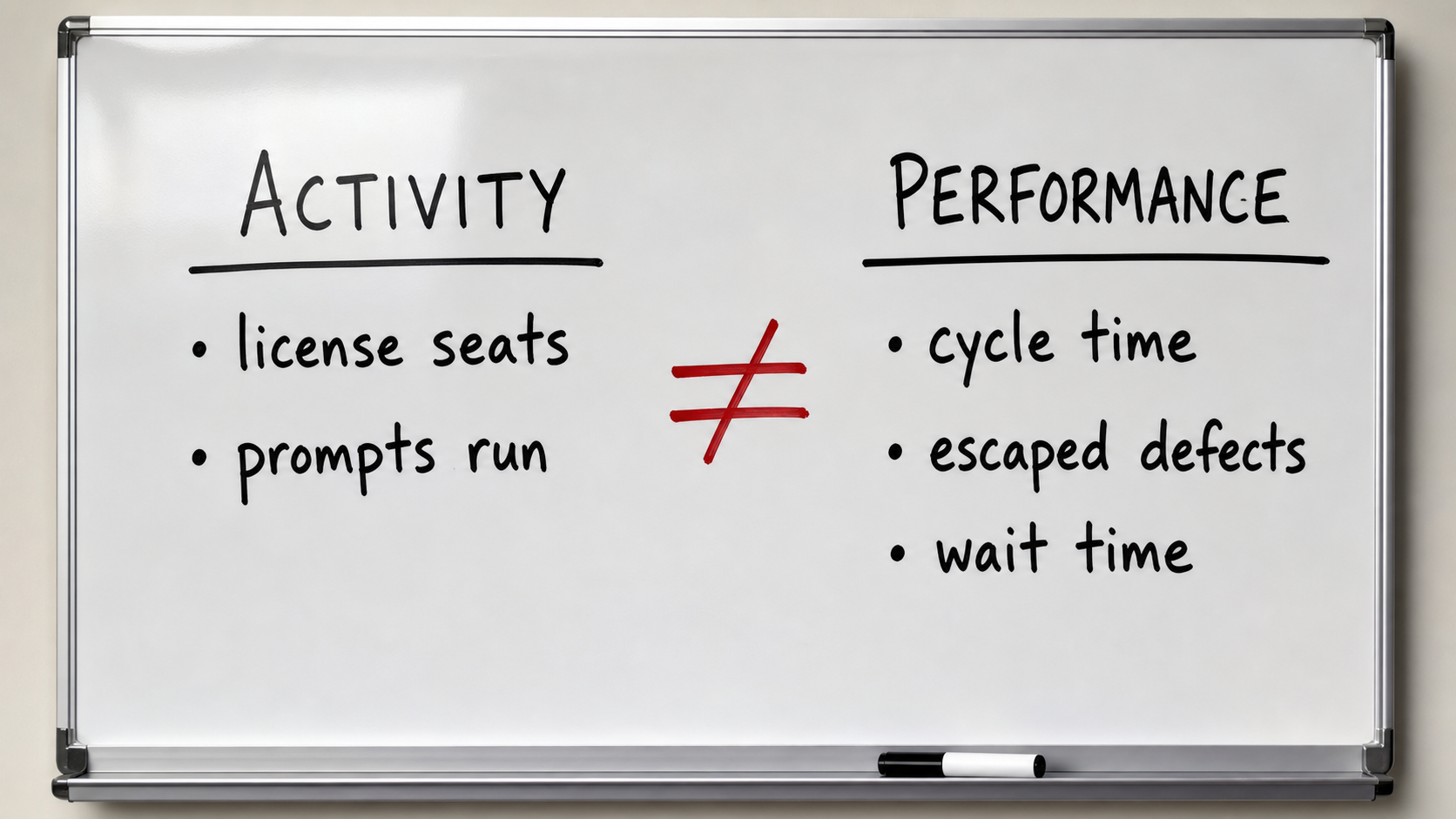
Here is the trap, and it is the most common one I see in delivery orgs. The PM reports ninety percent adoption, the room nods, and the meeting moves on. License utilization, active-user counts, the size of the shared prompt library: these are activity signals. They tell you the team logged in. They tell you nothing about whether delivery got better. Measuring AI adoption that stops at activity is measuring the wrong thing, and the gap it hides is the gap between proving adoption and proving impact.
Adoption, done honestly, is role-specific behavior change. The question is not "did the team use the tool" but "did the way the team works actually change, and did that change improve delivery." So the PM tracks adoption the way it actually behaves: where it is strong, where it is stalled, and where it is blocked. Strong adoption is a workflow the team now runs differently and would not give up. Stalled adoption is a tool that got opened twice and abandoned. Blocked adoption is a person who would use it but cannot, because of a license limit, a missing access grant, or a setup nobody walked them through. Each of those calls for a different action: clarify the expectation where it is stalled, escalate the access where it is blocked, pair someone up where the setup is the barrier.
Then the PM measures whether the changed behavior produced better delivery. This is where the real delivery metrics live: cycle time, lead time, wait time, throughput, predictability, rework, and escaped defects. None of those move because the team logged in. They move because the work changed. And you can only prove the move if you captured a baseline. The discipline is to capture a pre-AI or early-AI baseline before the rollout claims credit, so improvement is provable rather than asserted. A PM who cannot show the baseline cannot tell the difference between "AI helped" and "we got lucky this quarter."
The clean way to hold the distinction is to keep two columns in your head, and never let the left column stand in for the right.
| Activity signal (the team logged in) | Performance signal (delivery got better) |
|---|---|
| License seats used | Cycle time trend |
| Prompts run this week | Escaped defects per release |
| Training session attendance | Rework rate |
| Active-user count | Wait time between stages |
| Size of the shared prompt library | Predictability of delivery forecasts |
This is not a one-time measurement exercise. At L2, it becomes the project's operating rhythm. The PM AI maturity ladder names six required repeatable workflows that run every cycle, not as experiments but as the standing discipline of the project:
- Project meeting processing. Every recurring meeting produces a consistent structure of decisions, action items, open questions, risks, dependencies, and ownership.
- Project reporting. Weekly or sprint-based reports are generated from project data, then reviewed, adjusted for narrative, confirmed for accuracy, and finalized.
- Project metrics review. Cycle time, lead time, wait time, blocked items, aging work items, and throughput trends get reviewed on a cadence, not pulled together in a panic before a steering meeting.
- Risk and dependency tracking. Risks and dependencies are surfaced from artifacts and signals, validated with the team, prioritized, and escalated, and that tracking feeds the recurring report rather than living as a separate spreadsheet.
- Stakeholder tracking. Commitments, open questions, pending decisions, follow-up ownership, and escalation points stay visible.
- Quality gates reporting. Review status, testing expectations, critical-path coverage, and CI check status stay visible, and gaps that need a solutions architect or engineering lead get named.
That sixth workflow is the bridge to the second move. Reporting on quality gates is not the same as owning them. It is the difference between governing and implementing, and most of the value, and most of the confusion, lives right there. If you want the dashboard-level view of what these adoption and delivery signals look like when they are presented honestly, the companion piece on what an honest AI adoption dashboard looks like goes deeper on the measurement surface.
Governing quality gates without implementing them
The clarification almost every competitor misses is this: the PM does not write tests, configure CI, or own engineering controls. The PM is the role accountable for verifying that the quality gates are defined, visible, monitored, and acted on. The PM verifies the evidence and escalates the gaps. The technical owners, the solutions architect, the QA lead, the engineering lead, stay responsible for implementing the controls; the QA side of that split is worked through in the QA AI playbook. Confusing those two jobs is one of the fastest ways a good PM burns out and the controls stay weak anyway.
When AI lands on a team, this distinction stops being academic. AI-assisted code arrives faster and in larger batches than a reviewer can comfortably absorb. The quality bar holds only if the AI quality gates were defined ahead of the speed and someone keeps checking that they fire. That someone is the PM. The first place this shows up is the Definition of Done. The DoD has to carry explicit expectations for AI-assisted work: review requirements, traceability where it matters, and the verification expected before something is called done. A DoD written for hand-typed code and never updated is a gate that quietly stopped applying the moment the team's output pattern changed.
The second place is upstream of implementation. Left-shift quality means quality starts before code gets written, not after. Acceptance criteria, specification review, design and readiness review, test-strategy discussion, and TDD or a documented approved alternative all happen before work moves into development. Left-shift matters more under AI, not less, because AI compresses the cheap part, producing a candidate implementation, and leaves the expensive part, deciding whether it was the right thing to build and whether it is safe, exactly where it was. If the team is generating implementations faster than it is agreeing on what correct looks like, the PM's job is to surface that the front of the pipeline is now the constraint.
The third place is the evidence itself, and this is where the governance gets concrete enough to be real. At L3, the PM verifies quality-gate evidence for the evaluation period against named thresholds. Two worth quoting: unit and integration coverage of at least sixty percent for new or changed work, or a documented project-specific rationale plus a compensating control if that target genuinely does not apply; and API automated testing covering at least sixty percent of the applicable API scope, or a documented rationale if the project has no applicable API layer. Alongside those, the PM looks for UI and end-to-end automation covering the critical path, AI-assisted or static code-review evidence such as linting and CI checks and pull-request review output, and security review evidence for applicable changes. The crucial discipline is the exception handling. If a control is not applicable, the PM does not skip it silently. The PM captures why it does not apply, what risk remains, and what compensating control exists. If a control is applicable but missing, the PM escalates it until there is a documented decision or plan.
Notice what the PM is and is not doing. The line is worth drawing explicitly, because crossing it is the single most common way the governance role collapses back into an implementation role.
| What the PM verifies | What the PM does not implement |
|---|---|
| That the DoD includes AI-assisted-work review and verification expectations | The review tooling or the CI configuration that enforces it |
| That coverage thresholds are met or that a documented exception exists | The tests that produce the coverage |
| That security review happened for applicable changes | The security review itself |
| That left-shift artifacts (acceptance criteria, test strategy) exist before development | The acceptance criteria or test strategy content (that is the analyst, QA, and engineering work) |
| That gaps are escalated to the right technical owner | The technical fix for the gap |
There is one more L3 governance loop worth naming, because it is the discipline that keeps planning honest under AI. AI-supported forecasting is easy to produce and easy to trust too much. The governance move is the forecast-versus-actual loop: the PM compares the forecasts AI helped generate against what actually happened, over time, so prediction quality is something the team measures and improves rather than something it asserts. A PM who forecasts with AI and never checks the forecasts against reality has automated the production of confident numbers without improving any of them.

When AI compresses implementation, find where the bottleneck moved
This is the move no competitor article makes, and it is the one that separates a PM who governs AI delivery from a PM who celebrates the front half of it. AI does not speed up the whole delivery system evenly. It compresses one step, implementation, dramatically. Code that took a day now takes an hour. And a system never gets faster than its slowest step. So when you compress implementation, the constraint does not disappear. It migrates downstream, to wherever the next slowest step is. Usually that is review capacity, the wait time between done-coding and QA validation, and the handoff delays between them.
The symptom is recognizable once you know to look for it. Development moves visibly faster. More tickets reach the "done coding" column, sooner. And then they sit. The QA validation queue lengthens, tickets age before anyone tests them, and the lead time from intake to shipped barely moves even though the implementation time fell off a cliff. The team feels fast and delivers at the same pace. This is the AI velocity illusion at the project-governance level: the throughput of "done coding" rises while the throughput of "shipped and verified" stays flat, and a status report that only counts the front half will say everything is improving.
The PM's job is to catch the migration and re-home the constraint. Concretely, that means watching lead time and wait time as the leading indicators, not throughput of code. When dev throughput rises and shipped throughput does not, the wait time between stages is where the answer is hiding. The PM reviews the lead-time and wait-time signals with the team lead and QA lead, identifies where the constraint re-homed, and adjusts the workflow, whether that means rebalancing capacity toward review, changing the batch size of what moves to QA, or moving some validation left so it is not all stacked at the end. Rework is the second leading indicator. If the faster front half is also producing more defects that bounce back, the bottleneck is not only capacity, it is quality leaking past the gates the second move was supposed to govern.
Here is the shift, stated as a before-and-after, because the governance question is "where is the slowest step now" and the answer changed.
| Where the bottleneck sat (pre-AI) | Where the bottleneck sits (post-AI) |
|---|---|
| Writing the implementation | Reviewing the larger volume of implementation |
| Developer capacity | Wait time between done-coding and QA validation |
| Time to first working version | Time from working version to verified and shipped |
| Throughput limited by coding speed | Throughput limited by review and validation capacity |
A PM who does not run this analysis will keep reporting that AI made the team faster, while the people doing the work watch tickets pile up before QA and quietly lose faith in the numbers. The migration is invisible if you only measure the step AI sped up.

Pitfalls: how PM AI governance goes wrong
The failure modes are specific, and naming them is the cheapest insurance against them.
Treating the adoption rate as the goal. The team hits ninety percent adoption and the project declares victory. Adoption rate is an activity signal. It is necessary and nowhere near sufficient. The goal is provably better delivery, and adoption rate does not prove it.
Owning the controls instead of governing them. The PM, trying to help, starts writing tests or configuring CI checks personally. This does not scale, it burns the PM out, and the controls usually stay weak anyway because the PM is not the technical owner. Govern the gates, escalate the gaps, and let the technical owners implement.
Measuring the front half and missing the migrated bottleneck. The PM reports that implementation got faster and stops there. The constraint moved to review and QA validation, and nobody is watching wait time. The team is fast at the part that no longer matters and slow at the part that now does.
Forecasting without comparing to actuals. AI makes confident forecasts cheap. Without the forecast-versus-actual loop, the PM is producing a steady stream of predictions that never get better, and planning discipline erodes behind a wall of plausible numbers.
Reporting status faster instead of governing quality. The deepest pitfall, because it looks like success. The PM uses AI to produce the same status reports in half the time, and the role never actually changed. Faster status-tracking is L1 productivity dressed up as transformation. The role's value was supposed to migrate to governance, and it did not.
Key takeaways
- The PM has a dual AI responsibility no other role carries: use AI personally, and govern whether the team's AI adoption improves delivery without lowering quality. The governance half is where the role's leverage now sits.
- Measure adoption as behavior change, not tool logins. Activity signals (license seats, prompt counts) are not performance signals (cycle time, escaped defects). Capture a baseline so improvement is provable.
- Govern quality gates without implementing them. The PM verifies the Definition of Done, left-shift artifacts, coverage thresholds, and security review evidence, and escalates gaps. The technical owners build the controls.
- After AI compresses implementation, the bottleneck migrates downstream to review and QA validation. The PM watches lead time and wait time to catch the AI velocity illusion and re-home the constraint.
- The PM is the role that converts AI activity into AI performance at the project level, or fails to. That is the PM's seat in the AI operating model.
The role redesign is the point
The thing I keep coming back to is that none of this is about a tool. It is about what the project-management role is for once AI is in the building. An org that drops AI tools onto a delivery team and leaves the PM role measured the way it was always measured, on status reported and meetings coordinated, ends up exactly where the dashboard at the top of this article ends up: high adoption, more code, and no proof that delivery got better. The activity went up. The performance did not, or did and nobody could show it.
AI delivery governance is the redesign that closes that gap, and the PM is the role that holds it. The PM who measures behavior change instead of logins, governs the gates instead of trying to build them, and watches where the bottleneck moved instead of celebrating the part AI sped up, is the role converting AI activity into AI performance. The PM who skips that redesign is running a faster version of the old job while the quality bar slips underneath, unmeasured. The choice is not whether to adopt AI. The team already did. The choice is whether anyone is governing what the adoption actually did to delivery, and that is the PM's job now, or it is no one's.
AI Transparency Notice: This article and its accompanying images were created with the assistance of generative AI. The author directed the content, contributed the underlying ideas and analysis, and reviewed the final publication.