Why AI Creates New Bottlenecks Instead of Removing Old Ones
The strange part isn't that the win is small. It's that the win is missing. The coding got faster, and the time from request to customer stayed exactly the same.
The strange part isn't that the win is small. It's that the win is missing.
You bought the AI coding tools. The developers are visibly faster now: work that used to take a week lands in two days, pull requests stack up, the demos look great. Then you open the delivery dashboard and lead time hasn't moved, releases ship on the same rhythm, and the numbers you promised the board a quarter ago are flat. The next budget review is where someone asks whether the AI program is a real capability or a line of discretionary spend. So you go looking for the fault, and the two obvious suspects are the tools and the team.
Both are innocent.
AI does not remove delivery bottlenecks by default. When the stage it accelerates wasn't the system's binding constraint, the work keeps waiting exactly where it did before: you bought local speed, not delivery throughput. When the acceleration does hit the binding stage, the constraint relocates to the next tightest stage, and it relocates again the next time you accelerate. So across an accelerating system an AI delivery bottleneck behaves like a constraint that keeps relocating, more than a fault you fix once. Treated that way, an AI transformation is continuous constraint migration rather than one-time elimination. The job is to watch the bottleneck move and keep re-pointing your instruments at wherever it went.
The win that went missing
The pattern that should worry you more than a slow rollout is this: the coding got faster, and the time from "someone asked for this" to "customers have it" stayed exactly the same. That combination looks like a paradox. The explanation is mundane, and the tool is doing its job.
A delivery system is a line of stages that a piece of work passes through: someone specifies it, someone builds it, someone reviews and integrates it, someone decides it's allowed to ship, it ships. The whole line's output is governed by whichever stage is currently the tightest, not by the fastest one. Speed up a stage that wasn't the tight one and you get exactly what you'd expect: more output from that stage, faster commits, a taller stack of pull requests. What you don't get is more work reaching customers, because the work still queues at the stage that was already the constraint. That queue is where lead time lives, and a coding tool aimed at the coding stage doesn't widen it.
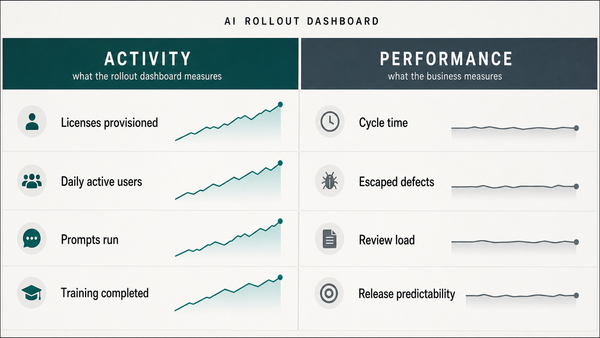
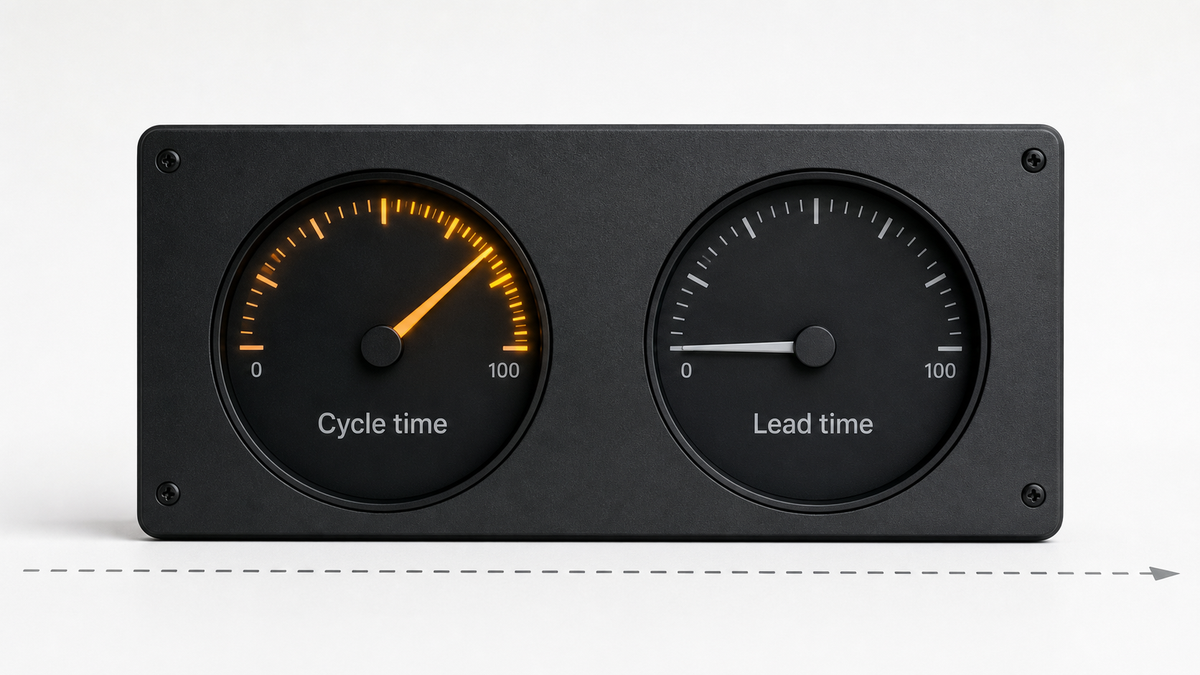
This is the distinction the dashboard hides. Cycle time, the active work inside the coding stage, dropped hard. Lead time, the full intake-to-production span, didn't. The dashboard is counting commits and story points at the stage that got fast, and it's reporting a real, local win. The constraint is measured in wait time at a stage nobody instrumented, and it's still sitting exactly where it was. A queue nobody's dashboard is pointed at.
I used to read flat numbers like these as an adoption problem: not enough people using the tools, not deeply enough. They aren't. Usage was fine. The system just didn't have its constraint where everyone was pointing.
The constraint relocates, it doesn't disappear
When you accelerate the binding stage, something good does happen: total lead time drops, measurably, because the thing that was throttling the whole line got wider. That's the case the tool vendors are selling, and when the accelerated stage was in fact the constraint, they're right.
The vendor deck skips the next part. That improvement is bounded by wherever the constraint lands next, and under real load it usually lands somewhere: another stage with the least slack, or sometimes something outside the delivery line entirely, a demand ceiling or a policy gate or a batch size. Widen the current constraint and, unless the system has genuine slack, the title of "tightest stage" transfers to whatever now binds hardest. The bottleneck didn't get removed. It got relocated. And the moment you accelerate the new binding stage, it will relocate again.
That is a falsifiable claim, which is what makes it worth stating. If it were false, you'd accelerate one stage and watch total lead time keep dropping in step, with no new downstream stage ever taking over as the limit. That is not the pattern I keep seeing after an AI acceleration. The common report is a local speedup and a stubbornly flat end-to-end number, which is the signature of a constraint that moved, or one that never left, rather than one that vanished. This is the old operations idea, Theory of Constraints, applied to a delivery line: throughput is set by the system's binding stage, so improving a non-binding stage improves that stage, not the system.
It helps to keep four measures separate, because AI tooling moves them at very different rates. Cycle time is the active work inside one stage. Throughput is units completed per period. Lead time is the full intake-to-production span. Predictability is how tightly delivery tracks its forecast, the variance between what you committed to and what actually shipped. AI coding tools can cut cycle time hard at the coding stage when they're adopted well, and can lift its local throughput. Whether they move system lead time depends entirely on whether coding was the binding stage, and often it wasn't. The real constraint is frequently somewhere less visible than the slowest-looking step (the tightest stage and the slowest-looking stage are not always the same thing): a review-capacity ceiling, a mandatory sign-off, a rework loop, a decision that only one person can make, two teams that can't move without syncing.
The rungs I keep watching the constraint climb
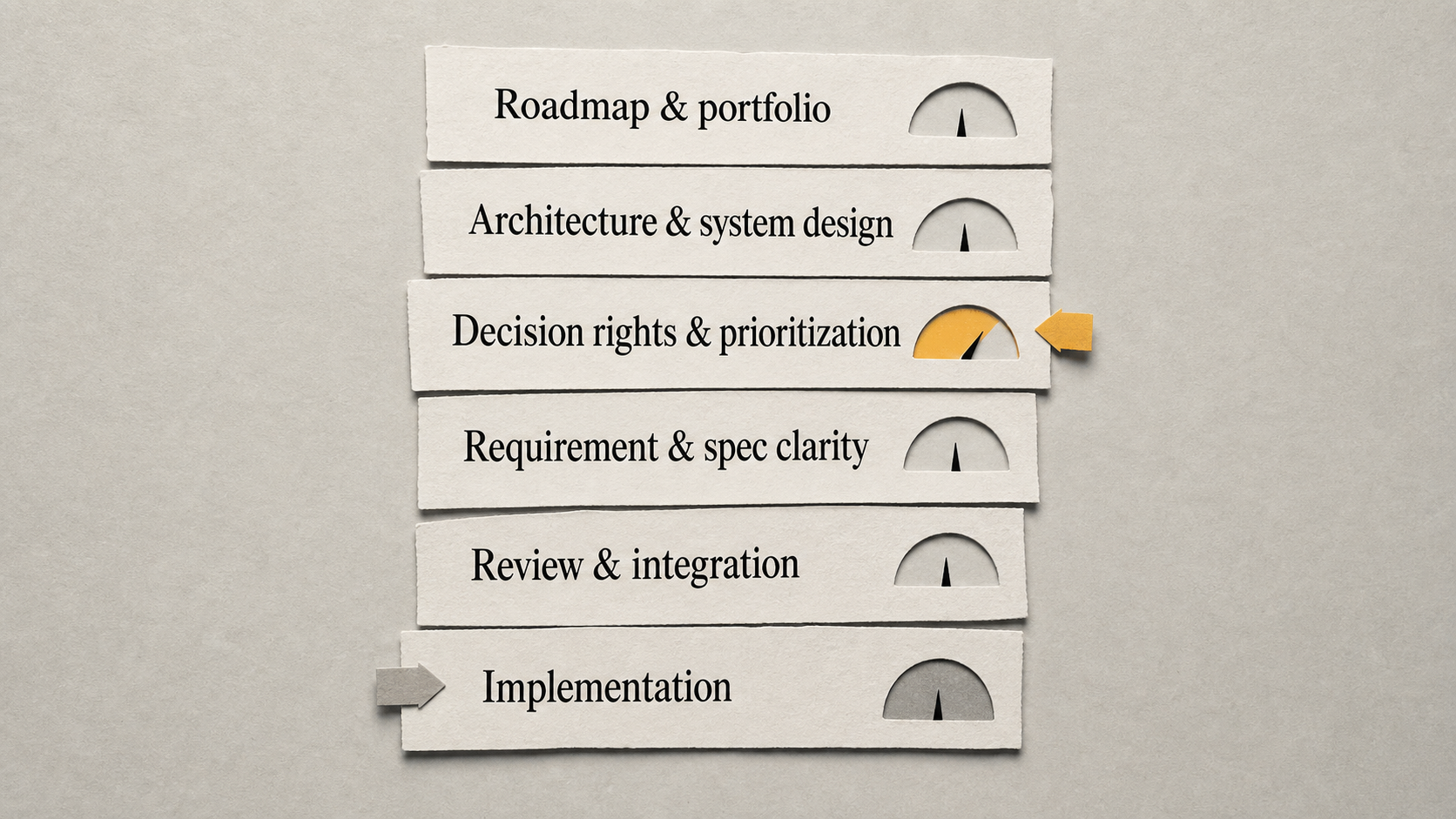
Once you start looking for the constraint instead of the tool, you see it move in a fairly consistent direction. Not a fixed law, more like a well-worn path. Accelerate implementation and the pressure tends to surface at review and integration. Relieve that and it tends to surface at how fast clear requirements arrive. And so on up the stack, toward the work that decides what gets built at all.
These are the rungs I keep watching the constraint climb, with the trend that signals it just arrived and what re-instrumenting means at each rung:
| Where it binds | What actually binds there | The trend that says it just became the constraint | What re-instrumenting means here |
|---|---|---|---|
| Implementation | Coding throughput. This is the rung most AI rollouts start on, and the single move from here up to review is the one covered in When AI Speeds Up Coding and the Bottleneck Moves. | Implementation time falling while the review queue starts aging. | Stop celebrating commit counts; start measuring wait time in review. |
| Review and integration | Reviewer attention, merge-and-integrate capacity, contention for shared test environments. | Pull requests sitting longer, review queue depth climbing, while coding time keeps dropping. | Measure review queue age and rework rate, not PR volume. |
| Requirement and spec clarity | How fast well-formed, buildable requirements actually arrive. | Builders and reviewers idle-blocked or churning on ambiguous tickets; "that's not what we meant" rework rising. | Measure requirement rework and time-to-clarified-spec, not tickets drafted. |
| Decision rights and prioritization | Who is allowed to say yes, and how quickly they do. | Finished work waiting on an approval; the "ready but not authorized" pile growing; decision latency rising. | Measure decision latency and the age of the ready-to-proceed queue, not output. |
| Architecture and system design | Whether the system can absorb the volume of change without coordination cost exploding. | Change lead time rising because every change touches shared surfaces; cross-team coordination overhead climbing. | Measure coordination overhead (teams a change has to sync with) and change blast radius (shared surfaces it touches), not features shipped. |
| Roadmap and portfolio | Whether the org is pointed at work that moves the business at all. | Fast, clean delivery of things that don't change any outcome. High output, flat results. | Measure outcome per unit delivered against a portfolio goal you chose on purpose, not delivery velocity. |
Treat that as a diagnostic prior, not a schedule. The real next constraint depends on the actual queues, policies, and capacity in a given org. Sometimes it skips a rung. Sometimes it never leaves requirements, and implementation was not the binding stage to begin with, which means the AI coding tools bought local speed and very little system throughput from the first day. Work pools at the new constraint the way water pools behind the next dam downstream, and the only way to know which dam is which is to go look at where it's actually backing up.
So why does the org keep buying tools?
Because it reads each migration as a surprise defect instead of the predictable next state. When the end-to-end number stays flat, the instinct is to reach for another tool: either a bigger version of the one aimed at the stage that already got fast, or a fresh tool for the newly-tight stage, framed as the one-off fix that'll finally move the chart.
I keep seeing the same failure. A team ships an AI coding rollout, watches implementation time drop by half, celebrates it in the all-hands, and puts "delivery velocity up" on the quarterly slide. A couple of planning cycles later the same team is back with the same flat lead-time chart and a proposal to buy an AI code-review tool, pitched as the thing that will finally make delivery numbers move. It might even help, because review probably is the constraint now (probably, not certainly, and that gap is the whole problem). But nobody re-pointed their instruments after the first move, so nobody can actually tell whether review is binding or whether the real queue has been sitting at requirements the whole time. The second purchase is a guess wearing the costume of a diagnosis.
That's the expensive part: the pattern of funding a fix for a constraint that has already relocated, then re-running the identical flat-number disappointment one layer up. Same chart, same quarter's promise, one rung higher.
If you invoke the operating model here, be precise about it: the constraint migration is exactly what you re-tune each time the bottleneck moves, and which parts you re-tune depends on where it landed. Review standards and reviewer roles when it's at review. Decision rights and cadence when it's at prioritization. Workflows, access, and the metrics themselves as it climbs. The migration is the whole operating model being re-fitted to a target that keeps moving, not one component swapped once.
Instrument for the next constraint, not the last one
The durable skill is re-instrumentation, not tool-selection: changing where you measure once the prior constraint has been widened. Concretely, that means moving your queue, wait-time, WIP, rework, and decision-latency measurements to the stage that is now binding, and retiring the metrics that described the stage you already fixed. The commit-count dashboard was honest when coding was the constraint. Keep it pointed there after the constraint has moved and it becomes a comfort object, reporting a win at a stage that no longer governs anything.
Someone has to own spotting the move, and it can't be the person who owns the tool, because their instrument is pointed at the stage they're responsible for. It has to be someone with a view of the whole line: a delivery lead, engineering leadership, whoever holds the operating model. The signal they're watching for is trend-based, never a fixed threshold. It's the wait time or queue age at a downstream stage rising while the stage you just accelerated keeps getting faster. That divergence, faster upstream and slower-to-clear downstream, is the constraint arriving at its next rung, usually before any single number crosses a line anyone set.
So the single next action, for a reader with decision rights, is smaller than another procurement cycle. Before you fund the next tool, find where work actually waits right now, and point one real metric at that spot. If you can only buy tools and not change how the org measures itself, you still have a move: name the constraint out loud in the room where the budget gets decided. Recognition changes what people ask for, even when it can't change what they're allowed to buy. Naming where the work waits is the first thing that has to be true before any purchase can land on the right stage.
The next acceleration you buy will work exactly as advertised at the stage it targets. Whether it moves the number the board is watching comes down to one thing you can check before you spend: whether that stage is where the work is waiting today. Find the wait first. The tool second.

AI Transparency Notice: This article and its accompanying images were created with the assistance of generative AI. The author directed the content, contributed the underlying ideas and analysis, and reviewed the final publication.