Loop Engineering Is Becoming Leadership Work, Not a Developer Trick
An engineer will drop the phrase into a planning meeting and mean it as a personal workflow upgrade. Take the phrase seriously. The framing it arrives in is the part to reject.

Sometime this quarter, an engineer will drop the phrase loop engineering into one of your planning meetings. They'll have picked it up from the essays circulating in agentic-coding circles, and they'll mean it as a personal workflow upgrade: prompts retired, loops installed, more code shipped per day.
Take the phrase seriously.
The framing it arrives in is the part to reject. Across the industry, this practice is being adopted as an individual developer skill. My position: it's engineering-leadership work. Leave it at the keyboard and you'll fund faster and faster agents while shipping at roughly the speed you ship today. The artifacts those loops run through are mapped in the six-class AI engineering stack.
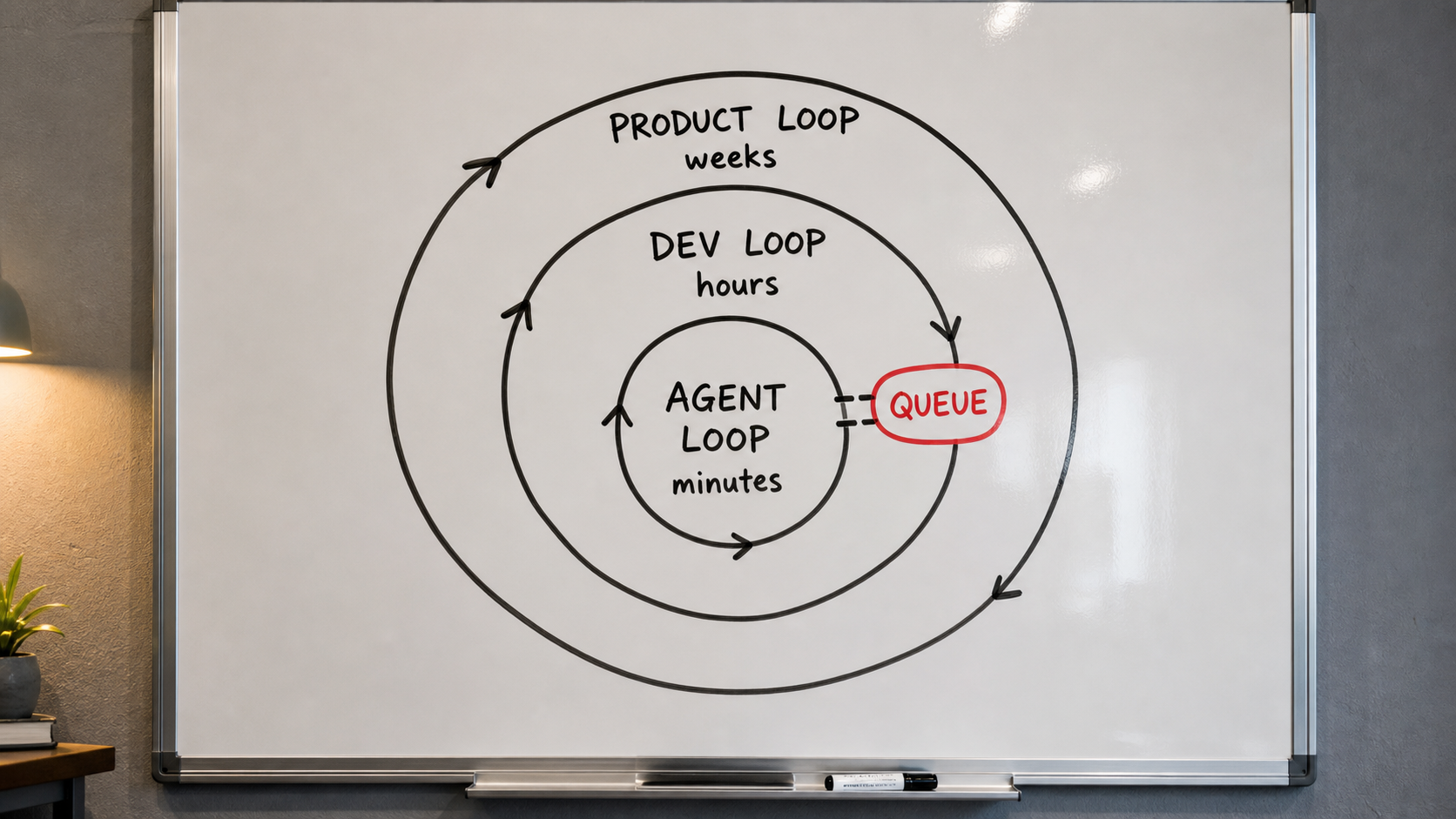
Loop engineering is the practice of designing the iteration loops that do the work in AI-assisted delivery, rather than hand-prompting each step. Three loops nest inside each other: the agentic coding loop, where an agent writes code, tests its own output, and iterates against a spec; the developer feedback loop, where a person reviews, steers, and re-specifies; and the product feedback loop, where users and telemetry turn shipped code into decisions. Shipping speed depends on all three.
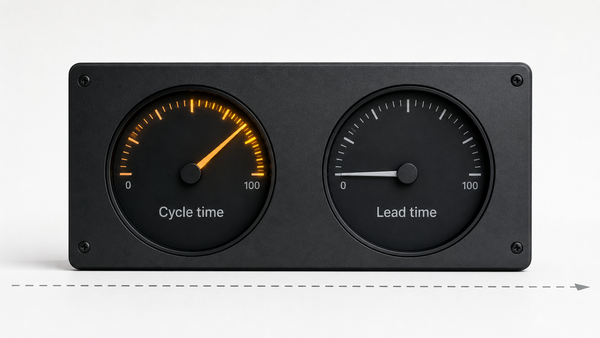
If you fund an engineering org, you've already paid for the first loop. The licenses are live, individual engineers are visibly faster, and the demos are impressive. And the release cadence, the number a board actually asks about, hasn't moved the way the invoices implied it would. That gap is a loop design problem, and right now nobody in your org owns it.
The people who named it were solving a different problem than yours
The vocabulary went viral in June 2026. Boris Cherny, creator of Claude Code at Anthropic, described his own shift in remarks Business Insider rounded up in late June: he barely writes individual prompts anymore; his work has become designing the loops that run the agent. Peter Steinberger, creator of the viral OpenClaw project, was quoted in the same roundup pushing it further: "You shouldn't be prompting coding agents anymore. You should be designing loops that prompt your agents." Addy Osmani's essay on loop engineering catalogued the working parts of the practice: automations, worktrees, skills, plugins, subagents.
Read those treatments back to back and one thing stands out. Nearly all of it is written for the person at the keyboard. That's not a criticism. It's provenance. The people who put the vocabulary into circulation are tool creators and solo builders, and they wrote what they live: how one practitioner multiplies their own output. Little in the circulating material carries what you are accountable for, which is review capacity, role definitions, and a delivery number that has to move at the level of the org rather than the individual.
The vocabulary is right. The altitude is wrong.
Your delivery system runs three loops, and the tools only touched one
Scale the decomposition up from one developer to a delivery org and the three loops separate cleanly by cadence. For a typical customer-facing feature, illustrative rather than universal: the agentic coding loop cycles in minutes, because the agent writes, tests its own work, and retries without waiting on anyone. The developer feedback loop cycles in hours, because review, steering, and spec repair wait on human attention. The product feedback loop cycles in days or weeks, because users, telemetry, and a decision meeting sit between exposure and the next bet. Change type shifts those numbers: a bugfix may skip the product loop entirely, and an experiment behind a feature flag can compress it to hours. The ordering, though, is stubborn.
Most of that new spend accelerated exactly one of the three.
When a change has to clear all three loops before a user sees value, a faster inner loop does not automatically shorten the path, because its output doesn't disappear. It accumulates. Code an agent produced in twenty minutes waits in a review queue staffed by the same reviewers as before, then waits again for the product loop to say whether it was the right code to write. This is queueing pressure, the oldest pattern in delivery: upstream capacity rises, downstream capacity stays flat, and inventory piles up at the boundary between them.
If your teams are still at autocomplete maturity rather than genuine agentic coding, read this as a forward plan. The constraint hasn't reached you yet. The loop math below is how you'll know when it has.
The slowest loop sets the price of the fastest one
When shipping feels slow, the reflex is to buy speed where speed is easiest to buy: a better model, more agents, a bigger token budget. That reflex has the arrow backwards once the binding constraint sits downstream. To be precise about scope: faster inner loops do buy real things. Fewer defects per attempt, wider exploration of solutions, lower cost per accepted change. What they don't buy, on their own, is a faster path to production when developer validation or product validation is a gate the change still has to clear. When those gates run in sequence and the work arriving outpaces the capacity behind them, the slowest loop on the path governs your cadence, and spend concentrated on the fastest loop shows up as inventory rather than shipping speed.
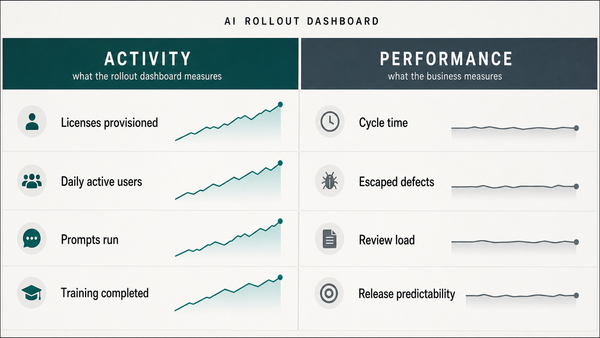
I keep seeing the same failure: a team switches on agentic coding, pull requests per engineer roughly double within a month, and merge latency stretches from same-day to two or three days because the same handful of senior engineers is still the entire review capacity. The activity dashboard says the team got faster. The release calendar says nothing changed. And the seniors, the people the org can least afford to burn, now spend their days working as a queue.
I've written before about how the bottleneck moves when AI speeds up coding. Loop language gives that migration a structure. When the agent closes its own inner loop, the developer's job moves one loop out, into review, steering, and the spec quality that determines what the agent converges on in the first place. In many orgs that makes the developer feedback loop the binding constraint. Not in all of them: CI capacity, compliance review, or product signoff binds first in plenty of shops.
The diagnosis matters more than the doctrine.
Loop health is measurable with clocks you already have
You don't need a new dashboard to find your binding loop. You need three timers with honest boundaries, run against your last batch of shipped changes. Time the agentic coding loop from the moment an implementation-ready task reaches the agent to the first diff that's ready for human review. Time the developer feedback loop from that first reviewable diff to the merged change, elapsed time, waiting included, because the waiting is the point. Time the product feedback loop, for the changes that actually get product validation, from first user exposure to an explicit decision: keep, kill, or iterate. Alongside the timers, watch two ratios: review rounds per merged change, counting each reviewer-requested revision cycle as a round, and where defects get caught versus the loop that should have caught them.
Resist the urge to benchmark against someone else's numbers. Loop times vary so much by change class, domain, and regulatory surface that a universal threshold for "good" is noise. Compare against your own median, split by change type, and watch the trend, the same discipline as an honest AI adoption dashboard: measure the system's behavior instead of letting activity stand in for outcomes.
In my own daily work with Claude Code and Codex, the inner loop is now fast enough that I've stopped watching it. The numbers worth watching moved one loop out. That migration, compressed into a single personal observation, is the whole argument of this piece.

Loop design belongs on someone's job description
Here's what it costs when nobody owns the loops: the org keeps paying for acceleration it can't absorb. Someone decides how much review capacity exists and what standard a merge must clear. Someone decides which changes need product validation and how fast the product loop returns a verdict. Someone decides what cadence each loop runs at, and whether the middle loop gets redesigned as agent output grows: review standards, spec discipline, steering time carved into real calendars. In most orgs today those decisions are split across engineering managers, a platform team, and product, with no one accountable for the system they form together.
That is loop design. It's one slice of the broader AI operating model, the slice that decides whether agentic speed compounds into shipping speed or pools at a boundary. It doesn't require a new title. It requires a name against the work: someone who reads the three timers, owns the trade-offs between them, and treats loop tuning as scheduled engineering work rather than something enthusiasts do to their own setups after hours.
So run the cheap diagnostic before the next tooling decision. Time your three loops across the last ten or twenty shipped changes, split by change type if the mix is wide. One of those numbers will probably embarrass you. That number, not another agent demo, is what should set your engineering agenda for the quarter.
AI Transparency Notice: This article and its accompanying images were created with the assistance of generative AI. The author directed the content, contributed the underlying ideas and analysis, and reviewed the final publication.