AI Engineering Governance Without Killing Speed
You funded the AI rollout. Per-developer output climbed, the demos got faster, and then the delivery numbers refused to move. The slowdown most teams blame on governance is usually the wrong governance, or its absence. Here is the version of the argument that holds up.
The slowdown most teams blame on governance is often caused by the wrong governance, or by its absence. You funded the AI coding rollout. Per-developer output climbed, the demos got faster, and then the delivery numbers refused to move. Somewhere in that gap, security or legal said the word "governance," and you heard a deceleration tax: gates, reviews, policy, the bureaucracy that will undo the speed you just bought.
That instinct is half right, which is what makes it dangerous. Bad governance does slow delivery. The mistake is concluding that the answer is less of it. Getting that design right is one component of the AI operating model.
AI engineering governance preserves delivery speed when its controls are risk-based, automated where the evidence is machine-checkable, placed near the work rather than batched at the end, and continuously measured for both risk reduction and flow cost. Designed that way, it is not a brake on AI-assisted delivery. It is the throttle that lets you keep your foot down. Poorly designed governance, by contrast, genuinely slows teams down, and skipping governance does not remove the cost; it relocates it downstream, into review, rework, and incidents.
I want to be precise, because the imprecise version is the one that loses an argument with a real team. The claim is not that any process labelled "governance" makes a team faster, and it is not that controls and speed are inherently the same thing. A team can absolutely add ceremony that slows it down; a late review board can be a real tax. The claim is narrower: the specific controls people most often resist, when they are risk-based and placed near the work, remove a downstream slowdown that ungoverned AI output creates. Skip them and you do not buy speed. You defer the bill into review and rework, where it is more expensive and harder to see.
Here is a test you can actually run, because the falsifiable version matters more than the confident one. Do not run your whole org without controls for two quarters; that is a security and compliance exposure, and two quarters buries the signal under model upgrades, staffing changes, and demand shifts that have nothing to do with governance. Instead, stage a comparison. Take similar teams or, better, comparable repositories, and run one on your current baseline controls and another on risk-tiered controls. A stepped-wedge rollout or a difference-in-differences design gives you a credible counterfactual. Track lead time, review effort, rework, and failure outcomes, broken out by change-risk class, because governance does not move every change the same way. If the risk-tiered set is slower or no safer once you account for change risk, the argument is wrong about your team.
AI moves the bottleneck. It does not remove it.
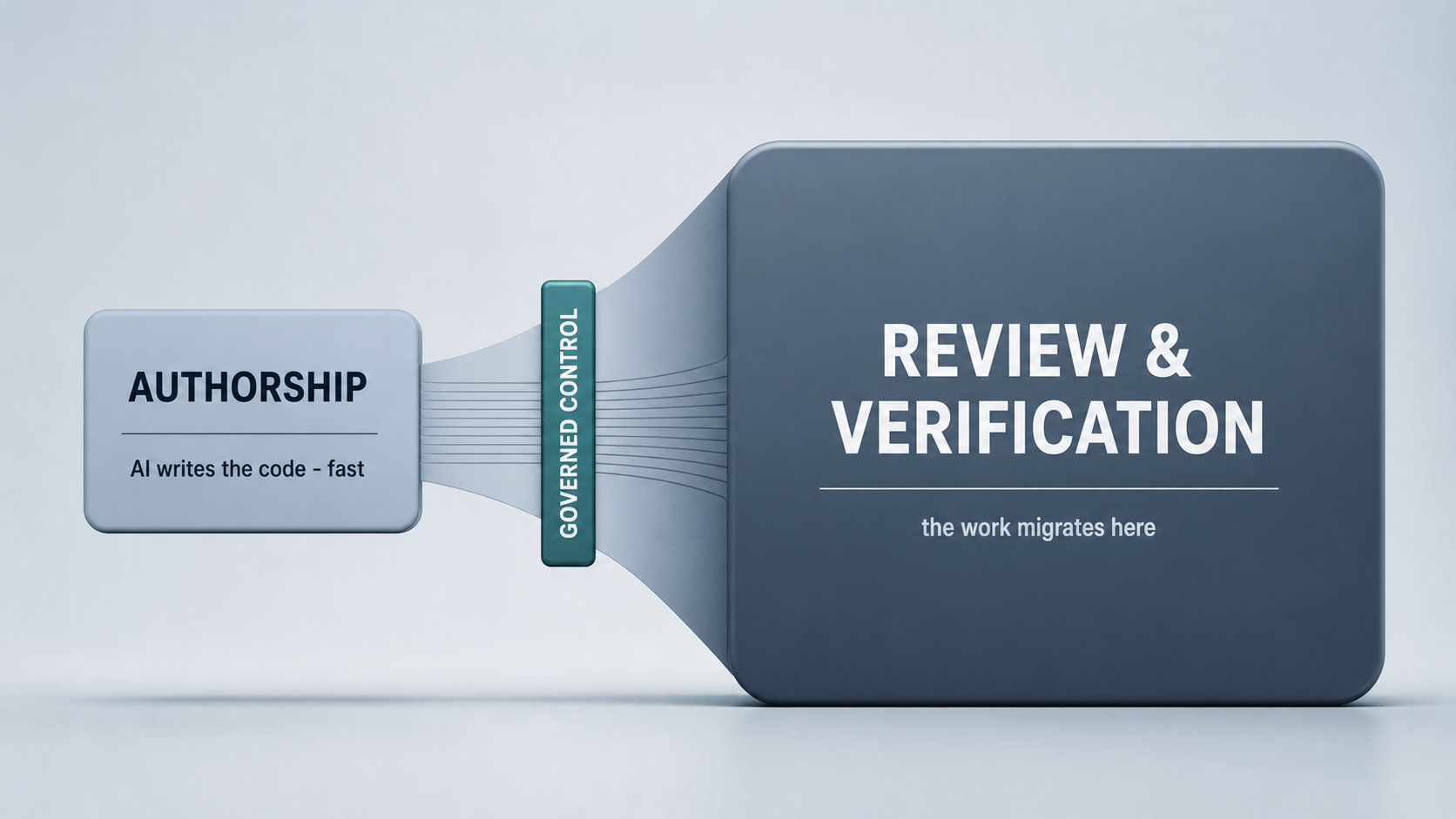
The mistake hiding inside the speed story is treating "writing the code" as the bottleneck. For a single developer on a single feature, AI compresses that step. The cursor fills faster than it ever has. But delivery is not the act of writing code. Delivery is the act of getting trusted, working change into production, and trust is produced somewhere other than the keyboard.
When the model writes faster, the work does not vanish. It migrates, from authorship to verification: from "produce the change" to "confirm the change is correct, safe, and does what was intended." That is the part of the picture the per-developer-output dashboards do not show, because they measure the step that got cheaper and ignore the step that got more expensive.
The research has started to map this, though it is worth being careful about what each study supports. A 2026 longitudinal questionnaire study of AI-assisted software work by Vella and Blincoe finds a perceived shift toward supervisory engineering: developers report their job moving from generation toward oversight, review, and correction (Vella and Blincoe, 2026). That is a measured shift in how the work feels, not a measured redistribution of labor hours, and it is not evidence that governance improves throughput. A separate controlled study from METR is the cautionary data point: with early-2025 tooling, sixteen experienced developers were roughly nineteen percent slower on two hundred forty-six tasks with AI assistance than without, against their own baselines, even when they felt faster (METR, 2025). A 2026 follow-up found directional speedups with newer tools, but with wide confidence intervals, so the honest read is "it depends on the tool and the task," not "AI is slow." And an open-source maintenance study of Copilot adoption observed more rework and a heavier reviewer burden after adoption; its own framing is that AI may reduce experienced-developer productivity under some conditions, not that it always does.
Read together, these point at a direction, not a law. Emerging evidence suggests AI can shift work toward verification and rework, especially when output volume rises faster than review capacity. That is not an argument against using AI to write code; it is an argument about where the cost lands. It lands where ungoverned teams have the least instrumentation: downstream, after the demo already convinced everyone things were fast. That is the part of the bill nobody sees at the keyboard, and the part every control on the "governance tax" list is built to reduce.
What "governance" actually means, and what it does not.
Most arguments about whether governance slows delivery collapse because "governance" is being used to mean five different things at once. Pull them apart and the question gets answerable.
Governance is decision rights under risk limits: who may decide what, within which boundaries, and what evidence a decision requires. Assurance is the evidence required before release: the proof obligations a change must satisfy. Engineering controls are the mechanisms: tests, scanners, permissions, review rules, the things that actually run. Flow design is placement: where those controls run in the pipeline and how exceptions move through it. Governance decides; assurance specifies the proof; engineering controls produce it; flow design positions it so it removes work instead of adding it.
The whole speed argument lives in the last two. A control that is correct but placed at the end of the pipeline behaves like a tax. The same control, risk-tiered and placed near the work, behaves like a throttle. So when the rest of this article talks about gates, specs, and governed paths, it is talking about engineering controls and their placement, not about adding decision boards. That distinction is what keeps the thesis falsifiable: you can ask, of any specific control, whether it removes more downstream cost than the flow cost it adds, for the risk class it covers.
A quality gate buys back your senior reviewers' most expensive hours.
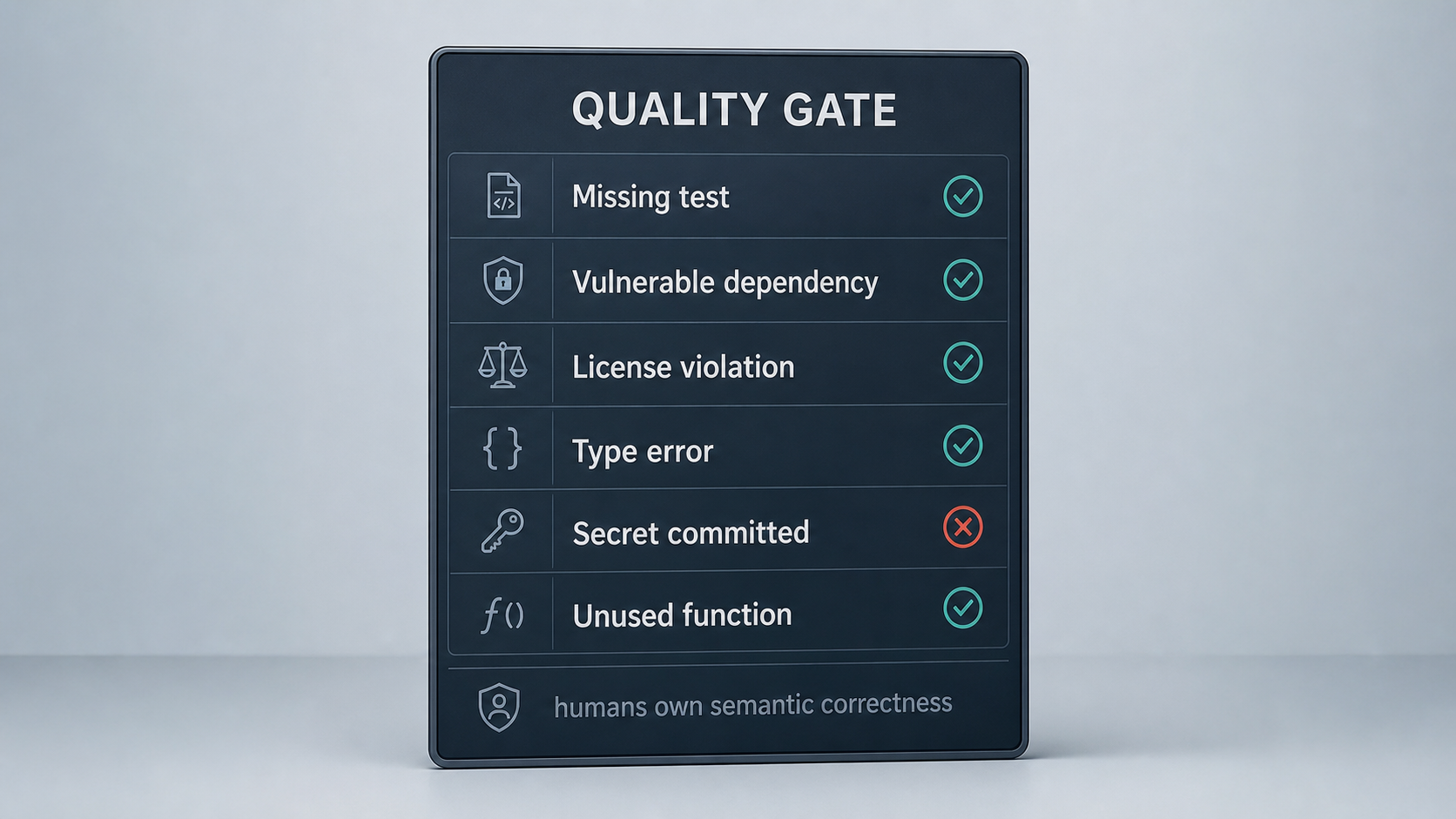
Start with the control that feels most like friction: the AI quality gate. A gate sits in the pipeline and refuses a change that fails a defined check. To the developer waiting on it, that is a stoplight. Placed near the work and scoped to a change's risk class, it is the cheapest place to catch a class of problem that gets brutally expensive one stage later. The full gate stack is laid out in quality gates under AI-assisted development.
Be precise about what a gate can and cannot do, because the imprecise version is where governance content loses credibility. A quality gate, automated or AI-assisted, catches plausible-but-wrong code that is specifiable, testable, or statically and security-checkable: a missing test, a known-vulnerable dependency, a license violation, a type error, a committed secret. It cannot, in general, detect that the code does the wrong thing for the right-looking reason. Intent mismatch and contextual correctness, "this is plausible but it is not what the ticket meant," remain a human's job, and AI review tools miss enough that handing them semantic correctness is a mistake. In Veracode's 2025 benchmark of security-relevant generation tasks, forty-five percent of generated samples failed security tests. That demonstrates the need for an independent security check; it is not an estimate of the vulnerability rate of code that actually ships. The gate narrows the river. It does not drain it.
So the gate's value is not "it makes code correct." It is narrower and more useful: it removes the most specifiable failures before they reach a human, so the human's expensive attention goes to the part only a human can do. Without the gate, your senior reviewers re-derive correctness by hand, change after change, including for failures a machine could have flagged in seconds. That is your most expensive people doing your cheapest checkable work, on repeat. The gate is how you stop re-reviewing the same class of mistake.
Spec discipline is not bureaucracy. It is what makes AI output checkable at all.
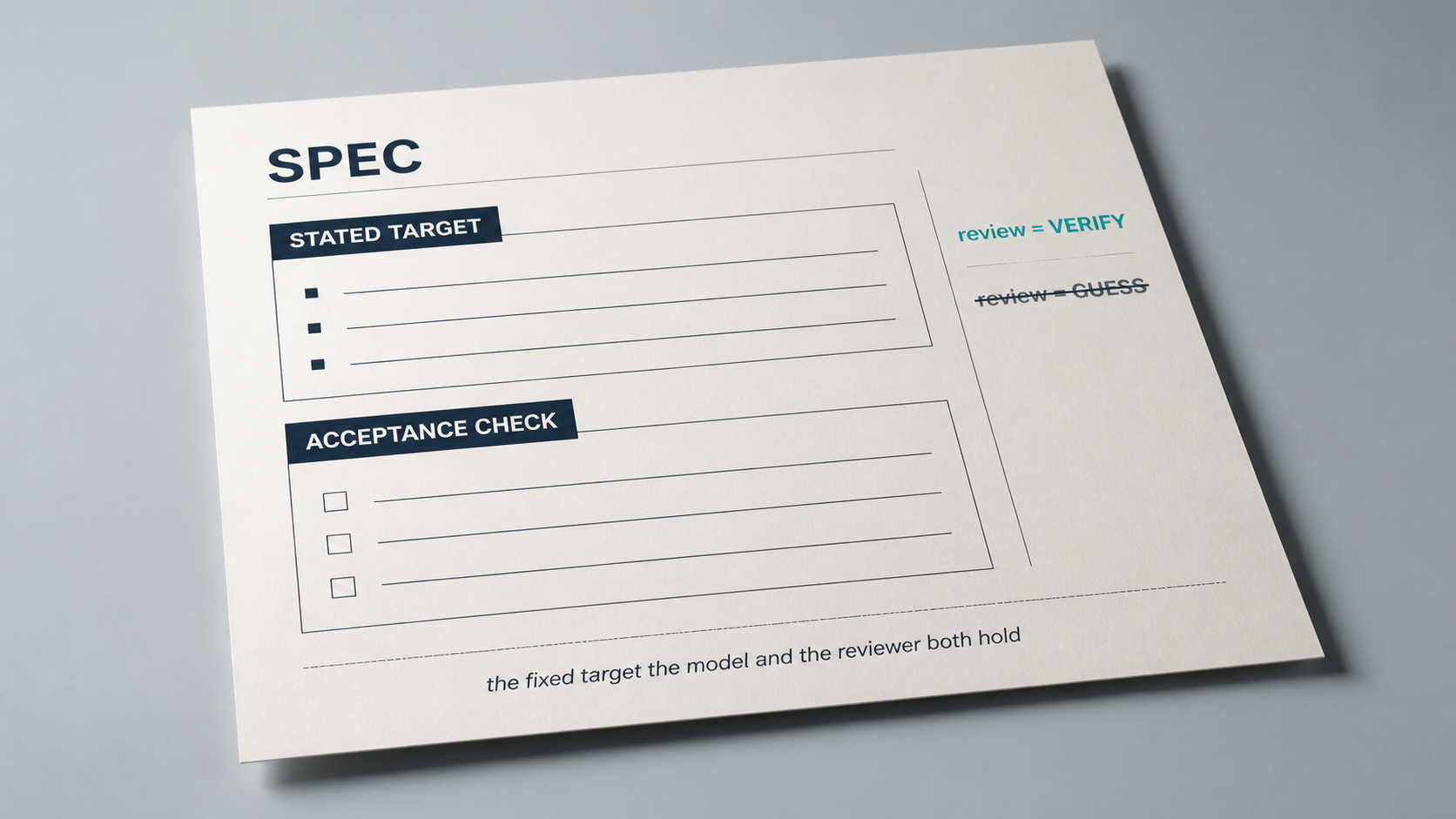
The second control is spec discipline: the insistence that a change has a stated target before the AI generates against it. Teams resist this as paperwork. The reframe is that without it, review is not review. It is guesswork.
Here is the mechanism. When an AI writes code against an unstated or vague intent, it optimizes toward a plausible interpretation of what you probably meant. The output looks finished. It compiles, it runs, it reads cleanly. But the reviewer has no fixed target to check it against, so review degrades into "guess what was intended, then judge whether this matches the guess." That is slow, inconsistent between reviewers, and exactly where ownership gets blurry: nobody is sure who decided what "correct" meant.
A spec, even a lightweight one, converts review from interpretation into verification. The reviewer stops asking "is this a reasonable thing to have built?" and starts asking "does this do the specified thing?" The first question has no stable answer and takes forever. The second is checkable, faster, and consistent. This is also where AI assistance compounds in your favor: a clear spec is a fixed target both the generating model and the reviewing human can hold, which is the only way the two stop drifting apart.
Skip spec discipline and you do not save the cost of writing the spec. You move it to every reviewer, on every change, in a more expensive and less reliable form. Governed in, it is one artifact. Governed out, it is a recurring tax on the most senior attention you have.
Governed tool paths beat blanket blocking, and they beat shadow AI even more.
The third control belongs as much to security as to delivery, and it is where the speed-versus-control framing does the most damage. The question is not whether developers use AI. They already do. The question is whether the output passes through a path you can see.
The reflex, when security gets nervous, is to block everything: lock down the models, restrict the tools, require sign-off on all of it. Blanket blocking of normal work usually backfires. A locked-down sanctioned path does not stop the usage; it pushes it underground, into personal accounts, browser tabs, and pasted snippets that never touch your review or standards layer. That is shadow AI: change produced outside any governed path, arriving in your codebase with no provenance and no checks. You did not prevent the risk. You blinded yourself to it. Shadow AI is the incident class that dominates the real log.
Blocking is not always wrong, and that nuance is the whole point. Blocking can genuinely reduce usage when it is backed by technical enforcement, monitoring, and a credible approved alternative. Some tools and some data classes genuinely must be prohibited; governance itself includes blocking high-risk actions. The principle is not "never block." It is: provide a low-friction approved path for normal work, while technically restricting the tools, data classes, and actions whose residual risk is unacceptable. That is what a governed tool path does. It makes the sanctioned path the easy path for ordinary work, so the output you are already getting flows through the same gates and review as everything else, and it draws a hard line only where the risk earns one.
Provenance, recording which tool or model contributed a change, supports that path but does not finish it. It helps an investigation reconstruct what happened; it does not prove the change was correct. The slowdown a governed path removes is the one that arrives latest and costs most: the cleanup. Shadow-routed output accumulates as change nobody can trace, in a codebase nobody fully trusts, until something breaks and the investigation has no thread to pull. That archaeology is a slowdown you pay in a lump sum, usually at the worst time. Governed paths convert that future lump sum into a continuous, visible, manageable cost. That is not a tax. That is insurance you can price.
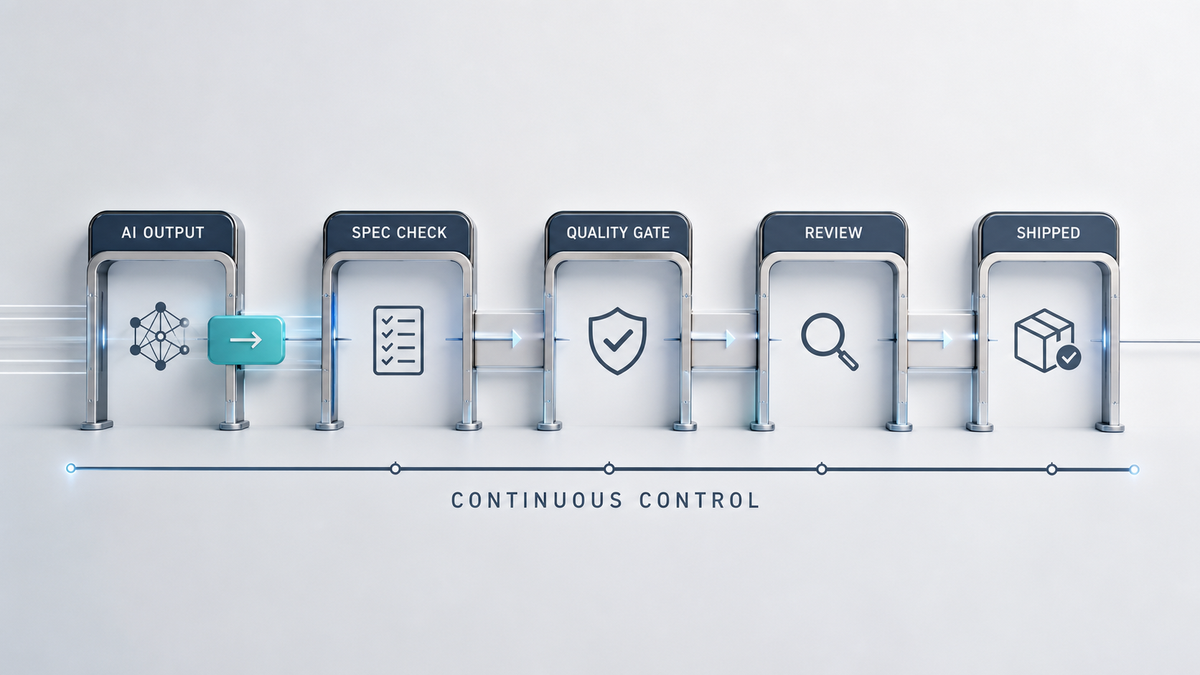
The same control placed continuously stops being a wall and becomes a current.
Notice what these controls share. The quality gate is a review and control standard. Spec discipline reshapes the workflow and handoff between intent and code. Governed tool paths are about information and system access. None of them is a policy document you write once and file. They are properties of how the delivery system runs, on every change.
This is the distinction between governance bolted on and governance built in, and it is where most programs fail. Bolted on, governance is a single late gate: a review board, an approval step, a checkpoint change must clear before release. That late gate is genuinely a tax. It batches risk until the last moment, then forces a slow, high-stakes inspection of everything at once, which is exactly the bottleneck people picture when they hear the word.
Built in, governance is the operating cadence: continuous, distributed across the pipeline, acting on each change as it moves rather than on a giant batch at the end. The same controls, placed continuously and tiered by risk, stop being a wall and start being a current. The work clears as it goes. The expensive late batch inspection rarely has to happen, because nothing accumulated into a dangerous batch; the targeted reviews that remain, the regulated, high-risk, or release-readiness checks, run against change that is already mostly clean.
This is why "just add quality gates" is the wrong way to think about it. Gates are one component. What changes when control becomes an enabler is the operating model: the review and control standards, the workflows and handoffs where AI output enters review, the information and system access that keeps usage on governed paths, and the operating cadence that runs all of it continuously. Treat governance as a single control and you get the late-gate tax. Treat it as an operating-model property, tuned to risk, and you get the throttle.
Compliance and engineering governance are different lenses that overlap.
It is tempting to wall compliance off entirely and say engineering governance has nothing to do with it. That is too clean, and increasingly false. Audits now routinely ask for evidence on access control, secure development, change approval, logging, dependency management, and human oversight, which are exactly the controls this article is about.
The honest framing is two lenses on overlapping ground. Compliance asks whether obligations are demonstrably satisfied. Engineering governance determines how delivery decisions and controls produce that evidence without destroying flow. Run engineering governance well and you are not chasing an audit; you are generating, as a byproduct, much of the evidence an audit wants. Treat the two as identical, though, and engineering teams inherit a compliance checklist that answers none of their delivery questions and a procurement owner who never touches the pipeline. Different buyers, different questions, operationally entangled.
Measure both sides of the ledger, by risk tier.
A governance program that only counts the failures it avoided is unfalsifiable; one that only counts the friction it adds is blind to the point. You have to measure both, and you have to measure by risk tier, because a control that is right for a payment path is overkill for a copy change.
Track, per tier: lead time and review queue time; reviewer hours and review rounds; pre-merge rejection and correction rate; escaped defects and change-failure rate; rollback and remediation time; security findings by severity; developer bypass and exception rates; and the control's own false-positive rate. One common metric needs a caveat: "rework commits after merge" is noisy, because post-merge commits are often ordinary evolution rather than corrective work, so read it as a trend by tier, not a verdict.
The blind spot most programs share is control cost. A governance system cannot prove its value if it only measures avoided failures, because every control also consumes delay and attention. Risk reduction is the benefit; flow cost is the price. A control earns its place only when, for the risk class it covers, the slowdown it removes downstream is larger than the friction it adds upstream. That comparison, run per tier, is the entire argument made operational.
The frame, stated plainly.
The reason control and speed look like opposites is timing. The speed shows up immediately, at the keyboard; the cost of skipping the right control shows up later, in review, rework, and cleanup, often on a different dashboard and a different team. The trade-off feels real even though it is mostly an artifact of when the bill arrives and where the control sits.
Well-designed control is not the opposite of speed. The quality gate that feels like a brake is what stops senior reviewers from re-checking the same class of defect forever. The spec that feels like paperwork turns review from guesswork into verification. The governed path that feels like a restriction keeps the cleanup from arriving as a lump sum. Risk-tiered and placed near the work, each removes a downstream slowdown the team cannot yet see. Design them badly, or batch them at the end, and they earn the tax reputation honestly.
So the question for your own delivery system is not "how much speed will governance cost us." It is sharper: which slowdowns is the absence of risk-based control quietly building up, on whose desk will that bill land, and for the controls you do run, are you measuring their flow cost alongside the risk they remove. The team that feels thirty percent faster and cannot move its delivery metrics is paying, on a delay, for the governance it skipped or misplaced. The right control, in the right place, measured on both sides, is what makes speed something you can keep.
AI Transparency Notice: This article and its accompanying images were created with the assistance of generative AI. The author directed the content, contributed the underlying ideas and analysis, and reviewed the final publication.