Why Coding Standards Must Become Agent-Readable
An agent applies the standard it can read, not the one you wrote. Writing a convention into the files the agent loads raises the odds it follows it, but guidance is not enforcement. The fix is a deliberate split across three control layers.
And why context files alone cannot enforce them.
The first time you notice it, you assume it is a one-off. An agent wrote a working function, the tests pass, the diff is clean, and somewhere in the middle of it sits a pattern the team retired two years ago. Not a bug. A convention. The kind of thing a senior engineer would have flagged in review with one comment, because everyone on the team knows it. Except the agent did not know it. And nobody told it.
You fix it, you move on, and a week later you see it again in a different file. Then a third time, in a third shape. At some point the pattern stops looking like a mistake and starts looking like a signal, and the signal is this: a standard your team holds is not being applied to a growing share of the code, and there is no failing build, no flagged review, nothing that would tell you it is happening. The work looks done. The bar moved, and nobody saw it move.
This is not an adoption problem and it is not a prompt problem. It is a control problem. The standard did not get weaker. The thing that used to apply it changed shape, and most teams have not noticed.
Quick answer. An agent-readable coding standard is necessary but insufficient. Writing a convention into the files an agent loads at generation time, the CLAUDE.md, the AGENTS.md, the scoped rules files, makes the convention available, and that raises the probability the agent follows it. It does not guarantee compliance, because a model's adherence to guidance is probabilistic. So every standard the team holds needs an explicit control destination across three layers: guidance raises the odds, enforcement blocks what a machine can check deterministically, and assurance detects what still needs judgment. The standard most likely to drift silently is the one assigned to none of them.
For most of the history of software, a coding standard was applied through a mix of two things, and the mix mattered more than teams ever named. The deterministic part of the standard, formatting, forbidden constructs, type safety, the parts a compiler or a linter could check, had been enforced by machines for decades. Long before any agent wrote a line, a CI pipeline could reject code that did not compile, a formatter could rewrite spacing, a test suite could block a regression. That was real enforcement, and it was already automated.
The other part was the judgment-heavy, tacit portion: whether a name read well, whether an abstraction was right, whether a boundary belonged where it sat, whether a retired pattern had crept back in. That part lived in the heads of experienced people and got applied in review, imperfectly but with judgment. A reviewer who knew the team named things in snake_case would catch the GetUserID that returned a customer_profile. The architect who knew the rule about not calling the database directly from a controller would block the pull request. The standard lived in two places at once: written down somewhere as a reference, and carried in the heads of the people doing and reviewing the work, where it became assurance.
That arrangement worked because the author of the code and the carrier of the tacit standard were the same kind of thing. A human author who had been onboarded into a team had the convention available whether or not the wiki page was open in another tab. Agentic delivery did not break this so much as expose how much of it was never encoded. It made visible how large the tacit, judgment-heavy portion had quietly become, and how much the team had been relying on humans to carry it for free.
Then the author changed. A coding agent cannot be assumed to retain your team's standards across runs. Modern coding agents do have memory features, Claude Code can carry auto-memory across sessions and Codex can use optional, off-by-default stored memories, so it is wrong to say the machine has no memory at all. Those are local recall, though, not a standards-control surface: OpenAI is explicit that required team rules belong in AGENTS.md or checked-in docs, not in memory. So you cannot assume the agent holds an authoritative, complete, and current copy of every convention the team values at the moment it generates. It applies what is available to it then: the context it was given, the files it loaded, what it could retrieve, and whatever its memory happens to hold. This is the hinge the whole argument turns on. Everything that follows is a consequence of it.
An agent applies the standard available to it, not the standard you wrote
A coding agent's behavior at generation time is bounded by what is available in its context. That is not a limitation to engineer around. It is how the system works. The model produces tokens conditioned on the tokens it was given. A convention that is neither loaded, retrieved, nor checked at the moment it matters cannot reliably influence the result. It may still be inferred from nearby code, but that inference is unreliable.
This is the distinction that gets lost. People talk about an agent "ignoring" a standard, as if it saw the rule and chose to skip it the way a junior developer in a hurry might. That is usually not what happens. More often the agent never had the convention available, because the convention lives in a surface the agent did not load. A wiki page that is never linked or retrieved is not in the context window. An onboarding deck is not in the context window. The thing a staff engineer carries in their head and applies in review is, by definition, not a document the model loaded.
There is a caveat here, and v1 of this argument got it wrong by stating it too absolutely. An out-of-context standard is not automatically invisible. A capable agent can reach beyond what was preloaded: it can search the filesystem, read a referenced doc, call an MCP server, hit the web, or run a skill that pulls in a convention on demand, but only when those tools, servers, credentials, network paths, and approval policies are enabled and authorized for that run. MCP, for instance, exposes the tools; the access controls and the human-in-the-loop confirmation live in the server and the client, not in the protocol. So a standard sitting in a wiki the agent can retrieve is not a zero signal, provided the retrieval path is actually wired and permitted. The accurate statement is narrower and more useful: a standard that is neither loaded into context, retrievable at the moment it matters, nor checked after generation cannot reliably influence the result. Availability, not mere existence, decides whether the convention touches the code. Guidance works by raising availability. It never makes availability certain.
The contrast with the human author is still worth holding onto, because it explains why the felt experience changed. A human who has internalized a standard applies it from memory, on every line, without being prompted, with judgment about when it bends. A machine author applies the standard that is available in the request, with adherence that is probabilistic rather than certain. So a coding standard, for agent-authored code, is only as strong as its weakest control destination. If the convention is loaded or reliably retrievable, adherence is likely but not guaranteed. If it is also backed by a deterministic check, the detectable violations get blocked. If neither is true, the standard is a suggestion the model follows when it happens to.
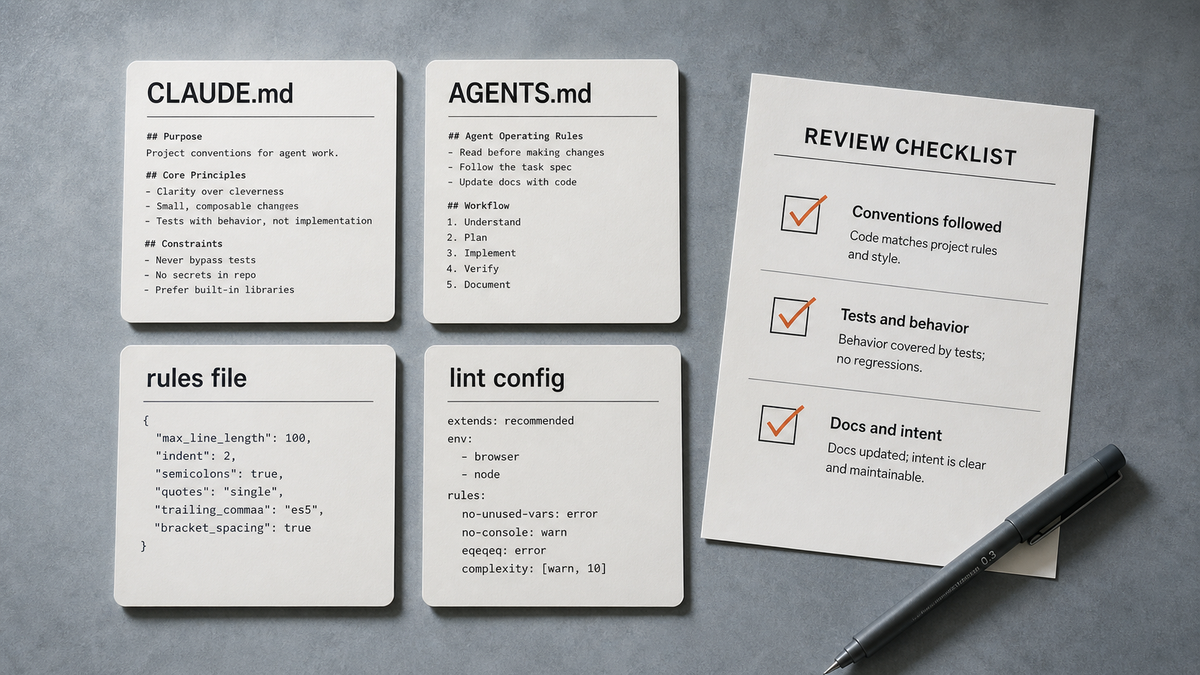
This is the part the tooling-tip content gets right without quite naming it. The advice to write a good CLAUDE.md, the practice of embedding your rules in an AGENTS.md, the discipline of putting conventions in rules files: all of that is correct, and all of it is one layer of the answer. You write the file because the file is how you give the standard to the agent at the moment it writes. Anthropic is explicit that a CLAUDE.md is context the model is told to follow, not a guarantee it will, and recommends deterministic hooks when an action must be controlled rather than merely suggested. OpenAI frames the AGENTS.md the same way, as project guidance to be paired with linters and type checkers. The file is the guidance layer. It is necessary. It is not, by itself, enforcement. Where standards sit among specs, skills, agents, and memory is mapped in the six-class AI engineering stack.
The standard did not get weaker. It went un-controlled
Here is the move that makes this hard to see, and it is the center of the whole problem.
When a human author skips a standard, there is often friction. The reviewer pushes back. The build fails on a lint rule. The architecture review flags the boundary violation. The skip leaves a mark. Somebody, somewhere in the pipeline, encounters the gap and has to decide what to do about it. The standard may lose that fight, but it shows up to it.
When agent-authored code skips a standard that had no control destination, there is no friction, because there is no encounter. The deterministic check that would catch it was never written. The reviewer, if there is one, is now reviewing a higher volume of code and is checking for what is in front of them, not for what went missing. The probabilistic guidance that might have caught it did not land on this generation, and nothing downstream blocked the case where it did not land. The violation does not announce itself. It becomes part of the codebase, indistinguishable from code that complied.
So the standard does not get repealed. Nobody decides to stop applying it. It does not get weaker. It goes un-controlled. It stays on the wiki page, still true, still endorsed, still what the team believes its standard is, while the actual code drifts away from it one agent-authored file at a time. The gap between the standard you think you hold and the standard the code actually meets opens silently, and it widens in proportion to how much of the code the agent now writes and how few of the team's standards have a real control behind them.
This is silent quality drift, and it is a different failure mode from the ones teams are equipped to see. Most quality problems are loud. A regression breaks a test. A latency spike pages someone. A security finding lands in a report. Teams have built their whole sense of "is the bar holding" around signals that fire when something goes wrong. Silent drift fires no signal. The bar is moving and every dashboard is green, because the dashboards measure the standards that were wired to a deterministic check and say nothing about the ones that were only ever suggested.
Run the consequence forward and it is uncomfortable. As agent share of code rises, the team's real quality bar collapses toward the subset of standards that has an actual control behind it: the deterministic checks that block violations, plus the standards a review gate is actually built to re-apply. Not the standards the team values most. Not the standards the team would protect if asked. The subset that happens to have a control destination. Everything else, however genuinely held, becomes decoration. It describes a bar the code is no longer measured against.
The activity-versus-performance trap sits right here. "The agents are producing code" is an activity claim, and it is easy to verify. "The standard is being applied" is a performance claim, and most teams cannot verify it at all, because the standard was never given a destination that would do the verifying. You can have very high AI activity and a falling quality bar at the same time, and nothing in your normal reporting will connect the two.
Three layers, three different guarantees
Look past the individual standard and look at the system. Every standard the team holds needs a destination, and there are three of them, each with a different guarantee. Conflating them is exactly the mistake v1 of this article made, and it is the mistake the tooling-tip framing makes too: it treats "in the CLAUDE.md" as if it were enforcement, when it is guidance.
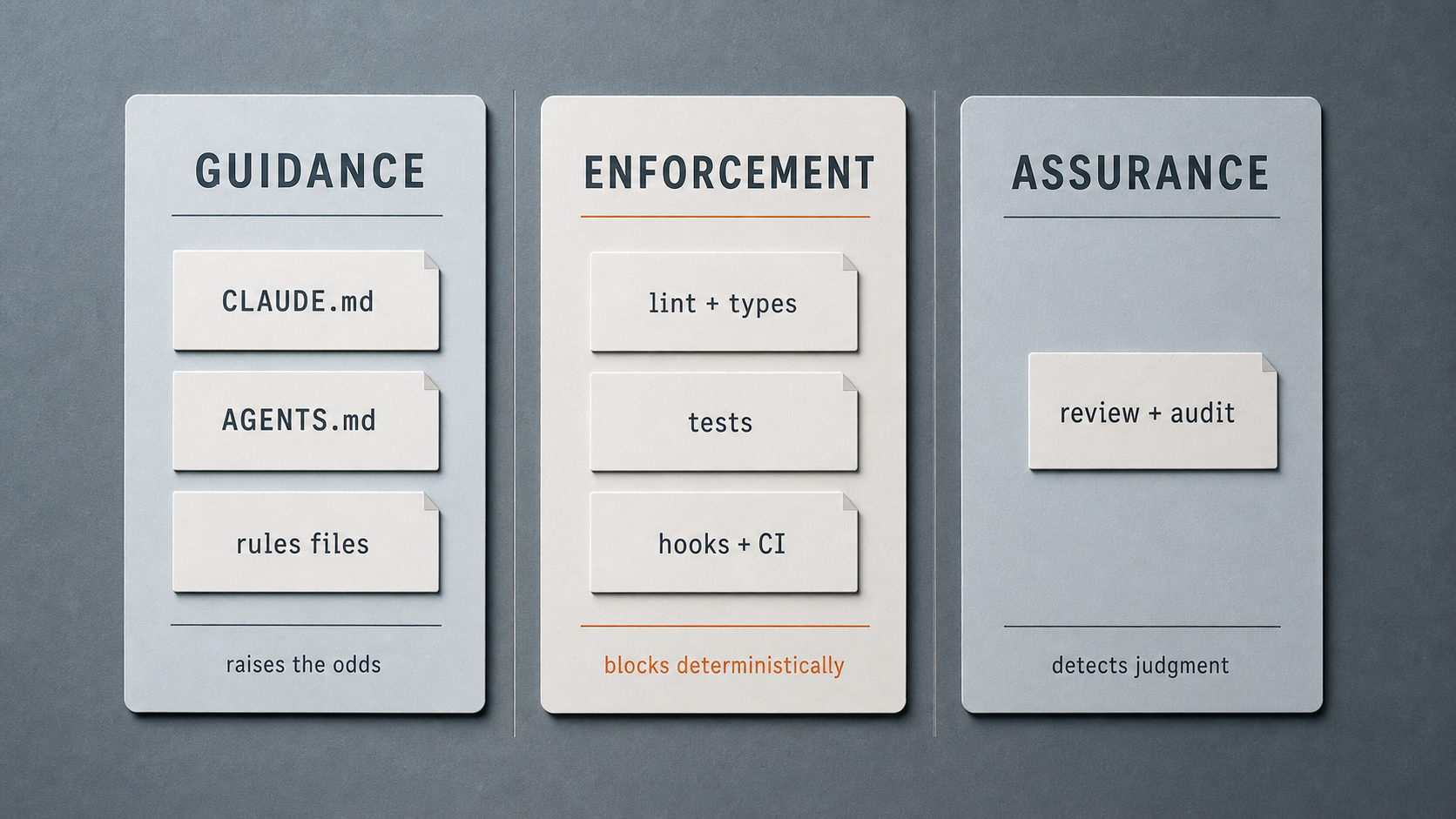
Guidance. The CLAUDE.md, the AGENTS.md, the scoped rules files, the retrieved docs and examples the agent loads or pulls in. This layer raises the probability that the agent applies the convention as it writes. It is the only layer that can shape code at the moment of generation, which makes it the right home for standards where catching the problem after the fact means a rewrite: naming, structure, the patterns to use and avoid, the spec the code is built against. Its guarantee is probabilistic. A well-written rules file makes the right output likely. It never makes it certain, because the model's adherence to instructions is, by its nature, a probability and not a lock.
Enforcement. The linters, formatters, type checkers, tests, policy-as-code, deterministic hooks, CI gates, and branch protection that run on the output regardless of who or what authored it. This layer blocks detectable violations deterministically. If a rule can be expressed as a check, enforcement is where it becomes a guarantee instead of a hope. A formatter does not raise the odds of correct spacing; it makes the spacing correct. A type checker does not suggest type safety; it fails the type-check step, and the build with it, when that step is wired as a required, fail-closed gate. A pre-tool hook does not ask the agent to stop before a forbidden, supported tool call; it blocks the call before it runs. The scope matters: a post-action hook runs after the operation and can warn or feed context back, but it cannot undo a side effect that already happened. This is the layer the word "enforce" actually belongs to, and the layer the guidance-equals-enforcement framing keeps borrowing the word from.
Assurance. Human or model review, sampling, audits. This layer detects judgment-dependent problems that no deterministic check can express: whether an abstraction is right, whether a test tests the thing it claims to, whether a boundary is appropriate. Its guarantee is partial and imperfect by construction, because judgment does not reduce to a check. And here is the trap a model-based reviewer walks straight into: a model review is not enforcement. It is assurance, with the same probabilistic adherence as any other model output, unless it is wired to a gate that actually blocks the merge on its verdict. An AI reviewer that posts comments a human can ignore is assurance. An AI reviewer whose blocking verdict halts the pipeline is assurance feeding enforcement. The wiring is the difference, not the model.
A standard is controlled only when it has been deliberately assigned to one or more of these layers. The standard most likely to drift silently is the one assigned to none of them: held in heads and wikis, never loaded, never checked, never reviewed for. The work is not "write a good config file." The work is to give every standard the team holds a control destination that matches the guarantee that standard actually needs.
The control places, and the moments they act
The three layers are not three single moments. A standard can be controlled at several points in the lifecycle, and good design uses more than one. It is wrong to claim there are "exactly two places" control can live. There are several, and the layers map across them.
Before generation, control is guidance: the context loaded into the conversation and the docs the agent can retrieve. This shapes the code as it is written and is the only point where a convention can prevent a rewrite rather than catch one.
During the action, control can be enforcement: tool permissions, deterministic hooks that block a forbidden operation, constraints on what the agent is allowed to do. This is where an action that must never happen gets stopped rather than discouraged.
After generation, control is enforcement again: the formatters, linters, type checkers, tests, and static analysis that run on the produced diff and reject what does not pass. This is the deterministic backstop for everything the guidance layer could not be trusted to hold, and no context window is infinite, so something always lands here.
Before acceptance, control is assurance: the human or model review that re-applies the judgment-heavy standards to the diff, blocking the merge when wired to do so.
After deployment, control is assurance again: monitoring, audits, and drift detection that catch what slipped through everything upstream.
What does not exist anymore as a free resource is the place most teams are still unconsciously relying on: the standard that lives nowhere a control touches, applied by a human who would have caught it because they happened to hold it. That human is now reviewing more code than before and cannot carry the whole standard across a rising volume of machine output. The work that human did for free has to be redistributed across guidance, enforcement, and assurance, on purpose.
What changes is different for each role that owns a standard
The control work does not land evenly. It lands on whoever owns a standard, and ownership is a team property, not a fixed org chart. The table below is illustrative, not universal: in many teams security rules belong to an AppSec function rather than the architect, and test standards are owned collectively rather than by a single QA lead. The rule that does generalize is this: the accountable owner of each standard names its control layer, its validation method, and its review cadence. The CTO funds the system; the engineering team collectively owns the quality standard.
For the Dev Lead, the change is the most direct. The Dev Lead typically owns the conventions that used to live in review comments and onboarding: naming, structure, error handling, the patterns the team standardized on and the anti-patterns it retired. Those conventions now need a control destination: the deterministically checkable ones go to lint and CI as enforcement, the generative ones go into rules files and always-loaded context as guidance, and the judgment calls stay with the review gate as assurance. The Dev Lead's job shifts from holding the bar in review to assigning the bar across the three layers, then using review for what only judgment can reach. The same encode-it-upstream move powers spec-driven development for AI-assisted teams: the artifact the agent reads is the artifact that binds.
For the QA Lead or whoever owns test quality, the standard that goes un-controlled is the test and review standard. What makes a test meaningful, what coverage actually has to include, what a review has to check: these were applied by people who knew them. When agents generate tests and agents generate code, the deterministic parts of the test standard (coverage thresholds, required test shapes) belong in enforcement, the generative parts (what a meaningful test looks like) belong in guidance the test-generating agent reads, and the judgment part belongs in a review gate that re-checks both code and tests. Otherwise the team gets more tests and a weaker test standard at the same time, which is the activity-versus-performance trap inside the test function.
For the Architect or AppSec owner, the un-controlled standards are the architectural and security rules: the boundaries that must not be crossed, the dependencies that are not allowed, the input surfaces that have to be treated as untrusted. These are exactly the standards most expensive to violate, and a large share of them can and should be made deterministic: dependency-boundary checks, policy-as-code, security linters, machine-checkable architecture constraints. The judgment-heavy remainder goes to assurance. What does not work is leaving them in prose the agent reads loosely and no gate re-applies, because an architectural violation in agent-authored code produces no friction when it is written and surfaces only when something breaks.
For the CTO or VP Engineering, the change is one of accounting, not encoding. The CTO does not write the rules files or the lint configs, but the CTO is accountable for whether the quality bar held, funds the control work, and has to measure the thing silent drift hides. The right question stops being "are the engineers using AI," which is an activity question with a comfortable answer, and becomes "did the bar hold," which is a performance question that requires checking whether the standards the team values are the standards the code meets. That measurement does not exist by default. It has to be built, and building it competes for the same engineering time the agents were supposed to free up. That accounting shift is one piece of the AI operating model.
| Role (illustrative ownership) | The standard that goes un-controlled | Where its control belongs |
|---|---|---|
| Dev Lead | Naming, structure, error handling, retired anti-patterns | Lint and CI for the checkable part (enforcement); rules files and loaded context for the generative part (guidance); review for the judgment part (assurance) |
| QA Lead / test owner | Test meaningfulness, coverage rules, review checklists | Coverage and required-shape checks (enforcement); meaningful-test guidance in context (guidance); a review gate re-checking code and tests (assurance) |
| Architect / AppSec | Boundaries, allowed dependencies, untrusted-input rules | Dependency and policy-as-code checks, security linters (enforcement); guidance for the rest; review for judgment calls (assurance) |
| CTO / VP Engineering | Whether the bar held at all | Funding the control work and a measurement that detects silent drift |
What a controlled standard actually is
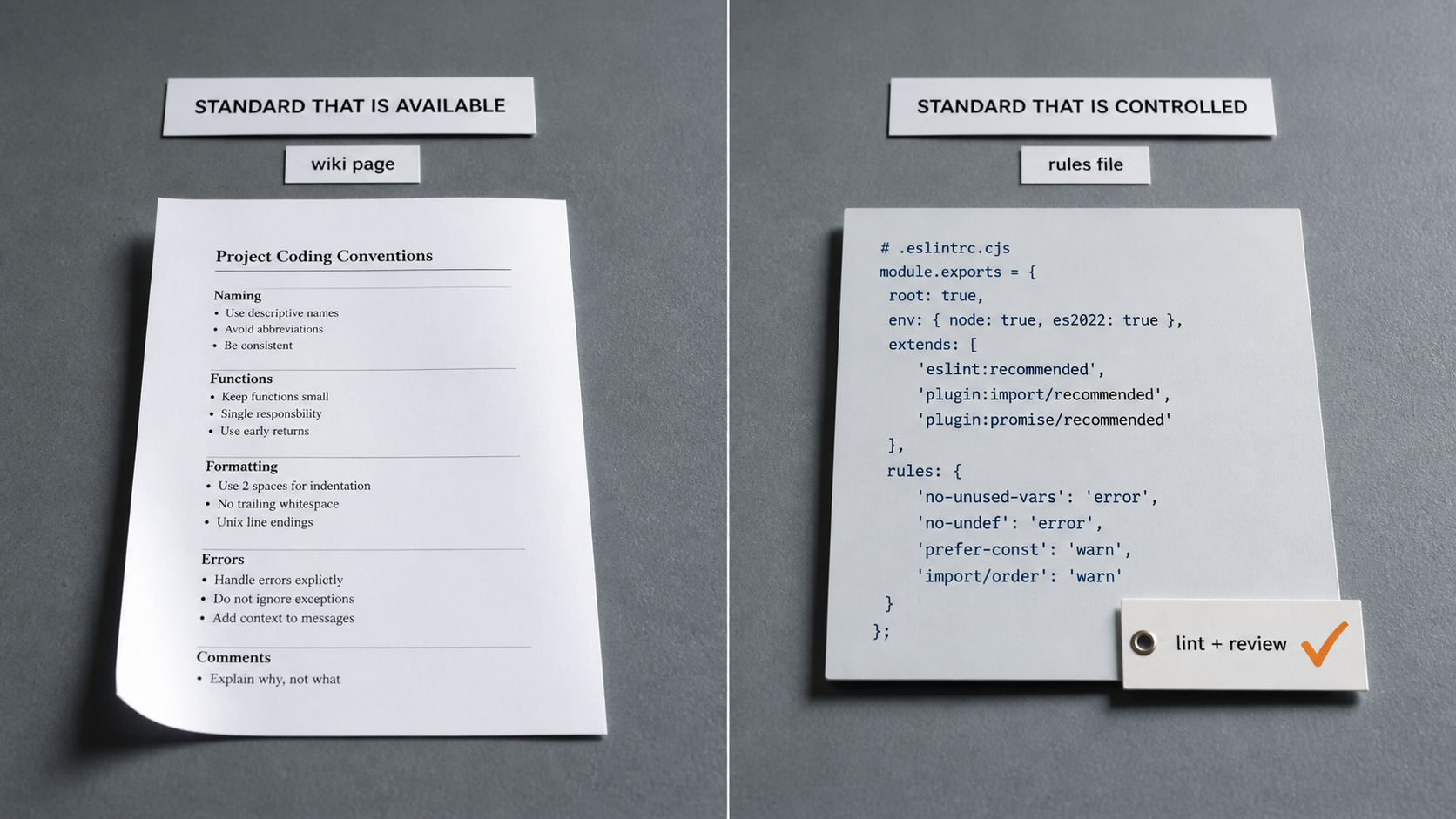
The phrase "agent-readable coding standards" is easy to nod along to and easy to misread as "put your standards in a file." The same is true of the adjacent phrasings teams reach for, machine-readable coding standards, coding standards for AI agents, the whole vocabulary of machine-loadable standards. The distinction that matters is not file versus no file, and it is not which phrase you use. It is the difference between a standard that is merely available and a standard that is controlled. AI coding standards enforcement is one part of the real subject; guidance and assurance are the other two, and the file-centric framing collapses all three into the file.
A standard that is merely available is a wiki page or even a well-written rules file: it raises the odds, and it touches agent-authored code more often than the wiki does, but it never guarantees the result. A standard that is controlled is assigned to a layer whose guarantee matches its need: guidance for the generative conventions that have to shape the code as it is written, enforcement for the deterministically checkable rules, assurance for the judgment calls. Controlled does not mean written down. It means the standard has a destination where one of the three guarantees actually operates on agent output.
That gives you the practical question, which is not "have we written our standards down" but "for each standard we hold, which control layer does it live in, and is that the layer its guarantee requires." A complete control layer requires every standard the team holds to be assigned somewhere the machine actually touches, and it requires the team to know which standards have not been assigned anywhere, because those are the ones drifting.
Here is the mapping that makes the assignment concrete.
| Control layer | What lives here | The guarantee it gives | What it cannot do |
|---|---|---|---|
| Guidance (CLAUDE.md, AGENTS.md, rules files, retrieved docs and examples) | The generative conventions the agent should apply on every relevant generation: naming, structure, the patterns to use and avoid, the spec the code is built against | Raises the probability the convention is applied as the code is written | Guarantee compliance. Adherence is probabilistic, and the context window is finite, so this layer carries the highest-value generative standards, not the full rulebook |
| Enforcement (linters, formatters, type checkers, tests, policy-as-code, deterministic hooks, CI gates, branch protection) | The deterministically checkable rules: formatting, forbidden constructs, type safety, dependency boundaries, anything expressible as a check or a blocking hook | Blocks detectable violations deterministically, regardless of author, when the check is encoded, runs on that change path, fails closed, and is required by the merge or release gate | Anything that requires judgment. A check verifies form, not whether the design is right. A check that is not encoded, not run on that path, or not required by a gate does not block |
| Assurance (human or model review, sampling, audits) | The judgment-dependent standards: is this the right abstraction, does this test test the thing, is this boundary appropriate | Detects judgment-heavy problems, imperfectly, against the actual output | Guarantee anything by itself. A model reviewer is enforcement only when wired to a blocking gate; otherwise its verdict is advisory and probabilistic too |
The point of the mapping is not that one layer is better. It is that a standard is controlled only when it has been deliberately placed in a layer whose guarantee matches what that standard needs, and the assignment is something a team now designs on purpose, the way it once designed a CI pipeline. The default, where standards sit on a wiki and humans carry the rest, controls almost nothing against the machine. Leaving the assignment to chance is how the quality bar collapses to the controlled subset by accident instead of by design.
The ways this goes wrong are predictable
Teams that take the control change seriously still tend to stumble on the same three things, and each one is worth naming because each one looks like progress while it is happening.
The first is treating guidance as if it were enforcement: writing a thorough CLAUDE.md, feeling the relief of having the standards "in the agent," and stopping there. This is the exact mistake the file-centric framing encourages. A well-written context file raises the odds, but it does not block anything, and it competes for the same tokens as the code and the task. A standards file that tries to carry every rule the team holds either grows too long to be reliably applied or crowds out the room the agent needs for the actual work. Guidance is the highest-value layer at generation time, and it is still only guidance. The deterministically checkable standards have to go to enforcement, the judgment calls have to go to assurance, and the team has to know which standards landed where. A good guidance file is a deliberate selection, not a dump, and it is one third of a control system, not the whole of it.
The second is assuming the agent will infer the convention from the codebase. Agents do pick up patterns from the surrounding code, and sometimes the pattern they pick up is the right one. The problem is the word "sometimes." Inference from the codebase is real but unreliable, and it is most unreliable exactly where it matters: a codebase that has already started to drift contains both the standard and its violations, and the agent has no reliable way to know which is canonical. Relying on inference is relying on the codebase to teach the standard, which only works while the codebase still mostly holds the standard, which is the thing the drift is eroding. Inference is a tailwind, not a control.
The third is writing standards for humans that an agent applies loosely and no layer re-checks. A convention phrased as a paragraph of prose advice, full of judgment calls and unstated context, is something a senior engineer reads correctly and an agent reads probabilistically. "Prefer composition over inheritance where it improves testability" is a sentence a human applies with judgment and an agent applies with a coin flip. The fix is not to dumb the standard down. It is to split it across the layers: express the machine-checkable part as enforcement, a lint rule, a structural constraint, a concrete example of the right and wrong shape, and reserve the prose for the judgment that genuinely needs assurance at the review gate. A standard written only as prose, with no check behind it, is handed to the layer least able to apply it consistently and never re-checked.
Key takeaways
- An agent-readable standard is necessary but insufficient. Writing a convention into context raises the probability the agent applies it; it never guarantees compliance, because a model's adherence to guidance is probabilistic.
- A standard needs a control destination. Guidance raises the odds, enforcement blocks what a machine can check deterministically, assurance detects what needs judgment. The standard assigned to none of the three is the one drifting.
- A model review is not enforcement unless it is wired to a blocking gate. Its judgment is probabilistic too; the gate, not the model, is what makes a verdict deterministic.
- The drift is silent. There is no failing build and no flagged review for a standard with no control destination, so the quality bar can fall while every dashboard stays green.
- The bar collapses to the controlled subset. As agent share of code rises, the standards that survive are the ones a team deliberately assigned a control to, not the ones it values most.
- The fix is design, not configuration. Assign every held standard to the layer whose guarantee it needs, and know which standards have not been assigned anywhere.
What this changes in how you run the team
It is tempting to read all of this as a tooling instruction: write better standards files, add a review step, tune the linter. Those are the right actions, but reading them as tooling misses what actually moved. The control system for code quality is part of the operating model, the part that decides how work gets done and how its quality is governed. When the author of the work changed from a human who carried the tacit standard to a machine that applies what is available with probabilistic adherence, the operating model changed underneath the team, and the standards-and-control layer is where that change shows up first and most visibly.
So the shift is not in any single artifact. It is in treating the guidance-enforcement-assurance layer as something the team designs deliberately, with ownership and accounting, rather than something it inherits from the era when reviewers carried the judgment-heavy standards for free. That means deciding, on purpose, which standards ride in guidance, which are blocked by enforcement, and which require assurance built for the new volume of machine output. It means giving each of those a clear owner. And it means measuring the thing silent drift hides: not whether agents are producing code, but whether the standards the team holds are the standards the code meets.
That layer is one component of the larger operating-model shift, not the whole of it. The standards-and-control layer sits alongside the way access to systems and information is governed, the way roles are redesigned, the way work is measured, and the rest of what changes when AI moves from a tool people use to the thing that does the work. An agent-readable standard is one artifact among several that reveal whether the operating model actually changed rather than just the toolset. It is a useful one to start with, because it is concrete, it is owned by people who can act on it this quarter, and the cost of leaving it alone is a quality bar that falls without anyone deciding to lower it.
The standard you wrote was always a claim about what your code should be. For as long as humans wrote and reviewed the code, the judgment-heavy part of that claim traveled with them for free, on top of the deterministic part the machines already enforced. The author changed, and the free part came loose. The work now is to give it back a destination. Agent-readable guidance makes the standard visible. Deterministic controls enforce what machines can verify. Risk-based review governs what still requires judgment. Agentic delivery needs all three, before the gap between the standard you believe you hold and the standard your code actually meets grows past the point where you can see it.
AI Transparency Notice: This article and its accompanying images were created with the assistance of generative AI. The author directed the content, contributed the underlying ideas and analysis, and reviewed the final publication.