Most AI Discussions Ignore the Cost of Verification
There is a number most CTOs cannot explain. Output volume is up, adoption is healthy, and the delivery metric that was supposed to move has not. The productivity did not disappear. It relocated.

There is a number most owners and CTOs cannot explain. Output volume is up. Engineers ship more code, PMs draft more stories, QAs generate more tests. And the delivery metric that was supposed to move has not moved, or has moved the wrong way. The dashboards say adoption is healthy. The cycle time says nothing changed. The instinct is to read this as an adoption problem. It is not. The productivity did not disappear. It relocated.
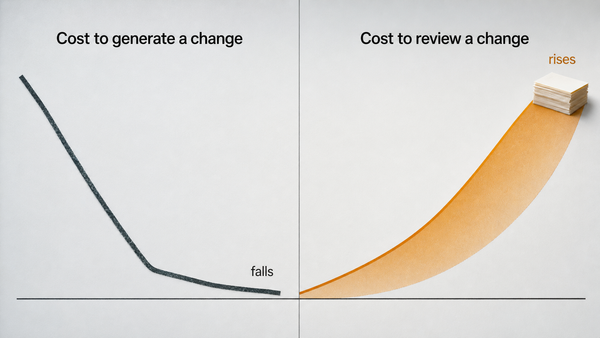
The cost of verification is the work of turning raw AI output into something an organization can trust enough to ship: review, validation, evaluation, and evidence-of-correctness. AI lowered the cost of generating candidate output. It did not automatically lower the total cost of establishing enough trust to ship that output, and when output volume rises faster than the capacity to check it, that verification cost becomes the binding constraint on delivery.
Generation is the part that got cheap. Trust is the part that did not. Most of the discussion about AI in software still prices the first and ignores the second, which is why the gains keep evaporating into a cost line nobody added to the budget.
Generation got cheap. Trust did not.
Watch where the cost actually sits in an AI-assisted delivery flow and the asymmetry becomes obvious. A model can produce a function, a test suite, a migration script, or a whole feature in seconds. The marginal cost of producing one more candidate output is now close to zero. But a candidate output is not a shippable change. Between the generated artifact and the deployable increment sits a second activity, and that activity did not get cheaper at the same rate.
That activity is verifying AI code and, more broadly, verifying AI output of any kind. The work runs from automated AI code review through human judgment, and it is the work of establishing that the thing the model produced is actually correct, safe, and fit to ship. AI did not lower the cost of delivering trustworthy software; it lowered the cost of generating output and left the cost of trusting that output standing. Trust is not a property the model emits. Trust gets produced, by review, by validation, by evaluation against expected behavior, and by accumulating evidence that the change does what it claims and breaks nothing it should not.
None of those trust-producing activities scales the way generation does. Some pieces of verification can get cheaper. Generated unit tests, static analysis, continuous-integration checks, and AI-assisted review can all reduce the per-change cost of certain checks. Model speed does not automatically reduce verification cost, though, and it can increase the total verification load when output volume rises faster than verification capacity. The cheap parts of checking sit underneath an expensive part that resists automation: a human, or a system a human is accountable for, has to decide this is correct enough to ship. That decision is the scarce good. It is also the value-bearing one. Nobody ships generated output; they ship verified output.
The economic reframe is small and it changes everything downstream. The unit of value in delivery was never lines of code. It was trusted change. When the cost of producing candidate change collapsed and the cost of trusting it did not, the verification bottleneck is where the constraint moved, to wherever trust gets manufactured, and the price of the whole system is now set there.
The cost relocated, and nobody added the line item
Picture the most ordinary version of this. A developer asks an agent for a feature, gets a working draft in a few minutes, and opens a pull request. The generation step that used to take a day took twenty minutes. Then the change waits. A reviewer has to read code they did not write, reconstruct intent they did not form, and decide whether to trust output that no human authored from scratch. The felt symptom shows up first in delivery teams as exactly this: developers generate more code, review load goes up, and seniors spend more time cleaning up output than they save in writing it. The relocation is not visible in the adoption survey. It is visible in the review queue.
The external evidence points in the same direction. GitClear's 2025 research, analyzing 211 million lines of code, found that code-cloning roughly quadrupled and that copy/pasted code exceeded moved code for the first time, while refactoring activity fell sharply. That is a decline in AI code quality by the structural measures GitClear tracks, and the point for verification is mechanical: more duplicated and less-refactored code is more surface area to review and more places for a defect to hide, which can raise the cost of verifying a change when reviewers have to reason across repeated or poorly-factored code paths. SonarSource, in a November 2025 analysis, framed the mechanism plainly from the vendor's vantage: the volume of generated code can overwhelm manual review capacity, and a team that accepts unverified AI output at scale risks a compounding quality decline that eventually slows delivery more than the tools speed it up. OpenAI's alignment team, writing in December 2025 about verifying code at scale, made the constraint explicit: the volume of produced code quickly exceeds the limits of thorough human oversight. These three sources are consistent with the same pattern. They do not, on their own, prove verification is the bottleneck in every delivery organization. The pattern they point to is one where output rose faster than the capacity to check it.
Here is what makes the cost invisible rather than merely large. Generation has an obvious owner, an obvious tool, and an obvious budget line; someone bought the licenses and someone can point to the usage dashboard. Verification has none of those by default. The work is real, but it gets absorbed, into reviewer evenings, into a senior's calendar, into rework that never gets attributed back to the generation step that caused it. The failure mode I see in delivery orgs is not that they refuse to pay the verification cost. It is that they pay it without naming it, so it never shows up where decisions get made.
A cost that has no name has no owner, and a cost that has no owner has no budget and no measurement. That is the structural reason the relocation goes undiagnosed. The money is being spent. It is just being spent in a column the operating model never created.
Why the gain evaporates between activity and performance
The reason the productivity is hard to find is not that it never existed. It is that the org is measuring the wrong half of the equation. Adoption dashboards report AI activity: licenses bought, active users, prompts run, tests generated. None of those measure whether the organization changed. AI verification economics says the gain only becomes real when generated output crosses into trusted output, and the metric that captures the gap, verified-output throughput, is the one almost nobody tracks.
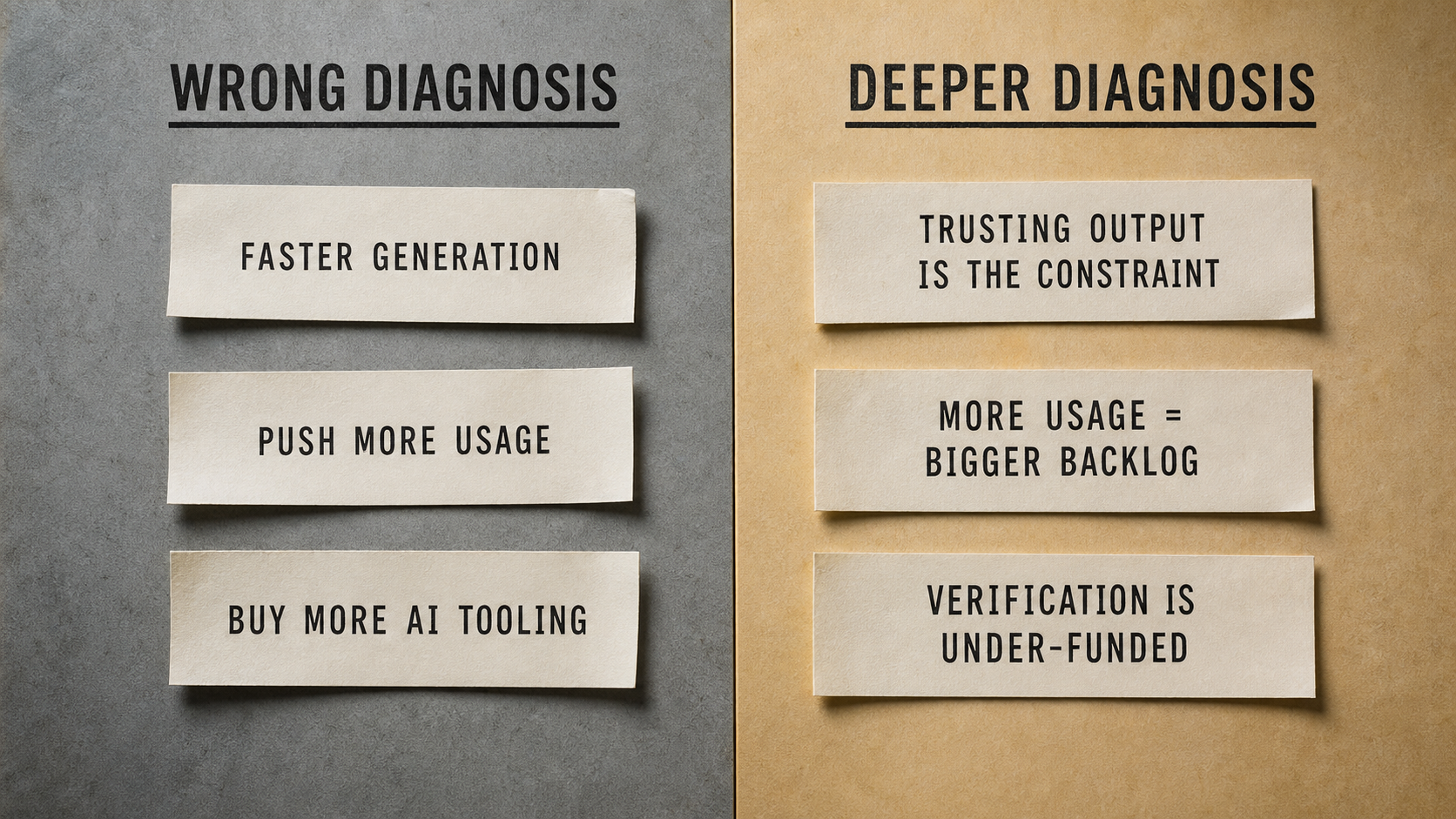
When the numbers stay flat, the diagnosis usually reaches for the generation side, because that is the side with the visible controls. The deeper read points the other way.
| Wrong diagnosis (generation side) | Deeper diagnosis (verification side) |
|---|---|
| "We need faster generation or a better model." | The model is not the constraint. The constraint is the capacity to trust what it produces. |
| "Adoption is too low, push more usage." | Usage is fine. More usage without more verification capacity makes the backlog worse, not better. |
| "Buy more AI tooling." | More generation capacity feeds the bottleneck. The under-funded activity is verification, not production. |
| "Quality is declining, so tighten standards." | Standards are not the gap. There is no owner, budget, or measurement for the verification work the standards assume. |
To define the terms precisely, because the argument depends on them: verification cost is review hours plus tooling plus rework, the full price of getting a change from generated to trusted. Verified-output throughput is the rate of changes that clear that bar, measured as deployable increments that carry their evidence-of-correctness, not as commits or merged pull requests. Measure it as deployable changes per week that meet a documented evidence standard, segmented by risk class, and price verification cost as reviewer hours plus tool and evaluation spend plus defect rework plus rollback or fix-forward effort. And evidence-of-correctness is not one thing. Process evidence (a QA plan was followed, a review happened) is cheaper and weaker. Behavioral, security, and production evidence (the change does what it claims, under load, without opening a hole) is more expensive and stronger. Conflating the two is how teams convince themselves they have verified something when they have only documented that they looked.
Hold those definitions and the evaporation stops being mysterious. The AI program raised generation throughput, which the activity dashboard happily reports. It did not raise verified-output throughput, because the verification system was never funded to keep pace. The gain is real and it is trapped, sitting in output that has been produced but not yet trusted enough to ship. Activity tells you people touched the tools. Performance tells you whether trusted change moved faster, and that number can stay flat, or fall, while every activity metric climbs.
The verification system is the product
If verification is now the scarce, expensive, value-bearing activity, then the verification system is the thing an AI-enabled org should be building, not the generation tooling everyone is buying. This is the part of the argument the speed story and the quality-decline story both stop short of. They treat verification as a tax to minimize. The economics say it is the asset to design.
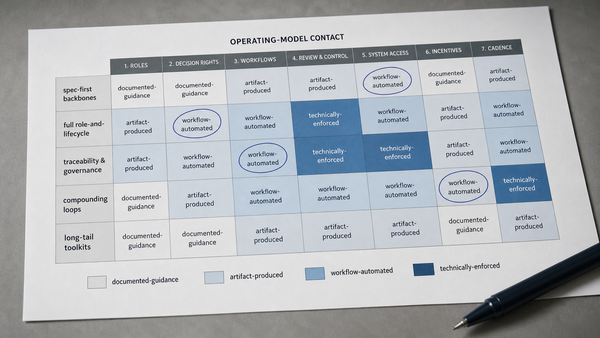
A verification system is not a tool purchase and it is not a single reviewer working harder. It is a designed sub-system of the operating model, and it shows up across three of the operating model's components. It lives in review and control standards (component 4): what evidence a change must carry before it is allowed to ship, and what kinds of evidence count for what kinds of risk. It lives in incentives and performance measures (component 6): whether the org rewards verified-output throughput or just raw generation, because a reviewer who is measured on their own feature output will always treat verifying someone else's as overhead. And it lives in workflows and handoffs (component 3): where verification happens in the flow, who owns each gate, and how evidence travels with a change rather than being reconstructed at the end.
Naming that sub-system is not the same as guaranteeing correct software, and it is important to be honest about the limit. Giving verification an owner, a budget, and an evidence trail makes it a governed system rather than an accident. It does not, by itself, ensure any particular change is correct. A well-funded verification system can still pass a bad change if its standards are weak or its evidence is shallow. What ownership, budget, and measurement buy is not correctness on demand. They buy the conditions under which the org can keep improving the odds of correctness instead of relitigating them per change. That distinction matters, because the failure mode in the other direction, believing a governance structure equals a guarantee, is how teams stop scrutinizing the evidence and start trusting the org chart.
The reframe, then, is not "verification matters." Everyone agrees verification matters. The reframe is that verification is the system worth building, owning, measuring, and funding as a first-class part of the operating model, on the same footing as the generation capability it exists to check. The org that builds the verification system is not slowing AI down. It is the only kind of org that can actually ship the output AI lets it produce.
One boundary to keep clear, so the argument does not overreach: the verification system is a component of the operating model, not the whole of it. It does not replace role redesign, governance, or delivery measurement; it sits alongside them as the trust-production layer. Collapsing the entire AI operating model into "build a verification system" would be its own mistake. The point is narrower and sharper. There is one operating-model component that AI made suddenly load-bearing and that most orgs have not built, and it is this one.
What a built verification system looks like, and what to read
Here is the thing I keep coming back to when judging whether an org has actually built this rather than talked about it: you can read it off the artifacts. A verification system that exists produces evidence you can pick up and inspect. QA plans that name what behavior a change had to demonstrate, not just that it was tested. Review patterns that show what a reviewer was checking for and why, not just an approval click. Decision logs that record what made a change trusted enough to ship. These are the evidence an AI quality gate checks, made legible, and they are the difference between a verification system that runs and an org that hopes review is happening somewhere.

The shift becomes concrete when you put the cost picture side by side. The same delivery work, priced before and after the verification system is built as a designed component.
| Before: verification absorbed | After: verification designed | |
|---|---|---|
| Where the cost sits | Reviewer evenings, senior rework, untracked overtime | A named line on the AI delivery budget |
| Who owns it | Nobody specific; falls to whoever last touched the change | A named owner for the verification system |
| What gets measured | AI adoption and usage | Verified-output throughput and escaped-defect-adjusted change |
| What the evidence is | A reconstructed argument after the fact | QA plans, review patterns, and decision logs that travel with the change |
| What the org can do | Hope review keeps up; absorb the backlog | Fund verification capacity against measured load |
Trusting AI generated code at scale is not a matter of trusting the model more. It is a matter of the org producing evidence it can inspect, on a cadence it can fund, owned by someone accountable for the trust the evidence is supposed to establish. Survey-grade self-report (people say they reviewed) is weaker than artifact-grade evidence (here is the review pattern, here is the decision log). One of the most reliable reads on whether an operating-model change is real is whether it left readable artifacts behind, which is the lens the Shift Harness Artifact Test applies: an operating-model change you cannot read from its artifacts probably did not happen. Verification evidence is exactly that kind of artifact, and the artifact test is a fair way to check whether the verification system was built or merely declared.
The four ways this goes wrong
Four failure modes turn up repeatedly when an org tries to act on this, and each one keeps the verification cost invisible instead of building the system to manage it.
The first is treating verification as a tool purchase. A reviewer agent, a static-analysis suite, or a better CI pipeline can lower the cost of specific checks, and they are worth having. But buying a tool is not the same as designing the system the tool plugs into. Without standards for what evidence a change must carry and an owner accountable for the gate, the tool just adds another check whose output nobody is responsible for acting on.
The second is absorbing the review cost as invisible overtime. When the verification load lands on reviewers' evenings and seniors' rework, the org gets to keep believing its AI program is free. The cost is being paid, in burnout and in attrition risk, but because it never reaches a budget line it never triggers the decision to fund verification capacity. The absorption is the problem, not a clever way around it.
The third is measuring AI adoption instead of verified-output throughput. An org that reports license utilization and prompt counts is measuring whether people touched the tools. It is not measuring whether trusted change moved faster. The metric that would expose the gap is the one that does not get built, so the gap stays comfortable and unexamined.
The fourth is assuming a better model removes the need to check the work. Each model generation does raise the floor on output quality, and that is real progress. It does not eliminate verification, because the cost was never only about catching the model's mistakes. It was about establishing, for an organization that has to stand behind a change, that the change is correct enough to ship. That accountability does not transfer to the model no matter how good the model gets.
Key takeaways
- AI lowered the cost of generating candidate output. It did not automatically lower the total cost of establishing enough trust to ship that output, and when output volume outpaces the capacity to check it, verification becomes the binding constraint on delivery.
- The productivity that does not show up in delivery metrics has usually relocated to verification, where it sits as a real cost with no owner, no budget line, and no measurement.
- Activity metrics (adoption, usage, prompts run) measure whether people touched the tools. Verified-output throughput measures whether trusted change actually moved faster. The two can diverge completely.
- The verification system is a designed sub-system of the operating model, spanning review and control standards, incentives and performance measures, and workflows and handoffs. Building it is the work; buying generation tooling is not.
- You can read whether the verification system was built off its artifacts: QA plans, review patterns, and decision logs that travel with a change. Artifact-grade evidence beats survey-grade self-report.
What this changes for your operating model
The next investment many AI-enabled delivery orgs with high AI usage but flat delivery numbers need to make is not another generation capability. It is the verification system: a named owner, a budget line, a measurement of verified-output throughput, and standards that decide what evidence a change must carry before it ships. Generation got cheap, which is exactly why the scarce, expensive, value-bearing activity is now the one nobody priced. The orgs whose AI gains finally show up in delivery numbers will be the ones that stopped treating trust-production as an after-the-fact review tax and started treating it as the part of the AI operating model worth building.
AI Transparency Notice: This article and its accompanying images were created with the assistance of generative AI. The author directed the content, contributed the underlying ideas and analysis, and reviewed the final publication.