The First AI Bottleneck Most Companies Hit Is Human Review Capacity
The dashboards look like a win: PRs merged up, cycle time down, adoption climbing. Then the same leaders say delivery feels flat and quality feels thinner. That gap is the subject.

Quick answer: for most delivery orgs, one of the first constraints AI exposes is not generation speed. It is the number of changes a senior engineer can verify properly in a day. AI can raise the inbound volume of pull requests faster than an org raises its verification capacity, and the gap shows up later as rework and escaped defects rather than on any adoption dashboard. The fix is an operating-model change to review standards, handoffs, and measurement, not more reviewers or a better review bot.
A pattern keeps coming up in conversations with engineering leaders who turned on AI coding assistants six to twelve months ago. The dashboards look like a win. Pull requests merged are up. Cycle time is down. Assistant adoption is high and still climbing. Every chart they have points the same direction.
Then the same leaders, in the same conversation, say some version of this: the numbers say we got faster, but I cannot point to anything that actually got better. Delivery feels flat. Quality feels thinner, though they would struggle to prove it. Something is off between what the charts report and what the org is shipping. The lagging signal is whatever the dashboards were never built to show.
That gap is what this piece is about. It is not a tooling complaint and not a productivity lament. It is a structural claim about where the first AI constraint actually lands, why it is hard to see, and what re-architecting around it requires. The short version: when generation speeds up and verification does not, the binding constraint moves to the one place nobody re-budgeted. Human attention on each change.
Review is not a speed problem, it is a capacity problem
When pull requests pile up, the instinct is to treat review as a throughput issue. The queue is too long, so the answer must be to clear the queue faster. That framing is where the diagnosis goes wrong, because it measures the wrong thing.
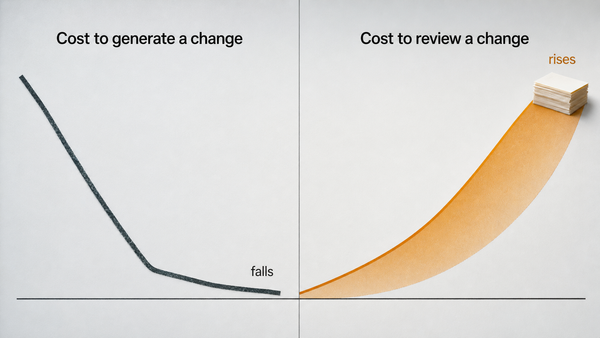
Review has two distinct properties that get collapsed into one. There is the speed of a review, how long a given reviewer takes to get through a single change. And there is the capacity of review, how many changes a reviewer can verify with real attention before the quality of that attention starts to degrade. These are not the same property, and AI tends to press on the second one more sharply than on the first. It can affect speed too, through larger diffs and unfamiliar generated code, but the capacity limit is the one that does not yield to working faster.
Consider what a senior engineer actually does when they review a change properly. They read the diff, but reading is the smallest part. They reconstruct the intent behind the change. They hold the surrounding system in working memory to judge whether the change fits or quietly breaks an assumption three files away. They check the edges the author probably did not think about. That work draws on a finite budget of focused attention, and that budget does not expand because the inbound queue grew.
Armin Ronacher, writing in February 2026 in The Final Bottleneck, observes the shift cleanly: writing code was historically slower than reviewing it, and AI-paced generation turns review into the bottleneck. He is right, and the observation matters. But the economics framing stops one step short of the operational consequence. It tells you review is now the costly act. It does not tell you that review cost is bounded by a per-reviewer attention ceiling that no amount of queue management moves.
Here is the mechanism that follows from that ceiling. When AI multiplies the volume of changes arriving for review, the queue often does not get slower in a way anyone notices, because reviewers compensate. They can throttle or batch the inbound, reject low-context changes, or escalate the riskiest ones. The most common compensation, and the least visible, is to spend less attention per change. The diff still gets a green check. The system model gets reconstructed less carefully, or not at all. The edges get a glance instead of a walk-through. Throughput holds steady on the surface while the depth of each review drops underneath it.
So "review is the new bottleneck" is true but incomplete as a diagnosis. The bottleneck is not the queue. The queue is the symptom you can see. The actual constraint is attention-per-change, and it stays hidden precisely because the people hitting it absorb it by lowering their own standard rather than by stopping.
The metric that moves is the wrong metric
The reason this constraint stays hidden is structural, not a matter of attentiveness. The metrics an org instruments when it rolls out AI are generation metrics, and the constraint lives on the verification side, which is usually not instrumented at all.
Walk the standard AI adoption dashboard. Pull requests merged. Cycle time from open to merge. Lines of code shipped. Assistant adoption rate across the team. Every one of those measures the production of changes. Each will move in the direction the org wants the moment AI lands, because AI is good at producing changes. The dashboard lights up green, and green reads as success.
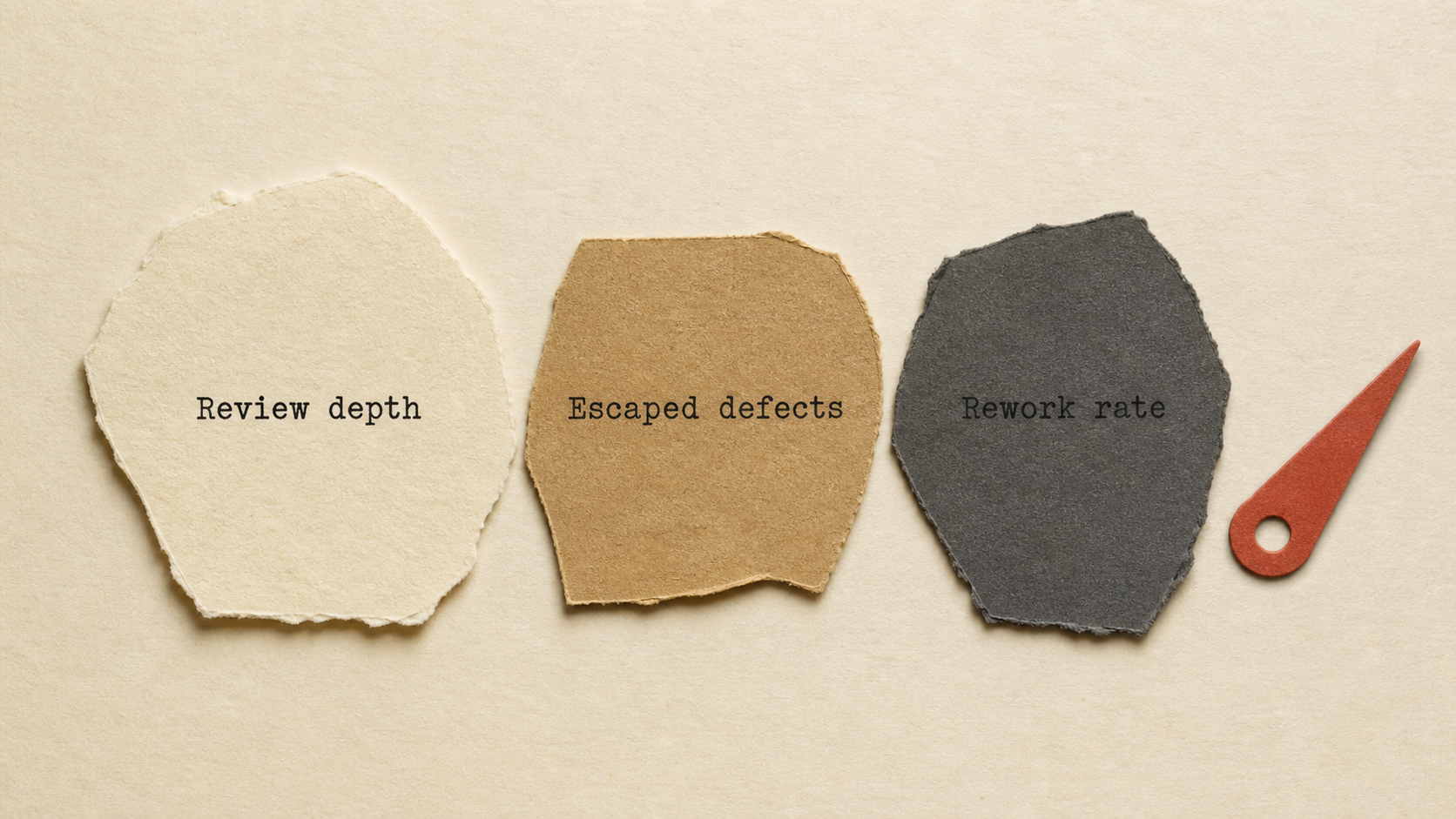
Now ask which number on that dashboard would move if review depth materially dropped. The honest answer in most orgs is: none of them. By review depth I mean a measurable proxy, not a vibe: risk-adjusted time on review, the number and type of issues a review surfaces, how much of the surrounding context a reviewer actually inspects, or the reviewer's own rated confidence. These are proxies, not a single clean instrument, which is part of the problem. Escaped-defect rate, defects attributable to a merged change within a defined window, is rarely tracked per change. Rework rate, the share of merged work reopened or rewritten inside a set window such as fourteen or thirty days, is rarely tracked at all. Review depth, the thing most likely degrading, usually has no instrument pointed at it. So the one variable that may be changing for the worse is the one variable nobody is watching.
This is what I mean by invisible quality debt, and the term needs an operational definition or it becomes a vague label for any later problem. Invisible quality debt is the quality risk created when review depth falls but defects, rework, and verification evidence are not measured until after merge or release. It is invisible not because it is subtle but because the measurement system was built for a world where generation was the slow part, so it points all its instruments at generation. When the slow part moves to verification, the instruments do not move with it.
Debt is the right word for two reasons. First, it accrues quietly while the surface metrics stay healthy, the way financial debt does not show up in this quarter's revenue. Second, it comes due later, and somewhere else than where it was taken on. A change that got a thin review can pass every pipeline check, merge clean, and surface as a production incident or a confusing rewrite two sprints downstream, by which point it reads as an unrelated bug rather than as the cost of a review that did not happen.
None of this is inevitable. An org that already instruments review depth, or that measures escaped defects and rework per change, will see the drop as it happens and can respond. The trap is specific to orgs whose measurement system still assumes generation is the constraint. In the orgs I have seen, that describes most of them one to two quarters into an AI rollout, which is around when the volume arrives.
Why hiring reviewers and buying a bot both miss
The two most common responses to an overflowing review queue are to add reviewers and to add a review bot. Both are reasonable on their face, and both can help at the margin. Neither resolves the constraint, because the constraint is not a shortage of review hours or review tooling. It is a mismatch between how verification is designed and the rate at which changes now arrive.
Look at the standard fixes against the actual cause:
| Symptom | Shallow fix | Why it falls short | Deeper cause |
|---|---|---|---|
| PR queue keeps growing | Hire more senior reviewers | Raises total review hours, and lower load per reviewer can help. But without tiering and explicit standards it tends to preserve the same flat allocation of attention rather than redirect it. | No tiering of changes by risk; every change is treated as equally deserving of full attention. |
| Reviews feel slow | Buy faster PR tooling | Speeds the mechanics of reviewing and can cut context-gathering cost, but it does not by itself resolve the judgment work. A reviewer who navigates diffs faster still spends the same scarce attention reconstructing intent and checking edges. | The slow part of review is judgment, not navigation, and tooling mostly optimizes navigation. |
| Quality is slipping | Add an AI review bot | May raise throughput on routine checks, but if the team treats a green check as proof of safety, it can reduce scrutiny on the harder changes the bot cannot judge. | Verification responsibility is undefined. Nobody specified what the bot verifies versus what a human must. |
| Defects rising post-merge | Tighten the PR template | Adds process friction without redirecting attention. A longer checklist on a thin review produces a thin review with a longer checklist. | What "good review" means was never re-specified for AI-paced volume. |
The pattern across the table is consistent. Each shallow fix treats a symptom as the problem, and each leaves the underlying design untouched. The org keeps running a verification system that was architected for human-paced generation, where the implicit rule "a human reviews every change with full attention" was affordable because the volume was bounded by how fast humans could write. AI removed that bound. The rule did not change with it.
This is the operational consequence the economics framing points at but does not finish. Saying review is now the expensive act tells you the price went up. It does not tell you the system pricing it was built for a different volume regime and needs redesigning, not just more capacity poured into the old shape.
David Poll, writing that code review is not about catching bugs, makes a complementary point worth holding alongside this one. His argument is that review and production validation answer different questions: review asks whether a change should be part of the product, while observability tells you what the system actually does once it runs, and judgment is the scarce thing across both. That widens the picture rather than competing with it. Production validation is one more verification surface that has to be designed into the system. It does not remove the human-attention ceiling on review; it sits next to it. Both are part of the same underlying gap.
Re-architecting verification: standards, handoffs, measurement
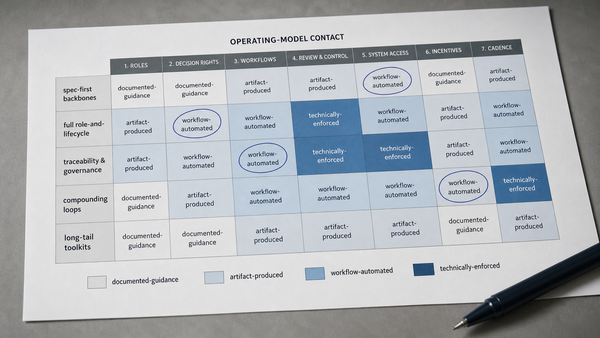
If the constraint is a verification system built for the wrong volume regime, the response is to redesign that system. This is the part that separates an operating-model change from a procurement decision. It is not only a staffing or a tooling problem. Staffing and tooling can both help, but they do not close the gap unless three things change together: the standards that govern review, the handoffs that decide who verifies what, and the measurement that tells you whether verification is actually happening.
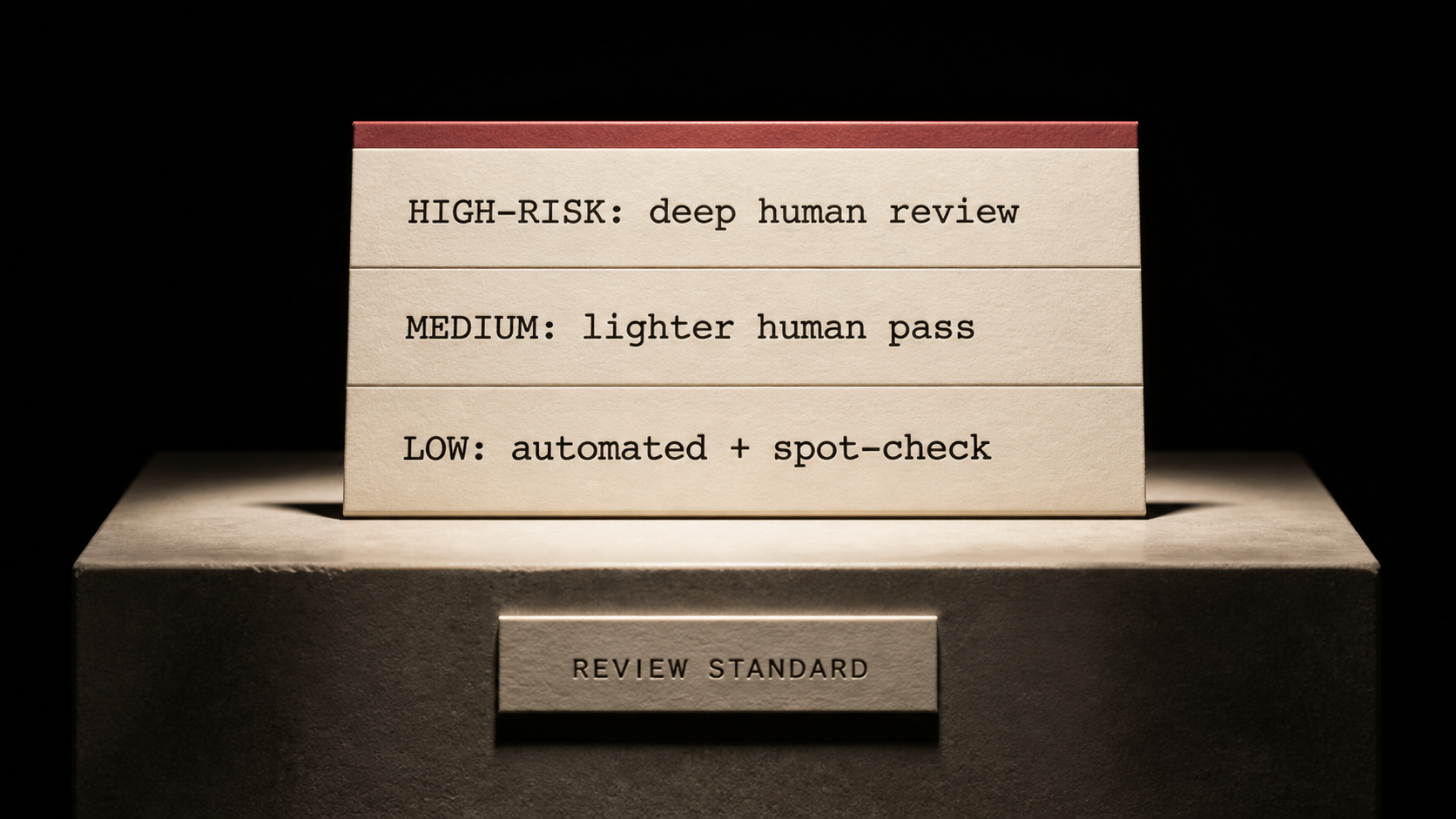
Start with review and control standards, because that is where most of the impact sits and where the old assumption is buried. The implicit standard in most orgs is uniform: every change gets a human review, every review is expected to be thorough. That standard was honest when volume was bounded. At AI-paced volume it quietly becomes a lie, because uniform thoroughness across a sharply larger queue is not affordable, so the thoroughness silently drops to whatever fits. The redesign is to make the standard explicit and tiered. Decide, deliberately, which classes of change get deep human review, which get a lighter human pass, and which can be verified primarily by automated checks with a human spot-check. A schema change to a payment path and a copy fix in a settings page do not warrant the same attention, and pretending they do is how the high-risk change ends up getting the same thin glance as the trivial one. Tiering is not lowering the bar. It is putting the scarce attention where the risk is, instead of spreading it evenly until it is thin everywhere.
Then workflows and handoffs, which is the question of what AI verifies versus what a human must. A review bot, a test suite, a static analyzer, a type checker, each of these covers a bounded class of automated checks rather than verifying the whole change, and the redesign is to specify their boundary explicitly rather than letting it form by accident. Designing those boundaries deliberately is its own discipline, and quality gates in AI development is how a team builds the automated layer of that handoff so a human's scarce attention is spent only where a machine check genuinely cannot reach. The failure mode when the boundary is implicit is the one in the table above: the human sees a green check and reads it as safety, the bot saw a class of problem it was never designed to catch, and the gap between them is where the defect lives. An effective handoff design states, per change tier, exactly what the automated layer is responsible for and what remains a human judgment that no green check discharges. The point is not to hand more to the machine. It is to make the division of verification labor a designed thing instead of an emergent accident.
Finally measurement and incentives, because the first two changes do not hold without the third. If review depth, escaped defects, and rework rate stay uninstrumented, the org cannot tell whether its new standards are being followed or whether they have quietly eroded again under the next volume increase. Reviewers also respond to what they are measured on. If the only visible signal is how fast a reviewer clears their queue, the system rewards the thin review and punishes the careful one, regardless of what the written standard says. Instrumenting verification depth and tying recognition to caught problems rather than to queue-clearing speed is what makes the redesigned standard durable instead of aspirational. The measurement is not overhead on top of the fix. It is the part that keeps the fix from decaying.
These three are one redesign, not three projects. Tiered standards without measurement erode. Measurement without an explicit handoff boundary instruments the wrong thing. Handoffs without standards have no tiers to assign work against. The reason more reviewers and a better bot both miss is that each is a single lever pulled on a system that needs all three moved together.
What this means for how your org is run
The general claim that AI moves the bottleneck rather than removing it has been made well elsewhere, including in the argument that the bottleneck moves with AI. What is worth being precise about is where it moves first. For most delivery orgs, the first place the constraint lands is human review capacity, and it lands there quietly, behind a dashboard that is still reporting the old constraint as solved.
That is an operating-model observation, not a tooling one. The review queue does not overflow because the team picked the wrong assistant or skimped on PR tooling. It overflows because the org changed the rate of generation without changing the system that verifies generation, and a verification system is made of standards, handoffs, and measurement, not of headcount and bots. Those three are operating-model components. Touching them is the work an AI rollout actually requires, and the work that buying a tool lets a leader feel they have done without doing.
So the practical question for a leader looking at a healthy-looking AI dashboard is not "are we adopting fast enough." It is "have we re-architected verification to match the new generation rate, or are we accruing quality risk that our instruments are not built to see." If the answer is the latter, more reviewers and a better bot will not change it, because they are answers to a question the org has not actually asked.
The redesign starts with a single move: stop treating review as a uniform act applied to every change, and start treating verification as a system designed against the risk of each change and measured for whether it is real. The per-reviewer attention ceiling is hard to scale linearly. Smaller changes, stronger specs and tests, clearer ownership, and risk routing can all stretch effective capacity, but none of them dissolve the underlying limit. What moves most is how deliberately the scarce attention behind it gets spent. Seeing review capacity as a designed operating-model component rather than a queue to clear is the lens Shift Harness applies to AI delivery work, and it is the difference between an AI rollout that compounds into capability and one that quietly trades visible speed for invisible debt.
AI Transparency Notice: This article and its accompanying images were created with the assistance of generative AI. The author directed the content, contributed the underlying ideas and analysis, and reviewed the final publication.