AI Makes Junior Developers Faster. It Can Also Freeze Their Learning Curve
The diff is clean, tests pass, and the work lands in half the time. Then a reviewer asks why the bug happened, and the answer does not come. Not because the junior is careless.

A junior developer on an AI-assisted team opens a pull request, the diff is clean, the tests pass, and the work lands in half the time it would have taken a year ago. Then a reviewer asks why the bug that the PR fixes happened in the first place, or why the structure is shaped the way it is, and the answer does not come. Not because the junior is careless. Because nobody on the team can point to the moment that understanding was supposed to form, and increasingly it does not. Your dashboard shows junior seats filling and output climbing. It does not show whether your senior bench is still growing underneath.
AI impact on junior developers is best understood as a divergence, not a decline: AI can make a junior's task output look stronger while reducing the measured learning that builds debugging and code-comprehension skill, when the team lets juniors accept generated work without explaining it, tracing it, or defending it. Whether that reaches further, into architecture judgment and the eventual conversion to senior, is the load-bearing hypothesis to watch and measure, not a result the current evidence settles. This is a delivery-system design problem, fixable at the operating layer, not a discipline problem the junior owns.
The skill risk is real, and the strongest evidence for it is mechanism-grade rather than panic-grade. What almost no one is saying is where the fix lives. The lane the public conversation has settled into puts the cause and the cure inside the junior: skills decay, so the junior should practice more deliberately, prompt more carefully, lean on the tool less. That framing treats capability as a trait the individual carries. It is not. A junior's learning curve is an output of the delivery system the junior works inside, and a system output is something an engineering org can redesign on purpose.
Friction was not an obstacle to learning. It was the mechanism of learning
For most of software's history, the path from junior to senior ran through a specific kind of struggle, and the struggle was load-bearing. Reading a stack trace you did not understand, forming a hypothesis about the cause, testing it, being wrong, and trying again is how debugging intuition gets built. The intuition is the residue of having traced enough failures to recognize the shape of a new one, and a tool preserves it only when it still requires the junior to perform or verify that reasoning step. The same is true one layer up. Choosing a structure, shipping it, and living with the consequences when the structure makes the next change painful is how architecture judgment forms. And reading unfamiliar code well enough to extend it, the code someone else wrote that you did not, is how an engineer builds the muscle for reasoning about systems they did not design.
None of that was pleasant, and that is the point most of the productivity conversation misses. The friction was not in the way of the learning. The friction was the learning. The error you could not immediately parse forced the trace. The structure you had to choose without certainty forced the judgment. The codebase you had to read because no one would explain it forced the comprehension.
AI changes what happens at each of those moments, and it changes it in a precise way. An AI coding tool can let the trace be skipped when the junior accepts the proposed cause without independently checking it. It can suggest a structure good enough to ship, so the judgment goes unexercised if the junior never has to defend the choice. It can write into the unfamiliar codebase so fluently that the unfamiliar code never has to be understood, only accepted. The output that lands looks like the output a more experienced engineer would have produced. The cognitive work that used to produce a more experienced engineer did not happen.
The conditional matters, and it is where the careful version of this argument lives. AI does not remove the friction by existing. It removes the friction when the team lets a junior accept the generated trace without running it, ship the suggested structure without defending it, and merge into code they never read. A junior who uses the same tool to generate a candidate cause and then verifies it against the actual failure is doing the trace. The friction moved, but it did not vanish. The capability still forms. What suppresses the capability is delegation deep enough that the cognitive step is skipped, not the presence of the tool.
Output climbs early. Capability climbs late, or not at all
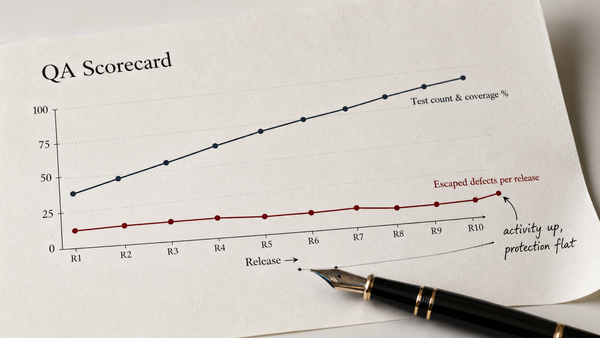
Two trajectories come apart under heavy delegation, and the gap between them is the whole problem. Output can rise on some tasks and workflows, because the tool is good at producing shippable work, though the productivity effect is heterogeneous: controlled studies show both speedups and slowdowns, and experienced engineers on mature codebases have measured slower, not faster, with early AI tools. The size and direction of the lift varies by task, by user, by codebase, and by how the work is delegated. Capability, the set of things the junior can do unaided, rises slowly and late, because the moments that used to build it are being absorbed. On a velocity chart these two lines look like one line, since the only thing the chart measures is output. The capability line is not on the chart at all.
The best available evidence that this divergence is real, rather than nostalgia about how things used to be harder, is bounded and experimental, and it deserves to be cited as exactly that. Anthropic research on AI assistance and coding skill formation (Shen and Tamkin, 2026) ran a controlled study of 52 participants learning to work with an unfamiliar library, comparing those given AI access against those given none. The AI-access group scored markedly lower on a comprehension quiz, with the largest gap on debugging, and showed no statistically significant speed gain for the trade. Within that AI group, the low-scoring interaction clusters, the ones associated with accepting generated work rather than engaging with it, were the ones with the heaviest delegation and the weakest quiz scores. Those clusters were qualitative patterns observed inside the AI arm, not randomized causal subgroups, so the right reading is association, not a causal subgroup estimate. That is a finding about how skills form on a controlled task under specific conditions. It is mechanism-grade support for the divergence. It is not a verdict that your senior bench is eroding across your real org, and presenting it as one would be the same overreach the layoff lane traffics in. It tells you the mechanism is plausible and measurable. It does not tell you the size of the effect in your delivery system.
The honest way to hold a claim like this is to make it falsifiable, and this one is. If juniors who lean heavily on AI form debugging intuition and architecture judgment at the same rate as juniors who worked through the friction themselves, the argument is wrong and you should ignore it. The prediction is the opposite: for juniors who lean on AI for most of the cognitive work rather than to check their own, a measurable gap opens between their output and their unaided capability, scored against a fixed instrument on a controlled task and compared to a friction-trained cohort, and the gap widens across early-career years rather than closing. The reason the gap is invisible is not that it is hard to find. It is that almost no delivery system measures the second thing.
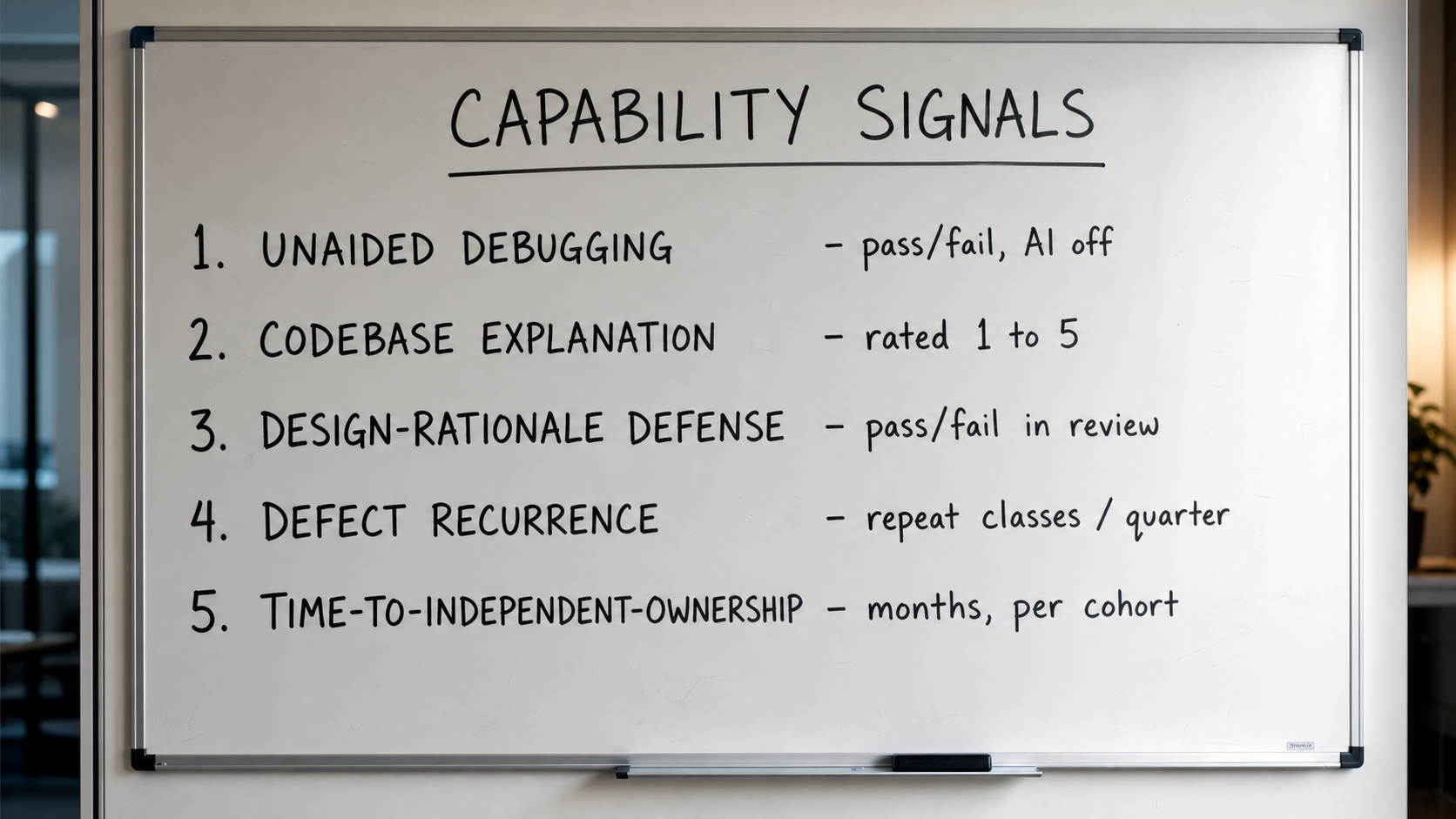
You can measure it, and naming the measures is what turns a worry into something an engineering org can act on. The capability side of the divergence shows up in things you can actually score:
| Capability signal | What it measures | How to score it |
|---|---|---|
| Unaided debugging success | Can the junior find a real bug with the AI assistant turned off | Pass / fail on a timed bug-hunt in unfamiliar code |
| Codebase explanation quality | Can the junior explain how a part of the system works that they did not write | Rated walkthrough, 1 to 5 with anchored levels, by a calibrated senior, on a complexity-controlled code area |
| Design-rationale defense | Can the junior defend why their structure is shaped the way it is, and name the alternative they rejected | Pass / fail in review |
| Post-review defect recurrence | Do the same classes of defect keep coming back after review | Count of repeat defect classes per quarter |
| Time-to-independent-ownership | How long until the junior can own a component end to end without a senior shadowing | Months, tracked per cohort |
Some of these run on lightweight review rituals you already have; others need a rubric, cohort tracking, and a calibrated evaluator before the number means anything. What they share is that none of them requires a new AI platform. They require deciding that the second trajectory is worth watching, which is a management decision, not a platform-procurement one.
Picture the review meeting where two of your juniors get compared
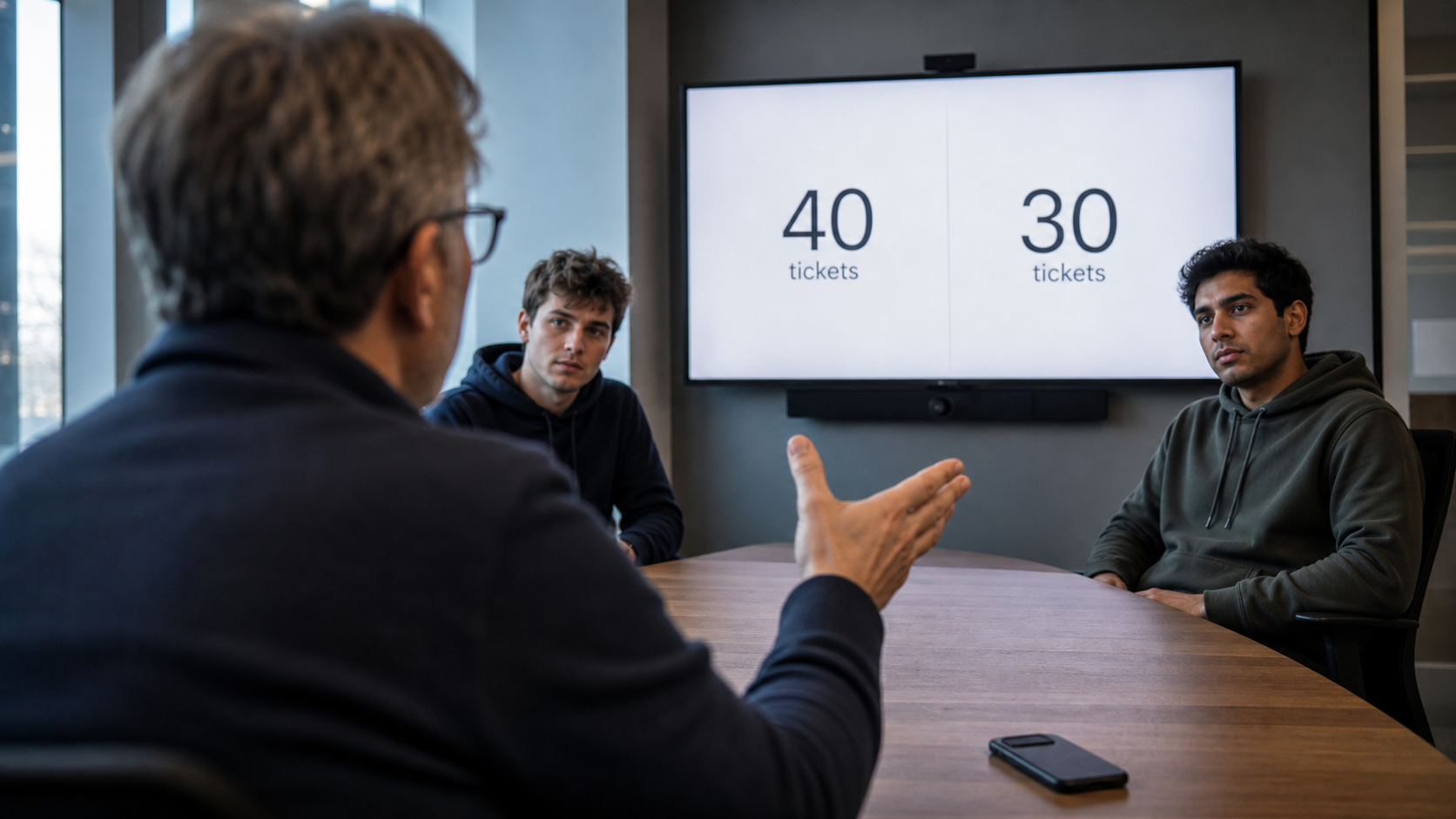
Sit in the promotion conversation for a moment, because that is where the divergence stops being abstract. One junior closed forty tickets last quarter and the other closed thirty, and on every dashboard the first one is winning. Then a senior who has paired with both says the quieter thing: the one who closed thirty can be handed an ambiguous problem in a part of the codebase nobody owns and will come back with a working answer and a reason, and the one who closed forty cannot do that yet without the assistant in the loop. The output metric and the capability the org actually needs from a senior have pointed in opposite directions, and the system has been rewarding the wrong one.
The reason the org could not see this coming is structural, not a failure of attention. The metric that went up, pull requests merged and tickets closed, is on the dashboard because it has always been easy to count. The metric that went flat, capability formed, is on no dashboard because no one ever had to count it. The teaching used to happen as a byproduct of the work, so the system never needed an instrument for it. The byproduct is what AI absorbed first.
The symptoms are recognizable once you know to look for them, and they tend to arrive together. Juniors produce more output while seniors spend more of their week cleaning that output up, which is a commonly reported failure mode in AI-enabled delivery and a warning sign that activity may be rising faster than capability. Juniors cannot reliably debug the AI-generated code that carries their name, because they did not form the hypothesis the fix encodes. Juniors cannot explain the architectural choices in their own PRs, because the choice was suggested rather than made. And the promotion-to-senior decision gets harder every cycle, because output now looks senior long before reasoning does, and the dashboard cannot tell the difference.
The root cause underneath all of it is one most delivery systems share: the system measures activity, not the formation of capability. That is the same decoupling that shows up across AI rollouts, where adoption metrics climb and the metrics leadership actually answers for stay flat. Here it has a sharper edge, because the activity being measured is not just failing to prove capability. The way the activity gets produced is quietly preventing the capability from forming.
The fix is a redesign of one operating-model component, not a willpower campaign
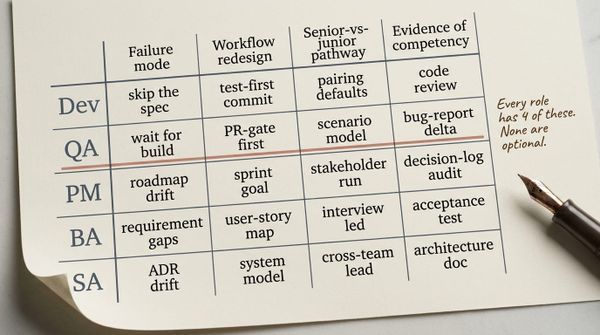
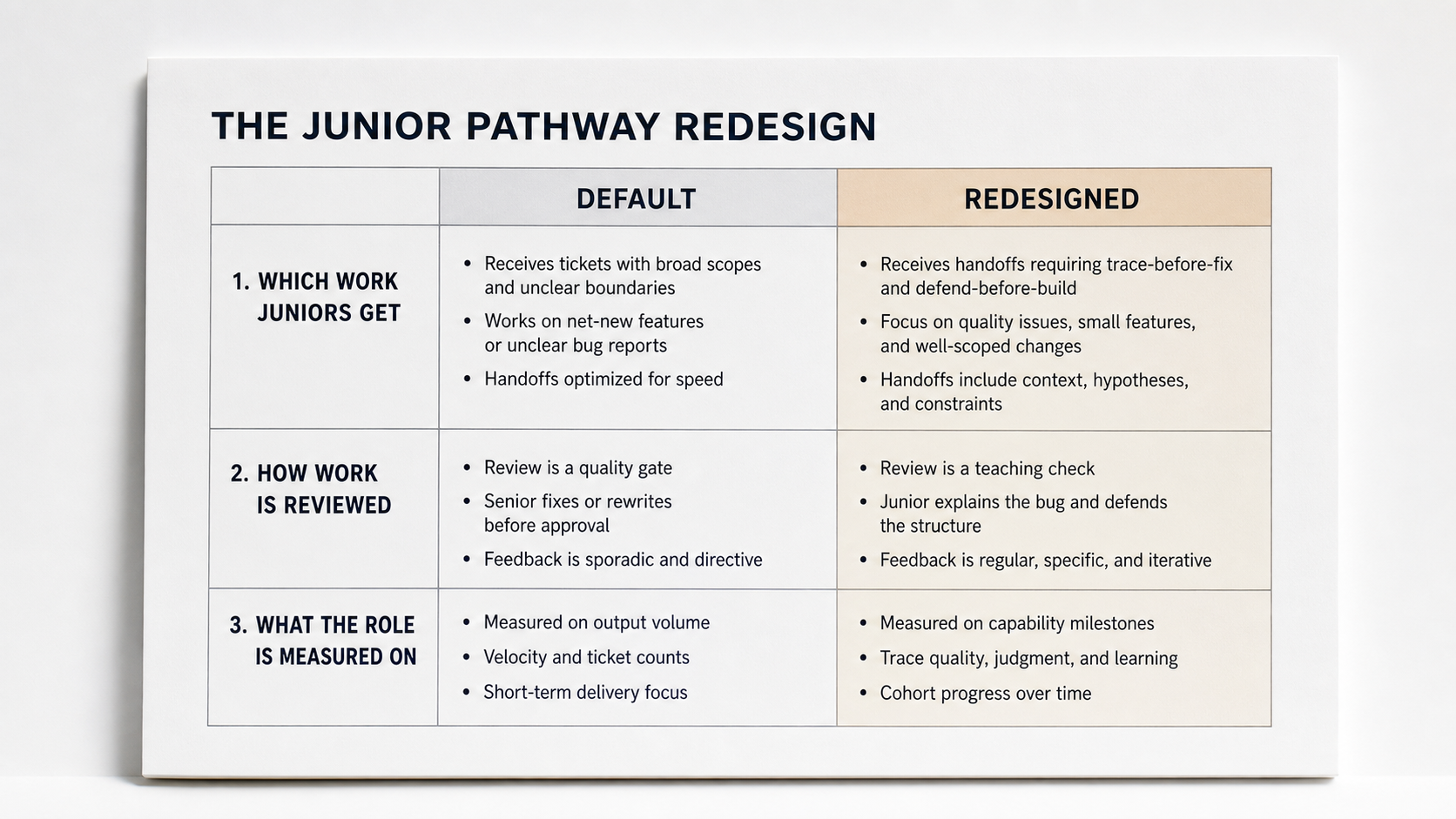
The junior pathway is a component of your delivery operating model, in the same family as the rest of role-level redesign, and it can be engineered the way any other component can. It is not the whole operating model, and treating a single role's redesign as if it were the entire system is its own mistake. But the junior pathway is a real surface, and three parts of it carry the load. Which work juniors get. How that work is reviewed. What the role is measured on. Redesign touches all three.
The first lever is the work itself, and the move is to put the friction back on purpose where it teaches. That does not mean banning the tool. It means designing handoffs where a junior has to trace a failure to its cause before the assistant is allowed to propose the fix, and has to choose and defend a structure before generating the code that implements it. The friction is reintroduced as a deliberate step in the workflow, not as a hardship, and the assistant stays in the loop everywhere it does not short-circuit the learning. A junior who states the cause, then uses the tool to check the hypothesis, has done the trace and kept the speed.
The second lever is review, and the shift is to treat review as a teaching mechanism, not only a quality gate. A review that asks "does this pass" lets AI-generated work through on the strength of the output. A review that also asks the junior to explain why the bug happened and defend why the structure is shaped the way it is turns every merge into a capability check. This is adjacent to the case for review-layer friction as a source of quality, but the target here is one layer earlier: not the defect that review catches, the understanding that review forces to form.
The third lever is measurement, and it is the one that makes the other two stick. If a junior is measured on output volume, no amount of redesigned work or teaching review will hold, because the incentive points the other way and incentives win. The fix is to put capability milestones next to the output count: the unaided-debugging signal, the design-defense in review, the time-to-independent-ownership, tracked per cohort and treated as the real promotion criteria. Measurement shapes incentives strongly, so an output-only promotion bar biases junior behavior toward visible throughput, and right now most junior roles are pointed at the trajectory that was already going to take care of itself.
| Operating-model lever | Default (output-optimized) | Redesigned (capability-optimized) |
|---|---|---|
| Which work juniors get | Whatever ships fastest with the assistant | Handoffs that require trace-before-fix and defend-before-build |
| How junior work is reviewed | Gate: does it pass | Teaching check: explain the bug, defend the structure |
| What the role is measured on | Tickets closed, PRs merged | Capability milestones tracked per cohort |
The four ways this redesign goes wrong
The first mistake is banning AI for juniors, which fails on every axis at once. It removes the output, removes the visibility you would get from the work, and can drive the usage onto personal accounts where you cannot see it, absent enforceable governance and a sanctioned alternative, and still does not rebuild the friction, because the friction was never about the tool's absence. It was about the cognitive step being taken. A ban skips the step in a different direction.
The second mistake is "just mentor harder" without changing what juniors are measured on. More mentoring against an unchanged output incentive is more effort poured into a system designed to defeat it. The mentor says understand the structure; the dashboard says close more tickets; the dashboard wins, because the dashboard is what the promotion runs on.
The third mistake is assuming the gap will self-correct, that juniors will pick up the deep capability later when they need it. They might, but later is more expensive and less likely, because the early-career window is when debugging intuition and architecture judgment form most cheaply, and it is exactly the window heavy delegation is most tempting and least visible.
The fourth mistake is the one the public conversation keeps making: treating this as an individual-discipline problem when it is a system-design problem. Telling juniors to practice more deliberately is advice for the junior. It is not a redesign of the pathway, and it leaves the org's incentives, handoffs, and review standards exactly where they were, which is to say pointed at the wrong trajectory.
What this costs you if the pathway stays unmanaged
- AI can make a junior's output look more mature while suppressing the formation of debugging intuition, architecture judgment, and unfamiliar-code comprehension, but only when the team lets juniors accept generated work without explaining it, tracing it, or defending it. The presence of the tool is not the cause. The depth of delegation is.
- The skill risk is real and the evidence is mechanism-grade, not field-grade. Anthropic research on AI assistance and coding skill formation supports the divergence on controlled tasks; it does not measure the effect in your org. You measure that yourself, with unaided-debugging success, codebase-explanation quality, design-rationale defense, defect recurrence, and time-to-independent-ownership.
- The org cannot see the problem because output is on every dashboard and capability formation is on none. The fix starts with deciding the second trajectory is worth measuring.
- The junior pathway is one operating-model component, and it is redesigned across three levers: the work juniors get, how that work is reviewed, and what the role is measured on. It is not the whole operating model, and it is not a willpower campaign aimed at the junior.
The junior learning curve was never a property of the junior. It was always an output of the system the junior worked inside, and AI did not change that. It changed what the system rewards by default: visible output can rise while capability formation becomes easier to miss, and where the work is delegated deeply enough to skip the reasoning, harder to form at all. The org-level size of that effect is the thing to measure, not assume, and AI left the redesign to whoever notices. The org that redesigns the junior pathway as a deliberate component improves the odds that it keeps developing the senior bench it will need in a few years. The org that does not is filling its junior seats while quietly draining the bench underneath them, and the bill comes due the first time a senior leaves and no one underneath can hold the architecture.
AI Transparency Notice: This article and its accompanying images were created with the assistance of generative AI. The author directed the content, contributed the underlying ideas and analysis, and reviewed the final publication.