AI Doesn't Replace QA. It Forces QA to Evolve Faster Than Any Other Role
Test count is up, the suite runs in minutes, coverage climbed after the AI generators went in. And escaped defects have not moved, or drifted the wrong way. More tests, same protection.
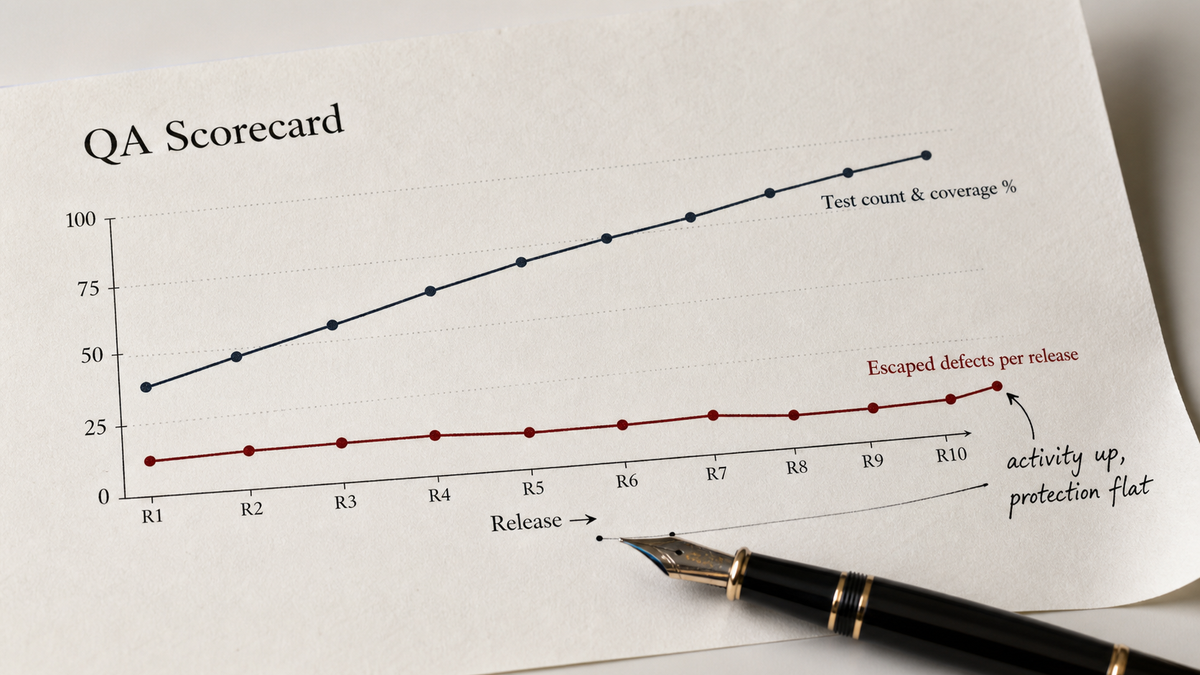
The dashboard looks like a win. Test count is up and to the right. The automated suite runs in minutes. Coverage numbers climbed after the AI test generators went in. And yet the numbers leadership actually cares about have not moved, or have quietly drifted the wrong way: escaped defects per release, reopens, the bugs customers find before the team does. Read those the same way release over release, and they are flat or worse while the activity numbers climb.
This is the pattern I keep seeing in delivery orgs that turned AI loose on their codebase and then turned it loose on their testing. More tests, same protection. Sometimes less. The instinct is to read this as an adoption problem or a tooling problem, so the team buys a better AI test generator and waits for the numbers to turn. A better generator can sharpen what gets written. What it does not change, on its own, is what the suite was built to find, and that is the gap the numbers are reporting. The problem was never the volume of tests. AI changed the target out from under the QA function before anyone updated the role.
So this is not an article about which AI testing tool to buy. It is an argument about what the QA role is becoming, and why, of all the delivery roles AI touches, QA is the one whose center of gravity moves the most. The short version: test execution shrinks, and systems-validation expands. The longer version is the rest of this piece.
QA is the role AI destabilizes most, and the reason is structural
Every delivery role assumed a human-paced supply of work. AI changes the pace for all of them. A developer who used to write a function now reviews three the agent drafted. A product manager who used to write one spec now triages five. That is real, and it reshapes those roles. But the pace change is a quantity change, and quantity changes are the kind of disruption a role can absorb by reorganizing how the same work gets done.
QA carries a second assumption that the other roles do not, and AI breaks that one too. QA was built around a model of where defects come from and what they look like. The defects a human writes have shapes: the off-by-one, the missed branch, the typo in the config, the edge case nobody thought about at 5pm on a Friday. Decades of test design, from boundary-value analysis to equivalence partitioning to the humble regression suite, are calibrated against those human-shaped failures. That calibration is the QA function's quiet inheritance, and most of it is invisible because it works.
AI-assisted code is not free of human-shaped defects, and QA still has to catch those. But it adds failure modes that the inherited calibration does not target well. Code that is syntactically clean, passes its own narrow assertions, and is confidently wrong about the requirement it was supposed to implement. Integrations wired plausibly but incorrectly. Assumptions baked in silently because the model filled a gap the prompt left open. Behavior that drifts when a prompt or a model version changes upstream. None of this is exotic. Research on AI-generated code has started to document distinct quality and security profiles for it, with security-relevant weaknesses appearing at rates that differ from human baselines, which is the empirical version of a claim every working QA engineer can feel: the bugs look different now. The point is not that conventional tests catch nothing. Many of them still catch plenty. The point is that a suite tuned for one defect distribution will under-cover a different one, and running it faster does not fix the coverage gap. It just reaches the wrong conclusion sooner.
That is why QA is the role that has to move the most. The other roles got a faster version of the same job. QA got a faster version of a job whose underlying target quietly changed.
The trap is that AI automates the part of QA that was already cheap
Here is the move that feels like progress and is not. A team adopts AI to write its tests, runs them in an autonomous pipeline, and watches the suite go green faster than it ever has. The "manual to autonomous" story the tooling market sells is real on its own terms. The tests do get written, and they do run. But in most software delivery, test writing and test running were never the scarce part of quality assurance. Execution infrastructure can get expensive in some contexts, regulated systems, embedded and hardware, broad device and browser matrices. The scarce input was never the typing or the running. It was the deciding. That commodity part is the part that scaled with effort and that automation has been eating in increments since the first Selenium script.
The expensive part is test design. Deciding what "correct" even means for a feature whose behavior is probabilistic. Choosing which of a thousand possible behaviors are worth asserting against. Writing the oracle, the thing that knows a right answer from a plausible one. Judging which failures matter and which are noise. That work is judgment, and it is the work AI is least able to own. AI can assist with it, draft candidate test cases, suggest edge conditions, even propose an oracle. What it cannot do is hold accountability for whether the oracle is right, for whether the risk judgment was sound, for whether the thing the team decided not to test was actually safe to skip. Accountability for correctness does not delegate.
So a QA function that hands the cheap part to AI and stops there has not transformed. It has automated the floor and left the ceiling unbuilt. The green suite is now faster at confirming the wrong things. This is the AI-activity-versus-AI-performance gap in its purest form: every activity metric improves, every performance metric stays flat, and the dashboard tells a success story the customers do not corroborate. A team in this state does not have a tooling problem. It has a role-design problem wearing a tooling problem's clothes.
What the role becomes is a systems-validation discipline
If the cheap part shrinks, something has to expand, and the thing that expands is the part that was always the point. I would call the destination a systems-validation discipline, and the distinction from traditional test execution is the whole argument of this piece. Test execution asks: does this code pass the checks we wrote? Systems-validation asks a harder set of questions: are these the right checks, does the behavior match the intent, and does the system around the model hold up when the model does something we did not anticipate?
Concretely, the work moving to the center of the QA role looks like this. Owning the definition of correct: turning a fuzzy product intent into an explicit, testable behavioral contract that the rest of the team can build against. Designing evaluation for non-deterministic output, the eval sets and behavioral checks that tell you whether an AI feature is getting better or worse release over release, which is a different craft from asserting a deterministic return value. Validating the system, not just the unit: the data flowing in, the integrations the model touches, the failure modes when an upstream dependency returns garbage or the model hallucinates a tool call. And owning the logic of the quality gates themselves, the rules that decide what is allowed to ship, which is where this systems-validation work lands operationally rather than living in a separate document.
The reason this is harder, and not just relabeled, is that it pulls QA upstream into work the role used to receive rather than originate. Defining the behavioral contract means sitting with the ambiguity before the code exists, not validating against a spec someone else froze. Designing an eval means deciding, in advance and on the record, what acceptable behavior is for an output that is not guaranteed to be identical twice, then defending that decision when a release looks worse on the new eval and someone wants to loosen it. Validating the system means understanding the surrounding architecture well enough to predict where it bends under a model that misbehaves, which is closer to what an architect or a senior engineer does than to what test execution ever asked for. This is why the role does not just change tools, it changes seniority. The questions QA now owns are the ones the rest of the team was implicitly leaning on someone to answer, and AI made it expensive to leave them unanswered because it generates plausible-looking work faster than a loose process can catch the parts that are wrong.

None of this is the test execution shrinking to zero. Regression suites still matter, and someone still has to keep them honest. The shift is in where the QA engineer's scarce attention goes. Less of it spent producing and babysitting checks, more of it spent deciding what to check and validating that the system behaves, which is a more senior kind of work than the role was historically scoped to do. This is the same direction a serious QA maturity model points: the advanced levels are defined by validating behavior and systems, not by the volume of tests produced. AI did not invent that destination. It just made the journey non-optional and compressed the timeline.
This is an operating-model change, which is why a tooling purchase will not deliver it
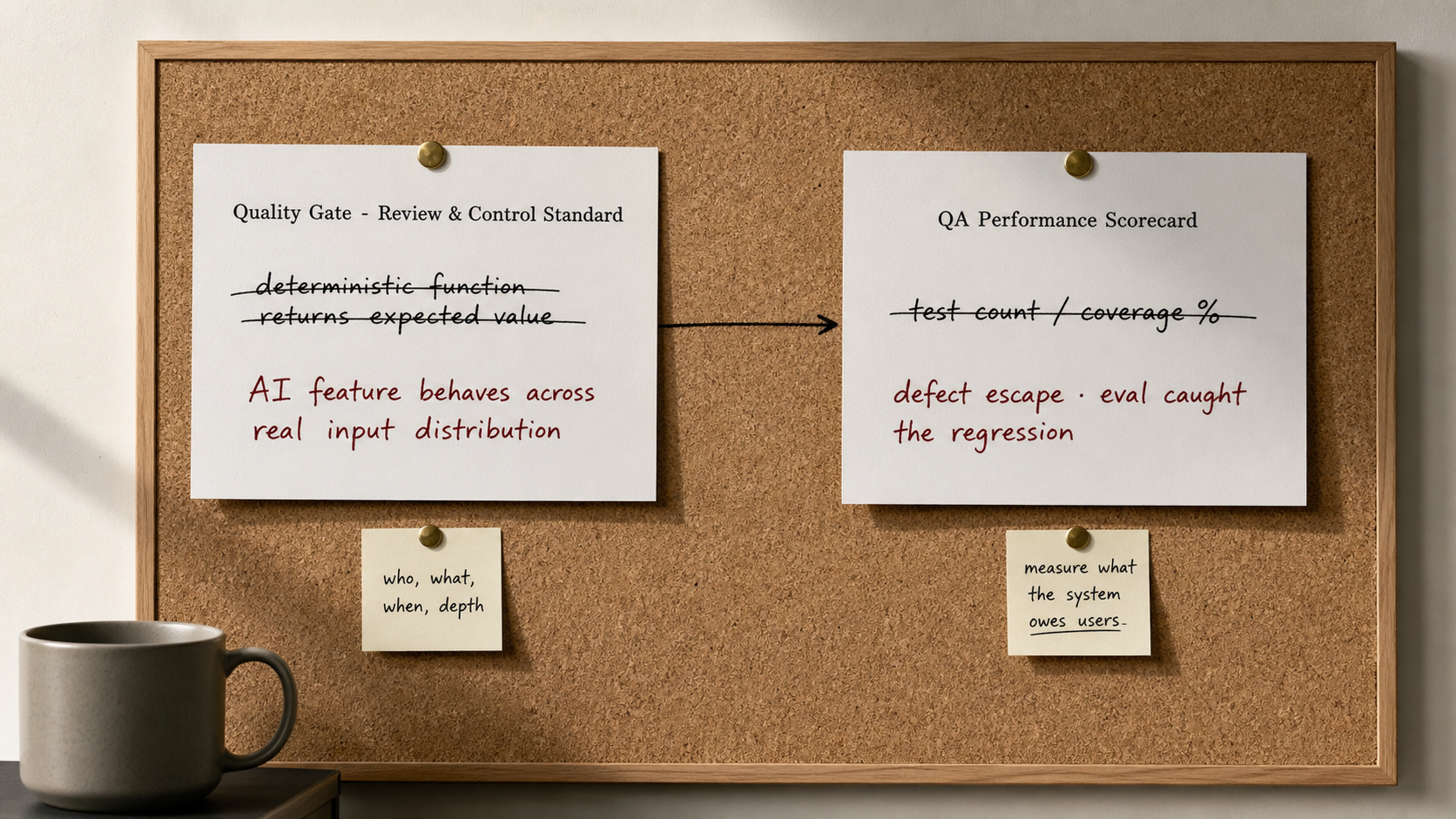
Notice what has to change for any of this to land, because it is not a list of features. The first thing that has to change is the review and control standard: what gets validated, by whom, and at what depth. A control standard built for "did the deterministic function return the expected value" does not cover "does this AI feature behave acceptably across the distribution of inputs real users will throw at it." If the gate that decides what ships still encodes the old standard, the systems-validation work has nowhere to attach, and it withers into a side project no release actually waits on.
The second thing that has to change is what QA is measured and rewarded for. If a QA function is still measured by test count or coverage percentage, it will rationally optimize test count and coverage percentage, which is exactly the cheap part AI now does for free. Optimizing the commodity is what the incentive points at. You cannot ask a function to move its center of gravity toward systems-validation while paying it for execution volume. The performance measure has to follow the work: defect escape, the cost and accuracy of the behavioral contract, whether the eval set caught the regression before the customer did. Until the scorecard changes, the role evolution stalls no matter how capable the individual engineers are, because the system around them keeps pulling them back to the metric on the wall.
I am naming two components here, the review-and-control standard and the performance measures, because they are the two that this specific shift touches hardest. They are not the whole operating model. A full operating-model redesign also moves decision rights, workflows, access, and cadence, and a serious QA transformation eventually touches those too. But a leader can start by asking two questions and learn most of what they need to know: what does our quality gate actually verify, and what do we pay our QA function to be good at. If the answers are "deterministic checks" and "test volume," the role has not evolved yet, whatever the tooling slide says.
Where teams go wrong
The failure modes here are consistent enough to name.
Mistaking AI-generated test volume for protection. The suite is bigger and greener, so the assumption is that the product is safer. It is only safer if the new tests assert the things that actually matter, and AI is happy to generate a thousand tests for behavior nobody is at risk on.
Calling "QA learns to prompt better" a role transformation. Teaching the QA function to drive the AI tools more efficiently is useful, but it is a tooling upgrade, not a redesign. It makes the cheap part cheaper. It does not move the role toward owning correctness.
Measuring coverage while defect escape rises. Coverage is a comfortable number because it goes up when you add tests that touch new code. It is also one of the easiest metrics to satisfy without improving protection. When coverage climbs and escaped defects climb with it, the metric is lying, and a QA function rewarded on it will keep producing the comfortable number.
Treating systems-validation as just smarter test writing. The temptation is to fold all of this back into "write better tests." But validating a behavioral contract, designing an eval for non-deterministic output, and stress-testing the system around a model are different disciplines from authoring assertions, and collapsing them back into test authoring is how a redesign quietly turns into a tooling memo.
The takeaway, for the leader holding the scorecard
A few things are worth holding onto. AI does not replace QA, but it does change the QA role more than it changes most of the roles around it, because it changed what the function was built to find, not just how fast it has to work. The cheap part of QA, writing and running tests, is the part AI automates well, and a function that stops there has automated the floor. The expensive part, deciding what correct means and validating the system around a probabilistic model, is the part that becomes the role. Test execution shrinks, and systems-validation expands.
The decision that determines whether this evolution actually happens is not a procurement decision. It is whether the quality gate and the QA scorecard get rewritten to point at validated behavior instead of executed tests. A QA lead can install a lot of this, and the companion to this piece walks through how the role redesign and the gates work in practice. But the lead cannot change what the function is measured on from below. That part sits with whoever owns the operating model. Fund AI test tooling and leave the quality gate and the QA scorecard exactly where they were, and the common result is the same one this piece opened on: a faster way to confirm the wrong things, and a dashboard that keeps telling you a success story your customers are not reading.
AI Transparency Notice: This article and its accompanying images were created with the assistance of generative AI. The author directed the content, contributed the underlying ideas and analysis, and reviewed the final publication.