Why AI Coding Without Memory Doesn't Compound
Every AI coding session feels productive. Then the quarter ends, delivery is flat, and the board asks what the per-seat spend bought. Both facts are true at once, and the gap between them is the cost you keep re-buying.
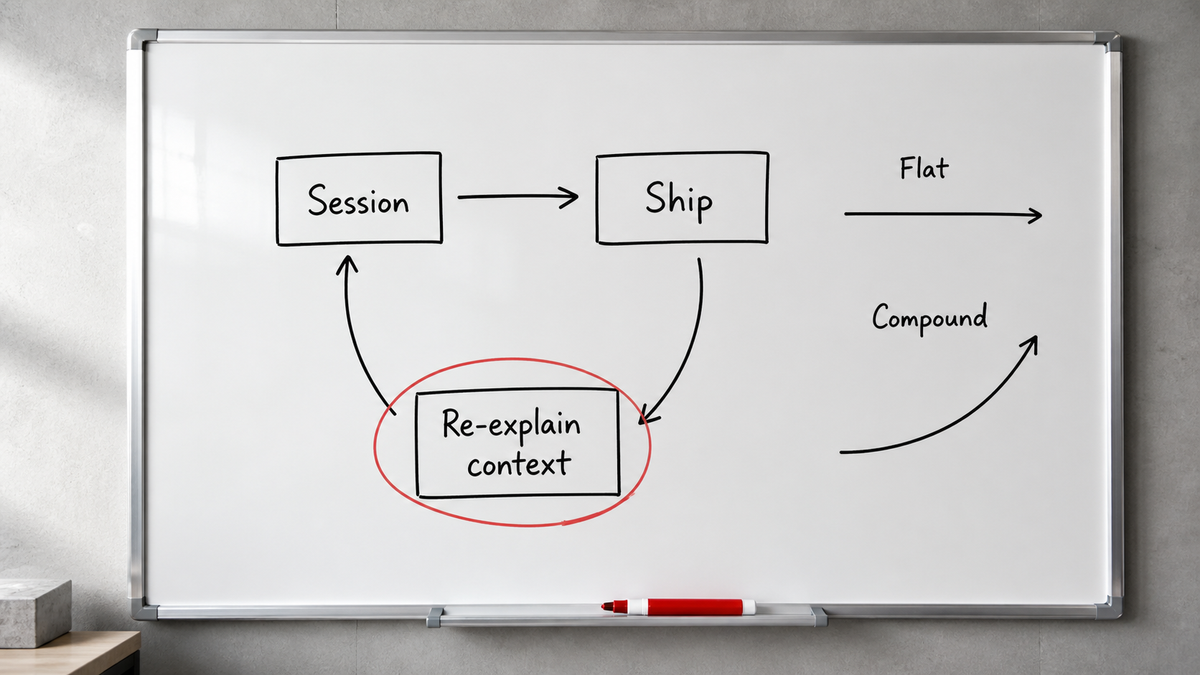
Every session feels productive. The agent writes the function, fixes the test, ships the change, and the developer closes the laptop having shipped more than they would have alone. Then the quarter ends, the delivery numbers are flat, and the board asks what the per-seat spend bought. The two observations do not fit together, and the gap between them is the most expensive thing in the building.
Quick answer: AI coding output compounds most reliably when the work is redesigned so that what a session learns gets written into durable artifacts the next session reloads. Skip that redesign and each new session starts from a fresh context window, so the team pays portions of the same context cost again and again. The result is per-session speedups that feel like progress but never accumulate. Compounding is a property of how the work is structured, not a feature the tool ships.
I keep coming back to this in AI-enabled delivery work, because the gap is so easy to misread. The developer is not wrong about the session. The session was fast. The CTO is not wrong about the quarter. The quarter was flat. Both numbers are real, and they coexist because the speed and the flatness measure two different things. The session measures how fast the agent moved once it understood the task. The quarter measures whether understanding the task got cheaper over time. For most teams that rolled out AI coding tools without changing anything else about how they work, it did not.
This is the failure mode I see most often in delivery orgs after the novelty phase ends. Adoption is high. The tools are good. Engineers reach for Claude Code or Codex by reflex now, not as an experiment. And the delivery metrics that mattered before AI look almost identical to the delivery metrics after it. The instinct is to call this an adoption problem and buy more licenses, or a prompting problem and run a workshop. It is neither. It is a cost-structure problem, and the cost stays invisible because it hides inside sessions that each look successful on their own.
High usage and flat output is the signature of a linear curve, not an adoption gap
There are two shapes a productivity gain can take, and they are easy to confuse because both feel good in the moment.
The first is linear. You get a per-session speedup: the agent does in twenty minutes what would have taken an hour, every time, reliably. Real value, and it does not go away. But it also does not grow. Next week the same class of task takes the same proportion of time, because next week's session starts knowing exactly as much as this week's session did, which is to say almost nothing about your specific system until you tell it again.
The second shape is compounding. Here the per-session speedup is not the headline. The headline is that the cost of getting the agent productive on your system keeps dropping, because each session inherits what earlier sessions worked out. The architecture decision you explained in March is loaded automatically in June. The convention the agent kept violating in week two is written down by week three and never re-litigated. The leverage accumulates.
I want to be precise about these two words, because they are doing real work and it would be easy to dress them up as a measured law they are not. Linear and compounding here are a conceptual frame, not a number I have benchmarked for your org. Linear means a per-session speedup with no improvement to how expensive the next session's setup is. Compounding means the setup cost itself trends down, or the success rate on repeated classes of work trends up, across comparable tasks over time. Which curve your team is on is something you would have to measure, and I will name what to measure later. The point of the frame is diagnostic, not predictive: it tells you what kind of problem flat output actually is.
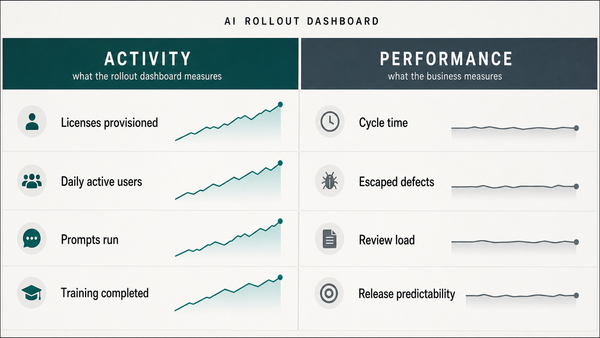
Flat delivery on top of high tool usage is a strong sign of a linear curve, once you have ruled out the usual confounders: a shifted task mix, a review bottleneck, tightened quality gates, or product churn. It is not the signature of low adoption, because adoption is high. It is not the signature of a bad tool, because the per-session speedups are real. It is the signature of an operating model where the tool got faster and the work got no cheaper to set up, sprint after sprint. The role the tool plugged into was never redesigned, so the leverage had nowhere to accumulate. That is Pain Point one and Pain Point eight in the same sentence: AI activity went up, AI performance did not, because activity and performance are different measurements and only one of them was ever going to move on its own.
The cost lives in the setup you keep re-buying
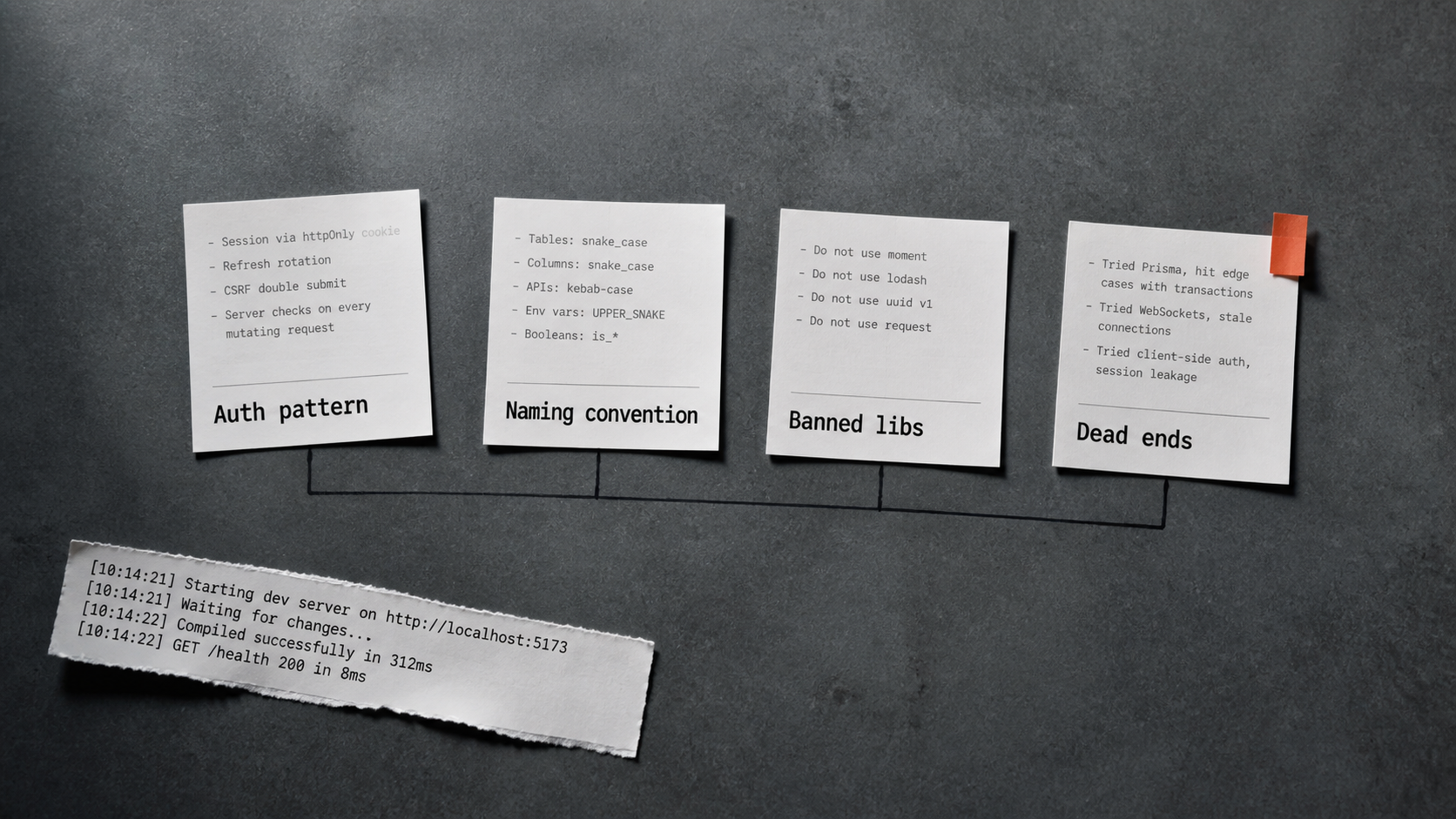
To see where the money goes, follow a single class of task across a quarter.
A developer opens a fresh session to add an endpoint. Before any code gets written, they re-establish the things the agent cannot know on its own: which auth pattern this service uses, why the team rejected the obvious ORM approach last spring, what the naming convention is for this layer, which two libraries are banned and why, what the test structure looks like, where the dead ends are. None of this is the work. All of it is the price of admission to the work. Then the agent, now oriented, moves fast.
Next week, a different developer opens a fresh session to add a similar endpoint. The setup happens again. Not because anyone was careless, but because by default the raw model session starts with a fresh context window, and continuity only exists for whatever the tool or the workflow deliberately reloads. The auth pattern gets re-explained. The rejected ORM approach gets re-discovered, sometimes by the agent re-proposing it and the developer re-rejecting it. The banned libraries get re-banned after one slips in. The same dead ends get re-explored because nothing recorded that they were dead.
This is the re-explanation tax, and its defining feature is that you do not pay it once. You re-buy portions of context you already own, repeatedly, tied to the decisions, conventions, and dead ends that recur across tasks. How much you re-buy varies. A task in a familiar corner of a well-indexed repo with good retrieval costs less to set up than a novel task in an unfamiliar service. Prompt caching, codebase indexing, and a developer who remembers last month's decision all shave it down. But the structural fact remains: the parts of the context that are specific to your system, your decisions, your hard-won conventions, are re-established by a human, by hand, at the start of work that needs them, every time that work recurs and nothing durable carries them forward.
The reason this stays invisible is that each individual payment is small and each individual session is a success. Nobody files a ticket called "spent eleven minutes re-explaining the auth pattern to the agent again." It dissolves into the cost of doing business. But run the arithmetic across every developer, every session, every recurring class of task, across a quarter, and the re-explanation tax is a substantial and entirely recurring line item that no one is looking at, because it never appears as a line item anywhere.
What memory actually is, stated precisely
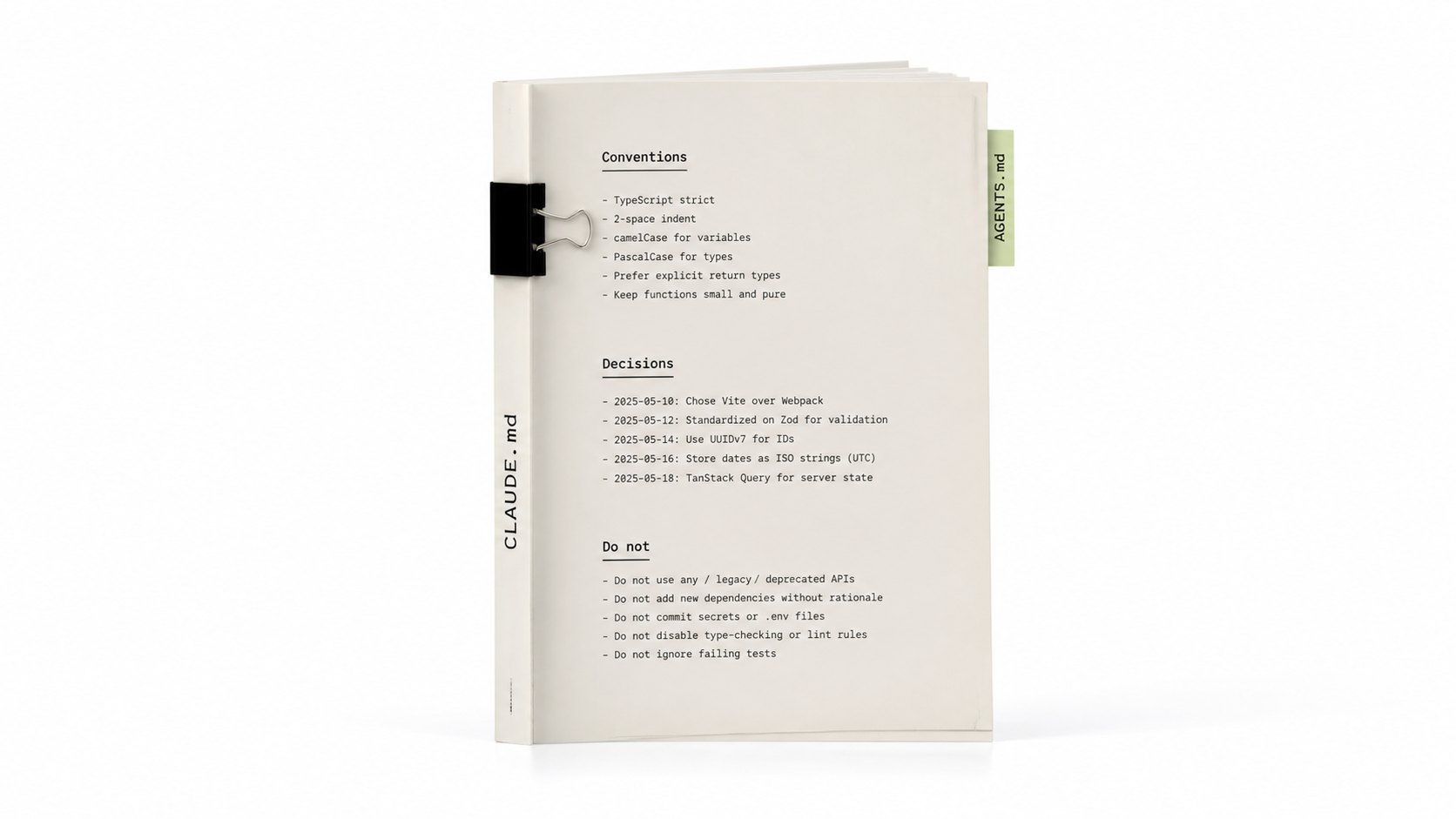
The word "memory" carries a lot of wrong assumptions, so it is worth saying exactly what these mechanisms are, because getting this wrong in front of an engineering audience costs you the room.
A project-instruction file is persisted context that the model reads at the start of a session. That is the whole mechanism. It is not enforcement. It is not a deterministic guarantee that the agent will behave a certain way. It is not a gate that blocks bad output, and it is not an access boundary that prevents the agent from touching something. It is a document that gets loaded into the context window so the model's behavior is shaped by your accumulated decisions instead of by its defaults. It makes the right behavior the loaded default; it does not force the right behavior. Execution stays probabilistic. The agent can still ignore an instruction, the same way a new hire can read the onboarding doc and still get it wrong. What the file changes is the starting point, and the starting point is most of the battle. In the six-class AI engineering stack, that is the whole job of the memory class.
The naming matters and it is tool-specific, so be exact. Claude Code reads a file called CLAUDE.md, and reads an AGENTS.md only if you import it through CLAUDE.md. Codex reads AGENTS.md. They are not interchangeable, and a team running both tools usually needs an import or a symlink to keep one source of truth instead of two drifting ones. As of this writing the behavior is roughly that: the raw session begins with a fresh context window, and these files plus any auto-memory the tool maintains are what carry knowledge across the boundary. Vendor behavior in this area is changing fast, so the specifics are worth a date-check before you rely on them; treat the mechanism as durable and the exact defaults as a moving target.
One honest caveat, because it is the part most write-ups skip and it is the part that protects you from doing this badly. Instruction files are not free wins. Early evidence and field experience are mixed on whether they help: concise, maintained, genuinely task-relevant context improves consistency and can cut setup cost, while bloated, stale, or self-contradicting files can reduce task success and raise cost, because the agent now has to reconcile instructions that disagree or wade through detail that does not apply. A neglected CLAUDE.md that accreted six months of half-true rules is worse than none. The lever is real, but it is a lever you have to maintain, not a switch you flip once and forget. That maintenance burden is exactly why this is a workflow question and not a feature question, which is where this is heading.
Compounding comes from the durable-artifact layer
So the mechanism that turns a linear curve into a compounding one is not mysterious. It is the deliberate practice of writing down what a session learns into a place the next session reads, and then keeping that place honest.
The most direct lever is the project-instruction file, because the root project-instruction file is read at the start of every session by default, which means a decision recorded there is a decision the agent inherits without anyone re-explaining it. But it is not the only lever, and it would be a mistake to imply it is. Output can compound through several durable artifacts that future work reloads:
- Project-instruction files (CLAUDE.md, AGENTS.md) carry conventions, architectural decisions, and the explicit list of things not to do, loaded automatically at session start.
- Decision logs record why a choice was made, so the rejected alternative does not get re-proposed and re-rejected every quarter.
- Reusable specs turn a one-time clarification into a standing input the next similar task starts from.
- Tests are a compounding artifact in their own right: a test that encodes a convention enforces it on every future change without anyone restating the convention to the agent.
- Architecture docs and CI feedback push the same accumulated knowledge into the moments where work actually happens.
The common thread is that the leverage lives in the artifact, not in the session. A session is ephemeral by design. An artifact persists, and persistence is what compounding requires. A team can build a compounding curve from any mix of these, which is why the claim is that durable artifacts are the most reliable lever, not the only one. Persistent context is the principle; project-instruction files are the most direct expression of it.
The redesign move, the thing that actually changes the curve, is a set of decisions almost none of which are technical. You decide what is worth writing down, which is a judgment about what recurs. You decide who maintains it, because an unowned artifact rots into the bloated-and-stale failure mode from the last section. You decide when it gets read and how it stays trustworthy. That is persistent context as a discipline, and it is the part of the role that has to be redesigned for any of it to work. Memory is not a setting you toggle. It is the part of the operating model you decided to make durable.
This is an operating-model question, not a tooling one

Here is where the diagnosis points somewhere uncomfortable for the budget holder.
The CTO who sees flat output and responds by buying a memory feature, or upgrading to the IDE that "remembers your codebase," is making the exact move this whole argument is about. They are treating compounding as something the vendor ships, a capability you purchase, a checkbox you enable. But the durable-artifact layer is not a product. It is a set of choices about how your team specifies work, reviews it, and records what it learned. A tool can make those choices cheaper to act on. It cannot make them for you, and it cannot decide which of your decisions are worth persisting, because it does not know which of your decisions recur.
This is the same shape as every operating-model failure in AI adoption. The tool changed; the work did not. AI transformation is operating-model change, not tool adoption, and the compound engineering version of that thesis is simply this: an AI coding workflow compounds when the workflow is redesigned to make session learning durable, and stays linear when the workflow is left exactly as it was and only the autocomplete got smarter. Most of the material I see ranking for these questions stops at the tooling layer. It explains how to configure a file, how to structure a prompt, how to install a method. That work is correct and useful, and it is silent on the layer above it, where the actual leverage either accumulates or does not. The operating-model layer is the one competitors leave empty, and it is the one that decides whether the spend compounds.
There is a real watch-item here, in fairness. If a coding tool eventually ships durable cross-session memory that genuinely persists your project's decisions by default, with no workflow redesign required, then "memory is role redesign" collapses into "memory is a setting" and this argument weakens. Worth tracking. But persisted memory still requires someone to decide what is worth keeping and to maintain it as the system changes, and that decision is the redesign. A tool that remembers everything indiscriminately reproduces the bloated-context failure mode at scale. So the mechanism holds: the judgment about what to persist is the work, and the work belongs to the operating model.
What this changes on Monday
The implication is not that you need a better tool or a stricter prompt template. It is that the flat number on the board is a structural property of an operating model that left the role unchanged while the tooling got faster, and structural properties yield to structural changes.
The first move is to stop reading flat output as an adoption problem. High usage with flat delivery is not a sign that the team needs more licenses or more enthusiasm. It is a sign that the AI pair programming context your engineers reconstruct by hand at the start of every session is never being captured, so it is never being reused, so the leverage that should be compounding is being re-bought instead. The team is paying portions of the same context tax twice, and the fix is to make the second payment unnecessary by writing the context down where the next session reads it.
If you want to know which curve you are actually on instead of guessing, measure it. None of these is a number I can hand you; they are the dependent variables you would track across comparable classes of work to see whether your setup cost is falling. Candidates worth picking from: repeated-context minutes per ticket, the setup tokens spent before useful work begins on a task, the rate of rework caused by the agent missing a convention that was never written down, first-pass PR acceptance for AI-assisted changes, and cycle time for comparable task classes over successive sprints. Pick the one or two that map to how your team actually works, baseline them, and watch whether the durable-artifact practice bends them. To make any of them comparable, fix what counts as setup before useful work begins, tag AI-assisted tickets, hold task class and size roughly constant, and baseline a few sprints before you change anything. A compounding curve shows up as those numbers improving on repeated work; a linear curve shows up as them holding flat no matter how much the tool usage climbs.
The deeper move, the one that separates teams that compound from teams that stay fast-but-flat, is to start reading the operating model by the artifacts it leaves behind. A team that is genuinely compounding accumulates a trail of durable context: maintained instruction files, decision logs that get read, specs and tests that encode hard-won conventions so the agent inherits them instead of relearning them. A team that is not compounding has high tool usage and almost nothing written down, because every session's learning evaporated when the context window closed. The artifacts are the evidence of whether the role was actually redesigned or just handed a faster tool. This is the lens the Shift Harness Artifact Test applies: you do not assess whether a team adopted AI by how much it uses the tools, you assess it by whether the work leaves durable artifacts the next session can stand on.
That is the difference between buying speed and building leverage. Speed you can purchase per seat, and it resets every session. Leverage you have to design into the work, and once you do, every session inherits it. The next project worth funding is not another tool. It is the decision about what your team finally stops re-explaining.
AI Transparency Notice: This article and its accompanying images were created with the assistance of generative AI. The author directed the content, contributed the underlying ideas and analysis, and reviewed the final publication.