AI in Procurement Is a Control-Design Problem, Not an Automation Rate
A rising touchless-invoice rate can still leave the CFO unable to say which invoices a person should have seen. The rules that replaced the human need an owner, change control and a boundary test.
A procurement dashboard can show the touchless-invoice rate climbing quarter after quarter and still leave the CFO unable to answer a plain question: which of those invoices should a person have looked at? The rate tells you how much work stopped needing a human. It says nothing about whether the rules that replaced the human are the right ones, who changed them last, or what they let through.
Quick answer: AI in procurement moves much of the transactional work into configured rules: approval thresholds, match tolerances, supplier-risk triggers and exception routing. Where those rules approve or route spend without a person, they encode part of procurement's decision rights. Touchless rate alone can't tell you whether that control design is sound. Ownership, change control and boundary testing of each rule family are where that evidence starts.
If you signed off on source-to-pay automation one feature at a time, an auto-approval limit here, a three-way match tolerance there, a supplier-onboarding workflow last year, you approved a control design that may never have been reviewed in one place. The question worth taking to a leadership review isn't how much is automated. It's who designs, owns and tests the rules that now decide on the function's behalf.
What procurement automation actually decides
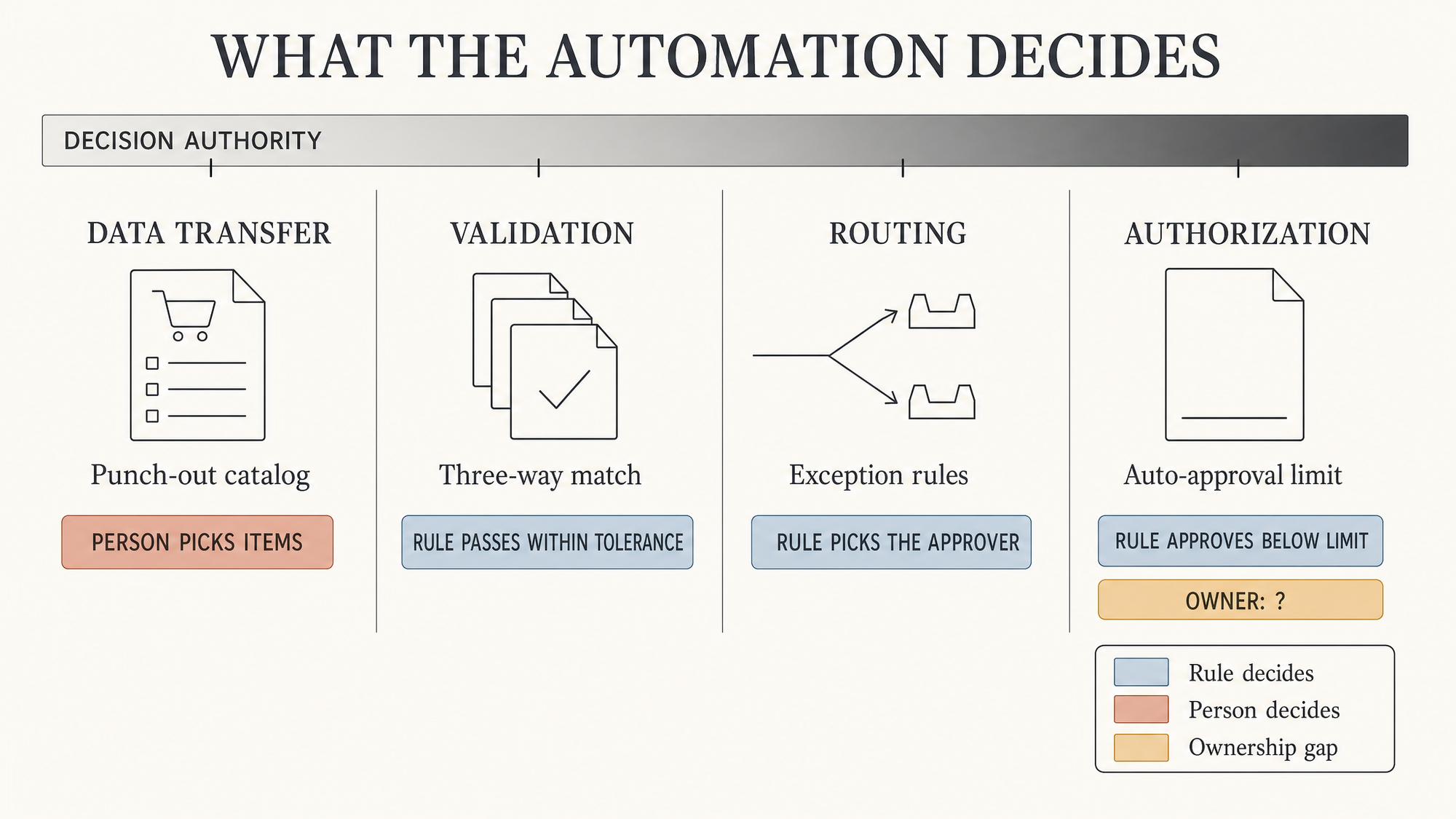
Procurement automation does four overlapping jobs, and they carry very different amounts of authority.
The first is data transfer. A punch-out catalog sends a buyer's cart from a supplier site back into a requisition. A person still picked the items, and the requisition can still route for approval. That's catalog integration. It rarely decides anything on its own. A bad price file or a wrong mapping still feeds errors into every control downstream, though.
The second is validation. Three-way matching compares the purchase order, the goods receipt and the invoice, and passes the invoice if the three agree within a tolerance. The third is routing: exception rules decide which mismatches go to which person, in what order, with what deadline, and so they also decide whether an approval happens at all. The fourth is authorization. An auto-approval limit approves spend up to a number without anyone signing, and whether the number itself counts as inside the limit can end up decided by the configuration rather than the policy.
Validation and authorization blur in practice. Where policy lets an invoice go to payment without further review once it matches, the tolerance becomes one of the conditions of approval: it decides which price and quantity differences pass. Other holds and payment controls may still apply, but for the variance itself, nobody else looks.
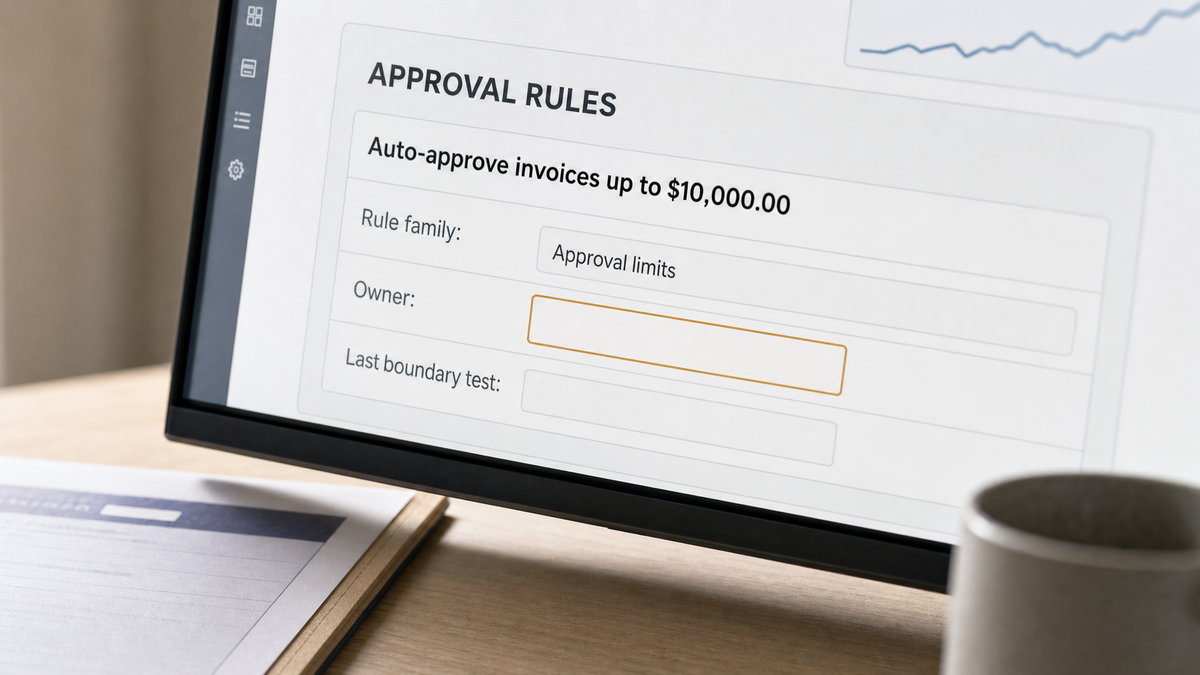
This is the distinction that matters, because the risk is not spread evenly. An automated approval limit is a delegation of authority written as configuration. The same approval made by a person would sit inside a delegation-of-authority policy with a named role, a sign-off and an audit trail. The configured version can inherit the number from that policy without inheriting the ownership around it: who may change the setting, who reviews the change, and what evidence shows it still does what the policy intended.
AI agents in procurement add another layer. A model step classifies spend, proposes which path an invoice takes, drafts a supplier response, or scores a new vendor, usually inside a workflow of deterministic steps. An agent goes further: it chooses actions within the permissions it's been given. Those limits hold only where the system checks them at execution, on every path the agent can act through, with credentials scoped to the task; a prompt can't enforce them. Rules and models can both make systematic errors, but a model also needs checks for drift and for inputs unlike the data it learned from, so the two shouldn't be discussed as one thing.
The ownership question is the same for both, though.
What the agent may approve on its own, what it must escalate, and which score sends a case to a person are rules too. The score only works as an escalation trigger if someone has checked that it means what the rule assumes, and someone has to own that as well. That includes re-checking it after the model or supplier mix changes.
In operating-model terms, these rules encode part of the function's decision rights and its review and control standards. They don't encode the rest of it: sourcing strategy, supplier relationships, category expertise, the incentives buyers work under. That's why the rules deserve an owner rather than a rewrite of the whole function.
Why touchless rate can't tell you whether the controls work
The headline metric for automation in procurement, the share of transactions that clear without a person, is a fair measure of efficiency. What it can't do is establish control effectiveness, because a high rate is compatible with both strong and weak controls.
Hold everything else steady and widen a match tolerance, and the touchless rate can go up. Tighten it and more variances go to review, which is a stronger control only if the threshold targets a real risk and reviewers can keep up with the queue. Better supplier master data also raises the rate, and so does a quietly raised approval limit. The number alone can't tell these apart. A rising touchless rate is easy to read as a rule set maturing. On its own it's inconclusive. The same trend line comes from cleaner data, a changed transaction mix and looser thresholds, and separating them takes the configuration history read alongside the data and the exception logs.
The better vendor and consultancy material doesn't ignore control. Sievo's guide to AI in procurement discusses approval thresholds, human review and audit requirements alongside its business case, and frames spend classification as roughly 80 percent automatable with the remainder routed to human review, an indicative business-case assumption rather than a measured rate. PwC's piece on agentic AI in procurement expects at least 75 percent of procurement activities to be transformed, a figure that in its own framing includes work people and agents do together. Those two numbers measure different things, a share of classification cases in one and a share of activities touched in the other. Neither measures how much authority moved, and combining them would produce a figure nobody measured.
So the gap in the conversation is narrower than "nobody talks about governance." Once a rule family decides on the function's behalf, who owns its changes, who tests it, and what evidence would show that it's wrong? That part rarely gets the same attention as the business case.
Where an untested rule can fail without an alert
Source to pay automation fails differently from a person, who at least gets suspicious. A rule does exactly what it was configured to do, including when the configuration no longer fits. Each of the cases below is a labeled hypothetical, and each has a safeguard that would catch or limit it: an aggregation check, variance monitoring, a scheduled re-baseline, a watched review queue. None of them works automatically. Each exists only if someone designed it and someone acts on what it shows.
Picture a company with an auto-approval limit of $10,000 per purchase order. If approvals evaluate each order separately and nothing aggregates by supplier, requester and period, three orders of $9,800 for the same piece of work can all clear. Nothing malfunctioned.
Now picture a two percent price tolerance on invoice matching. An invoice priced one and a half percent above the purchase order passes the price check every time, and if nobody monitors cumulative variance by supplier, nothing flags the repetition. Whether that adds up to real money depends on volume and on whether anyone reviews variance trends. The rule alone can't tell you.
A supplier-risk trigger calibrated before a supply shock keeps applying its old thresholds after the shock, unless someone owns re-baselining it. If the shock made a new kind of supplier failure material, the trigger can keep scoring those suppliers as safe. And an agent tuned to escalate generously can create the opposite problem: if the review queue grows well past reviewer capacity and nobody tracks override rates and time-to-approve, review can drift toward approval by default. That's a risk to watch for, and it depends on how the queue is managed.
Tail spend automation is where these conditions stack. Transaction counts are high, values are low, category rules apply broadly, and each transaction gets less scrutiny by design. None of that is wrong. It does mean the rules carry more of the weight there, per transaction, than in the parts of the function where a buyer negotiates each deal.
Who should own a procurement rule family
Every rule family that approves or routes spend needs a named business owner, and ideally that owner isn't the person who maintains the configuration. Where one person has to do both, an independent review of changes becomes the compensating control. It mitigates the separation-of-duties risk rather than removing it, and its timing and coverage need checking too.
Three responsibilities get conflated here. Business accountability sits with a process owner, often the head of purchase-to-pay or the CPO, together with the controller for anything touching payment: they decide what the rule should do and sign off changes to it. Configuration maintenance sits with a system administrator or an implementation partner, who changes the settings under change control, versioned and re-run against the boundary tests before release. Exception handling sits with buyers and accounts payable, who work what the rules route out.
Ownership doesn't need a new job title. A named purchase-to-pay process owner who approves tolerances with the controller and requires testing of configuration changes already covers it. The risk appears when those responsibilities are unclear, because then a change to an approval threshold can go live without anyone accountable for what it now permits. Tool defaults and a partner's configuration workbook are reasonable starting points. The risk grows when nobody in the business reviews what they decide.
The buyer's job may shift as more routine transactions clear on their own, toward exception handling and rule stewardship, while sourcing and negotiation stay where they were. Early research on an adjacent back-office function points the same way: Choi and Xie, in the Journal of Accounting Research (2026), find generative AI adoption among accountants associated with effort moving away from routine data entry toward business communication and quality assurance. The authors present it as early evidence, and it comes from accounting rather than procurement, so read it as a direction rather than a forecast. It's still a useful prompt for rewriting job descriptions before the work changes underneath them.
A test to bring to the next leadership review
The cheapest evidence that a rule does what the policy intends is a boundary test, and it doesn't need new software.
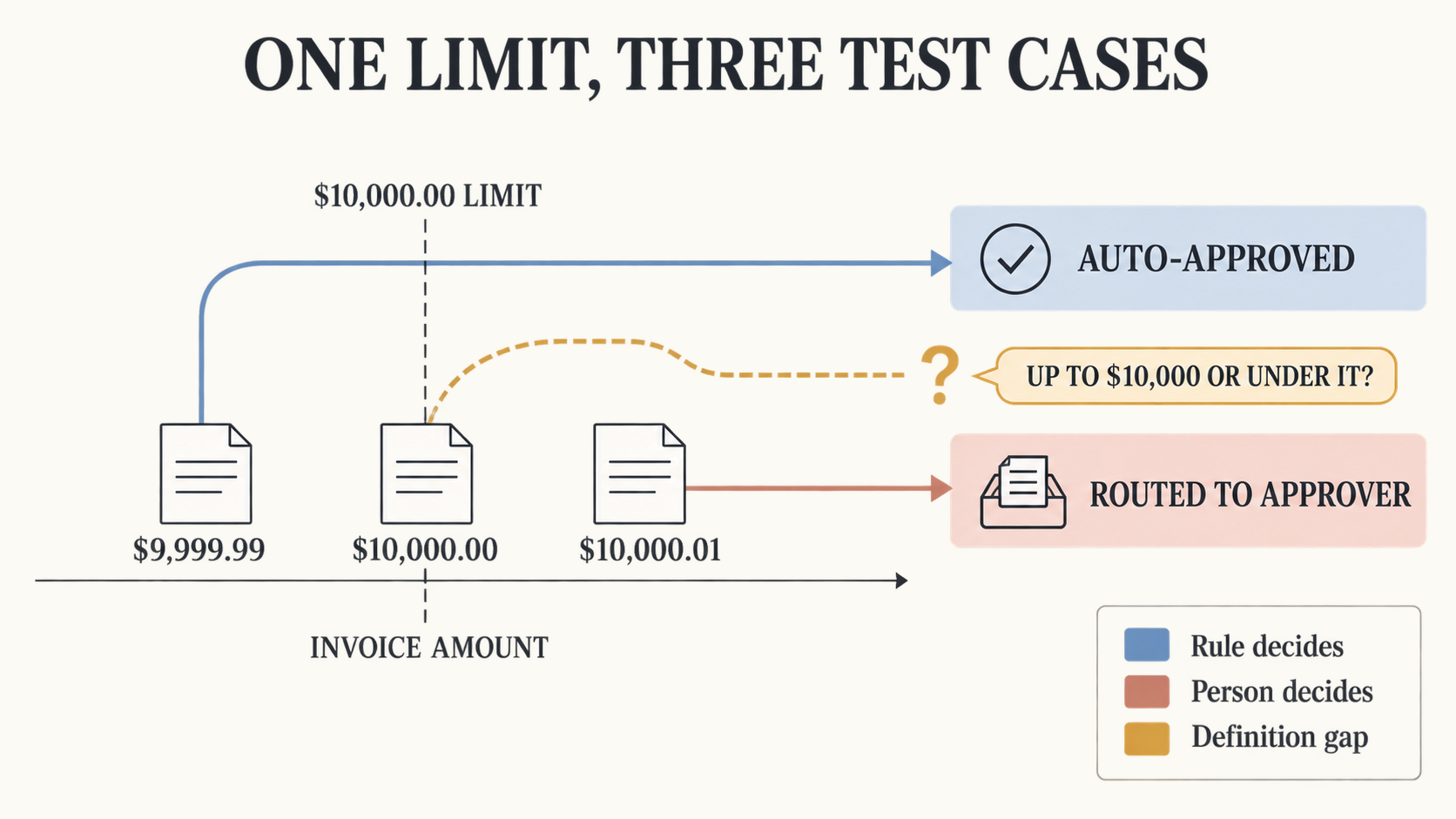
Take the $10,000 auto-approval limit, in a test environment, with the policy and configuration versions written down. Create three test cases just below, at and just above the limit, using the smallest amount the system accepts: $9,999.99, $10,000.00 and $10,000.01. Decide first whether the limit applies per line or per order and whether tax and freight count, and hold every other eligibility condition constant. Before running them, write down the expected result for each: auto-approved, or routed, and to whom. Then check the workflow log for what actually happened. If the policy doesn't say whether "up to" includes $10,000.00, or the $10,000 case behaves differently from what it does say, you found a definition gap before an auditor did.
Repeat it for a match tolerance, after writing down the variance formula and any absolute cap, and for aggregation, after defining what makes two orders related and over what time window. Keep the case identifiers and the logs. A passing test shows the rule did what was specified for the cases tested. It doesn't show the specification was right. So the owner signs off the expected results, not the administrator. Run it after every configuration change, and on a schedule set by how much damage the rule family could do if it were wrong.
For each automated approval path, three questions belong on the agenda: who owns this rule, when was it last tested at its boundary, and what would we see in the logs if it were wrong? If finding the answers takes longer than the meeting, the automation rate on the dashboard is measuring speed through a design nobody can currently vouch for.
AI Transparency Notice: This article and its accompanying images were created with the assistance of generative AI. The author directed the content, contributed the underlying ideas and analysis, and reviewed the final publication.